
Swamp Hibiscus (Hibiscus coccineus)
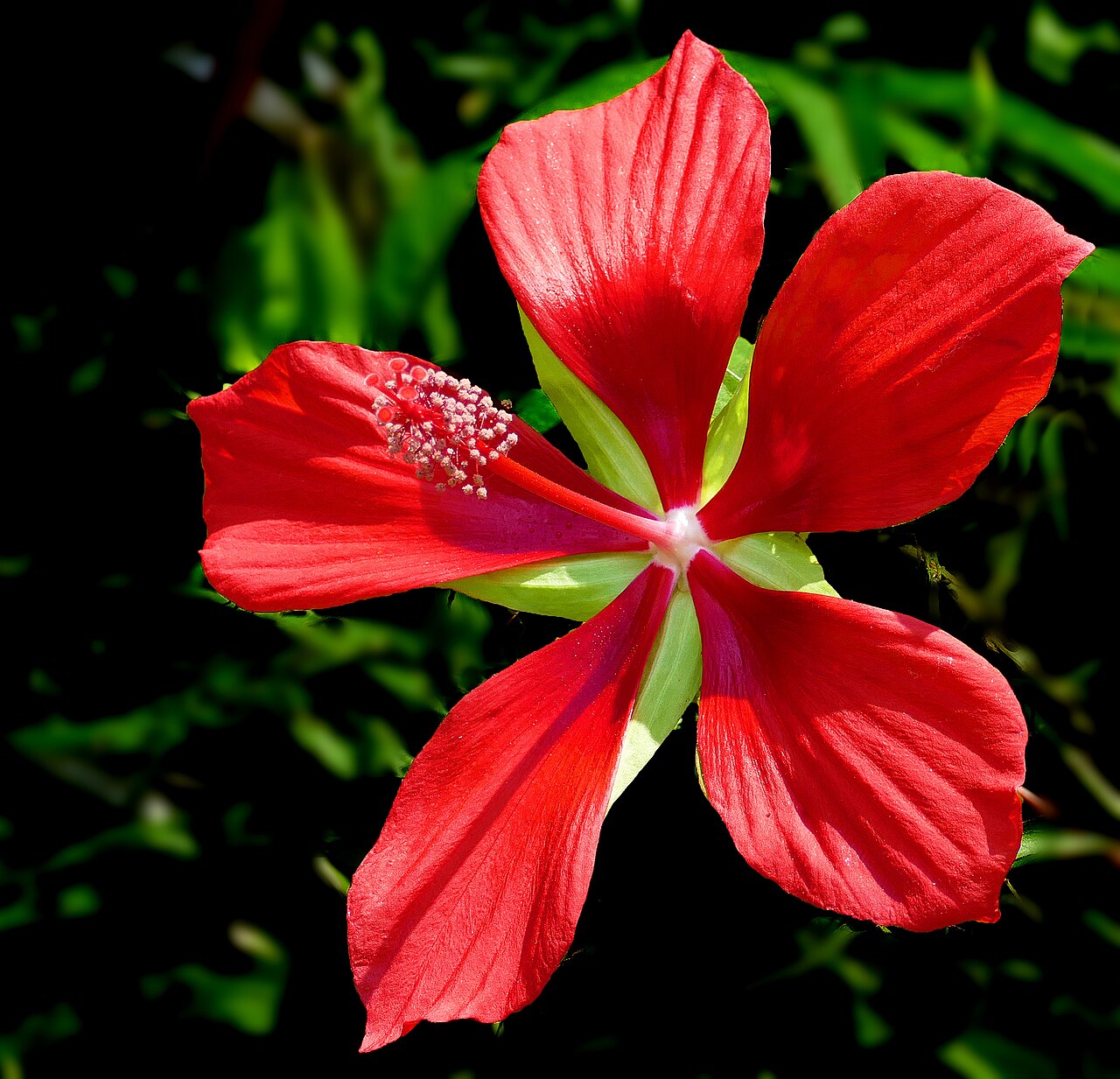
Swamp hibiscus (Hibiscus coccineus), also called scarlet rose-mallow, is a tall southeastern perennial with open, star-like red flowers and deeply divided leaves. NC State now treats the same plant as Muenchhusia coccinea; the familiar Hibiscus name remains useful for nursery searches. This is a hardy wetland-associated perennial, not the tropical potted hibiscus often sold for summer patios.
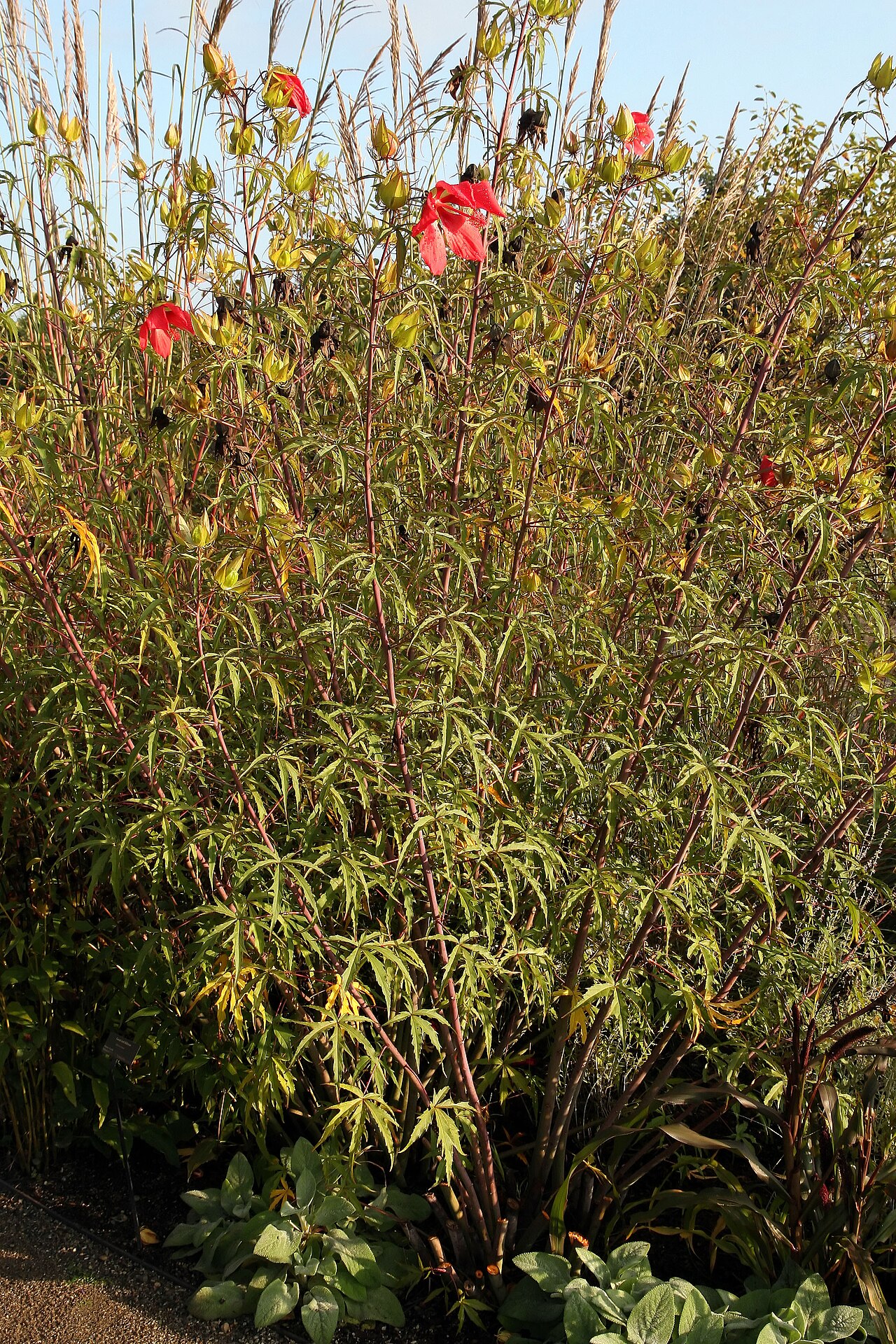
At 6–8 feet tall, it makes a strong vertical feature behind shorter perennials. Individual flowers are large, but the plant is not a solid wall of overlapping petals: the narrow red segments leave spaces between them, emphasizing the star shape and central staminal column. Its slender, cut-leaved outline allows glimpses through the clump even when the stems are tall.
The best garden use follows its natural association with sunny, moist places. A pond edge, a rain garden with dependable moisture, or a well-watered border is more suitable than a dry curbside strip. The regional table’s average-moisture entry has been broadened to average-to-wet soil moisture, with the important qualification that a mature plant still needs space and light.
Identification
Stems & Habit
Several upright stems can arise from the perennial crown. They grow rapidly during the warm season, carrying foliage and flowers well above smaller border plants. The top growth dies back in cold weather, so an empty-looking winter spot does not necessarily indicate a dead plant. Mark the crown and allow time for late spring emergence before replacing it.
Stems can remain standing after the season ends. They are not permanent woody branches that must be retained to support next year’s flowers. New flowering growth arises during the following season, giving gardeners some flexibility in managing height and winter structure without treating the plant like a small tree.
Leaves
The leaves are deeply divided into narrow, pointed lobes, with fine teeth along their margins. Their cut appearance contributes to the airy habit and is a useful contrast with broad-leaved wetland perennials. The foliage should be evaluated together with flowers and fruit rather than identified from a superficial resemblance to another deeply lobed plant.
A young plant or a shoot without flowers may look quite different from a mature specimen in bloom. Avoid pulling up an unfamiliar shoot from a marked crown simply because the foliage does not resemble a conventional rounded hibiscus leaf. Nursery hybrids and other rose-mallows vary considerably in leaf shape, height, and flower form.
Flowers
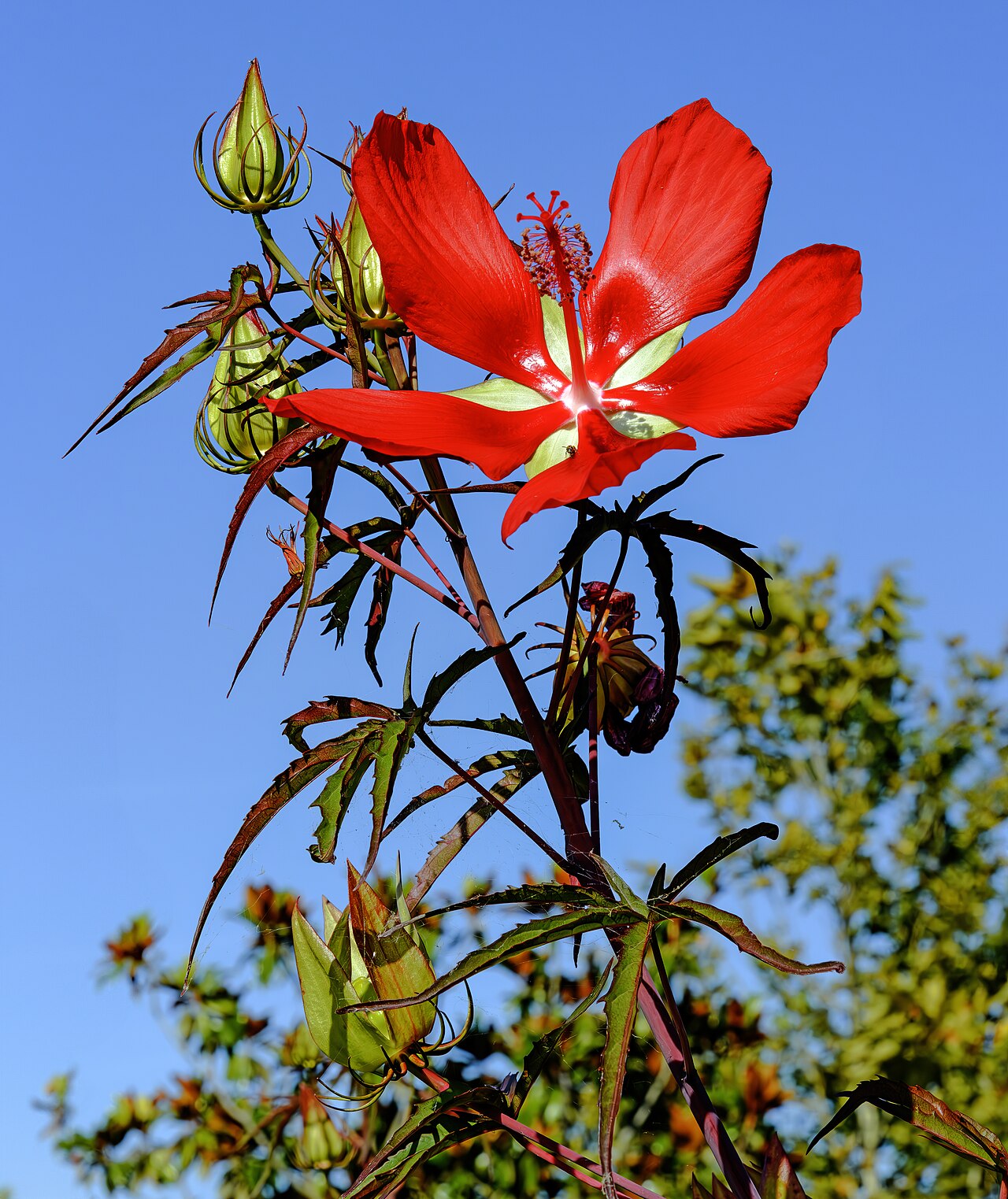
The scarlet flowers have five conspicuous spreading petals and a projecting central column bearing reproductive structures. Open spaces between the petals give the bloom its characteristic star-like outline. Flowers can approach or exceed six inches across, depending on the plant and growing conditions. The photographs show the structure from the front and from a flowering stem with developing buds.
Bloom occurs in summer into early autumn, with July through September listed by the Wildflower Center. A single flower is short-lived, but a vigorous clump develops successive buds. The relevant garden question is therefore the supply of new flowers over the season, not whether one photographed bloom remains open for a week.
Fruit & Seeds
After flowering, capsules develop where the blossoms stood. The surrounding green structures can remain conspicuous as the capsules mature. Leave some to ripen if seed collection is intended, but distinguish a developing fruit from an unopened flower bud before deciding that a plant has stopped flowering.
Seed-grown offspring are useful for increasing a species planting, provided the parent identity is known. A commercial plant labeled only ‘hardy hibiscus’ may be a hybrid rather than this species. Keep seed labels tied to the actual parent, and do not assign a scientific name solely because a seedling eventually produces a red flower.
Quick Facts
| Scientific Name | Hibiscus coccineus; also treated as Muenchhusia coccinea |
| Family | Malvaceae (mallow family) |
| Plant Type | Herbaceous perennial |
| Mature Height | 6–8 ft |
| Mature Spread | 2–3 ft |
| Growth Rate | Moderate seasonal growth |
| Sun Exposure | Full sun; partial shade tolerated |
| Water Needs | Moist to wet soil; dependable moisture in garden beds |
| Soil Type | Moist garden soil or suitable wetland-margin soil |
| Soil pH | Test the site; no narrow numerical requirement adopted here |
| Bloom Time | Summer to early autumn, commonly July–September |
| Flower Color | Scarlet red |
| Fall Color | Seasonal foliage dies back; not grown for dependable fall color |
| Fruit | Seed capsules |
| Deer Resistant | No; susceptible to deer damage |
| USDA Hardiness Zones | Approximately 5b–9, following NC State |
Native Range
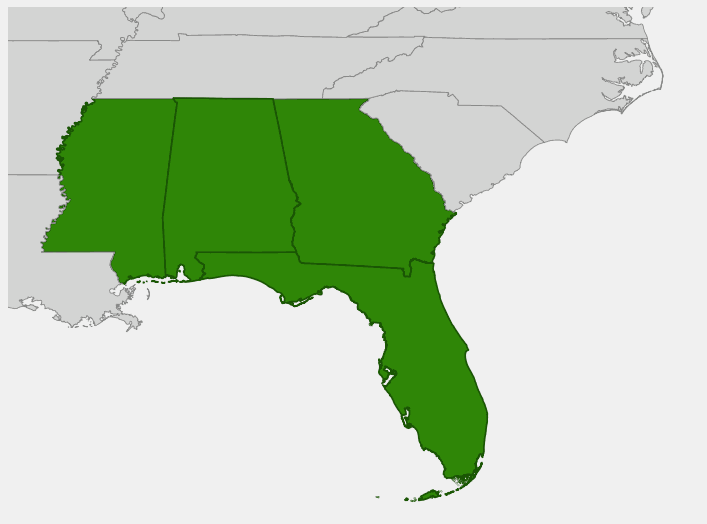
The sources used here place swamp hibiscus in the southeastern United States. The Wildflower Center describes its native range as Florida to Mississippi, while NC State’s descriptive account names marshes and swamps in Alabama, Georgia, and Florida. The map combines those explicit core-range accounts as AL, FL, GA, and MS.
Broader occurrence lists include additional states, but they do not by themselves distinguish indigenous populations from garden escapes or planted records. This guide therefore does not color every state where the plant has been reported. For a county-specific restoration project, consult a local flora or herbarium and use the USDA link as an additional distribution reference.
Typical habitats include Coastal Plain marshes, swamps, and wet ditches. These settings explain its preference for sun and dependable water. Its winter hardiness permits cultivation beyond that core native range, but the ability to survive a colder garden is not evidence of local nativity. The common nursery name ‘Texas star’ likewise should not be used as a geographic range statement.
Native Range at a Glance
| U.S. States | AL, FL, GA, MS — core range from the cited native-range accounts |
| Mexico or Canadian Provinces | Not included in the native range used here |
| Ecoregion | Southeastern Coastal Plain wetland communities |
| Elevation Range | Primarily lowland wet habitats; no exact numerical range established here |
| Habitat | Marshes, swamps, wet ditches, sunny wetland margins |
| Common Associates | Locally appropriate wetland sedges, rushes, grasses and flowering perennials; community varies by site |
| Range Source | Lady Bird Johnson Wildflower Center; USDA (County-Level Data) |
📋 Explore the Alabama, Georgia & Mississippi native plant list.
Growing & Care Guide
Light
Full sun is the clearest match to the regional table and the Wildflower Center’s guidance. NC State also allows partial shade, but shade should not be used to compensate for an otherwise unsuitable dry site. Place it where neighboring shrubs will not overtop the summer stems and where flowers can be seen without stepping into the wet planting area.
Soil & Water
Keep the root zone moist, with occasional wetness acceptable. A sunny rain garden can be suitable if it retains enough moisture between storms; one that drains rapidly to drought may not be. Assess the actual seasonal water pattern instead of relying on the label ‘rain garden.’ A pond margin is different from deep open water.
During establishment, water the nursery root ball and surrounding soil thoroughly, then check moisture before irrigating again. Containers dry faster than a moist ground bed and need closer attention. A large plant with extensive foliage can outgrow a small pot’s water reserve quickly in southern summer heat.
Do not prescribe a fixed fertilizer dose or narrow pH range without a soil test. The practical priority is a site with sufficient rooting volume and water. If a plant remains weak despite irrigation, inspect drainage and root health rather than repeatedly adding fertilizer. Established wetland plants can still be damaged by a poorly constructed planting pocket.
Planting Tips
Plan for a clump approximately 2–3 feet wide and stems 6–8 feet tall. Set it at the rear of a border or where its height frames a view rather than blocking a doorway or path. Leave working space to inspect the crown and manage old stems without trampling smaller neighboring plants.
Plant at the original crown depth, firm the soil gently, and water it in. In a mixed bed, avoid burying the dormant crown under later additions of compost or mulch. Mark the site through winter so spring gardening does not damage new shoots before they are obvious.
Use nursery-propagated plants, seed, or cuttings rather than collecting from a marsh. Even a robust-looking wetland population is part of a larger habitat, and digging can disturb hydrology and neighboring vegetation. Ask the nursery whether stock is the species or a named hybrid if local ecological suitability is important.
Pruning & Maintenance
Flowers develop on new growth. Pruning can change the timing and shape of the display, but constant clipping defeats the tall, open habit. Decide at planting whether the mature height is acceptable; choosing a shorter species is often better than repeatedly forcing this one into a small space.
NC State recommends leaving dead stems cut to approximately 12–24 inches to support stem-nesting bees, allowing those remnants to break down naturally. Place the plant where that winter structure is compatible with the garden design. A habitat planting does not need to be cut to bare soil at the first frost.
Deer can damage the plant. Protect a young clump if local browsing is severe, and distinguish browsing from failure to emerge. Keep an eye on storm damage in exposed positions; a broad, well-spaced planting is easier to support discreetly than one squeezed between hard surfaces.
Propagation
Seed and stem cuttings are recognized propagation methods in the extension account, and the Wildflower Center describes it as readily grown from seed. Keep a record of the parent and collection year. Species identity matters more than a common name such as swamp hibiscus, which may be applied to several different rose-mallows.
Start with a manageable number of seedlings and provide adequate light as they grow. Do not place young plants directly into an extreme wet or dry position merely because mature plants tolerate moisture. Acclimate nursery-grown material to the outdoor site and check the small root systems more often during establishment.
Landscape Uses
- A tall red-flowering accent at the back of a sunny perennial border.
- A moist rain-garden planting where water remains available between storms.
- A pond or stream margin above deep open water.
- A summer hummingbird and pollinator garden with compatible wet-soil companions.
- A seasonal screen or focal clump whose winter stems can remain for habitat.
Wildlife & Ecological Value
For Pollinators
NC State identifies hummingbirds, butterflies, and other pollinators as flower visitors. It also notes specialized bee associations within Hibiscus and the value of dead stems for nesting bees. Those are two separate resources: living flowers supply the seasonal display, while retained stems can remain useful after flowering is over. Avoid insecticide applications to open blooms.
For Birds
The red flowers attract hummingbird attention in a summer garden. The plant should not, however, be described as a substitute for a diversity of shrubs and trees that provide nesting cover and fruit. Combine it with other locally suitable plants whose resources extend through the rest of the year.
For Mammals
This is not a reliably deer-resistant choice. Where browsing repeatedly removes shoot tips, flowering can suffer even though the crown survives. Use physical protection when necessary and select a location where a barrier does not interfere with access to water or garden paths. A single undamaged season does not establish permanent resistance.
Ecosystem Role
Its wetland association makes it useful in designed plantings that connect sunny water margins with a taller herbaceous layer. That does not authorize introducing it into an intact wetland outside its documented local range. Habitat restoration calls for local species and provenance decisions, while a managed garden can explain when a regionally native plant is being cultivated beyond its indigenous area.
Cultural & Historical Uses
Scarlet rose-mallow, swamp hibiscus, and Texas star emphasize different aspects of the same familiar ornamental: red flowers, wet habitat, and a star-like outline. The Texas name is horticultural usage, not a reliable account of where the plant originated. Scientific names help keep these claims separate.
The alternative name Muenchhusia coccinea appears in NC State’s current treatment. Gardeners may encounter both names in reputable references and nursery catalogs. Recording the synonym makes it possible to compare care information without assuming that a new genus name means a different plant.
This guide focuses on documented ornamental and habitat uses. It does not transfer food or medicinal claims from other hibiscus species to this one. A familiar genus contains many plants with different histories, and a red flower is not sufficient evidence for a tea ingredient or other edible use.
Frequently Asked Questions
Is this the same as tropical hibiscus?
No. Scarlet rose-mallow is a herbaceous perennial adapted to a seasonal outdoor cycle, with top growth that dies back in cold weather. Tropical potted hibiscus and many hardy garden hybrids have different identities and care needs.
Why has it not emerged in early spring?
The Wildflower Center notes that clumps start growth late. Mark the crown and wait for local warm-season growth before assuming it has died. Avoid digging into the crown while checking neighboring plants.
Can it grow in an ordinary border?
Yes, if the border has full sun, enough room, and dependable moisture. A dry exposed bed is a poor match. Its wetland association should guide site selection rather than be reduced to an ornamental label.
Should I remove every dead stem?
Not necessarily. NC State recommends retaining 12–24-inch stem sections for stem-nesting bees and letting them decay naturally. Place the plant where this habitat-friendly winter appearance is acceptable.
Does Texas star mean it is native to Texas?
No. Common names do not establish native range. This guide maps the southeastern core range supported by the cited sources and distinguishes cultivation records from indigenous populations.
Sources & Further Reading
- NC State Extension Plant Toolbox — Scarlet Rose Mallow
- Lady Bird Johnson Wildflower Center — Hibiscus coccineus
Find Native Plants Near You
Ask for nursery-propagated species stock. Browse native plant nurseries for Alabama, Georgia, and Mississippi.