
Hōʻawa (Pittosporum hosmeri)
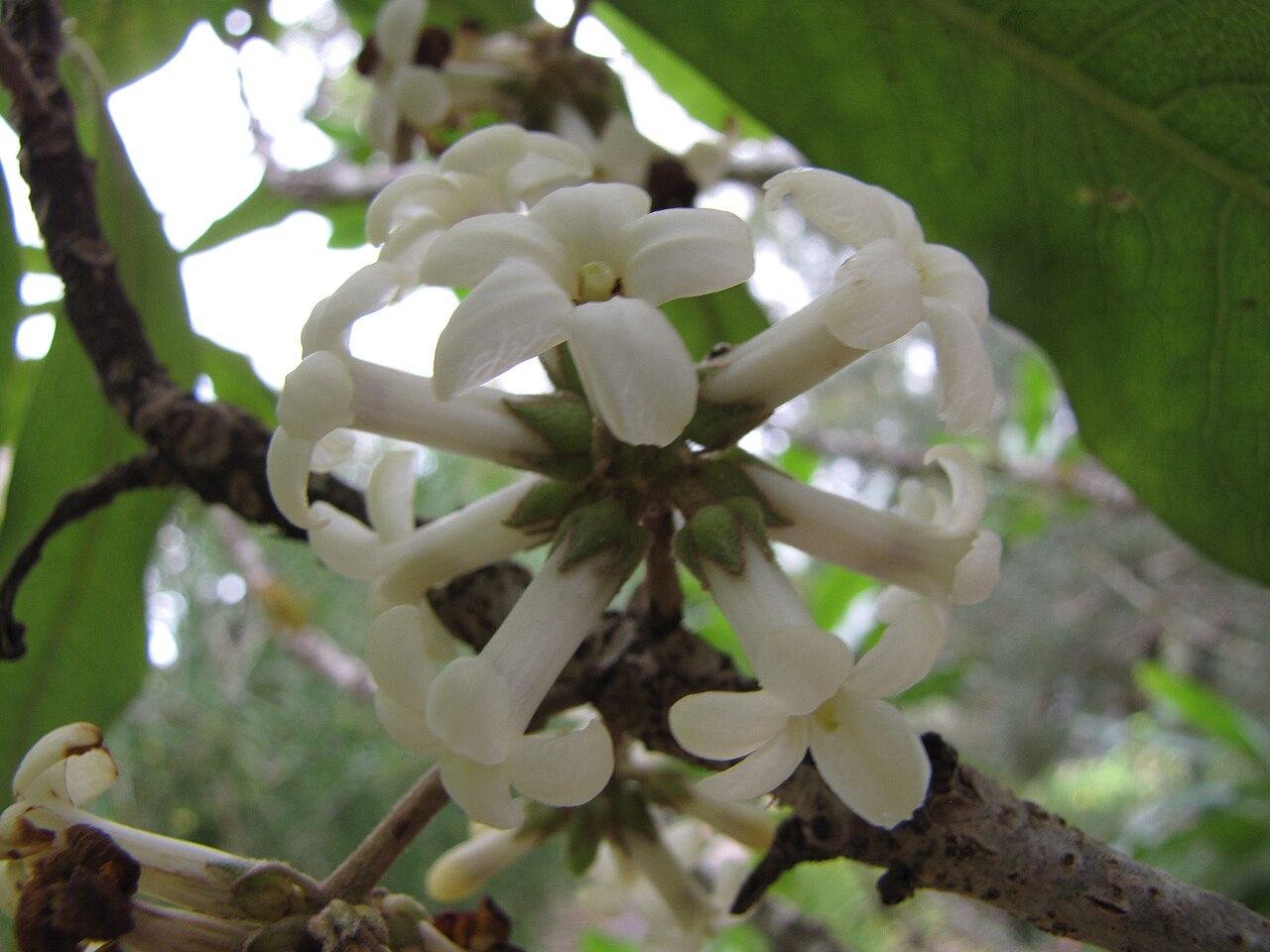
Hōʻawa (Pittosporum hosmeri) is a Hawaiian native small tree with long leaves gathered near shoot tips, softly colored new growth, and large woody seed capsules. It offers a distinctive alternative to introduced pittosporums in a suitable native garden. Its creamy flowers are attractive at close range and can have a subtle nighttime fragrance.
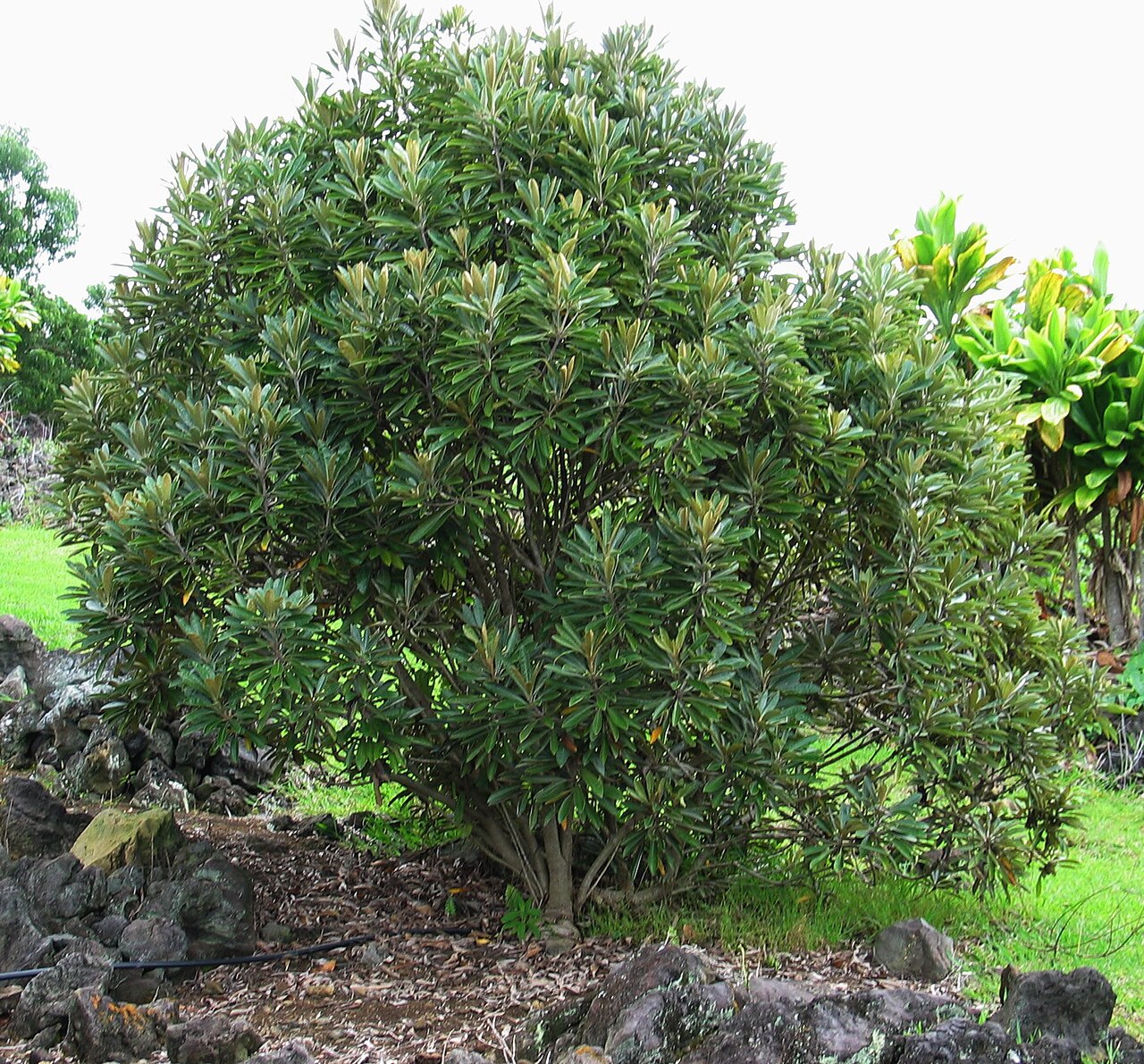
The Hawaiian name hōʻawa is shared by several native Pittosporum species. This page is specifically about P. hosmeri, a species native to Hawaiʻi Island. A tree cultivated in a Maui garden, as in some of the photographs here, remains a cultivated example of that species rather than evidence that Maui is part of its natural range.
Choose it for foliage, fruit structure, and a manageable small-tree form, while allowing time for growth. Good drainage, careful root handling, and water during dry periods matter more than forcing rapid growth. It should not be treated as a salt-spray or extreme-drought tree simply because a nursery lists relatively modest watering needs.
Identification
Bark & Stems
The tree forms woody branches carrying tufts of foliage near their ends. Flowers and capsules can occur on the branches below the newest leaves, so an inspection limited to the growing tip may miss important features. Look at the whole branching pattern without snapping off shoots from a wild plant.
Leaves
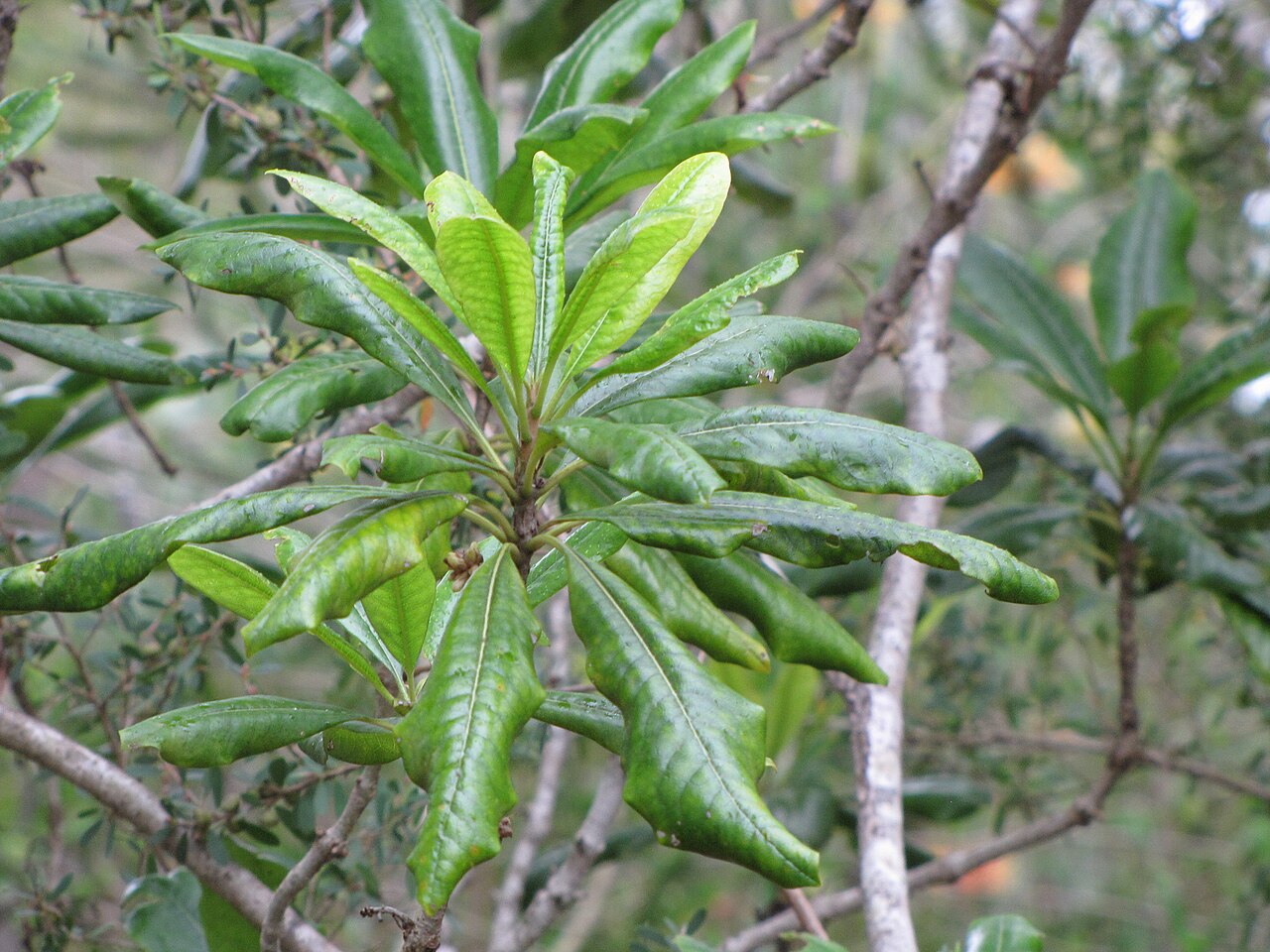
Long, comparatively narrow leaves cluster near branch tips. The margins can curl under, and hairs on young growth or leaf undersides may give a yellowish, tan, or rusty appearance. That combination of shape, arrangement, and surface texture is more useful than identifying the tree from leaf color alone.
Flowers
White to cream flowers appear in clusters and can be subtly sweet-scented at night. The display is best appreciated nearby rather than as a distant mass of color. Flower color and general leaf form should still be checked against the other Hawaiian hōʻawa species when identity is uncertain.
Fruit & Seeds
The large, woody capsules are one of the tree’s signature features. When ripe and open, the contrasting inner surfaces and dark seeds make them conspicuous. These are seed capsules, not edible nuts, even if their size and hard exterior invite comparison with a walnut.
Quick Facts
| Scientific Name | Pittosporum hosmeri |
| Family | Pittosporaceae |
| Plant Type | Evergreen native tree |
| Mature Height | 15–30 ft |
| Mature Spread | About 12 ft |
| Growth Rate | Slow |
| Sun Exposure | Partial sun; full sun also suitable in appropriate conditions |
| Water Needs | Average; irrigate in dry periods and avoid waterlogging |
| Soil Type | Well-drained, site-appropriate soils; protect roots from compaction |
| Soil pH | Assess actual soil and local nursery performance; do not amend routinely |
| Bloom Time | Seasonal to sporadic; timing varies with source and conditions |
| Flower Color | White to cream flowers, subtly fragrant at night |
| Fall Color | Evergreen; new growth may provide seasonal contrast |
| Fruit | Large woody capsules enclosing dark seeds |
| Deer Resistant | Protect young plants from introduced browsing animals |
| USDA Hardiness Zones | Hawaiian tropical to subtropical sites; match island, elevation, and exposure |
Native Range
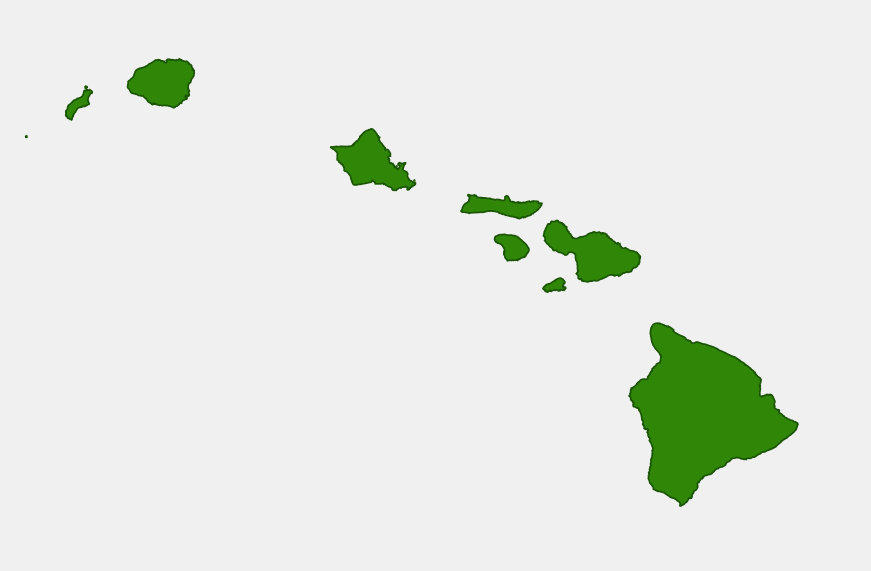
Pittosporum hosmeri is endemic to Hawaiʻi Island. The University of Hawaiʻi profile places it primarily on the leeward side, from the Kohala Mountains south toward Kaʻū, in mesic-to-wet forest. It reports an elevation range of roughly 1,250 to more than 3,500 feet.
The species can be cultivated outside those forest settings, including at lower elevations, but garden success and natural distribution are different questions. When buying a tree, ask whether the nursery source has performed well at a site comparable to yours rather than relying on a general “Hawaiian native” label.
The Hawaii map is a state-level overview and does not show this species as naturally distributed across all the shaded islands. The written range is the more precise guide. For conservation planting, use an appropriate local source and the receiving project’s collection and planting plan.
Native Range
| U.S. States | Hawaii |
| Hawaiian Islands | Hawaiʻi Island; cultivation elsewhere is not proof of natural range |
| Mexico / Canadian Provinces | Not included in the verified native range used here |
| Ecoregion | Hawaiian tropical forest and woodland |
| Elevation Range | About 1,250–3,500 ft or more |
| Habitat | Mesic to wet forest, mainly leeward Hawaiʻi Island |
| Common Associates | Locally appropriate native trees and understory matched to the same habitat |
USDA PLANTS profile (PIHO). Species identity verified; this link is not a guarantee of county-level distribution data.
📋 See the Hawaii native plant list for other native trees and complementary planting choices.
Growing & Care Guide
Light
Partial sun is a useful garden-planning starting point, and the Hawaiian horticultural profile also reports good performance in full sun. Match the exposure to the nursery stock and its acclimation. A sheltered nursery plant should not be moved abruptly into a harsh, reflective, windy position without considering that transition.
Soil & Water
Provide well-drained soil and supplementary water when needed during dry periods. The source profile lists relatively dry watering conditions but also warns that the species is not drought tolerant. Read that combination as a reason to monitor the plant carefully, not as permission to neglect a newly planted tree or let its root ball repeatedly desiccate.
Average garden moisture does not mean a constantly saturated planting hole. Check drainage after rain and account for runoff from nearby paving or roofs. Keep water off the trunk base and adjust irrigation to the actual root-zone conditions instead of repeating an unchanged schedule throughout the year.
Planting Tips
Handle the roots gently and set the tree at its established nursery depth. Avoid routine aggressive teasing or cutting of a root ball; choose healthy nursery stock that does not require major corrective root work. The surrounding soil should support expanding roots without creating a small water-holding pocket.
Allow for a tree around 15–30 feet tall and roughly 12 feet wide, with variation among plants. Keep it far enough from a path or building that the foliage and capsules can develop naturally. Mulch the establishment area while leaving the bark and root collar clear.
Pruning & Maintenance
Use light, purposeful maintenance rather than repeated hard shearing. Hōʻawa’s clustered foliage and interesting capsules are part of its appeal; a heavily clipped shape can remove the features for which it was planted. If structure needs correction, act thoughtfully while branches are small.
Watch for insects such as scale or mealybugs and for sooty growth associated with sap-feeding pests. Identify the cause before treatment. A coating on foliage is not automatically a fungal infection of the tree itself, and general decline should also prompt checks of watering, drainage, and roots.
Propagation
Use correctly identified nursery material or seed from an authorized, documented source. Keep P. hosmeri separate from other hōʻawa species through propagation. A shared Hawaiian name is not enough information for a conservation collection.
Follow a species-specific nursery method for handling the sticky seeds and establishing seedlings. Clean containers, sound drainage, and careful labeling are more useful than improvising from instructions for an unrelated ornamental pittosporum. For restoration, coordinate seed collection and planting with the project rather than collecting casually from a wild stand.
Landscape Uses
- Native focal tree: display the clustered foliage and woody capsules at a comfortable viewing distance.
- Mixed native garden: combine with plants suited to similar light, drainage, and moisture.
- Educational planting: explain the relationship between forest plants and seed-dispersing birds.
- Replacement ornamental: consider this native species where an introduced pittosporum would otherwise be planted, after checking the site.
Wildlife & Ecological Value
For Pollinators
The flowers are part of the tree’s reproductive relationship with its environment. Observe actual visitors and avoid spraying flowering branches. A varied native planting will provide a more complete sequence of floral resources than a single specimen alone.
For Birds
Hōʻawa has an important documented relationship with ʻalalā, the Hawaiian crow. Hawaii’s Department of Land and Natural Resources describes the bird’s consumption of P. hosmeri seeds in dry-forest settings. This supports discussion of a real ecological connection without promising that an ʻalalā will visit a home garden.
The conservation status and management of ʻalalā are separate from the choice to plant one tree. The useful garden lesson is that plants and animals interact through food and dispersal, and that losing one part of a forest community can affect others. Habitat recovery requires coordinated work beyond ornamental planting.
For Mammals
Protect young trees where introduced browsing animals or livestock can reach them. Roots also need protection from trampling and soil compaction. A guard around the stem alone may not address the full area used by a growing root system.
Ecosystem Role
As an endemic forest tree, hōʻawa contributes foliage, branching structure, litter, and seeds to its community. In a garden, maintain suitable neighbors and control invasive competitors so that the tree is part of a coherent native planting rather than an isolated label surrounded by unsuitable vegetation.
Cultural & Historical Uses
Hawaiian accounts describe the use of hōʻawa wood in canoe construction, including gunwales. Such uses connect the tree to practical knowledge of native materials. They should be interpreted in their cultural context rather than as an invitation to harvest a young garden specimen.
Historical references also discuss uses of capsule material. These are records of practice, not instructions for preparing medicine or a claim that the fruit is edible. A cultural garden can acknowledge the history while keeping modern interpretation accurate and appropriately specific.
Because several species share the name hōʻawa, not every historical statement can automatically be assigned uniquely to P. hosmeri. Retain the scientific label and involve knowledgeable local practitioners when developing detailed interpretation.
Frequently Asked Questions
Is every hōʻawa Pittosporum hosmeri?
No. Several Hawaiian species share the common name. Check the full scientific identity of nursery stock.
Does a Maui garden photograph prove it is native to Maui?
No. Cultivated occurrence is different from natural range; this species is native to Hawaiʻi Island.
Is it a drought-proof tree?
No. Although watering needs may be modest when established, Hawaiian horticultural guidance cautions against drought and salt exposure. Monitor roots and irrigate appropriately in dry periods.
Are the woody capsules edible nuts?
No. They are seed capsules, and resemblance to a walnut is only a visual comparison.
Will planting it bring Hawaiian crows?
That is not a realistic promise. The tree has a documented ecological relationship with ʻalalā, but bird conservation and distribution involve much more than a garden planting.
Sources & Further Reading
- University of Hawaiʻi, Native Plants Hawaiʻi species profile
- Hawaii DLNR: Final ʻAlalā Environmental Assessment, diet and forest relationships
Botanical range, identification, and cultural information are based on these sources. Garden-management advice should be adapted to local soil, exposure, and nursery provenance.
Find Native Plants Near You
Look for correctly identified, nursery-propagated plants with documented Hawaiian provenance. Visit our Hawaii native plant nursery directory and ask about stock suited to your island, elevation, and rainfall.