
Indian Cucumber-root (Medeola virginiana)
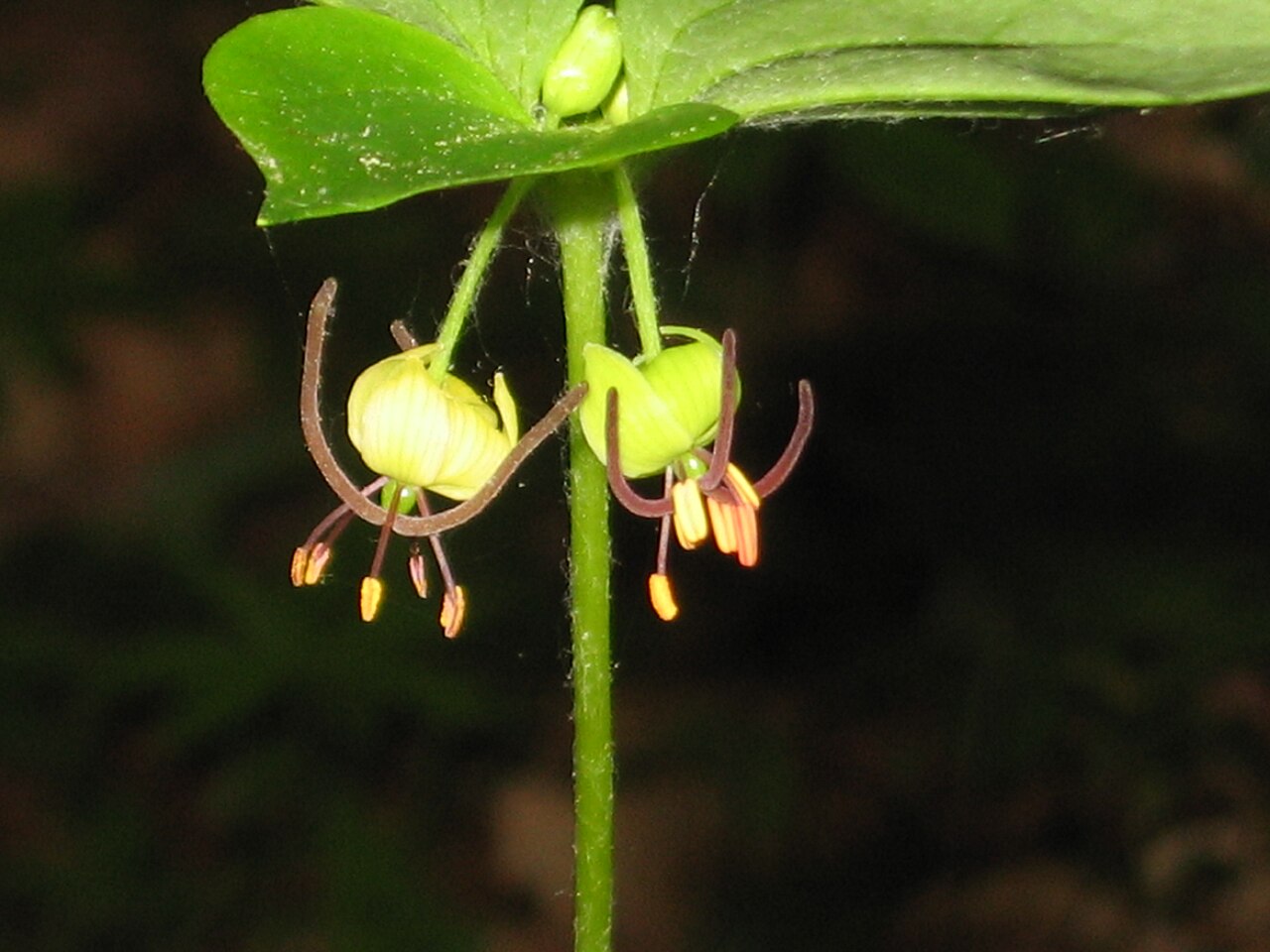
Indian cucumber-root (Medeola virginiana) is a native woodland lily with an unusually architectural form. On a flowering shoot, one broad whorl of leaves spreads around the stem and a smaller whorl sits above it. Small greenish-yellow flowers hang beneath the upper leaves, followed by dark fruits. Later in the season, red coloration around the bases of the upper leaves makes the fruiting display more conspicuous than the modest flowers were.
It is a plant to enjoy in a sheltered woodland setting, not a fast-growing border filler. The stems are typically one to two feet tall, and the plant depends on a relatively undisturbed, organically rich soil surface beneath shade. The New England regional table formerly used the older name Medeola virginica and described “magenta floral bracts.” The accepted name used here is Medeola virginiana; the colorful feature is the upper foliage around the fruit, not showy magenta flowers.
Gardeners should approach this species with patience and a conservation-minded sourcing policy. It grows slowly, can be difficult to transplant, and is not an appropriate plant to dig from the woods for a quick landscape project. If nursery-propagated stock is available, choose its location carefully before planting. Its historic food-related name does not make it a recommended garden crop or justify removing its roots.
Identification
Stems & Rootstock
A slender, upright, unbranched stem rises from a perennial underground rootstock. Young stems may carry fine whitish hairs. The plant has no woody bark and should not be cut back while the leaves are still green merely to neaten the bed. The brittle underground parts are one reason to minimize disturbance. Recognize the plant above ground rather than digging to inspect the rootstock; that keeps both the individual and the surrounding woodland soil intact.
Leaves
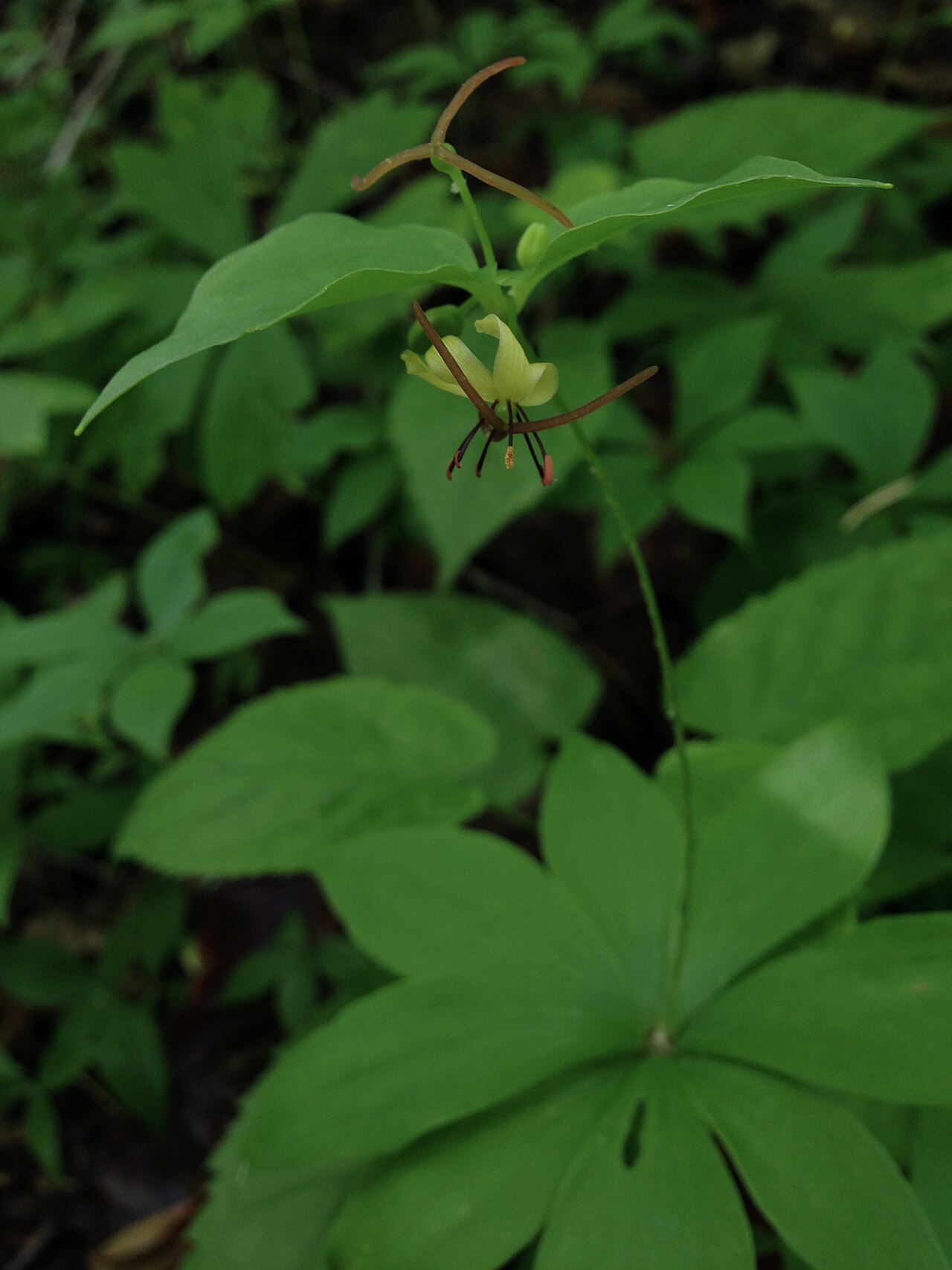
Flowering plants usually have two distinct tiers: a lower whorl with several larger leaves and an upper whorl typically made of three smaller leaves. The leaves are simple, smooth-edged, and pointed, spreading out from the stem like the spokes of a small umbrella. Nonflowering plants may have only the lower whorl. That difference is normal and is important for identification: a one-tier plant is not necessarily damaged or a separate species. In fruit, the bases of the upper leaves can turn red or scarlet.
Flowers
The small flowers nod beneath the upper whorl on thin stalks. Their greenish-yellow tepals curve back, exposing projecting reproductive parts that can be easier to see in a close photograph than from above. Flowers are generally a late-spring to early-summer feature, with regional timing differences. They are subtle rather than a mass of bright color. Place the plant where you can look at it from the side without stepping into its root zone.
Fruit & Look-alikes
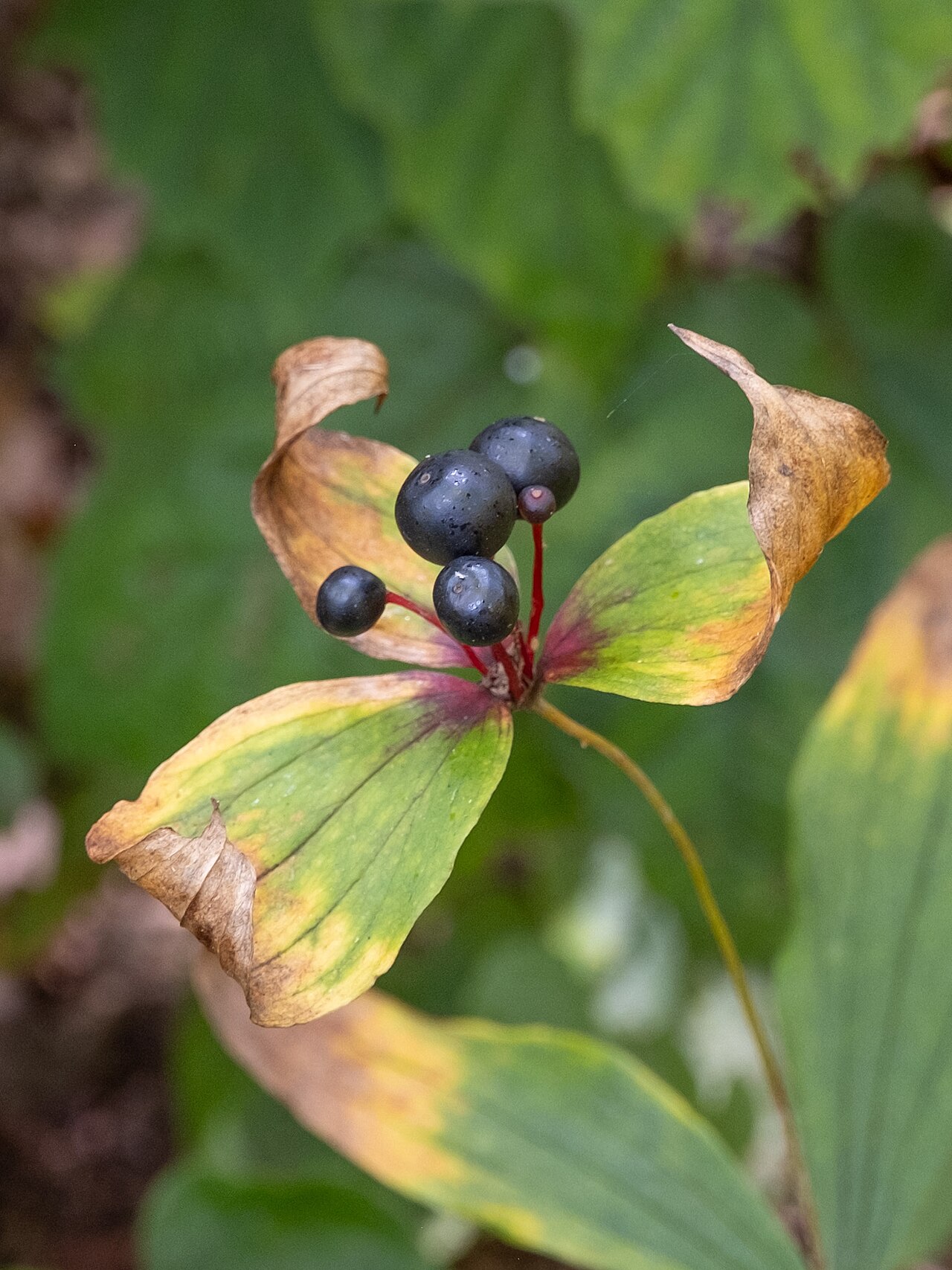
The fruits develop above the upper leaves and darken to blue-black or purplish black as they ripen. The contrast with reddening leaf bases is a characteristic late-season feature. A young, single-whorled shoot can resemble a whorled pogonia orchid at a glance; flowers and stem details help distinguish them. Do not uproot a plant because a quick photograph is inconclusive, especially in habitat where rare orchids may occur. The roots and fruits are not needed for routine garden identification.
Quick Facts
| Scientific Name | Medeola virginiana L.; older synonym Medeola virginica |
| Family | Liliaceae (lily family) |
| Plant Type | Native herbaceous woodland perennial |
| Mature Height | 12–24 inches (1–2 feet) |
| Mature Spread | About 12–18 inches for a developing clump |
| Growth Rate | Slow; several years may pass before seed-grown plants flower |
| Sun Exposure | Part shade to full shade |
| Water Needs | Average to moist, well-drained woodland soil |
| Soil Type | Organically rich loam or sandy woodland soil |
| Soil pH | Acidic conditions preferred |
| Bloom Time | Late spring to early summer, varying by location |
| Flower Color | Greenish yellow |
| Fall Color | Upper leaf bases may become scarlet around the ripening fruit |
| Fruit | Dark blue-black berries; leave for wildlife and observation |
| Deer Resistant | Not a dependable deer-proof choice; monitor local browsing |
| USDA Hardiness Zones | 3–8 |
Native Range
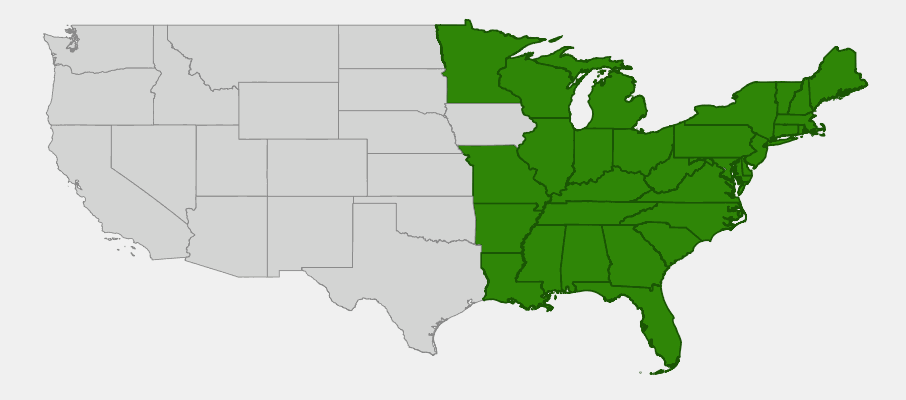
Indian cucumber-root is native to eastern North America, including eastern Canada and a broad portion of the eastern United States. It is a woodland species throughout that range, not a plant confined to Virginia despite its name. In New England it belongs to native forest understories where the canopy and forest floor create shelter from exposed summer conditions.
Its typical habitat is a mesic woodland, slope, ravine, or valley with organic matter and reasonably good drainage. “Mesic” describes a moderate moisture environment: neither a persistently drought-baked site nor an open-water setting. Local populations can occupy different positions along that gradient, but the safest garden starting point is shaded, moisture-retentive soil that is not compacted or continually flooded.
The state outline below follows the distribution reported by NatureServe, with the eastern range also supported by NC State and regional floras. A state record is not a statement that the plant is common everywhere in that state. At range edges it may be scarce, and state conservation treatment varies. Check local guidance before any restoration or field work, and use propagated plants rather than treating a range map as permission to collect.
📋 Regional plant list: New England
Growing & Care Guide
Light
Choose partial to full woodland shade. The broad leaf whorls are adapted to an understory setting, and strong direct sun is a poor starting point for this plant. A deciduous canopy can provide seasonal spring light followed by summer shelter. Be cautious around newly removed trees: the plant’s former shade may disappear even though the bed itself has not moved. If a garden offers only exposed sun or deep, very dry shade under dense competing roots, a different native plant may be a better choice.
Soil & Water
Provide a cool, organically rich, well-drained root zone. Maintain moisture during establishment without making a saturated pocket around the rootstock. Preserve a light layer of leaf-derived organic matter, but do not pile fresh mulch over the shoot. The plant’s natural woodland setting is not bare cultivated soil, and repeated hoeing can damage both emerging stems and underground parts. Check soil moisture by hand near, but not directly through, the crown. If the site repeatedly dries hard in summer, address the site or choose another species rather than relying on emergency watering after foliage collapses.
Planting Tips
Obtain nursery-propagated plants and ask how they were grown. Set the root ball at its original level with minimal root disturbance, water gently, and keep a marker nearby so the dormant plant is not accidentally dug up. Choose the final position before planting: this is not a perennial to move around each season while experimenting with a design. Leave space for the leaf whorls and keep aggressive neighboring roots at a distance. A small, well-sited group is more likely to succeed than a large installation in untested conditions.
Pruning & Maintenance
Do not cut back the plant after flowering while the foliage remains green. Those leaves support the perennial rootstock and the developing fruit. Let the seasonal display proceed, then remove dead material only if it creates a practical problem. Weed by hand with care and avoid tugging intertwined roots through the crown. If a shoot appears late or is smaller than expected, observe before digging; slow woodland plants do not always respond on the schedule of vigorous border perennials.
Propagation
Seed propagation requires patience. NC State notes that germination can be delayed for roughly two years and flowering can take several more seasons. Use a species-specific nursery method that accommodates dormancy rather than declaring a pot empty after one spring. Keep records of sowing date, source, and any treatment. Because transplanting can be difficult and the underground parts are brittle, avoid casual division of a small plant. Purchasing a propagated plant from a knowledgeable native nursery is a better route than harvesting roots or lifting a wild colony.
Protecting a Woodland Planting
Keep the bed out of shortcuts and equipment routes. A plant with a single slender stem can lose a whole season’s aboveground growth to one misplaced step. Place labels where they can be read from the path rather than requiring visitors to enter the bed. If browsing is evident, use an appropriately sized physical barrier while the plant establishes. Do not promise that a native species will automatically resist deer; judge the local situation and protect vulnerable specimens when necessary.
Landscape Uses
- A quiet focal plant beside a shaded woodland path, viewed at leaf and flower level.
- A native garden detail that shows the contrast between one-tier nonflowering shoots and two-tier flowering shoots.
- A late-season woodland accent when dark fruit contrasts with red upper leaf bases.
- A carefully sourced addition to an existing mesic woodland garden with minimal soil disturbance.
- A teaching plant for plant architecture and seasonal development, not a crop for root harvesting.
Wildlife & Ecological Value
For Pollinators
The small flowers form part of the woodland’s seasonal flowering layer. Retain a diverse surrounding planting rather than expecting this one subtle species to provide a large floral resource. Avoid unnecessary insecticide use around flowering plants and observe visitors without handling the delicate stems. Specific pollinator claims should be tied to documented observations rather than inferred from the flower color alone.
For Birds
The fruits attract birds and remain one of the most conspicuous features after the flowers are gone. Leave them on the plant so that the fruiting cycle can finish and wildlife has access. Dark fruit above a reddening leaf whorl is also useful for garden observation; a close photograph can record the display without cutting a stem. Human harvest is not needed to enjoy or understand this part of the plant’s life.
For Mammals
Small mammals are part of the woodland community in which the species occurs, but their presence does not turn every interaction into a problem to eliminate. Protect new plants from severe damage when necessary and distinguish browsing from breakage or drought injury. The appropriate response is based on what actually happened in the bed, not on an unsupported claim that the plant is universally resistant or universally attractive to a particular animal.
Ecosystem Role
Indian cucumber-root adds a distinctive herbaceous layer to an intact forest floor. Its slow growth and sensitivity to disturbance make preserving established habitat especially important. A native garden can echo those conditions by keeping soil covered, protecting canopy structure, and avoiding repeated relocation of plants. In a natural woodland, leaving a healthy colony in place is preferable to moving it into a decorative bed, even if the species is native elsewhere on the property.
Cultural & Historical Uses
The common name refers to the cucumber-like character historically associated with the underground rootstock. NC State records past Indigenous food and medicinal use, but a broad historical summary should not be treated as a recipe or as a substitute for the knowledge of particular communities. This page does not recommend harvesting the rootstock; removing it destroys or seriously damages a slow-growing woodland plant.
The botanical name has also had a history of variation. Medeola virginica appears in older usage and in some planting lists, while current references use Medeola virginiana. NC State explicitly lists the former among older names for the same plant. Correcting a nursery or regional-list label to the accepted name improves identification without inventing a new species or creating a second page for the same taxon.
The plant’s strongest modern garden role is educational and ecological. Its tiered leaves, almost hidden flowers, and later fruit display reward repeated visits through the season. Propagated stock makes that experience possible without collecting from wild populations. Treat it as a long-term woodland resident and give it a stable place, rather than as a disposable accent to move whenever the border design changes.
Frequently Asked Questions
Is Medeola virginica a different plant?
The name appears as an older synonym of Medeola virginiana in current horticultural references. This page and the corrected regional row use Medeola virginiana, the accepted name.
Why does my plant have only one ring of leaves?
Nonflowering shoots can have a single whorl. Flowering plants usually develop a second, smaller upper whorl. A one-tier shoot is not by itself evidence of damage or incorrect identification.
Are the magenta structures its flowers?
No. The flowers are small and greenish yellow. The conspicuous reddish color later in the season develops around the bases of the upper leaves near the fruit.
Can I move it after it establishes?
Avoid unnecessary relocation. The plant is slow-growing and can be difficult to transplant. Choose the site carefully, preserve the root ball when planting nursery stock, and give it time to settle.
Should I grow it as an edible root crop?
No. This guide recommends it as a woodland ornamental and habitat plant. Historical food use does not justify harvesting a slow-growing plant or collecting from wild populations. Buy propagated stock and leave its root system intact.
Sources & Further Reading
- NC State Extension: Medeola virginiana, including older synonyms
- Native Plant Trust Go Botany: Indian cucumber root
- NatureServe: Medeola virginiana distribution and habitat
- Kew Plants of the World Online: Medeola virginiana
- USDA PLANTS: Medeola virginiana
Find Native Plants
Ask growers about nursery propagation and regional provenance. Browse our Maine native plant nurseries, New Hampshire native plant nurseries, Vermont native plant nurseries, Connecticut native plant nurseries directory for suppliers.