
Red Bay (Persea borbonia)
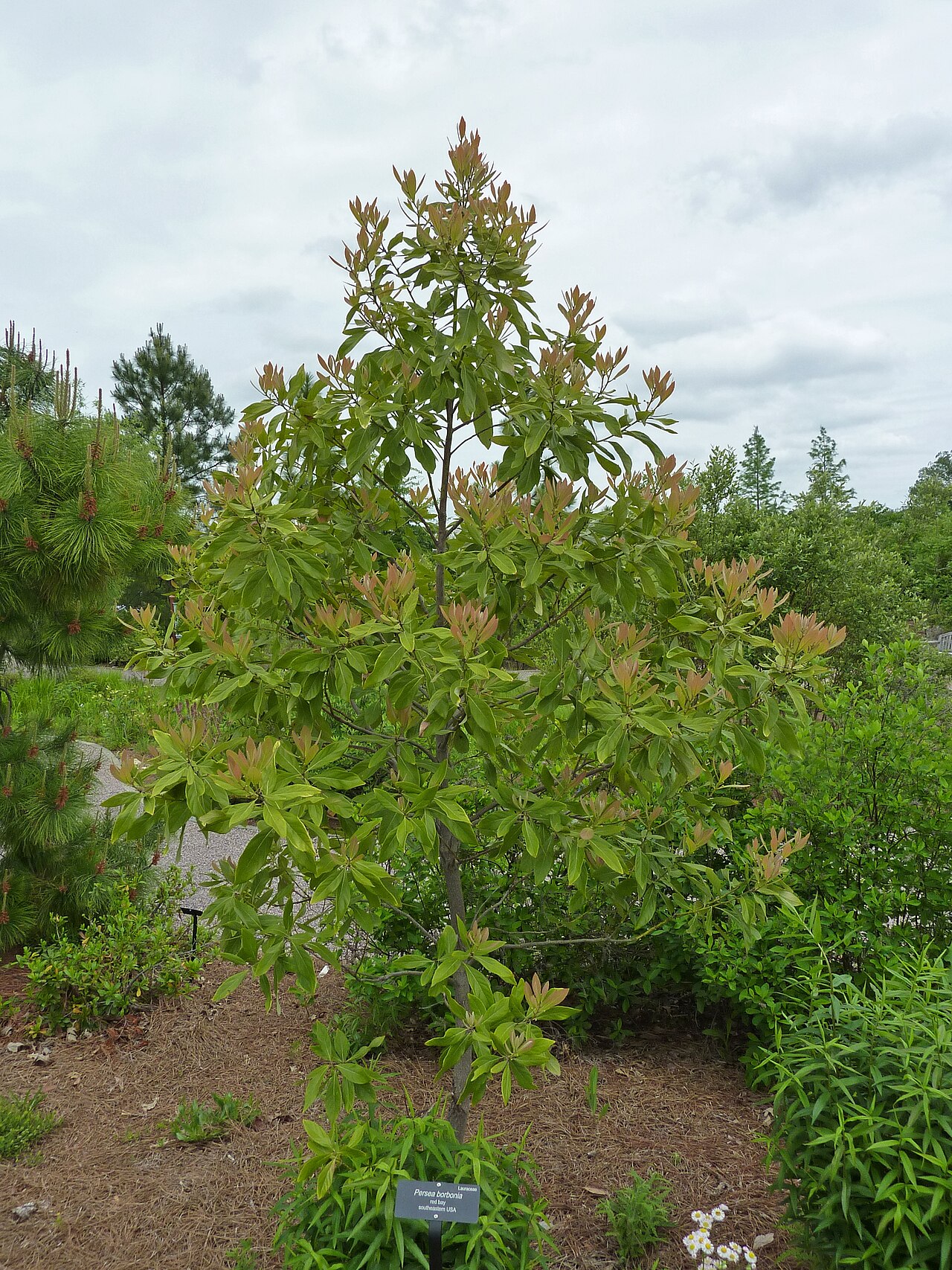
Red bay (Persea borbonia) is an aromatic evergreen of the southeastern United States, with leathery leaves, dark blue fruit, and a particular importance to native swallowtail butterflies. In a suitable coastal-plain woodland it supplies something a showier flowering tree cannot: persistent foliage, seasonal fruit, and larval food within the same crown. Its quiet green appearance makes the details worth seeking out—young shoots, the smell of a crushed fallen leaf, and the rounded fruit clusters late in the season.
It is not the Mediterranean culinary bay, a magnolia called sweetbay, or an interchangeable name for swamp bay. We retain Persea borbonia here, following USDA PLANTS and Kew's accepted-name treatment; some southeastern references, including NC State Extension, use Tamala borbonia. Our existing Swamp Bay page concerns Persea palustris, a closely related but separate plant. Nursery labels and older references deserve careful checking because broad historical treatments combined several southeastern bays.
The most important modern gardening issue is laurel wilt. This destructive beetle-associated disease changes a planting decision that might otherwise seem straightforward. Where the disease is established, consult your extension service before buying or moving a bay tree; the Florida Native Plant Society cautions against planting susceptible bays. This guide is as much about recognizing and caring for existing red bay habitat as recommending a new specimen. A healthy native tree is valuable, but an attractive label is not evidence that moving it is safe.
Identification
Bark, branches and overall form
Red bay may remain a many-branched small tree or become a taller woodland tree. The regional table's 20–65-foot range covers both forms; some botanical accounts report trees near 70 feet. Older trunks develop brown to reddish-brown bark broken into irregular ridges. A nursery plant with low branches will not instantly become a clear-trunked shade tree, so assess its structure and eventual spread rather than buying on height alone. Do not strip bark or cut branches from a wild tree to identify it.
Leaves and the bay-tree lookalikes
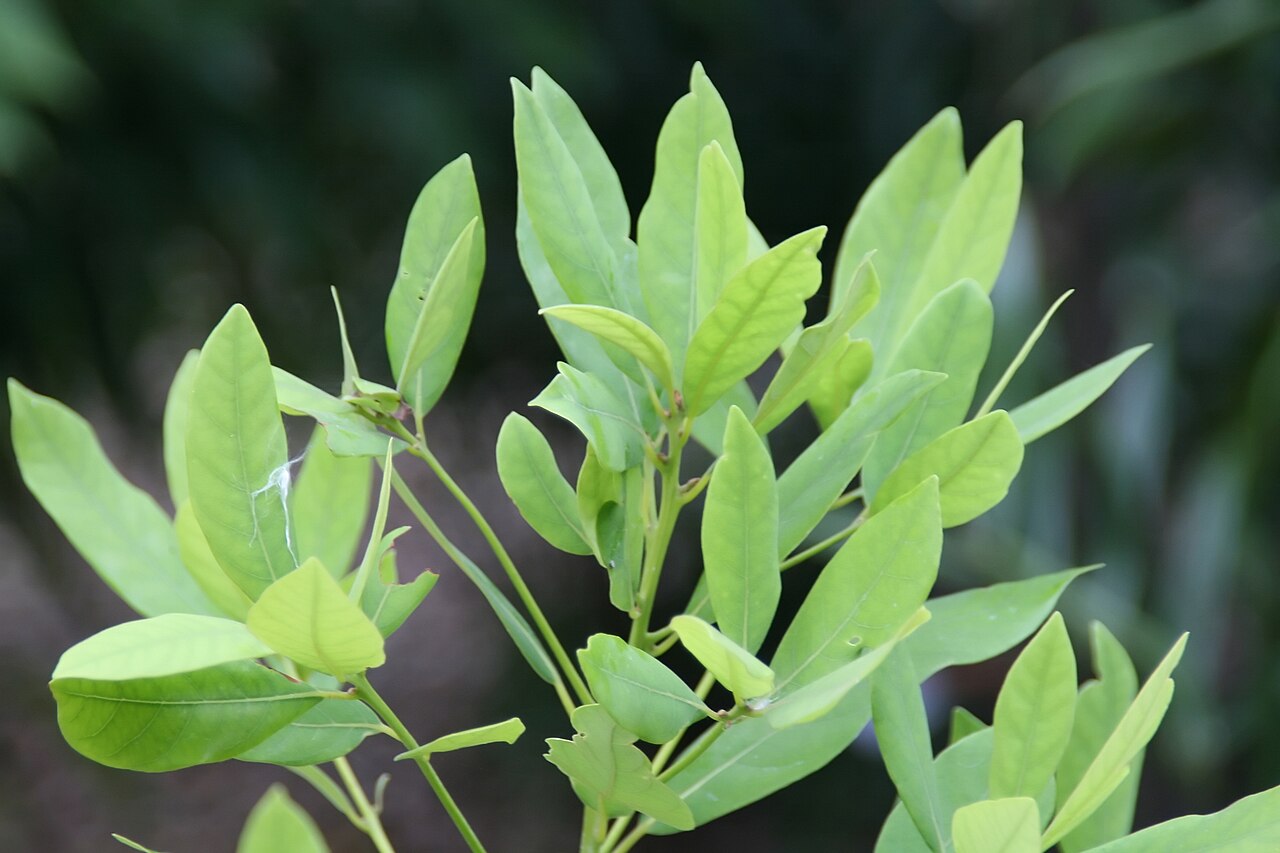
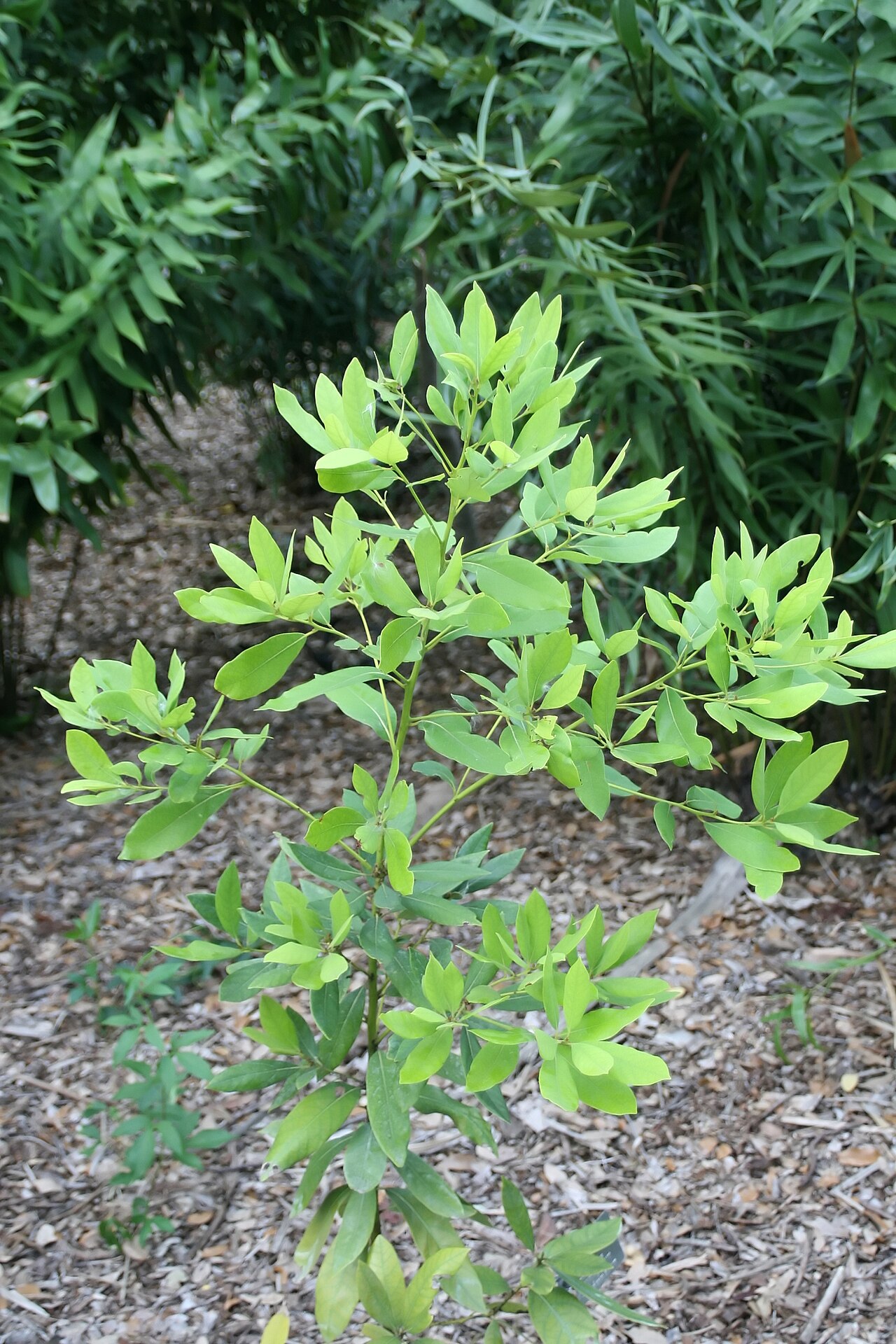
Leaves are simple and alternate, with an unlobed outline, smooth edges, and a firm evergreen texture. Most are a few inches long and narrow toward their tips. The familiar spicy scent is helpful but cannot distinguish every member of the laurel family. Close examination of hairs on the lower leaf surface and young shoots is more informative when separating red bay from swamp bay: swamp bay generally has longer, more conspicuous hairs. Because hairiness varies and old names overlap, use a regional botanical key, not scent or habitat by itself, for a doubtful tree.
Flowers
Small pale yellow-green flowers occur in branched clusters during spring to early summer. They are easy to overlook from a distance, especially against new foliage, but a close view can reveal visiting insects. Red bay should not be selected for a mass of white petals like a dogwood or magnolia. Its flowering display is subtle; its principal landscape features are the evergreen crown, the foliage texture, and later fruit. Observe blossoms without removing them, particularly on a small tree with few flowering shoots.
Fruit and seasonal clues
The fruit is a small, dark blue to nearly black drupe, ripening in autumn. A drupe has a fleshy exterior surrounding a hard seed-bearing center; it is not an acorn or a magnolia cone. Birds may remove fruit quickly, so a tree that appears unproductive during a single visit may simply have already fed its visitors. Old leaves can yellow or redden and drop while the tree remains evergreen overall. Sudden persistent browning of an entire crown is a different pattern and deserves professional assessment for laurel wilt or another serious problem.
Quick Facts
| Scientific Name | Persea borbonia; treated as Tamala borbonia in some southeastern references |
| Family | Lauraceae (laurel family) |
| Plant Type | Broadleaf evergreen native tree or large shrub |
| Mature Height | 20–65 ft in the regional list; favorable sites may approach 70 ft |
| Mature Spread | Often 10–30 ft; leave room for a developing crown |
| Growth Rate | Generally moderate; establishment and site strongly affect growth |
| Sun Exposure | Partial shade to full sun; partial shade is the regional-table recommendation |
| Water Needs | Average to moist soil, with drainage; irrigate during establishment |
| Soil Type | Sand or loam, including moist coastal woodland soils |
| Soil pH | Site dependent; use local soil testing rather than routine amendment |
| Bloom Time | Spring into early summer, varying with locality |
| Flower Color | Pale yellow-green |
| Fall Color | Evergreen; scattered older leaves may turn yellow or red |
| Fruit | Dark blue to black drupes in autumn |
| Deer Resistant | Not deer-proof; foliage can be browsed |
| USDA Hardiness Zones | Generally 7–9; provenance and exposure matter |
Native Range
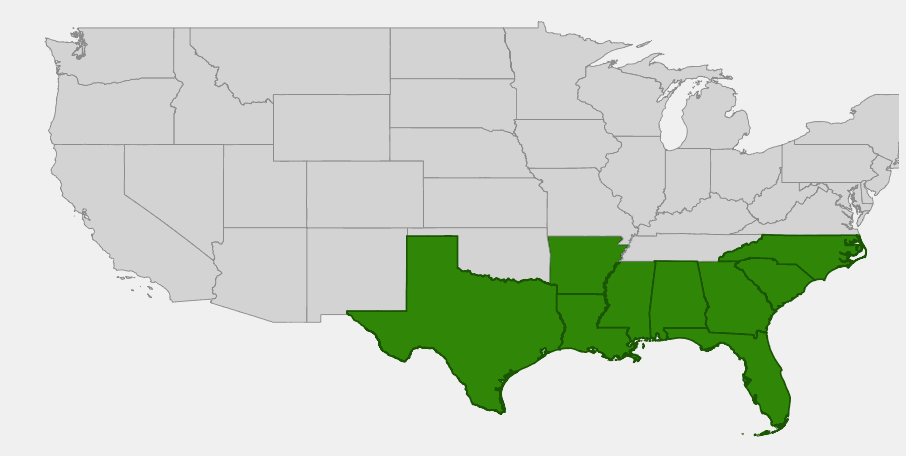
The conservative state-level range shown here follows Kew's Persea borbonia treatment: Alabama, Arkansas, Florida, Georgia, Louisiana, Mississippi, North Carolina, South Carolina, and Texas. This is a southeastern and Gulf-coast plant, not a species native throughout every state included in our Arkansas–Louisiana–Oklahoma–Texas regional list. In particular, the Oklahoma portion of that combined list should not be read as evidence of Oklahoma nativity for red bay.
Its habitats include coastal woods, hammocks, maritime forests, and related lowland woodland settings. Different sources use different boundaries for red bay and swamp bay, which can make historical range descriptions appear wider than a modern, narrower taxon treatment. The map therefore depicts states documented for the treatment used here, not every old record filed under a broad bay name. For a restoration project, county records and a locally appropriate seed source are more useful than an entire shaded state.
Within the western part of the range, match a nursery source to the humid woodland environments of eastern Texas, Louisiana, or verified Arkansas localities. A shaded, irrigated yard in a much drier region does not become native red bay habitat merely because the plant survives there. The photographed Washington, DC specimen is a botanical-garden planting and does not expand the native map. The same distinction applies to cultivated trees outside the southeastern United States.
📋 Regional plant list: Arkansas, Louisiana, Eastern Oklahoma and Eastern Texas
Growing & Care Guide
Light and placement
Partial shade is a sensible starting point in the regional planting table, especially for a small nursery tree on a hot site. Established red bay also grows in sun where soil and moisture are suitable. Walk the proposed site in the afternoon before deciding: reflected heat from paving is different from the filtered light at a woodland edge. Provide enough open soil for roots to spread and enough clearance that the eventual crown will not require repeated cutting against a roof or utility line.
Soil and water
Aim for a moist but functioning root zone rather than permanent standing water. Water a new tree slowly into its original root ball and surrounding soil, then check actual moisture before irrigating again. A sandy site may dry quickly even after rain; a compacted clay planting hole may remain wet while its surface looks dry. These are different problems and need different responses. The table's A means average moisture, not a promise of drought immunity. Keep a broad mulched area around the tree while leaving the trunk base uncovered.
Planting and disease-aware sourcing
Before purchasing, ask the grower about local laurel-wilt conditions, the source of its stock, and any movement restrictions or inspection requirements. Where planting is discouraged, retain healthy existing native vegetation and choose another locally suitable tree for the new planting. If local guidance supports planting, use a healthy nursery-propagated specimen, locate the root flare at grade, and avoid burying the trunk. Do not dig up a wild bay or bring home wood from a declining stand as mulch or firewood.
Pruning and maintenance
Choose a site large enough for the natural habit so pruning can remain selective. Remove damaged or poorly placed branches while they are small, using correct cuts at the branch collar; do not top a mature red bay to make it fit a small bed. Keep mowers and trimmers away from the trunk. Where a larger tree overhangs a frequently used space, have structural concerns assessed rather than assuming an evergreen crown means sound wood. For diseased material, follow local disposal advice instead of transporting it elsewhere.
Laurel wilt: what to watch for
A rapidly browning crown with leaves retained on the branches is a warning, not a diagnosis. Contact the county extension office, forestry service, or a qualified arborist, and provide photographs of the whole tree, foliage, trunk, and recent site changes. Laurel wilt involves a fungus carried by ambrosia beetles; home remedies and extra fertilizer do not solve the underlying infection. Avoid moving potentially infested wood. Do not apply an insecticide or fungicide based only on a photo comparison—identification and locally supported treatment guidance come first.
Propagation
Red bay can be propagated from seed, but sourcing and hygiene remain important wherever laurel wilt occurs. Work with a native nursery or conservation program rather than taking seed or cuttings from a declining stand and moving them across regions. The Native Plant Society of Texas describes cleaning ripe dark fruit and a short cold-moist treatment before sowing. Keep each lot labeled with parent identification and collection locality. Seedling variability is normal; a small healthy tree with known provenance is more useful than a fast-grown but untraceable specimen.
Landscape Uses
- Conserve a healthy existing red bay as part of a native woodland canopy.
- Provide evergreen structure in a sufficiently roomy, locally appropriate woodland planting where disease guidance permits.
- Include in a documented swallowtail habitat project coordinated with local conservation advice.
- Use an existing tree as an identification and seasonal-observation feature, without disturbing its roots.
- Avoid exposed infrastructure-confined sites and avoid moving suspect bay wood or planting stock.
Wildlife & Ecological Value
For pollinators and caterpillars
The foliage is particularly important as larval food for Palamedes swallowtails and is also used by spicebush swallowtails. That is a different service from nectar: a butterfly garden needs plants caterpillars can eat, not only flowers adults can visit. Some chewed leaves therefore represent a successful habitat function rather than a failed ornamental tree. Check for the actual insect before treating foliage, and do not spray a host tree merely to make every leaf unblemished.
For birds
Dark fruit and evergreen cover make red bay useful within a mixed planting. Preserve nearby layers of native shrubs and leaf litter so birds have sheltered approaches and several food sources across the year. A single fruiting tree surrounded by pavement cannot replace the structure of a woodland. Fruit removal by birds also helps explain why ripe drupes may be scarce on a tree that flowered well; watch over several weeks rather than judging productivity on one autumn afternoon.
For mammals
Several mammals consume the fruit, and deer may browse foliage. This does not mean the tree is an appropriate human food source or that it will be untouched in a deer-heavy garden. Protect a newly planted tree physically if local browsing pressure is high, leaving room for trunk growth and checking guards regularly. In a natural setting, fruit consumption and seed movement are part of the tree's role in the broader food web.
Ecosystem role
Laurel-wilt losses can remove both canopy structure and specialized host foliage. A disease-aware conservation response therefore focuses on the living community, not simply replacing a dead tree with another susceptible one. Preserve healthy regeneration where advised, avoid transporting infested material, and maintain diverse native planting layers. Diversity will not cure laurel wilt, but it prevents the whole landscape from depending on a single vulnerable species.
Cultural & Historical Uses
Red bay has a long history of use for its wood and aromatic foliage. Botanical and extension references describe wood used in cabinetry or interior work and leaves used as seasoning. Those records explain part of the plant's cultural interest; they are not a field-identification test or a recommendation to sample an uncertain bay. The shared word bay applies to unrelated and sometimes unsuitable plants.
The scientific-name history is unusually relevant for gardeners. USDA and Kew retain Persea borbonia, while some regional references place the southeastern bays in Tamala. Older literature also treated swamp bay and silk bay within a broader red-bay concept. Keeping the scientific name and source treatment together helps readers understand why descriptions of hairiness, moisture, and distribution may differ.
Today the strongest reason to learn this tree may be conservation rather than timber or kitchen use. Recognizing a healthy red bay, distinguishing it from its relatives, and noticing a sudden change in a local stand can support useful conversations with forestry and extension specialists. Photographing the tree and recording where it grows is more constructive than stripping bark, collecting wild seedlings, or moving affected branches to obtain a second opinion.
Frequently Asked Questions
Is red bay the same as swamp bay?
No. This page uses Persea borbonia for red bay and treats Persea palustris as a separate species. They are close relatives, and older sources sometimes combined them. Leaf and twig hairs, flowers, and a regional botanical key are more useful than common names alone.
Should I plant red bay in an area with laurel wilt?
Ask your local extension or forestry service first. The Florida Native Plant Society discourages planting susceptible bays where the disease is a concern. Never move potentially infested wood or assume nursery stock is safe solely because its foliage is green.
Does the regional table mean red bay is native in Oklahoma?
No. The table combines four broad regions, but each plant has its own distribution. The verified state list used here includes Arkansas, Louisiana, and Texas, not Oklahoma. Check county-level native records for restoration work.
Why do butterflies eat the leaves?
Their caterpillars use red bay as a host plant. That feeding supports native butterfly life cycles and is different from a tree disease. Identify the cause of damage before deciding that treatment is needed.
How large should I expect it to grow?
The regional list gives 20–65 feet; many references place landscape trees within roughly 30–60 feet, and favorable sites can produce taller trees. Allow space for the crown and roots rather than treating the size of a young nursery specimen as its permanent scale.
Sources & Further Reading
- Kew Plants of the World Online: accepted name and native distribution
- NC State Extension: red bay characteristics and cultivation
- USDA Forest Service: modern red bay and swamp bay silvics
- Native Plant Society of Texas: red bay
- Florida Native Plant Society: red bay and laurel-wilt cautions
- USDA National Invasive Species Information Center: laurel wilt
Find Native Plants
Ask growers about nursery propagation and regional provenance. Browse our Arkansas native plant nurseries, Louisiana native plant nurseries, Oklahoma native plant nurseries, Texas native plant nurseries directory for suppliers.