
Yellow Jessamine (Gelsemium sempervirens)
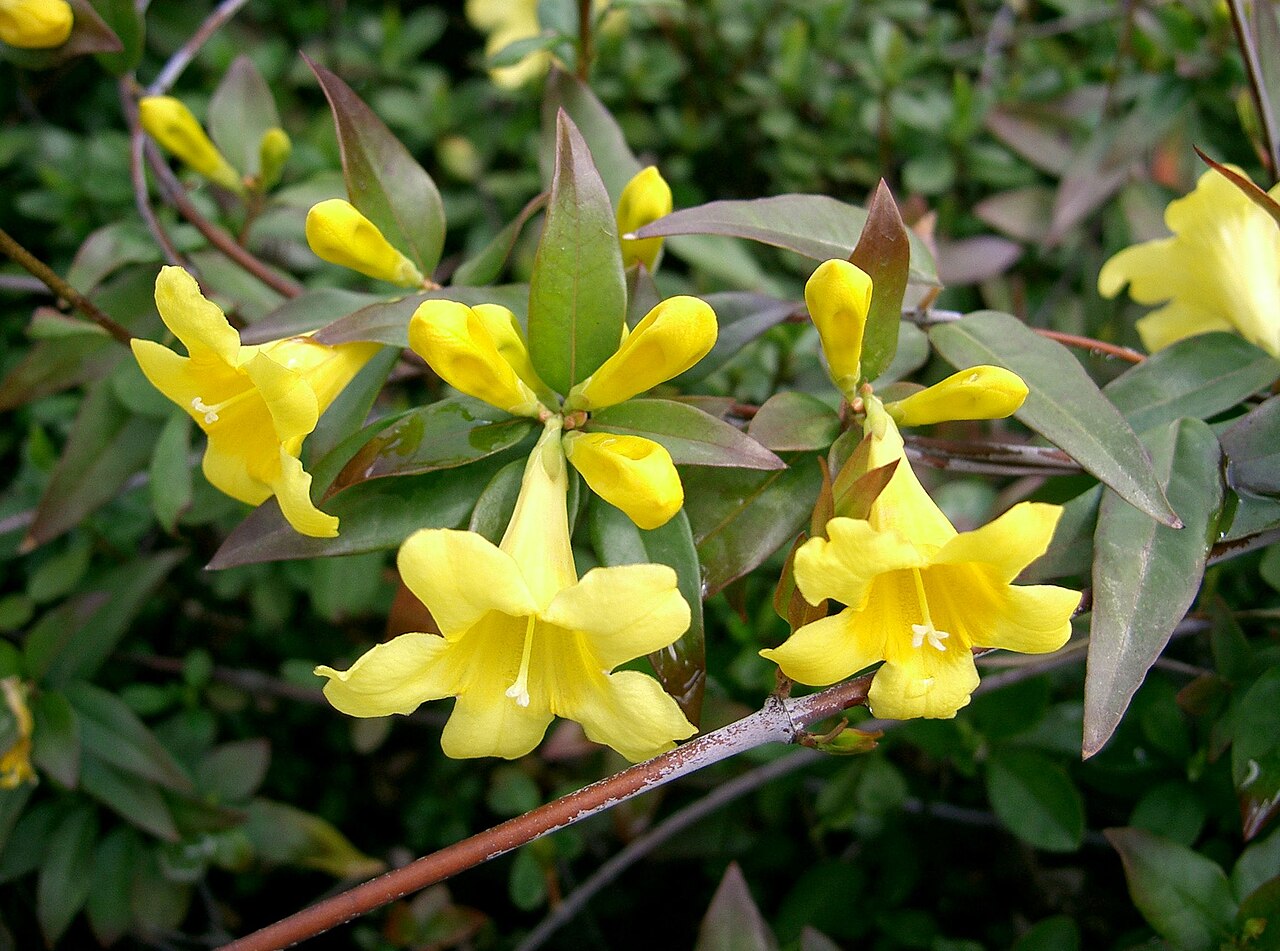
Yellow jessamine can turn a late-winter fence into a sheet of fragrant yellow trumpets. Its wiry stems, glossy simple leaves and early flowering make it a distinctive southeastern native vine. It is also a plant that must be chosen deliberately: all parts are toxic if eaten, and its name should never lead anyone to treat it as an edible jasmine or honeysuckle.
In a suitable garden, the vine offers a finer-textured evergreen screen than the heavier crossvine. It climbs by winding its stems around supports, rather than by adhesive tendrils. That difference matters when choosing a trellis and when separating it from neighboring shrubs during maintenance. Young plants can take time to settle in before making much vertical growth.
Our Arkansas–Louisiana–eastern Oklahoma–eastern Texas table includes the species, but the regional grouping is not a statement of nativity in all four states. The Kew native distribution used here includes Arkansas, Louisiana and Texas, not Oklahoma. Check local occurrence near a range edge and do not use horticultural survival as evidence of native status.
Identification
Bark & Stems
Thin stems twine around a support and gradually become woody. New growth may have a reddish cast. Trace the winding stem rather than searching for the gripping discs found on crossvine. A plant without a support can spread as a low tangled cover, so its appearance in a bed can be quite different from the same species on a tall arbor.
Leaves
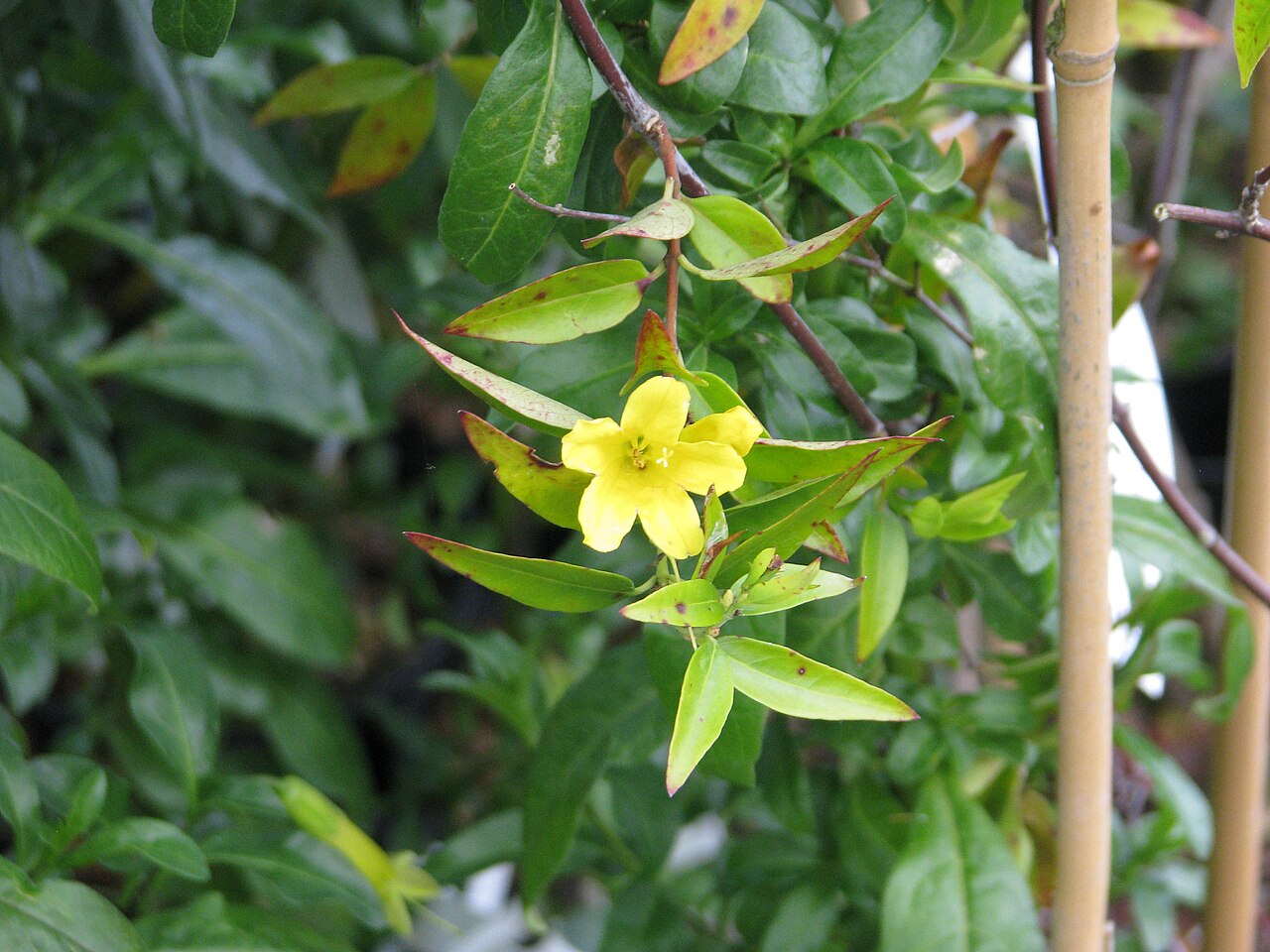
Opposite, simple leaves are narrow to broadly lance-shaped with smooth margins and a glossy surface. They are not divided into leaflets. Winter bronzing is common, particularly in colder positions, and some leaf loss can occur toward the northern edge of cultivation. Compare leaf arrangement and flower structure together; many unrelated vines are casually called jasmine.
Flowers
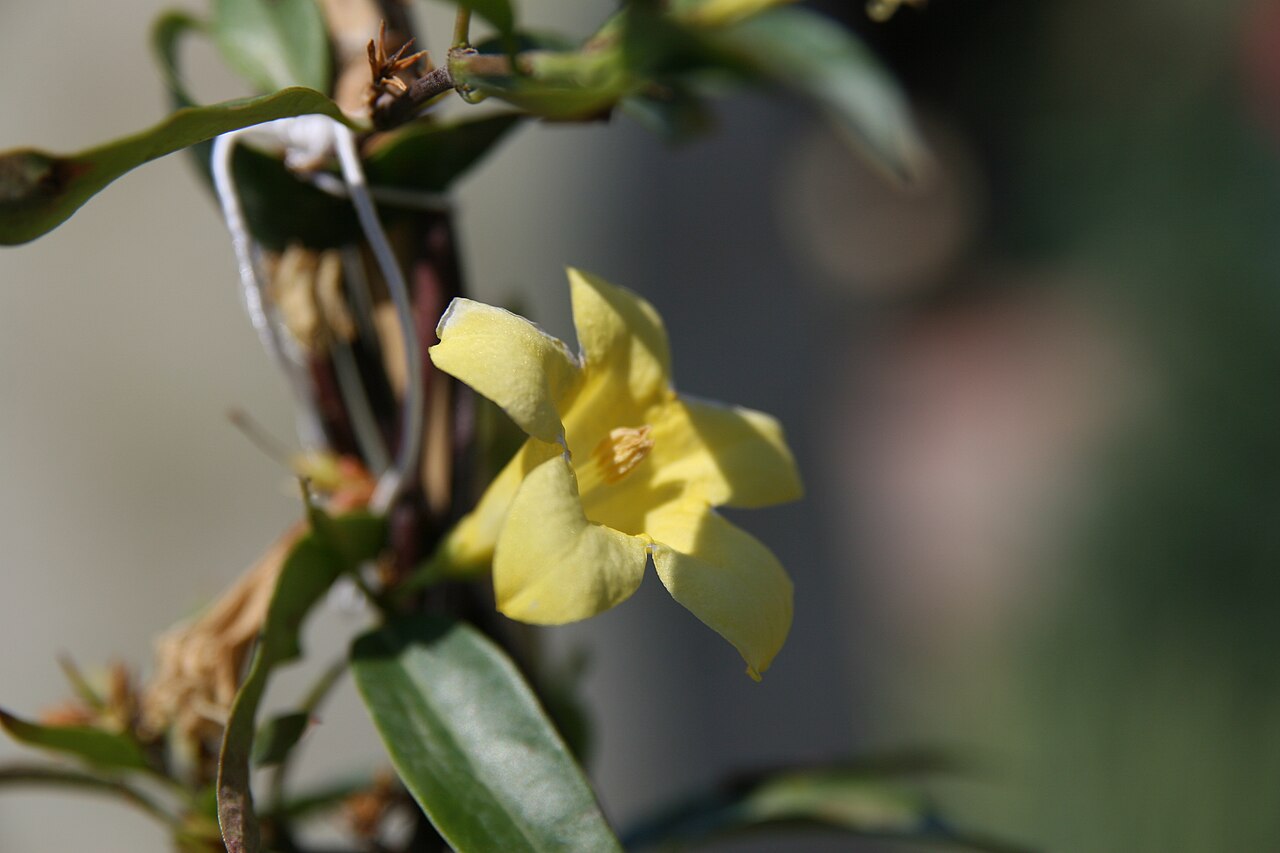
The fragrant yellow blooms are funnel-shaped with a flared, five-lobed opening, borne singly or in small clusters. Main flowering comes in late winter or spring, with the date shifting across the range. The floral tube and yellow color can invite mistaken comparisons with honeysuckle; do not taste the nectar. The related swamp jessamine is a different species, so fragrance, habitat and other diagnostic characters matter when identifying wild material.
Fruit & Seeds
Dry, flattened capsules follow flowering and change from green to brown. They open to release seeds rather than ripening into a fleshy edible fruit. Old capsules may remain visible after the floral display ends. If children or pets investigate seed pods, place the vine where access is controlled and remove reachable trimmings promptly.
Quick Facts
| Scientific Name | Gelsemium sempervirens |
| Family | Gelsemiaceae |
| Plant Type | Woody twining vine; evergreen to semi-evergreen |
| Mature Height | 10–20 ft on a suitable support |
| Mature Spread | Can spread broadly, reaching 20–30 ft if unsupported and unrestrained |
| Growth Rate | Moderate; faster after establishment |
| Sun Exposure | Full sun to partial shade |
| Water Needs | Moist, well-drained soil; short dry spells tolerated once established |
| Soil Type | Organically rich soil with drainage |
| Soil pH | Adaptable across acidic to alkaline soils; test before amending |
| Bloom Time | Late winter to spring; often February–May by locality |
| Flower Color | Clear yellow, sometimes orange inside the throat |
| Fall Color | Foliage may bronze or become purplish in winter |
| Fruit | Flattened dry capsules; not edible |
| Deer Resistant | Often avoided, but no plant is browse-proof |
| USDA Hardiness Zones | 6–10; cold tolerance depends on provenance and site |
Native Range
Kew places the species in the southeastern United States and south through parts of Mexico into Central America. The U.S. native-state map below follows that treatment. It deliberately excludes places where garden cultivation, roadside escape or a broad regional gardening list might otherwise create a misleading impression of nativity.
The plant grows through wooded margins and thickets, taking advantage of supporting vegetation. A moist but aerated root zone is a useful garden model. Neither standing water nor a permanently dry planter reproduces that setting well. In coastal areas it can tolerate some exposure, but a sheltered establishment period is still beneficial.
State-level shading is only an overview. The northern and western limits deserve local checking, particularly for restoration or habitat projects. A cultivated photograph from Maryland, Japan or England illustrates the plant's appearance, not its natural range there. Where provenance matters, ask for source information and avoid substituting a similar yellow-flowered vine.
Native Range at a Glance
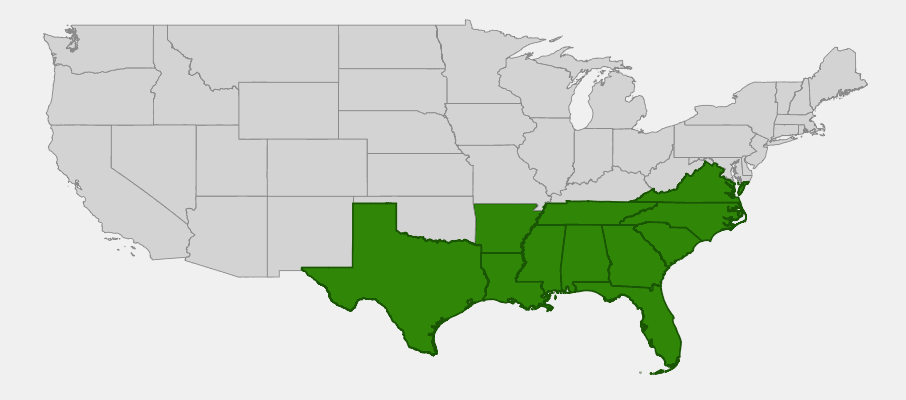
| U.S. States | Alabama, Arkansas, Florida, Georgia, Louisiana, Mississippi, North Carolina, South Carolina, Tennessee, Texas, Virginia |
| Mexico / Canada / Other Range | Native through parts of Mexico to Guatemala and Honduras |
| Ecoregion | Southeastern coastal plains, lower Piedmont and warm woodland edges |
| Elevation Range | Lowland to lower upland sites; consult a local flora for limits |
| Habitat | Thickets, woodland openings, stream corridors and forest edges |
| Common Associates | Pines, hardwoods and shrubs of local southeastern woodland margins |
📋 Explore the native plant list for Arkansas, Louisiana, eastern Oklahoma and eastern Texas. Species occurrence differs within this multi-state region.
Growing & Care Guide
Light
A sunny canopy generally gives the strongest floral display. Light shade is workable, but dense shade can result in a thin, wandering plant with fewer flowers. A sunny trellis with a cool mulched root zone is a useful arrangement in hot climates. Do not use a vine to conceal a structural problem in a wall or fence that still needs regular access.
Soil & Water
Water new plants consistently while roots spread into the bed, without keeping the planting hole stagnant. A soil with organic matter and drainage gives a better balance than either heavy compacted fill or a small pot that dries each afternoon. Once established, the vine tolerates short dry periods, but repeated drought can reduce growth and flowering. Fertilize only to address a demonstrated need rather than to force rapid coverage.
Planting Tips
Install the permanent support first. Set the crown at the nursery soil level and guide a few stems onto narrow upright or diagonal members. Leave room behind and beside the support for inspection. Avoid placing a highly toxic vine in an edible herb bed, beside a child's playhouse, or along a livestock fence where browsing is likely. The right location makes later pruning and safe cleanup much simpler.
Pruning & Maintenance
Shape after the main spring bloom so the display is not sacrificed unnecessarily. Remove dead, damaged or badly tangled growth and redirect stems before they enter gutters or neighboring plants. Wear gloves when handling sap-sensitive material, and collect all cuttings. Do not compost trimmings where animals can access fresh foliage. A plant that repeatedly outgrows its allotted support needs a larger space, not ever more severe emergency cuts.
Propagation
Use correctly identified nursery-propagated stock, or seek a species-specific propagation protocol for seed and cuttings. Plants propagated from a known selection retain a more predictable identity than an unlabeled vine traded as 'jasmine.' Avoid collecting from wild stands and do not move garden soil carrying invasive weeds. Keep propagation containers clearly labeled because the toxicity warning remains relevant even for very small plants.
Landscape Uses
- A supervised ornamental arbor away from edible harvest areas.
- A sunny freestanding screen where woody stems can be maintained.
- A woodland-edge garden within its verified native range.
- An early-season flowering accent paired with later native blooms.
Wildlife & Ecological Value
For Pollinators
The flowers are visited by pollinators, and dense growth can offer cover. However, floral visitors do not make the plant safe for human consumption. Extension information also warns about toxicity in relation to honeybees, so it should not be promoted uncritically as a universal bee forage plant. A diverse planting is preferable to relying on one species for an entire flowering season.
For Birds
Birds can use the vine's tangle as shelter and perching structure. This is not a fleshy-fruited berry vine, so its bird value should not be described as a large autumn berry crop. Place it in a habitat mosaic with shrubs and trees that provide complementary food and shelter resources.
For Mammals
The plant's toxic chemistry is an essential management consideration around mammals. Keep pets and grazing livestock away from foliage, flowers and pruning debris. Reports of reduced deer browsing are not a guarantee of protection, and toxicity is not a substitute for careful garden siting.
Ecosystem Role
A native woody climber adds structure to a woodland margin, but in a garden it can also overwhelm a small shrub used as an accidental support. Directing growth onto a trellis protects neighboring plants and makes the vine easier to monitor. Preserve a mixture of heights and plant forms instead of allowing every nearby plant to disappear under one climber.
Cultural & Historical Uses
Yellow jessamine is closely associated with the southeastern landscape and is the state flower of South Carolina. Its early blooms are a recognizable seasonal marker. The word jessamine is a common-name connection to fragrance, not a botanical claim that it belongs to Jasminum.
Older references may place the plant in Loganiaceae, while modern treatments recognize Gelsemiaceae. Names such as Bignonia sempervirens and Gelsemium nitidum occur in its synonym history. Those taxonomic records are useful when checking old literature, but the accepted name on the nursery label should remain clear.
Historical medicinal use does not make home preparation safe. This profile recommends no teas, tinctures or nectar tasting. The worthwhile tradition to carry into a modern garden is appreciation of the flowers and foliage while respecting the plant's potent toxicity.
Frequently Asked Questions
Is yellow jessamine an edible jasmine?
No. It is Gelsemium sempervirens, not a true jasmine, and all parts are toxic if eaten. Do not taste flowers or nectar.
Is it native throughout Oklahoma?
The native-range treatment used here does not include Oklahoma. Its presence on a multi-state list is not proof of local nativity.
When should I prune it?
Shape it after the main spring flowering period, and remove dead or damaged growth as needed.
Why is the foliage bronze in winter?
Winter bronzing can be normal. Evaluate stem health and spring regrowth before treating seasonal color as disease.
Why is a newly planted vine slow?
It may need time to establish roots. Check soil moisture, drainage and light rather than trying to force growth with heavy fertilizer.
Sources & Further Reading
- Kew Plants of the World Online: identity, synonyms and native distribution
- USDA PLANTS profile
- NC State Extension Gardener Plant Toolbox: identification and cultivation
Find Native Plants Near You
Ask a native-plant nursery for correctly identified, nursery-propagated stock and information about regional provenance. Match the plant to your site rather than collecting it from a wild population.
Arkansas native plant nurseries · Louisiana native plant nurseries · Texas native plant nurseries