
Silky Camellia (Stewartia malacodendron)
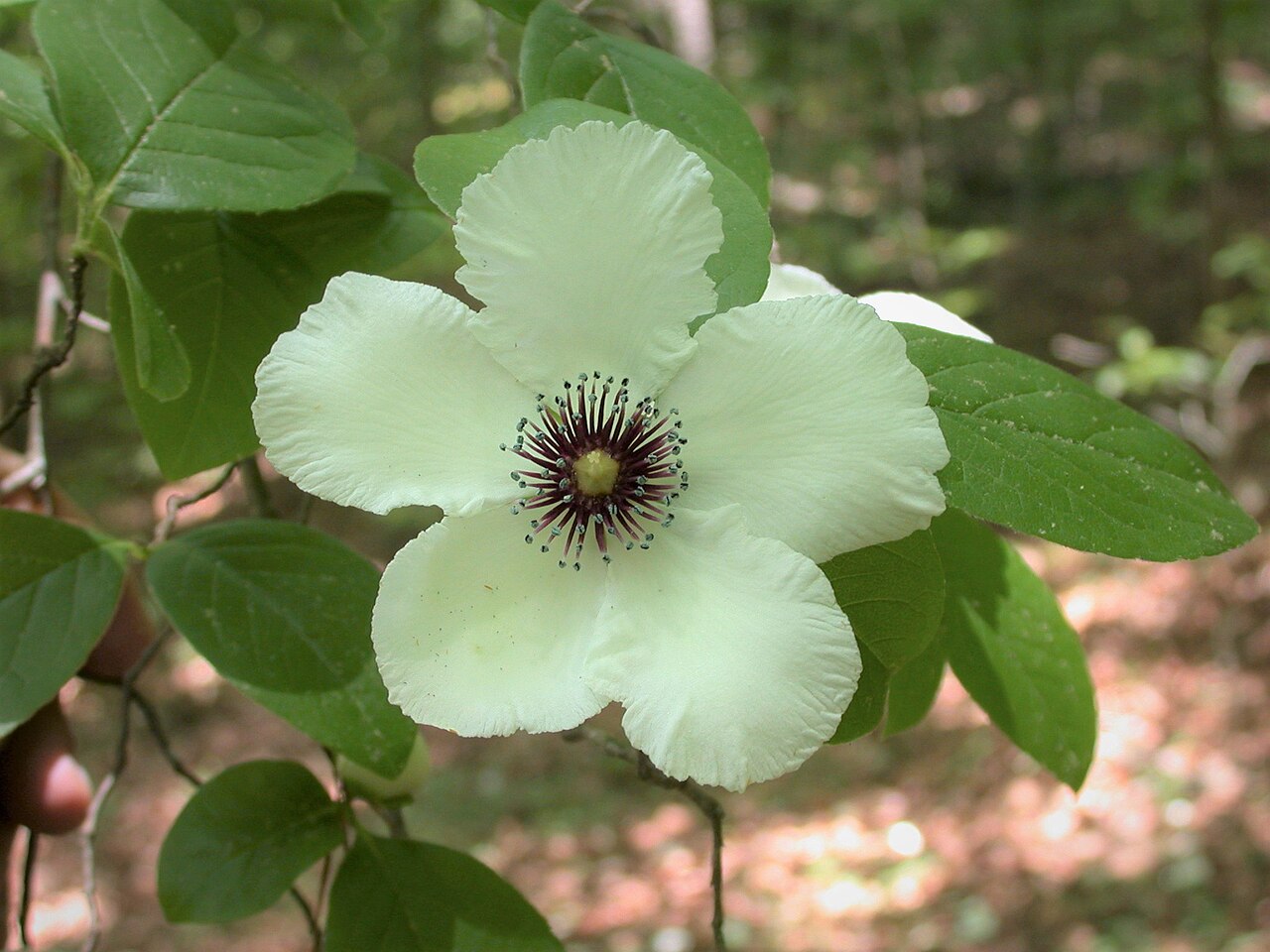
Silky camellia (Stewartia malacodendron) is a southeastern native shrub or small tree whose white flowers reward a close look. Purple stamens tipped with blue anthers stand against the pale petals, while silky hairs on the foliage and young growth explain the common name. The flowers have the restrained elegance of a woodland plant rather than the dense display of a clipped flowering hedge.
Although related to familiar garden camellias in the tea family, this species is a Stewartia, not a Camellia. It is deciduous, slow-growing, and best suited to a sheltered woodland-style setting with moist, well-drained soil. PlantNative's regional table lists a height of 10–15 feet. Extension references allow somewhat larger plants, so make space for a broad mature shrub rather than treating it as a compact border perennial.
A carefully sourced nursery plant is the right starting point. Wild populations can be local and conservation-sensitive, and the species is difficult to transplant once established. Choose its permanent site thoughtfully, preserve the root system, and resist the temptation to collect a flowering specimen from the woods. Its appeal is strongest when its natural form, root environment, and seasonal rhythm are respected.
Identification
Form and bark
Silky camellia often develops multiple stems and an open, spreading outline. It may be trained as a small tree, but heavy pruning is unnecessary when it has adequate room. Bark can develop cinnamon tones and exfoliating surfaces. These features add interest outside the flowering season, but bark color alone is not enough to separate all cultivated Stewartia species.
Leaves and silky surfaces
The alternate, simple leaves are oval to elliptic with finely toothed margins. Young stems and the lower leaf surfaces can carry the soft hairs reflected in the plant's common name. Look at a fresh leaf from both sides and examine the petiole and twig, rather than judging from a distant photograph. Autumn foliage often develops yellow tones before falling; intensity depends on the plant and growing conditions.
Flowers and their distinctive centers
The conspicuous white flowers have five broad petals and are roughly three inches across, with some botanical descriptions giving a somewhat larger span. Purple stamens and blue anthers are especially useful field characters. Flowering occurs in spring to early summer depending on locality and weather. A photograph of white petals without a clear view of the center may not support an identification, since several related cultivated species have superficially similar blooms.
Fruit and comparisons
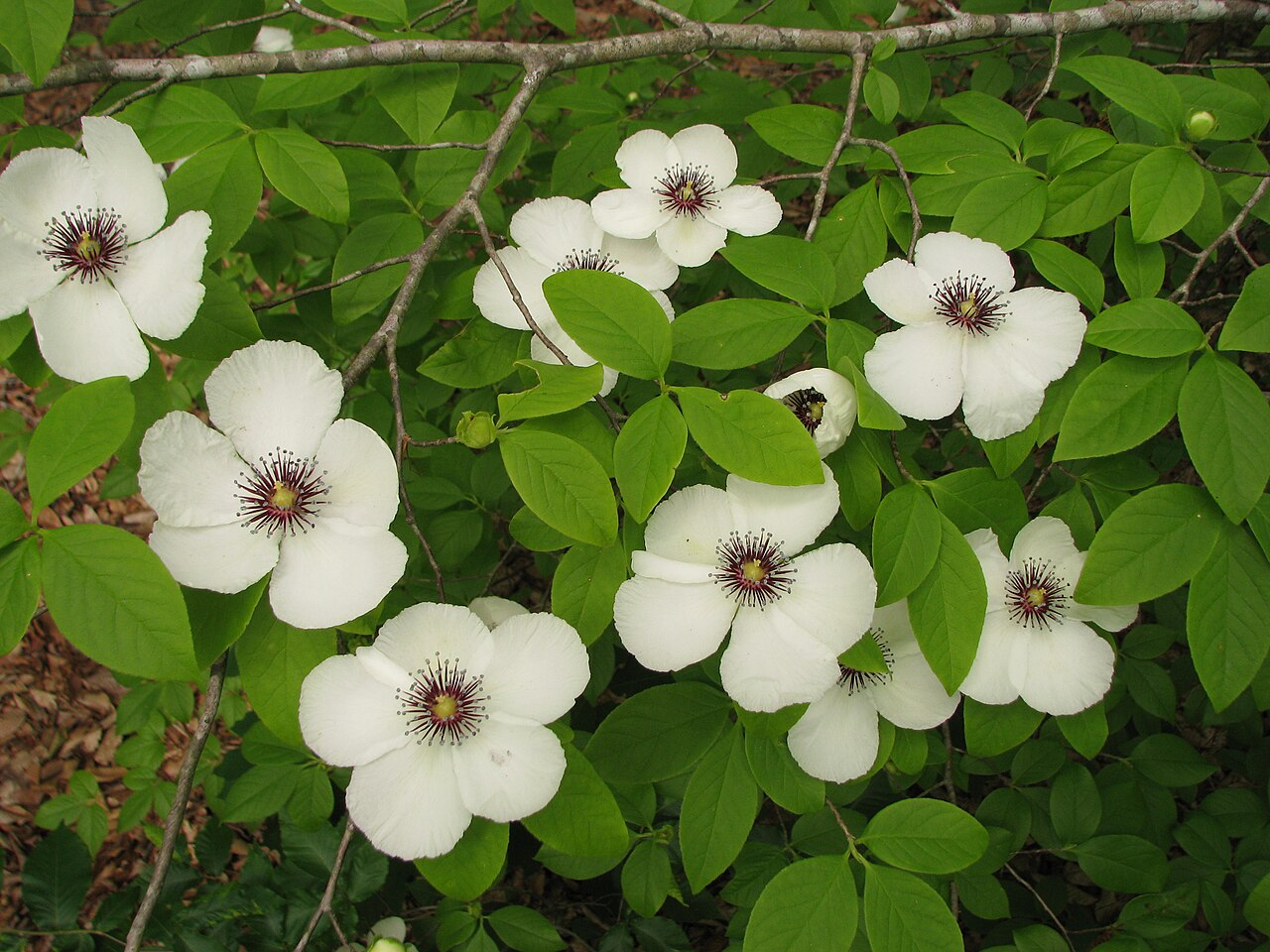
After flowering, the plant can develop a small, dry, woody capsule rather than a fleshy berry. Compare it with mountain stewartia, Stewartia ovata, and with Asian stewartias offered in horticulture. Native range, flower structure, leaves, and fruit together provide a much better identification than a nursery common name. The Australian garden photograph on this page documents the species in cultivation; it does not imply that the species is native to Australia.
Quick Facts
| Scientific Name | Stewartia malacodendron |
| Family | Theaceae — Tea family |
| Plant Type | Deciduous shrub or small tree |
| Mature Height | 10–15 feet in the regional table; extension references commonly allow 10–18 feet |
| Mature Spread | Broad-spreading; potentially 15–25 feet under favorable conditions |
| Growth Rate | Slow |
| Sun Exposure | Partial to deep shade; protect from harsh afternoon sun |
| Water Needs | Average to consistently moist, with good drainage |
| Soil Type | Humus-rich, generally acidic woodland soil |
| Flowers | White petals with purple stamens and blue anthers; spring to early summer |
| Fruit | Small dry woody capsules |
| USDA Hardiness Zones | Commonly described for USDA zones 7b–9a; use locally adapted stock |
| Flower Color | White petals, purple stamens, blue anthers |
| Bloom Time | Spring to early summer |
| Foliage | Deciduous; silky hairs especially beneath leaves |
Native Range
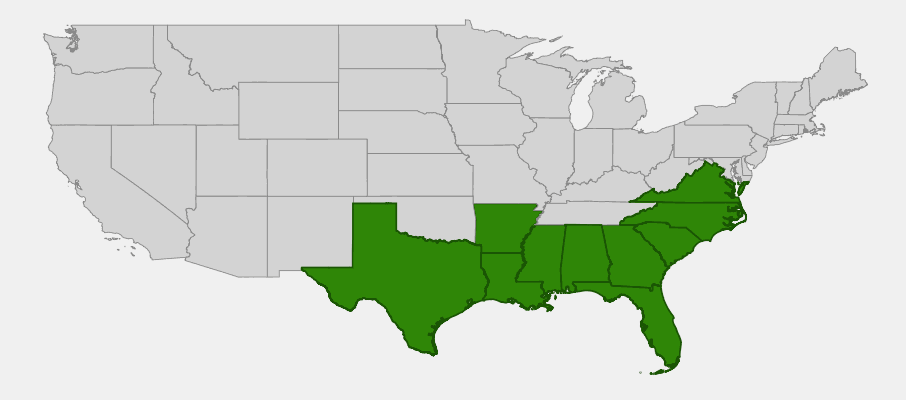
Kew lists native occurrences in Alabama, Arkansas, Florida, Georgia, Louisiana, Mississippi, North Carolina, South Carolina, Texas, and Virginia. This southeastern distribution is not a continuous carpet of plants. Silky camellia is often local, associated with suitable wooded sites, and absent from extensive areas inside the same highlighted states.
Moist, sheltered woodland environments with adequate drainage provide a better guide to garden placement than the state map alone. Slope position, soil chemistry, canopy cover, and protection from drying winds all matter. In Florida, University of Florida guidance describes a limited panhandle distribution rather than a species for every part of the peninsula. The plant's presence in a state does not guarantee adaptation to an exposed urban lot in that state.
Our Arkansas–Louisiana–eastern Oklahoma–eastern Texas table combines several geographic areas. Oklahoma is not part of the native state set documented here. Use the table as a regional starting point, then check county-level records and local ecological context. Conservation status also varies by jurisdiction; obtain propagated plants from responsible nurseries rather than relocating wild specimens.
📋 Regional plant list: Arkansas, Louisiana, Eastern Oklahoma and Eastern Texas
Growing & Care Guide
A sheltered woodland position
Choose filtered light or partial shade with protection from intense afternoon heat. The regional table allows P–S, reflecting the woodland character of the species. University of Florida notes that full sun can be tolerated with ample rooting space and suitable moisture, but this does not make an exposed, dry planting pocket the best default. Start with the shaded conditions most likely to keep leaves and roots from unnecessary stress.
Soil and drainage
Aim for a humus-rich soil that holds moisture without remaining stagnant. Acidic conditions are a sound starting point; University of Florida lists an acidic pH range for cultivation. If the site is strongly alkaline, compacted, or chronically waterlogged, consider a more appropriate species rather than relying on repeated corrective products. Surface organic matter and an undisturbed root environment support the woodland conditions this plant favors.
Plant once, carefully
Because established plants can be difficult to move, select the permanent location before purchasing. Prefer well-grown nursery stock with a healthy root system over a large, freshly dug specimen of uncertain origin. Keep the root flare at the appropriate finished grade, handle the root ball gently, and water thoroughly to settle soil without compressing it into a hard basin. Allow enough eventual width so the plant will not need relocation when it matures.
Moisture through establishment
Check the actual root-ball moisture during the first growing seasons. A shaded site can still become dry beneath established tree roots, while a poorly drained hole can stay wet even when the surface looks dry. Water as needed to maintain an evenly moist root environment, reducing frequency when rainfall supplies enough. A broad organic mulch layer can moderate soil temperature and evaporation; keep it off the stems and do not bury the crown.
Pruning without losing the form
Remove dead or damaged growth and correct rubbing or poorly attached branches while cuts are small. Avoid shearing the plant into a dense geometric hedge or repeatedly shortening every shoot. The natural branching and individual flowers are part of its character. If a path or building will require continual size reduction, the original placement is too cramped. A trained arborist or experienced woody-plant gardener can help establish a small-tree form where appropriate.
Propagation and provenance
Seed and vegetative propagation are both reported, but success can require more skill and patience than a beginner expects. Seed dormancy and variable germination mean that a generic instruction to sow and expect flowers next year would be misleading. For most home gardeners, a nursery-propagated plant is the practical choice. Ask about propagation method and geographic origin, and avoid assuming a garden plant grown far from the native range is the best source for a restoration project.
Monitoring stress
Extension sources do not characterize silky camellia as a plant beset by a routine severe pest complex. Nevertheless, leaf scorch, sparse growth, or decline deserves a site review before a pesticide application. Check root depth, moisture, drainage, wind exposure, and recent disturbance. Slow growth is normal for this species and is not automatically a fertilizer deficiency. Use soil testing and a specific diagnosis rather than repeatedly feeding a plant whose roots are under stress.
Landscape Uses
- A specimen flowering shrub along a shaded woodland path where the flower centers can be appreciated closely.
- A slow-growing small tree in a sheltered native garden with room for its natural spread.
- A component of a carefully planned southeastern woodland planting using responsibly propagated stock.
- A companion to regionally appropriate shade-tolerant plants that need similar moisture and acidic soil.
- Not an exposed drought-garden shrub, clipped hedge, or plant to dig from a wild population.
Wildlife & Ecological Value
Flowers in a woodland setting
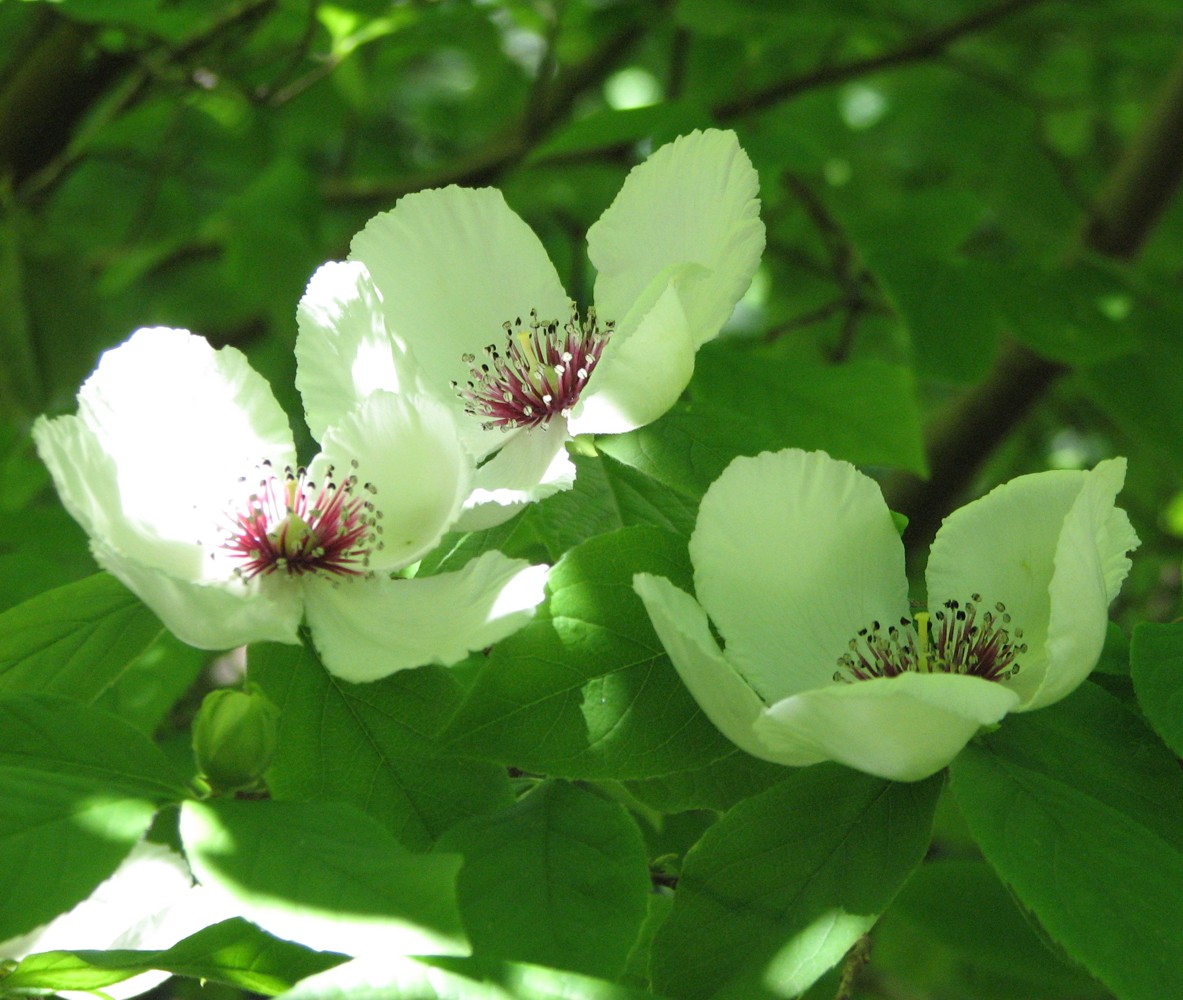
The conspicuous flowers offer an opportunity to observe visiting insects at close range. Their ecological value should be described without inventing a specialist pollinator relationship unsupported by a source. Watch which insects actually visit in your garden and retain a variety of other locally native flowering plants so one brief flowering period is part of a longer season of resources.
Shelter and layered habitat
The branching structure and foliage add a woody layer beneath or beside larger trees. This can contribute cover and small-scale habitat in a garden otherwise dominated by lawn. The benefit is strongest when the shrub connects to a broader planting with leaf litter and other native vegetation, rather than standing alone in a heavily maintained patch of bare mulch.
Fruit is not a berry crop
The capsules are dry fruits, not the abundant fleshy berries produced by many wildlife shrubs. Do not choose silky camellia on the promise of a heavy berry harvest for birds. Its contribution lies in woodland structure, flowering, and native plant diversity. Include other appropriate shrubs if reliable seasonal fleshy fruit is a separate design goal.
Conservation begins with the source
A locally uncommon plant can be harmed by enthusiastic collection even when the collector intends to garden with natives. Buy propagated material, preserve wild populations and their habitat, and respect protected land rules. A nursery receipt and a clear propagation history are more useful conservation tools than an undocumented claim that a plant was rescued.
Cultural & Historical Uses
Silky camellia belongs to a genus long valued by collectors of ornamental woody plants. Its flower structure links it to the tea family, while the genus name distinguishes it from the evergreen Camellia shrubs familiar in many southern gardens. Scientific names are therefore especially helpful when ordering this deciduous native.
Botanical nomenclature has included historical names such as Stewartia virginica and Stewartia nobilis. Modern identification should follow an accepted treatment and preserve older names only where they help interpret records. The use of a white-flowered Stewartia in a distant garden does not establish native occurrence in that country or region.
This plant is best presented as a woodland ornamental and a conservation-conscious native planting choice. This guide does not recommend medicinal use, harvesting wild plants, or treating the species as a substitute for tea. Enjoying its flowers and supporting legitimate propagation are sufficient reasons to grow it.
Frequently Asked Questions
Is silky camellia a true Camellia?
It belongs to the same family but to the genus Stewartia. Unlike many familiar garden camellias, it is deciduous.
Can it grow in full sun?
Some suitable sites can support it, but partial shade and protection from harsh afternoon sun are safer general choices, especially in warm or drying conditions.
Why is my plant growing slowly?
Slow growth is characteristic. First check moisture, root depth, drainage, and exposure; do not assume the plant needs more fertilizer.
Can I move an established plant?
It can be difficult to transplant successfully. Plan a permanent site and seek experienced help if moving an established specimen is unavoidable.
Does the flower color identify it?
White petals alone do not. The purple stamens and blue anthers, along with leaves, fruit, and botanical context, are much more useful.
Where should I buy it?
Seek a nursery that offers propagated native woody plants and can explain the source. Do not dig it from a wild population.
Sources & Further Reading
- NC State Extension — Stewartia malacodendron
- Kew Plants of the World Online — accepted name and distribution
- University of Florida — Silky Camellia cultivation
- Florida Native Plant Society — Stewartia malacodendron
- Georgia Biodiversity — species account
Find Native Plants
Ask growers about nursery propagation and regional provenance. Browse our Arkansas native plant nurseries, Louisiana native plant nurseries, Oklahoma native plant nurseries, Texas native plant nurseries directory for suppliers.