
Hoary Vervain (Verbena stricta)
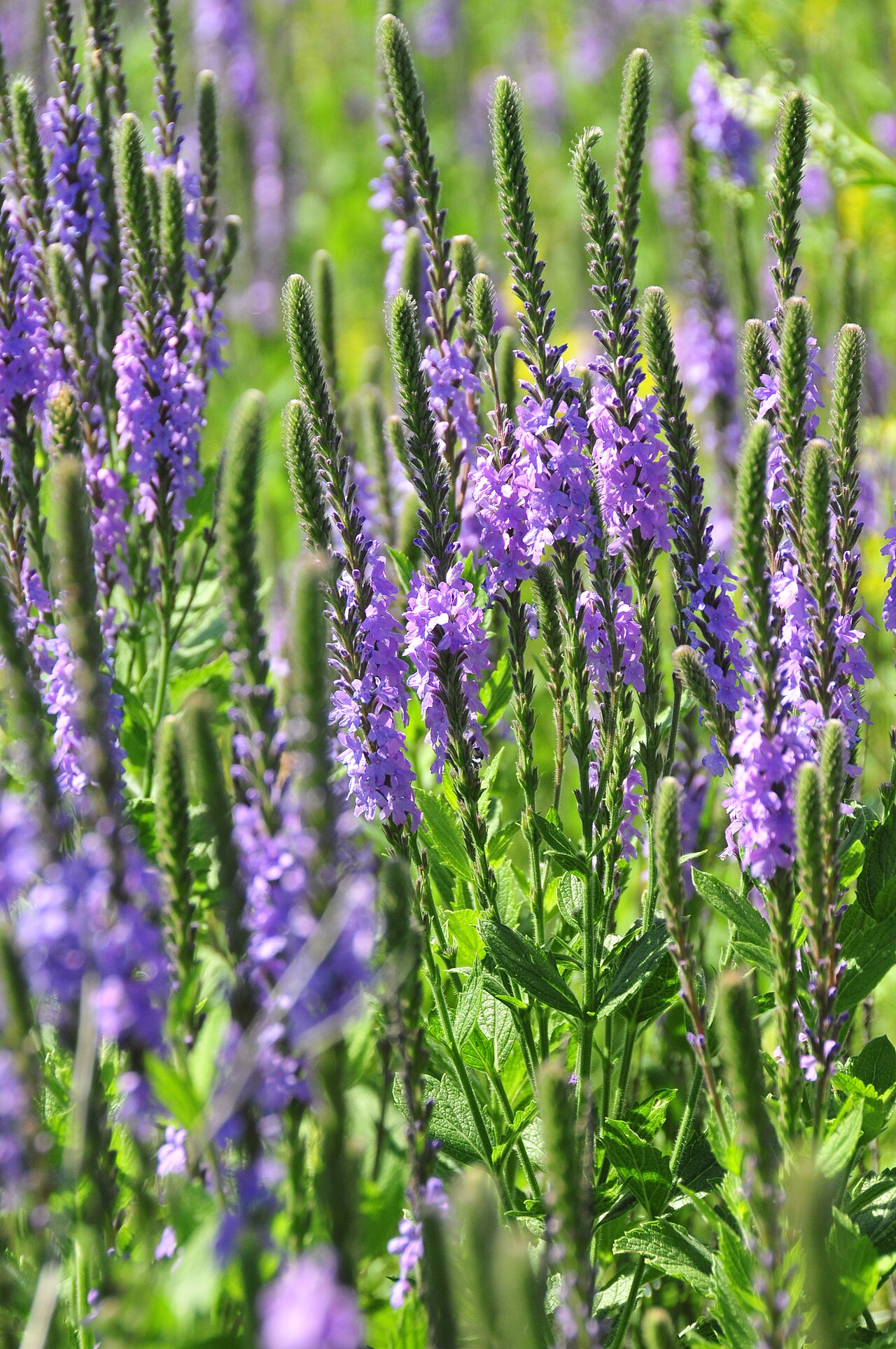
Hoary vervain (Verbena stricta) brings a different kind of summer color to a prairie garden: upright, gray-green stems topped by narrow purple flower spikes, with fresh blossoms opening progressively rather than all at once. Its broad, softly hairy leaves give the plant substance even before flowering. A plant around three feet tall fits naturally among shorter prairie grasses, where the flower stalks can rise above the surrounding foliage without demanding a rich, irrigated border.
This is a dry-site vervain, not a substitute for a wetland species simply because their common names sound alike. It belongs on sunny ground that drains after rain. In the Michigan, Wisconsin and Minnesota regional list, F means full sun and D describes dry soil moisture; neither code means a newly planted plug can be left without establishment water. The species is native in these states, but gardeners should still choose seed appropriate to the local prairie or open-land habitat.
Hoary vervain can be an excellent pollinator plant and a willing self-sower at the same time. That combination is useful in a naturalized meadow but deserves forethought beside a formal path. Give it room to seed where renewal is welcome, or remove some spent spikes where a fixed planting pattern matters. The aim is a lasting population in suitable habitat, not necessarily the same individual plant occupying the same spot indefinitely.
Identification
Stems and overall habit
The stems are upright and conspicuously hairy, often green with a reddish cast. Plants branch toward the upper portion and can form several flowering stems from one base. Expect an herbaceous perennial rather than a woody shrub: the old stems dry after the growing season and fresh growth develops from below. A typical garden height is roughly two to four feet, while drought, grazing and competition can keep individual plants shorter. Inspect the hairs and leaf arrangement before identifying a volunteer solely from its purple flowers.
Leaves
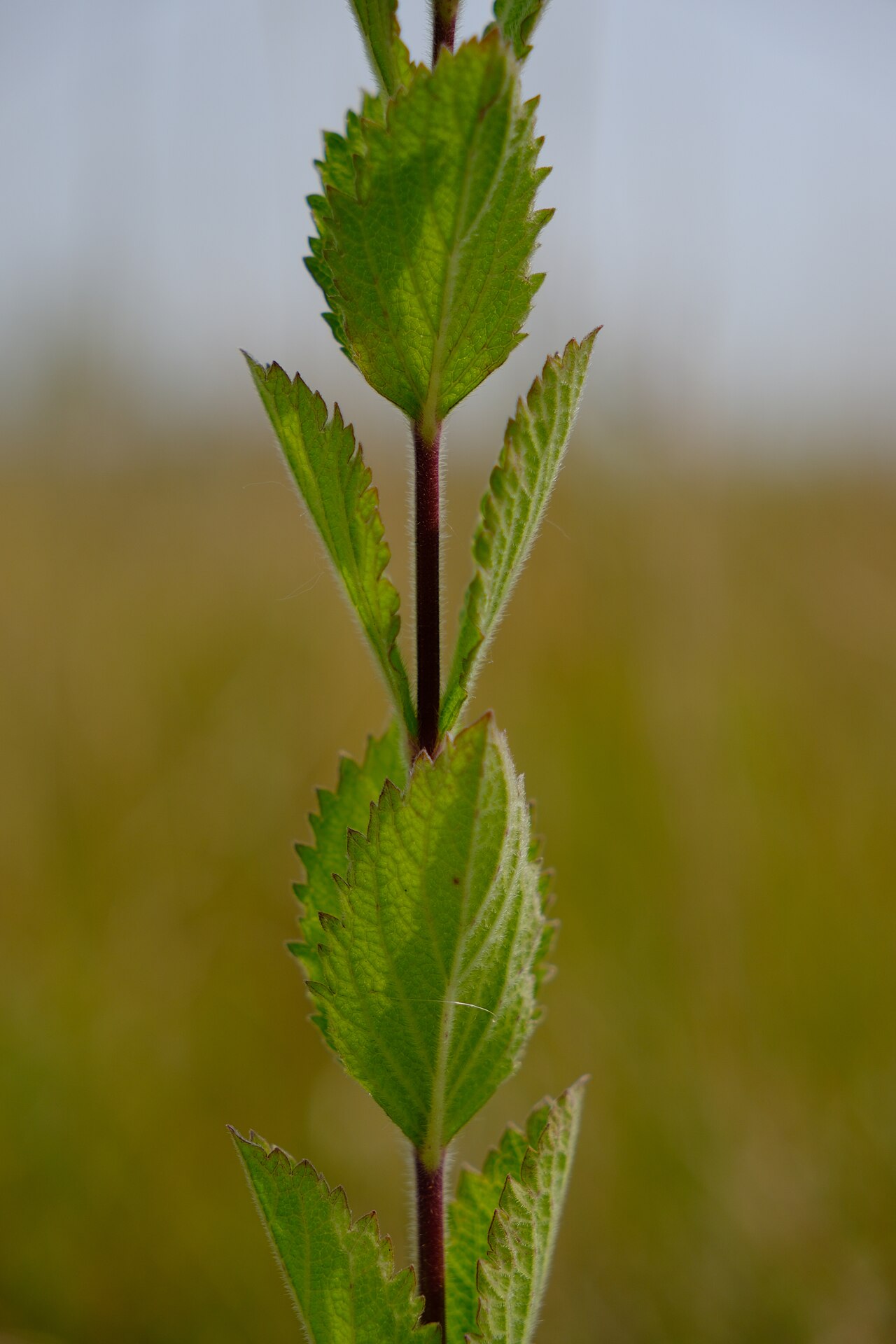
Pairs of broad leaves sit opposite one another along the stems. Their edges are coarsely toothed and the surface has a noticeable network of veins. Fine pale hairs, particularly beneath the leaves and along stems, create the hoary appearance responsible for the common name. Compared with many other vervains, the leaves look relatively wide rather than long and narrow. Do not confuse a gray-green appearance caused by mildew with normal pubescence: normal hairs are attached individually and occur consistently on healthy new growth.
Flowers
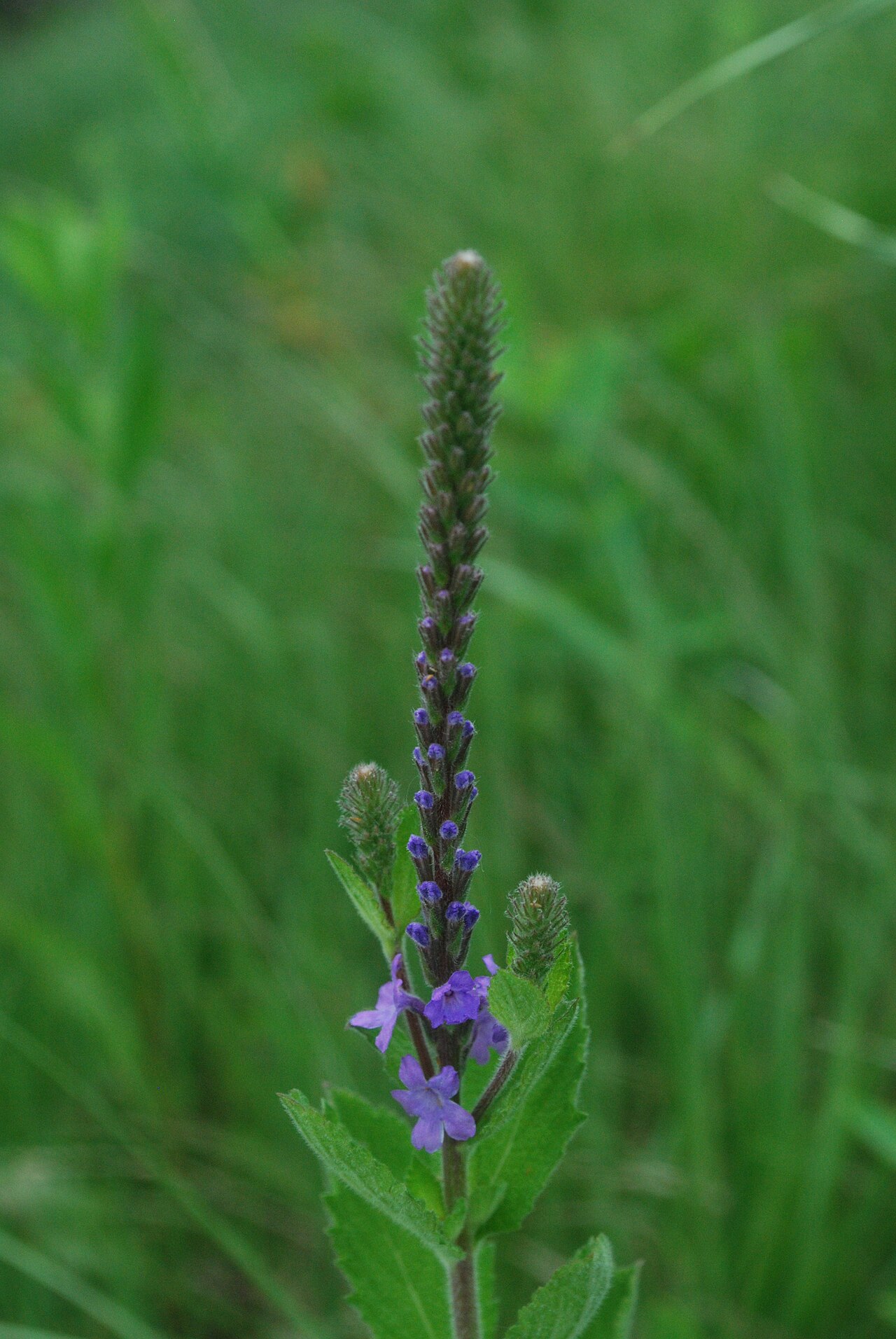
The flowering spikes are slender and elongated, carrying many tightly packed buds and old calyces. Small lavender to blue-purple flowers open in a moving band, so part of a spike may be flowering while another part remains in bud or has already set fruit. Looking closely reveals a short tube ending in spreading lobes. A summer visit made on one day captures only a fraction of the display. Photographs in this guide show both dense stands and a single spike, helping connect garden-scale appearance with the details used in identification.
Fruit and comparison with other vervains
After flowering, tiny dry nutlets develop within the persistent flower structures. The drying spikes therefore provide a useful seed source and a recognizable winter outline rather than fleshy berries. Blue vervain, Verbena hastata, generally has a more branched candelabra-like flowering display and is associated with wetter ground. Narrow-leaved vervains require a closer look at leaves and hairs. Hybrids can occur, so a plant with intermediate features is not a good choice for collecting species-labelled seed without further identification.
Quick Facts
| Scientific Name | Verbena stricta |
| Family | Verbenaceae |
| Plant Type | Herbaceous perennial; often relatively short-lived |
| Mature Height | 2–4 feet; regional list example 36 inches |
| Mature Spread | About 18–24 inches per plant; seedlings may occur beyond the clump |
| Growth Rate | Moderate |
| Sun Exposure | Full sun |
| Water Needs | Dry to average moisture with good drainage; drought tolerant after establishment |
| Soil Type | Well-drained sandy, gravelly or clay-containing soil |
| Soil pH | No narrow pH target required; prioritize drainage |
| Bloom Time | Mid to late summer; timing varies with latitude and season |
| Flower Color | Lavender to blue-purple, occasionally paler |
| Fall Color | Foliage dries to brown; not grown for fall color |
| Fruit | Small dry nutlets retained among spent flower structures |
| Deer Resistant | Often little browsed; not deer-proof |
| USDA Hardiness Zones | Typically 4–8 in cultivation |
Native Range
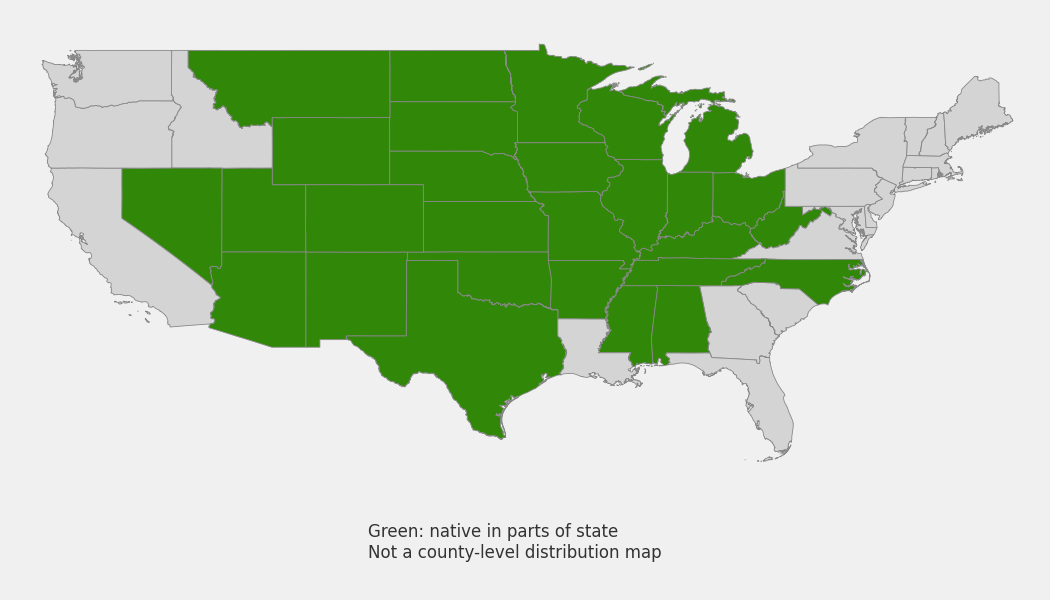
Hoary vervain has a strong center of distribution in the central United States, including prairie country of the Great Plains and Midwest. It also occurs beyond that center. A broad national occurrence list must not automatically be interpreted as a native-range map: botanical treatments disagree about peripheral records, and the Native Plant Trust explicitly treats New England occurrences as introduced. This guide does not shade New England as native.
The map is a conservative state-level overview of the central and interior range, assembled from the sources below. It highlights states containing native populations, not every county or every square mile. Michigan, Wisconsin and Minnesota belong to the regional context of this page, but a sunny dry prairie opening is a much better ecological match than a shaded bog in the same state. Where a local flora differs from a national checklist, use that finer-scale flora and locally sourced planting material.
Typical settings include open prairie, dry grassland, rocky openings and disturbed open ground. Disturbance can create the light and exposed soil needed for seedling establishment, which explains why the plant may prosper along a track or pasture margin. This should not be taken as a reason to disturb an intact remnant prairie. In gardens, a small amount of open mineral soil can supply recruitment space without broad soil cultivation.
📋 Regional plant list: Michigan, Wisconsin and Eastern Minnesota
Growing & Care Guide
Light
Choose a position with at least six hours of direct sunlight through the growing season. Watch the future shade cast by nearby shrubs, not only the conditions when planting. A site that seems sunny in April may be much darker after trees leaf out. If mature stems repeatedly lean into an opening, reassess light and crowding before adding fertilizer or stakes. In a small planting, put the vervain where its spikes can be viewed against lower foliage rather than hidden behind taller, denser perennials.
Soil and water
Drainage matters more than luxurious soil. Work with an existing dry or average garden soil rather than excavating a rich pocket that traps water in surrounding clay. Give a newly planted root ball a thorough watering, then check moisture before repeating. During establishment the root ball can dry differently from the soil around it; both need attention. Once roots extend beyond the original pot, allow the surface to dry between waterings. Persistent wetness, especially around the crown, is a reason to improve the location rather than keep treating symptoms.
Planting and spacing
Plant nursery-grown plugs or seedlings in spring or early autumn when possible, giving them a period of moderate weather before severe heat or winter. Position the crown at its original soil level and firm the surrounding soil gently. Space plants with their eventual eighteen- to twenty-four-inch spread in mind. If establishing a mixed prairie bed, leave a visible marker for each small plant so it is not mistaken for a weed during its first season. Avoid piling mulch against the basal shoots; an open collar also makes emerging volunteers easier to recognize.
Pruning and maintenance
No woody pruning is needed. Remove damaged stems if necessary and decide how much seed production to allow. Deadheading some spikes can reduce volunteers in a formal bed, while leaving others supports renewal and a winter seed resource. Cut old stems when the new season's maintenance schedule permits, taking care not to scalp fresh basal growth. In rich or heavily watered ground the plant can become less tidy; changing that growing environment is more sustainable than repeated cosmetic trimming. Keep a few seedlings of known identity where older plants are fading.
Propagation
Seed is usually the most practical route to a new population. Buy species-labelled seed from a supplier that records its origin, or collect a modest quantity from cultivated plants you can identify confidently. Sow into a weed-free, well-drained seedbed and follow the supplier's pretreatment guidance for the seed lot. Small seeds should not be buried deeply. Keep the germination surface from drying abruptly, then gradually expose seedlings to the conditions of their final site. A first-year plant may concentrate on roots and foliage rather than flowers, so lack of immediate bloom is not automatically a failure.
Solving common garden problems
If stems are weak, check shade, excessive nitrogen and crowding. If lower leaves dry during a long drought, inspect the whole plant before assuming a disease: some leaf loss can accompany water stress. A crown sitting in saturated soil needs a drier position, while a newly planted plug wilting in dry soil needs careful establishment watering. Seedlings appearing away from the parent are normal recruitment, not an underground invasion. Remove unwanted seedlings while small and before they form a substantial root system.
Landscape Uses
- A sunny pollinator border with lean to ordinary soil.
- Dry prairie or meadow restoration within the verified native range.
- A small group beside lower grasses, where the hairy leaves remain visible.
- A managed self-sowing patch that can renew between longer-lived plants.
Wildlife & Ecological Value
For pollinators
The succession of small flowers makes a useful summer feeding station. Watch a patch at different times rather than judging it from one brief visit: bees, butterflies and other flower-visiting insects use plants according to weather and local availability. Hoary vervain is particularly useful when a dry site cannot support moisture-demanding summer flowers. Keep insecticides away from the open spikes and avoid systemic-treated nursery stock when the purpose of the planting is to support pollinators.
For birds
The small dry seeds can contribute to the food available in a diverse planting. They are not large fruits and should not be advertised as a major food crop on their own. Leaving a portion of the spent spikes gives birds access to seed and also makes a more varied winter garden. Balance that practice with the number of volunteer seedlings you are willing to manage in spring.
For mammals and foliage-feeding insects
Hairiness and unpalatability often limit mammal browsing, but hungry animals do not read plant labels. Protect small transplants if local browsing pressure is intense. Some insects feed on vervain foliage as part of the food web; minor chewing is not necessarily a reason to intervene. A plant kept immaculate with broad-spectrum pesticides offers less ecological value than a vigorous plant allowed to participate in ordinary herbivory.
Role in an open-land planting
Hoary vervain occupies a niche among plants of sunny, relatively open ground. Its capacity to establish where soil is exposed can help a garden recruit a new generation after a gap appears. In a densely shaded, heavily mulched bed that process may be absent. Design the planting for the ecological behavior you want: allow modest gaps in a meadow, or use deadheading and hand removal where a more controlled border is appropriate.
Cultural & Historical Uses
The word hoary refers to the pale hairs rather than the age of the plant. It is a useful descriptive name because this feature can be examined before flowering. Vervain, by contrast, is a common name shared by several species and appears in a wide range of historical writing. A medicinal or folkloric statement about a different Verbena should not be transferred automatically to this species.
For the home gardener, the clearest modern use is as a prairie and pollinator ornamental. The photographs taken in South Dakota, Minnesota and Wisconsin show the species in its North American context rather than relying exclusively on cultivated European examples. A photograph documents the pictured plant; it does not establish that every plant sold under the same common name has the same identity or regional origin.
The most meaningful contribution a planting can make is practical: retain a suitable dry site, use correctly named nursery-propagated material, and allow flowers and some seed to complete their season. This guide does not recommend harvesting hoary vervain for tea or medicine. Its garden value does not depend on an unverified claim about traditional use.
Frequently Asked Questions
Is this the same plant as blue vervain?
No. Hoary vervain is Verbena stricta, with conspicuously hairy broad leaves and a preference for drier ground. Blue vervain is Verbena hastata and generally suits wetter sites. Choose by scientific name and habitat, not flower color alone.
Does it need irrigation?
Young plants need establishment care. Well-rooted plants in suitable soil usually tolerate dry periods, but soil depth and drought severity still matter. Water according to actual moisture around the roots rather than applying an automatic daily schedule.
Will it spread everywhere?
It can self-seed where conditions suit it. That makes renewal easy in a meadow but requires monitoring in a formal bed. Remove some spent spikes before seed matures and pull unwanted seedlings while small.
Why are only a few flowers open on a spike?
The flowers open progressively along the spike. Buds, open flowers and developing fruit can all be present at the same time. This is normal and helps extend the seasonal display.
Is it native wherever it has been recorded?
No. Occurrence and native status are different. Regional floras identify introduced populations in parts of the Northeast, including New England. Check your county or regional flora when planting for restoration, even when a broad national source lists the species in your state.
Sources & Further Reading
- NC State Extension: Verbena stricta
- Illinois Wildflowers: field description and ecology
- Native Plant Trust: northeastern introduced status
- Kew: accepted name and broad distribution
- Illinois DNR: hoary vervain
Find Native Plants
Ask growers about nursery propagation and regional provenance. Browse our MI native plant nurseries, WI native plant nurseries, MN native plant nurseries directory for suppliers. Explore the native nursery finder.