
Pink Turtlehead (Chelone lyonii)
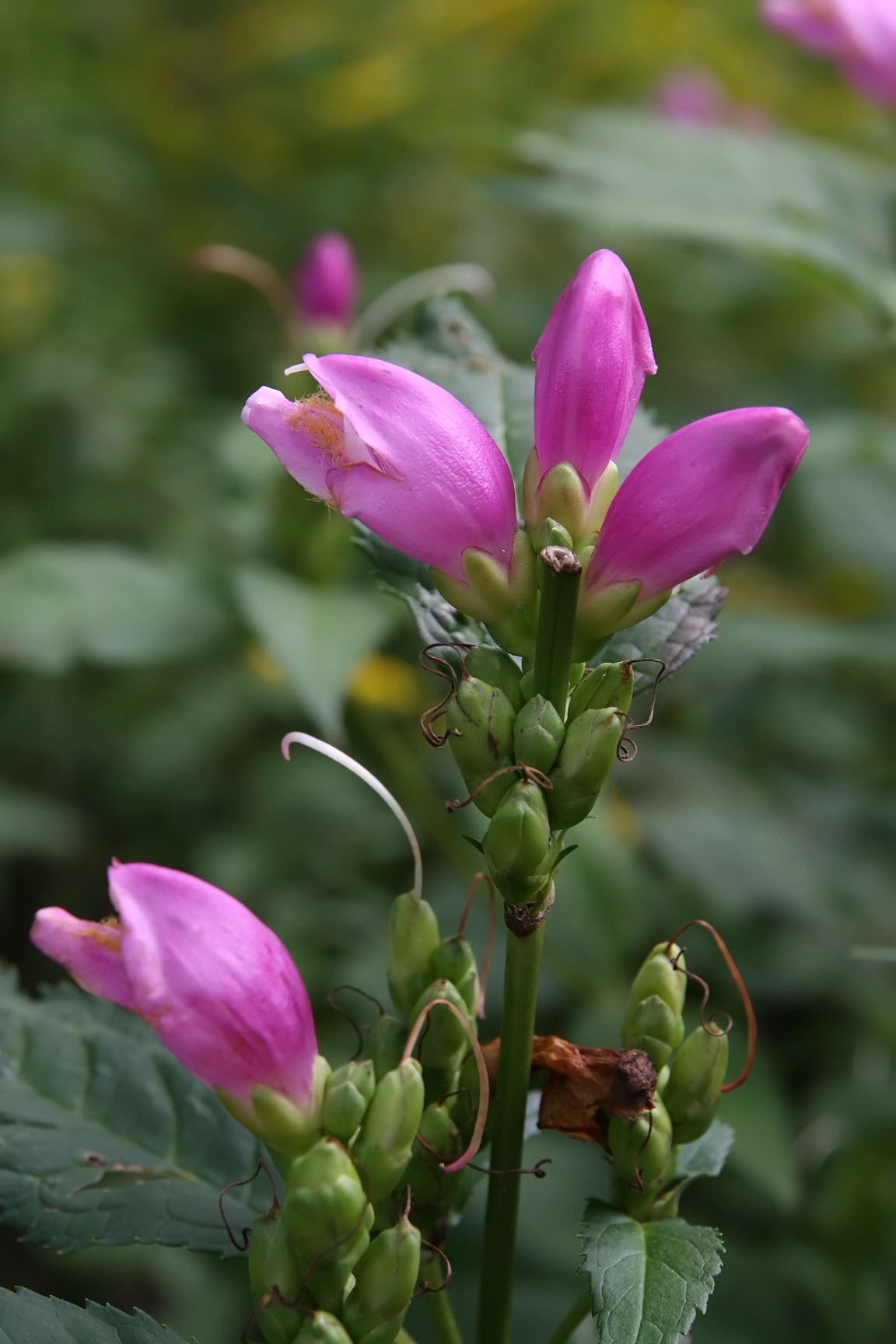
Pink turtlehead (Chelone lyonii) is a moisture-loving perennial with glossy-looking opposite leaves and plump pink flowers that seem almost closed. The terminal clusters arrive late in the growing season, when a moist woodland edge or rain-garden margin can benefit from fresh color. Unlike a sprawling ground cover, it makes a recognizable clump of upright stems, usually about two to four feet high in gardens.
Its native identity is important: this species belongs to the Southern Appalachian region, not the whole eastern United States. The fact that it grows successfully in a New York or Pennsylvania garden does not make it native there. PlantNative retains the older regional-table listing with an explicit caveat, while the map and native-range discussion on this page show its southern mountain origins. Within the Carolinas, native occurrence is also concentrated geographically rather than statewide.
Choose pink turtlehead for a site where soil stays moist through summer, not merely one that receives occasional heavy rain. A sunny bed can work with dependable moisture; partial shade often makes that balance easier in hot weather. For a native-habitat planting beyond its range, investigate a locally native turtlehead instead of assuming that all Chelone species are interchangeable.
Identification
Stems and seasonal habit
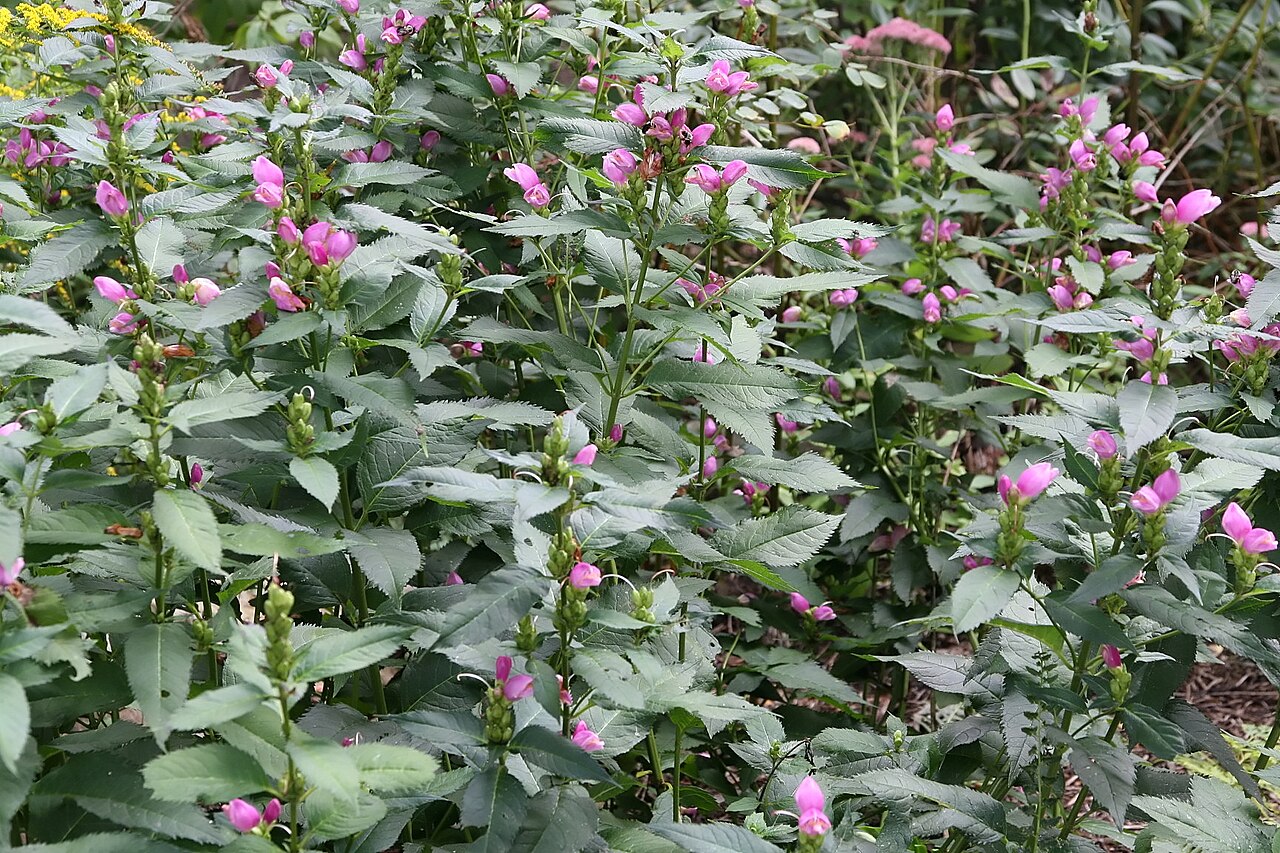
The plant grows as a perennial clump with upright herbaceous stems. New shoots replace the old, dry stems each year rather than developing into permanent woody branches. Flower clusters gather at the stem tips, making a flowering plant look orderly even in a fairly loose planting. A young or compact garden plant may remain near the lower end of the height range; older plants in favorable moisture can be taller than the twenty-four- to thirty-inch shorthand used in some nursery lists.
Leaves
Leaves occur in opposite pairs, with conspicuous teeth along their edges. The blades are broad near the base and taper to a point, and the leaf stalks are visible. The lower surface is paler than the upper surface. In an identification check, examine a complete leaf and its attachment rather than relying on a photograph of a pink flower. Closely related turtleheads can have similar flower colors but differ in leaf bases, stalk length and details inside the corolla.
Flowers
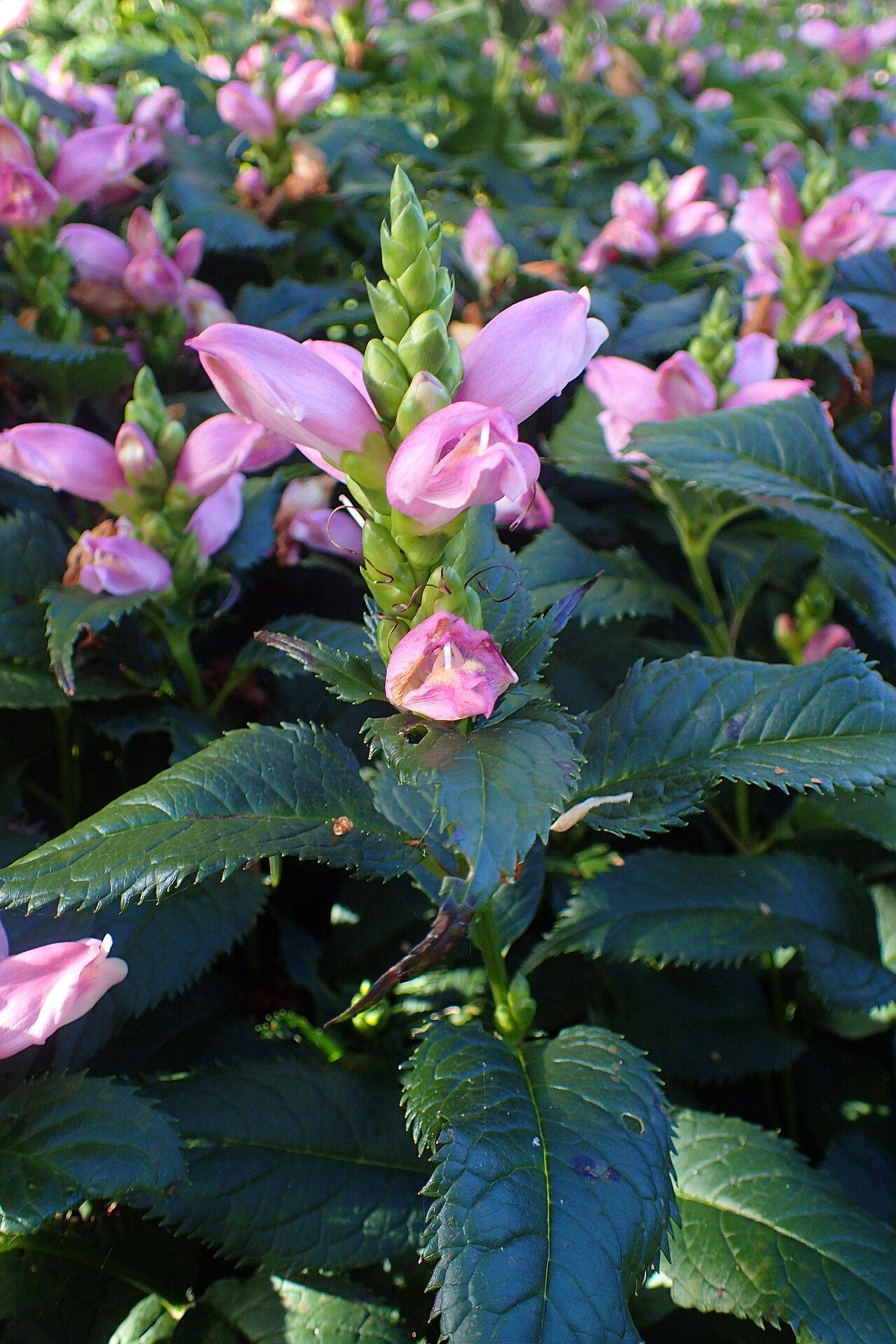
The inflated pink to rose-purple flowers sit in compact clusters. Seen from the side, the upper part curves over a narrower opening like a turtle's head. The lower lip has lobes and yellowish hairs within the throat. The nearly closed opening is normal, not a sign that the flower has failed to open. Buds and flowers at different stages share the same cluster, so color and apparent shape can change over several weeks. The photographs here include cultivated plants clearly labelled as such; their garden locations are not used as range evidence.
Fruit and similar species
Flowers that set fruit produce dry capsules containing small seeds. These are not fleshy berries. White turtlehead, Chelone glabra, normally has white flowers and a much wider eastern distribution; purple turtlehead, Chelone obliqua, can have similarly pink flowers but differs in leaf shape and other details. A plant sold only as pink turtlehead may be a cultivar or another Chelone. Ask for the botanical name, and obtain a specialist identification when collecting conservation seed.
Quick Facts
| Scientific Name | Chelone lyonii |
| Family | Plantaginaceae |
| Plant Type | Winter-dormant herbaceous perennial |
| Mature Height | Usually 2–4 feet; compact plants may be 24–30 inches |
| Mature Spread | About 18–30 inches, with clump expansion over time |
| Growth Rate | Moderate |
| Sun Exposure | Full sun with reliable moisture to partial shade |
| Water Needs | Consistently moist soil; tolerates occasional wetness, not drought |
| Soil Type | Moist, humus-rich loam or clay-containing soil |
| Soil pH | Approximately neutral is suitable; assess site soil rather than forcing a narrow target |
| Bloom Time | Late summer into early autumn; often July–September depending on locality |
| Flower Color | Pink to rose-purple |
| Fall Color | Foliage fades and dies back; not primarily a fall-color plant |
| Fruit | Dry capsules with small seeds |
| Deer Resistant | Usually resistant, but not guaranteed |
| USDA Hardiness Zones | Commonly grown in zones 3–8; hardiness does not establish nativity |
Native Range
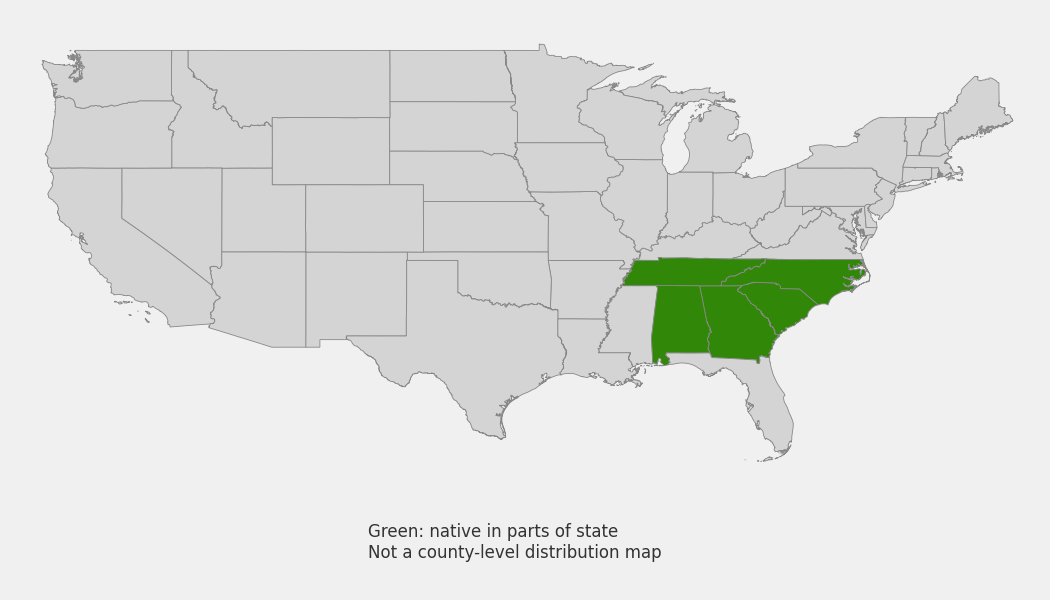
Regional botanical sources describe pink turtlehead as a Southern Appalachian endemic. The Georgia Department of Natural Resources account places its native range in portions of Alabama, Georgia, North Carolina, South Carolina and Tennessee. The state-level map follows that regional treatment. It is deliberately not a map of all garden escapes, cultivated collections or herbarium records lacking an origin determination.
This distinction affects the two regional lists that link here. North Carolina and South Carolina contain native mountain habitat for the species, although much of each state lies outside that habitat. New York, Pennsylvania and northern New Jersey do not form part of the Southern Appalachian native range described here. Their historical table row is retained as an explicitly nonnative horticultural listing, not as a restoration recommendation.
In natural settings the species is associated with moist mountain woods, stream corridors and other cool, wet microsites. A damp pocket next to moving water is not the same environment as a permanently submerged pond bottom. In gardens, observe summer soil moisture and drainage together. Native populations can be uncommon locally, so nursery propagation is preferable to digging wild plants even where a population appears abundant.
📋 Regional plant list: North Carolina and South Carolina
Growing & Care Guide
Light
Partial shade is a useful starting point, especially where summers are hot. Morning sunlight with protection later in the day can give good flowering without excessive moisture stress. Full sun is possible if soil stays moist, but it should not be chosen on the assumption that a drought rescue watering once a week will always suffice. Deep shade may produce weaker stems and fewer flowers. Judge light in midsummer after neighboring trees and shrubs are fully leafed out.
Soil and water
Prepare a moist, reasonably fertile rooting zone with organic matter distributed through the bed rather than confined to a small planting hole. Keep moisture steady during establishment and during hot spells. Mulch can slow evaporation, but leave the crown uncovered. A rain garden is suitable only in the part whose hydrology matches the plant: a dry upper rim or a basin with persistent deep standing water may both be unsuitable. Check beneath the mulch before irrigating, since a damp surface and a dry root ball can coexist.
Planting and spacing
Use nursery-propagated plants of known identity. Plant at the depth at which the crown grew in the pot, spread circling roots gently where needed, and water the surrounding soil thoroughly. An eighteen- to thirty-inch spacing is a reasonable planning range for individual clumps, adjusted for cultivar and site. Leave access for inspection rather than packing every gap immediately. The plant may not show its mature clumping habit in the first season; temporary mulch and careful weeding are preferable to crowding it with vigorous neighbors.
Pruning and maintenance
Remove old stems when preparing the bed for new growth. An early-season pinch can encourage branching, but repeated or late cutting can sacrifice the terminal flowers you are growing it to enjoy. If plants lean, consider whether shade or crowding is the cause before installing permanent supports. Divide a crowded garden clump when needed, keeping healthy roots with each division and watering them promptly. Do not dig or divide wild populations for the garden.
Propagation
Division of a cultivated, established clump is often the most direct way to retain a selected form. Seed is useful when genetic diversity is important, but plants raised from a named cultivar may not resemble that cultivar consistently. Purchase seed with a clear species identity and follow the supplier's moist chilling and sowing instructions for that lot. Use a clean, moisture-retentive but aerated medium and label the tray immediately. Seedling establishment is a separate phase from the drought and competition experienced by mature plants.
Troubleshooting
Repeated midday wilting, browned leaf edges and reduced flowering invite a check of soil moisture and heat exposure. A plant that remains wet yet declines needs a drainage and root assessment rather than more water. White powdery growth on leaves is different from normal leaf color; improve spacing and inspect watering practice if mildew appears. Avoid routine preventive spraying. Keep notes on when the problem begins, because a flowering disappointment caused by late pruning needs a different correction from one caused by deep shade.
Landscape Uses
- A moist partial-shade border within its native Southern Appalachian region.
- A rain-garden zone that remains moist but is not permanently submerged.
- Late-season flower clusters near a path where their structure is easy to see.
- A clearly labelled ornamental planting outside the native range, where appropriate and permitted.
Wildlife & Ecological Value
For pollinators
The enclosed flower shape makes visits interesting to observe. Bees able to work the opening can reach the reward within, and a patch supplies late-season floral resources. Avoid claiming that every visiting insect pollinates it equally. Much detailed turtlehead pollination research concerns white turtlehead rather than this species, so those findings should not be transferred as an exact species-specific visitor list. A varied planting that flowers before and after turtlehead supports a longer season of insect activity.
For birds
Pink turtlehead is not a berry-producing shrub. Its contribution to bird habitat is better understood as one component of a moist planting containing insects, cover and other plant structures. Keep some stems through the dormant season if the garden layout allows, but do not describe its seed as a principal winter bird food without evidence. Combine it with locally appropriate plants serving other seasonal functions rather than expecting one perennial to provide every resource.
For mammals and foliage-feeding insects
Deer resistance is a useful practical quality but does not mean invulnerability. Young transplants can still be damaged by browsing or trampling, and local pressure varies. Some insects feed on turtleheads; tolerating modest chewing is compatible with a healthy garden. Species-specific host relationships need careful sourcing. In particular, a relationship documented for Chelone glabra is not by itself proof of the same relationship for every pink-flowered garden Chelone.
Habitat and conservation
Conserving a wild plant includes protecting the water regime around it. A surviving patch below a newly drained slope may be in trouble even when nobody has picked its flowers. In the garden, manage runoff gently and control invasive neighbors rather than treating the turtlehead as an isolated decorative object. Where the species is locally rare, buying nursery-propagated stock helps separate horticultural interest from pressure on natural populations.
Cultural & Historical Uses
The generic name Chelone refers to a turtle, a comparison that remains useful when explaining the flower to a new gardener. The species epithet commemorates botanist John Lyon. Neither the appealing name nor a long garden history changes the plant's geographically limited native distribution.
Pink turtlehead has become familiar in gardens far beyond its Appalachian home. Cultivars such as 'Hot Lips' illustrate that horticultural popularity, but this page describes the species rather than promising the exact size, foliage color or growth habit of every named selection. Ask the nursery whether a plant is seed-grown species material or a clonally propagated cultivar when that distinction matters to the project.
This guide makes no medicinal or edible-use recommendation. Historical claims made for turtleheads as a group require a separate examination of species, preparation and source; they are not necessary to appreciate the plant as a moist-site ornamental. The sound garden choice is to match moisture, light and regional purpose before buying it.
Frequently Asked Questions
Is pink turtlehead native to New York or Pennsylvania?
Not under the Southern Appalachian native-range treatment followed here. It can be cultivated and may escape in northern states, but those records do not establish local nativity. The older northern regional-table entry is now explicitly labelled accordingly.
Can it grow in full sun?
Yes, where moisture remains dependable. Partial shade often makes management easier in hot summers. If full sun repeatedly dries the root zone, change the location or choose a better-adapted plant rather than allowing repeated severe wilting.
Does pink flower color identify Chelone lyonii?
No. Other turtleheads and horticultural selections can have pink flowers. Leaf shape, leaf stalks and floral details matter. Buy plants with a full botanical name and do not infer species from a common-name label alone.
Why are the flowers nearly closed?
That inflated, narrow-mouthed shape is characteristic of turtleheads. A bee may push into the opening. Do not peel flowers apart in an attempt to help them open; the normal structure is part of how the flower functions.
Should I collect plants from a mountain stream?
No. Use nursery-propagated stock. Natural populations may be uncommon and disturbance to their rooting zone or water supply can be damaging. A garden planting should not come at the expense of the habitat it is intended to celebrate.
📋 Also listed: New York, Pennsylvania and Northern New Jersey — horticultural listing, not native range
Sources & Further Reading
- NC State Extension: horticulture and identification
- Georgia DNR: Appalachian turtlehead, range and conservation
- North Carolina vascular flora: pink turtlehead
- USDA PLANTS: Chelone lyonii
Find Native Plants
Ask growers about nursery propagation and regional provenance. Browse our NC native plant nurseries, SC native plant nurseries directory for suppliers. Explore the native nursery finder.