
Tall Larkspur (Delphinium glaucum)
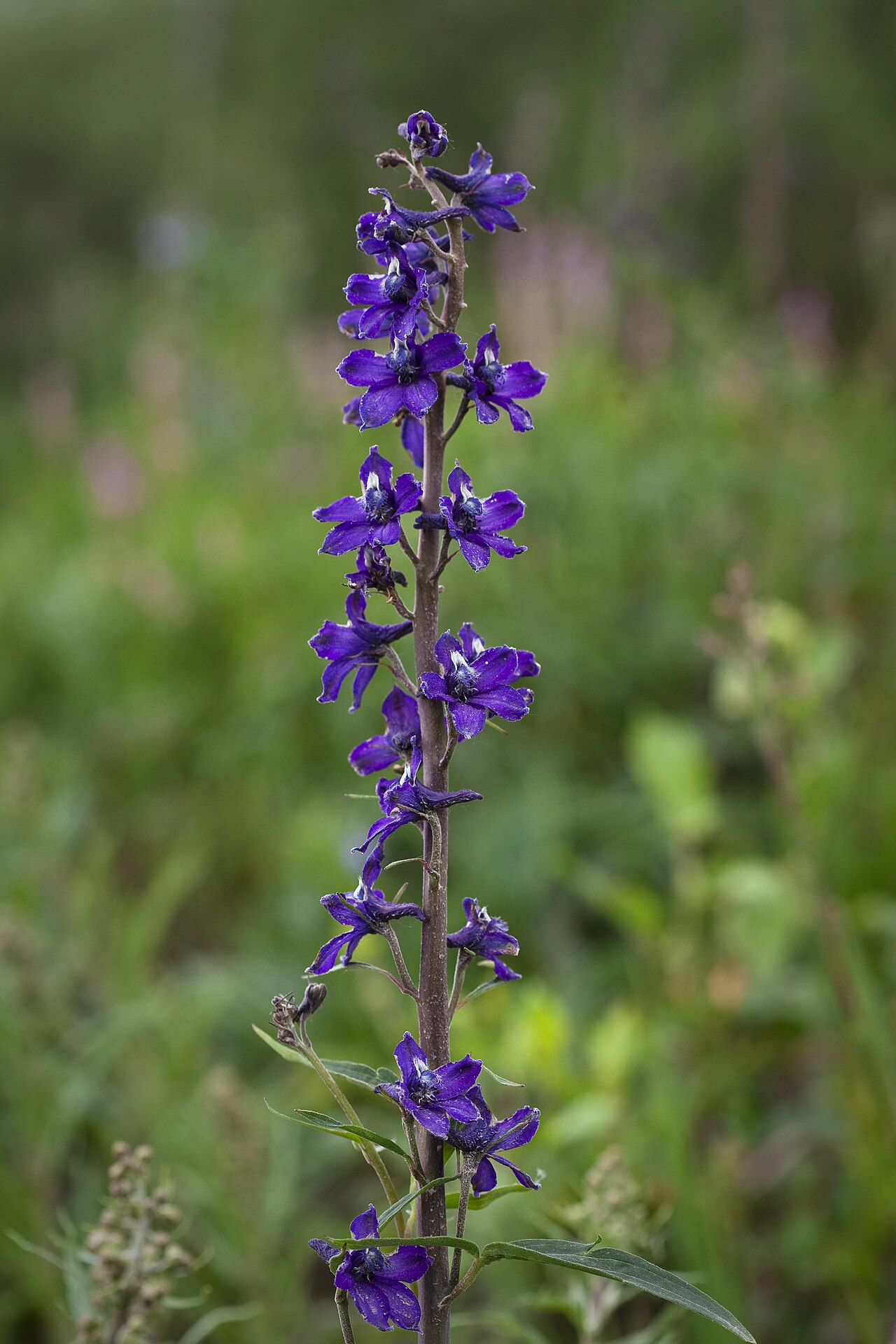
Tall larkspur lifts blue-purple flower spires above the leafy vegetation of moist mountain meadows and northern woodland edges. Its divided leaves and spurred blossoms give it a distinctive outline, but its size is the first practical consideration: this is a substantial wild perennial, not a small rock-garden delphinium.
For an Alaskan garden with cool summers and dependable moisture, a nursery-grown plant can provide a strong vertical accent behind lower native flowers. It should have room to grow without being repeatedly cut back, and it should not be planted where grazing animals can reach it. All planting decisions need to account for the toxicity of larkspurs.
This guide treats Delphinium glaucum in the broad sense accepted by Plants of the World Online. Some northern records have been published as Delphinium brownii. Keeping the scientific name and source locality with a purchased plant is more useful than relying on the common name larkspur, which is applied to numerous species and garden hybrids.
Identification
Stems and leaves
The flowering stems rise well above the surrounding foliage. Look for deeply palmately divided leaves, with the divisions themselves cut or toothed, rather than the narrow undivided leaves of many other blue-flowered meadow plants. Examine the whole stem as well as one leaf; upper leaves become smaller and the lowest leaves may no longer be obvious when flowering is advanced.
Flowers and spur
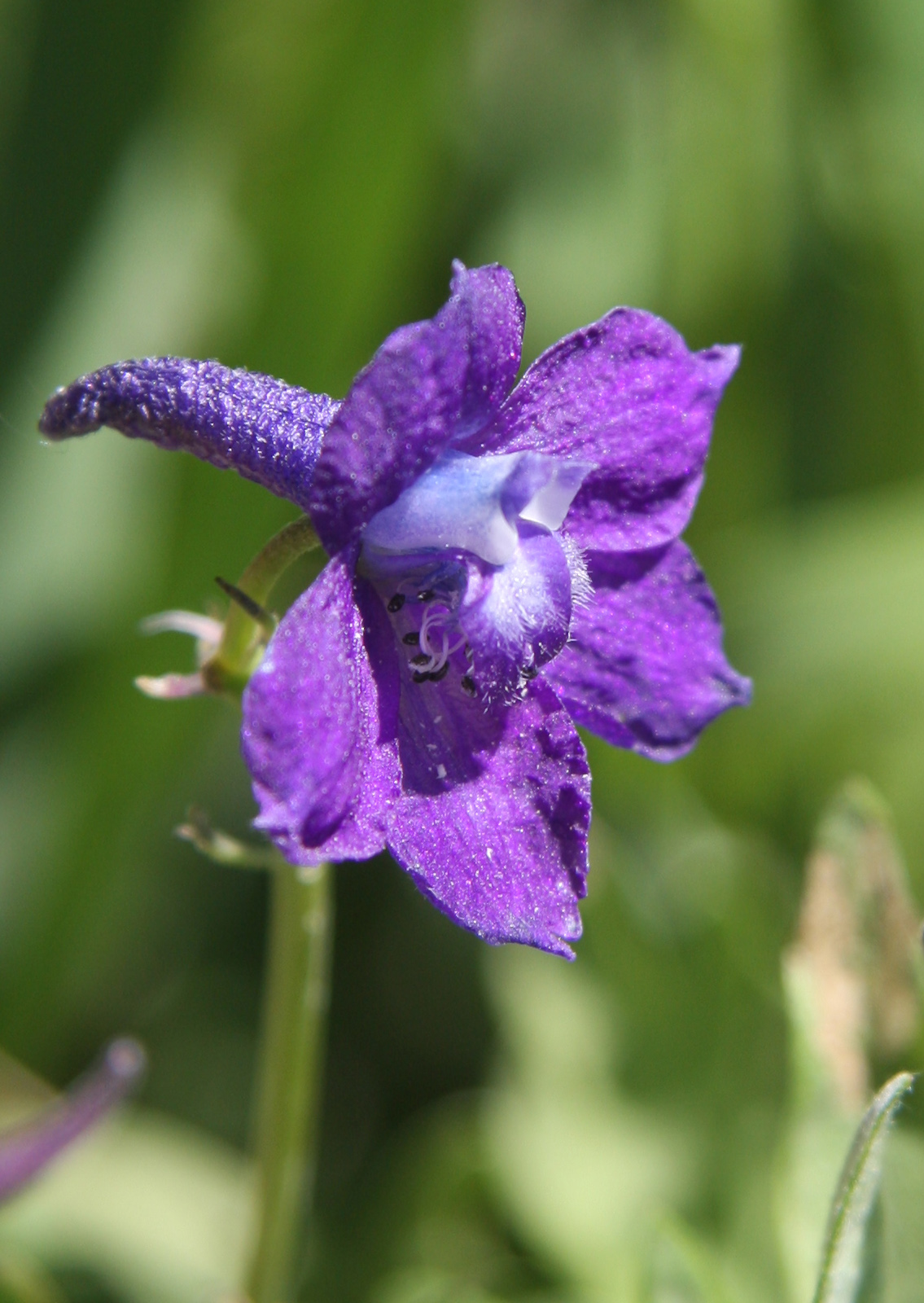
A projecting spur behind each bloom is an important clue. The conspicuous blue-purple outer parts are sepals, while smaller petals occupy the center. Turn a flower sideways without picking it to see the spur and the difference between the outer and inner floral parts. Color alone will not distinguish this species from other larkspurs.
Size and seasonal appearance
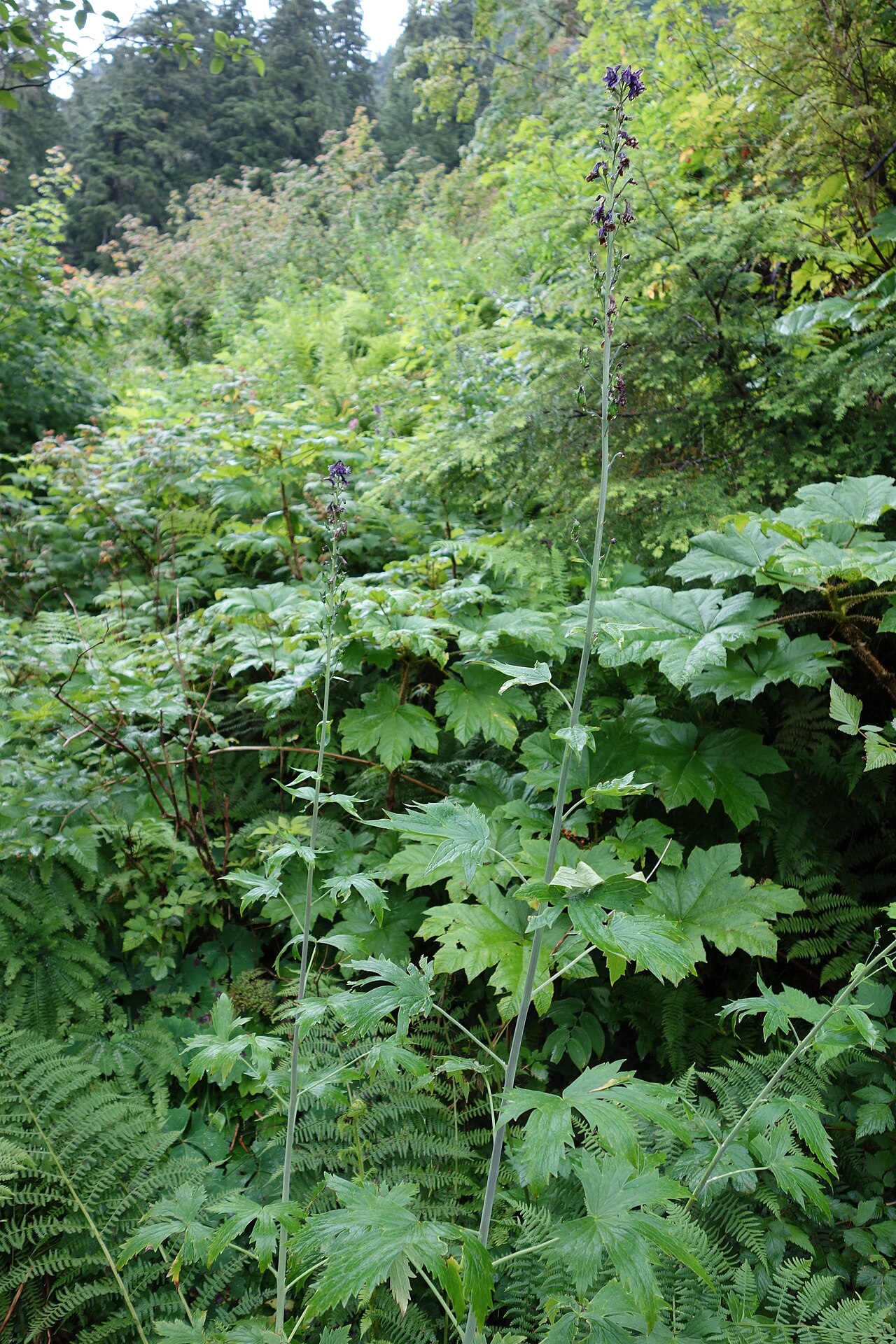
Plan for a plant roughly person-height in favorable conditions, rather than assuming every individual will match a photograph from an exposed mountain site. The crown survives underground while the stems are seasonal. A dormant patch therefore needs a marker so spring cleanup does not damage emerging shoots or lead to an unnecessary replacement purchase.
Distinguishing related plants
Monkshoods have a hooded upper floral part rather than the same elongated larkspur spur. Both groups can be dangerous if eaten, so a garden identification exercise should never include tasting. Identification within Delphinium can require a regional key, especially where several species occur together. For restoration stock, ask for the collection locality and the botanical name used by the grower.
Quick Facts
| Scientific Name | Delphinium glaucum |
| Family | Ranunculaceae |
| Plant Type | Rhizomatous herbaceous perennial |
| Mature Height | Usually 3–6 feet; exceptionally taller in favorable habitat |
| Mature Spread | A persistent crown; allow space around tall flowering stems |
| Growth Rate | Seasonal upright growth from a perennial rootstock |
| Sun Exposure | Full sun to partial shade in cool, moist sites |
| Water Needs | Consistently moist; not a dry-bed perennial |
| Soil Type | Moist meadow or woodland-edge soil with organic matter and drainage |
| Soil pH | No narrow garden pH prescription established here; match local habitat |
| Bloom Time | Summer; timing shifts with snowmelt and latitude |
| Flower Color | Blue-purple to lavender, often with paler inner petals |
| Fall Color | Herbaceous foliage dies back |
| Fruit | Dry follicles containing seeds; not edible |
| Deer Resistant | Not a browsing guarantee; toxic to livestock and people |
| USDA Hardiness Zones | Use locally adapted stock; a single reliable garden-zone range is not established here |
Native Range
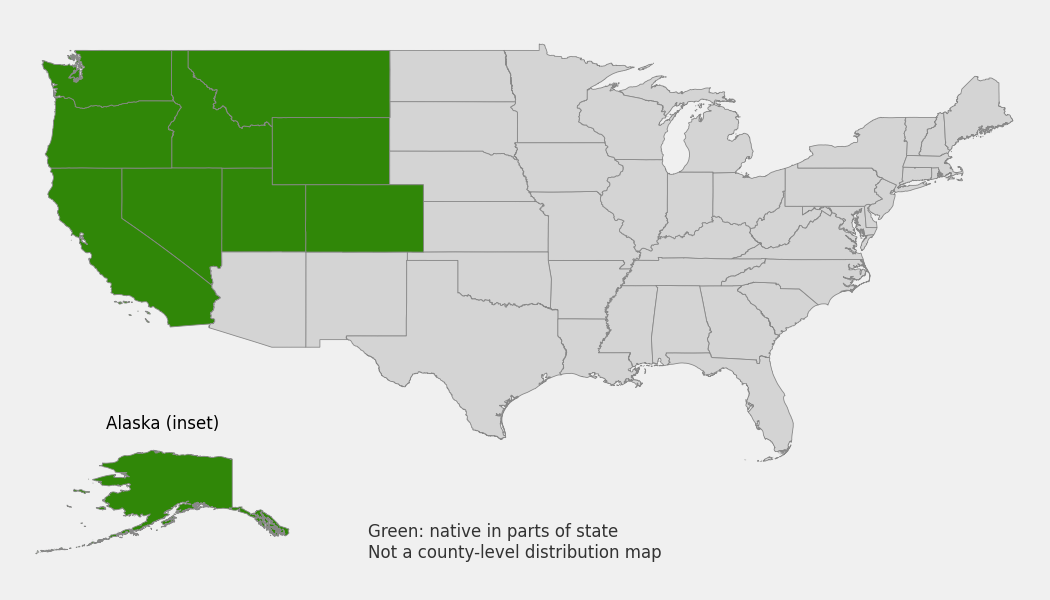
This is a western and northern North American native. The state map follows the broad Kew treatment: Alaska and parts of the western contiguous states, extending through western Canada and the Canadian interior. It is not a species native across every part of the United States simply because ornamental delphiniums are widely planted.
The habitat is generally cool and moist: meadow edges, streamside vegetation, wet thickets and openings in mountain forests. A state-wide shaded area represents a documented presence somewhere in that state, not a claim that every lowland, dry slope or urban site is appropriate. Within Alaska, local provenance and snowmelt conditions still matter.
The regional table uses a wet moisture code. Read that as a warning against chronic drying, not as an instruction to keep a nursery pot submerged. The root zone still needs air. If a proposed bed is hot, gravelly and dry all summer, choose a plant adapted to those conditions instead of trying to maintain this larkspur with emergency watering.
📋 Regional plant list: Alaska
Growing & Care Guide
Choose a site before buying
Observe the proposed bed during the driest part of the growing season. A place that looks moist just after snowmelt may dry sharply later. Prefer an open, cool site with room for the mature flowering stems and access for careful watering. Keep it separate from vegetable beds, play areas where plants are mouthed, livestock enclosures and cut vegetation that might be fed to animals.
Planting a nursery-grown crown
Set the crown at the depth at which it grew in its container, rather than burying the stem bases in a deep pocket of compost. Loosen surrounding soil gently and water the root ball thoroughly after planting. Check the actual root ball during the establishment period; surrounding damp soil does not always mean the original container medium has been rewetted.
Water and root-zone management
Use the soil rather than a rigid calendar to decide when to irrigate. A finger or small probe beside the root ball can reveal whether moisture is reaching below the surface. Water at soil level and allow excess water to drain. If the site remains saturated and sour-smelling, address drainage before adding more water or fertilizer.
Light and competition
Full sun is suitable in cool, moisture-retentive situations; partial shade can reduce drying at a woodland edge. Avoid deep shade combined with dense competition from tree roots. If growth leans strongly toward the light, consider whether the site is too shaded before making repeated staking a permanent maintenance requirement.
Supporting stems
A sheltered position helps preserve the natural spires. If support is needed, install an unobtrusive support early so stems can grow through it, and use soft ties that do not constrict expansion. Do not pack several crowns tightly together to create an instant display; crowded stems are harder to inspect and more difficult to keep upright without damage.
Feeding and mulch
Start with healthy soil and modest surface protection rather than a high-nitrogen feeding program. Keep mulch away from the crown itself. If growth is weak, check water, light, root health and competition before treating the problem as a nutrient shortage. A soil test is preferable to repeated speculative applications of fertilizer.
Propagation and sourcing
Ask a northern native-plant grower for the germination method appropriate to the seed lot and its provenance. Do not assume a packet of cultivated hybrid delphinium seed will produce this species. Keep seed labeled with both name and source, and handle it as toxic material. Collecting from wild stands requires permission and should not deplete the seed supply of a small population.
After flowering and winter
Leave some stems to develop seed only where that fits the garden and safety plan. Where seed is not wanted, remove spent inflorescences before mature seed is shed. Cut dead material when appropriate for the local season, wearing gloves and keeping cuttings away from animal feed. A winter marker is useful because the aboveground display disappears.
Troubleshooting
A drooping stem can reflect wind, dry roots, root damage or disease; it is not a diagnosis by itself. Inspect the base and the moisture profile before adding water. Remove badly diseased material with clean tools and seek local extension advice if decline spreads. Avoid routine broad-spectrum insecticide applications to flowers visited by insects.
Landscape Uses
- A tall seasonal accent at the back of a cool, moist native border.
- A meadow-edge planting where its height will not obscure small alpine plants.
- A teaching plant for observing spurred flowers without handling or tasting them.
- Not a pasture, forage plant, edible garden species or low-water xeriscape choice.
Wildlife & Ecological Value
Flowers and visitors
The spurred flowers are visited by pollinating animals; the Burke Herbarium account records a range of bee and other visitors. In a garden, observe who is actually visiting rather than assuming that every insect seen nearby is pollinating. Leave flowers unsprayed and combine the larkspur with locally native plants that bloom before and after it.
Toxicity is an ecological and management issue
USDA Agricultural Research Service guidance emphasizes the danger of larkspurs to grazing livestock. Toxicity varies among species and plant stages, but a gardener should not turn that variation into an assurance that a particular leaf or seed is safe. Keep the plant and its trimmings out of feed and do not encourage animals to sample it.
Protecting habitat
A cultivated display is not a substitute for conserving the moist meadow and streamside habitats where the species occurs. Buy propagated plants rather than digging a flowering clump. Where a restoration is planned, use the species concept and seed-transfer guidance adopted by the responsible local land manager.
Cultural & Historical Uses
The word larkspur refers to the shape of the flower, while the scientific name separates this perennial from unrelated plants sold under similar labels. Northern and western floras have not always drawn the same species boundaries, which explains why old records may use names different from a current catalog.
Garden delphiniums have a long horticultural history, but a cultivated hybrid is not automatically an appropriate replacement for a local wild species. A label should distinguish a native species from a named ornamental selection, and a restoration project needs more provenance information than a decorative garden purchase.
The safest modern use is visual and ecological. Historical or anecdotal uses of poisonous plants are not preparation instructions. This page deliberately provides no edible or medicinal recipe for larkspur; the combination of beauty and toxicity is a reason for thoughtful placement, not for experimentation.
Frequently Asked Questions
Is this the same as annual larkspur?
No. This page concerns the perennial Delphinium glaucum, not annual garden larkspurs or hybrid delphiniums.
Can I plant it where horses or cattle graze?
No. Larkspurs are important poisonous plants for livestock. Keep plants, seeds and cuttings out of grazing and feed areas.
Does the wet code mean pond planting?
No. It indicates a moisture-demanding plant; a pot or crown should not be kept in stagnant, airless water.
Will it remain visible in winter?
The flowering stems and leaves are seasonal. Mark the perennial crown so it is not disturbed during dormancy.
Is Delphinium brownii a separate page here?
It is treated as a synonym within the broad accepted concept used for this guide. Local floras may use a narrower treatment, so retain provenance records.
Sources & Further Reading
- Kew POWO — accepted name and distribution
- University of Washington Burke Herbarium — identification and habitat
- USDA ARS — larkspur livestock toxicity
- FHWA — native plants for landscape use in Alaska
- USDA PLANTS — Delphinium glaucum
Find Native Plants
Ask growers about nursery propagation and regional provenance. Browse our AK native plant nurseries directory for suppliers. Explore the native nursery finder.