
Needle-tip Blue-eyed Grass (Sisyrinchium mucronatum)
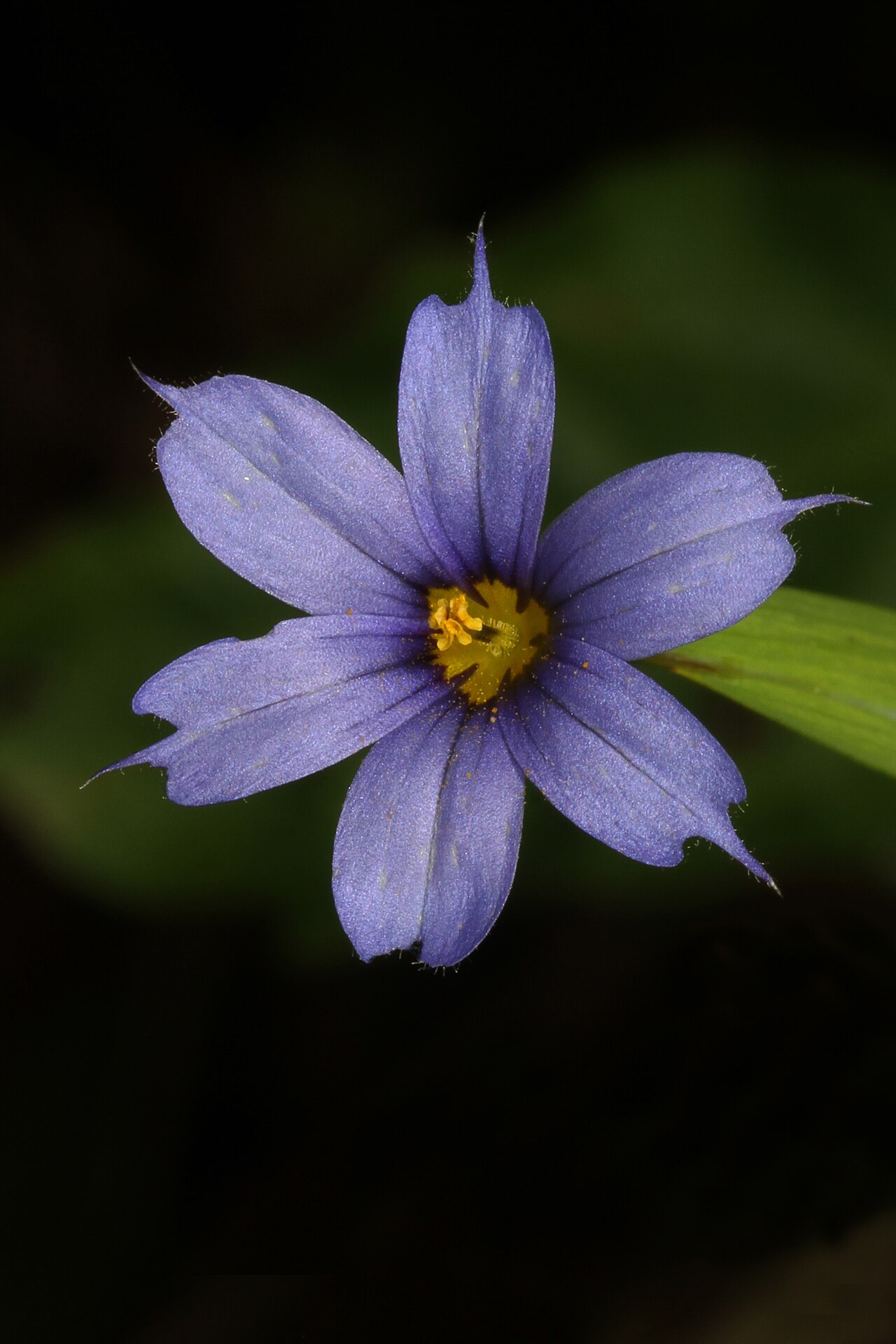
Needle-tip blue-eyed grass is a small iris relative with a much bigger visual presence when it flowers. Blue to violet stars with yellow centers open above narrow foliage, rewarding a close look at the front of a meadow planting or along a quiet path. Its scientific name is Sisyrinchium mucronatum. Despite the common name, it is not a true grass and should not be treated as turf.
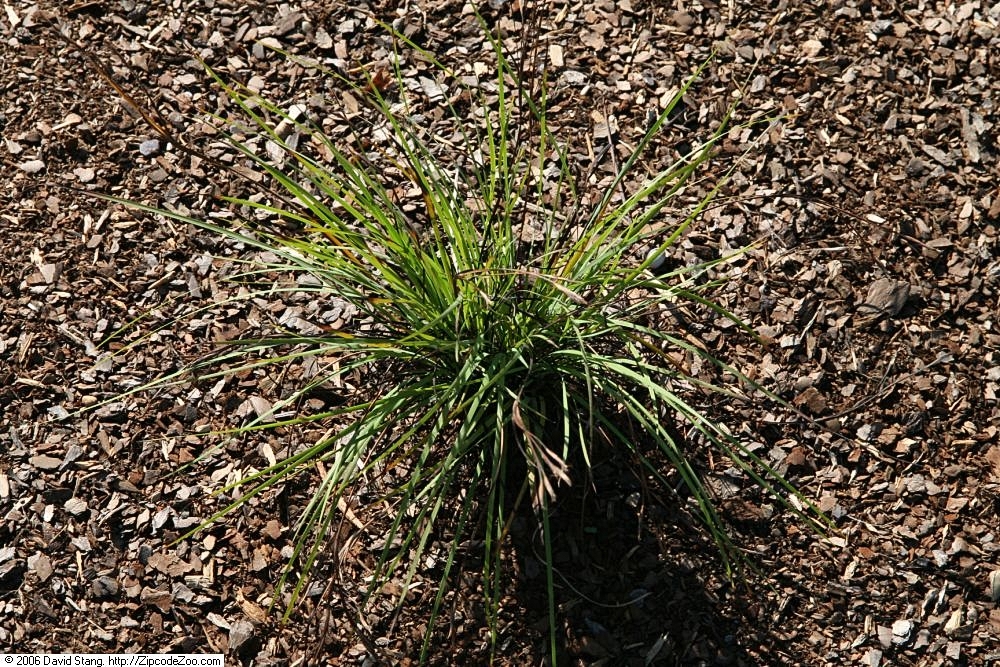
The plant forms a modest clump and usually stands roughly 6–18 inches tall in flower. It is suited to a detailed, low planting where taller neighbors will not hide its short bloom. The effect is delicate rather than massive: a handful of small plants spaced where people can see them may work better than burying one specimen behind broad-leaved perennials.
Identification deserves care. Several blue-eyed grasses share blue flowers, a yellow eye and narrow leaves. For this species, examine the slender, only slightly winged, usually unbranched flowering stem and its terminal inflorescence, not just the flower color. The Carolina flora notes that some historical records were misidentified, a useful reminder that a familiar common name is not enough for accurate regional planting.
Identification
Stems & Growth Habit
An upright flowering stem rises from a small tuft of narrow leaves. The stem is slender and subtly flattened or winged rather than broadly winged and heavily branched. The inflorescence is usually solitary at the stem tip. Look at several stems on a mature flowering plant, because an incomplete specimen can conceal the features used by a botanical key.
Leaves
The basal leaves are narrow and grasslike, with parallel veins. They are generally shorter than the flowering stems. The plant has an iris-family growth form, not the nodes and flower structures of an ordinary lawn grass. Preserve enough of the lower leaves for identification and avoid making a diagnosis from a cropped flower photograph alone.
Flowers
The small flowers have six blue-purple perianth segments around a yellow center. Each segment narrows to a small pointed tip, and the three stamens are part of the iris-family structure. Flowers open successively rather than creating a heavy long-lasting cluster. Their opening can vary with time of day and conditions, so a closed flower in the afternoon is not necessarily a failed bloom.
Fruit & Seeds
Small rounded capsules replace the flowers and mature on the slender stems. They are dry fruits, not berries. A close view of stem width, the enclosing bracts and capsule shape can help a specialist distinguish similar species. Leave some to mature if seed production is desired, but retain botanical labels because seedlings of different blue-eyed grasses can be difficult to separate casually.
Quick Facts
| Scientific Name | Sisyrinchium mucronatum |
| Family | Iridaceae |
| Plant Type | Small herbaceous perennial; not a true grass |
| Mature Height | About 6–18 in in flower |
| Mature Spread | Approximately 6–8 in per clump |
| Growth Rate | Moderate; site-dependent |
| Sun Exposure | Full sun to part shade |
| Water Needs | Average to moist, well-drained soil; occasional dryness tolerated |
| Soil Type | Loam or sandy soil with drainage |
| Soil pH | Tolerates a range; use local soil and provenance guidance |
| Bloom Time | Spring to early summer; often April–June in the Southeast |
| Flower Color | Blue to violet with a yellow eye; occasional white forms |
| Fall Color | Not a major ornamental feature |
| Fruit | Small dry capsules |
| Deer Resistant | No dependable guarantee |
| USDA Hardiness Zones | Approximately 3–8 |
Native Range
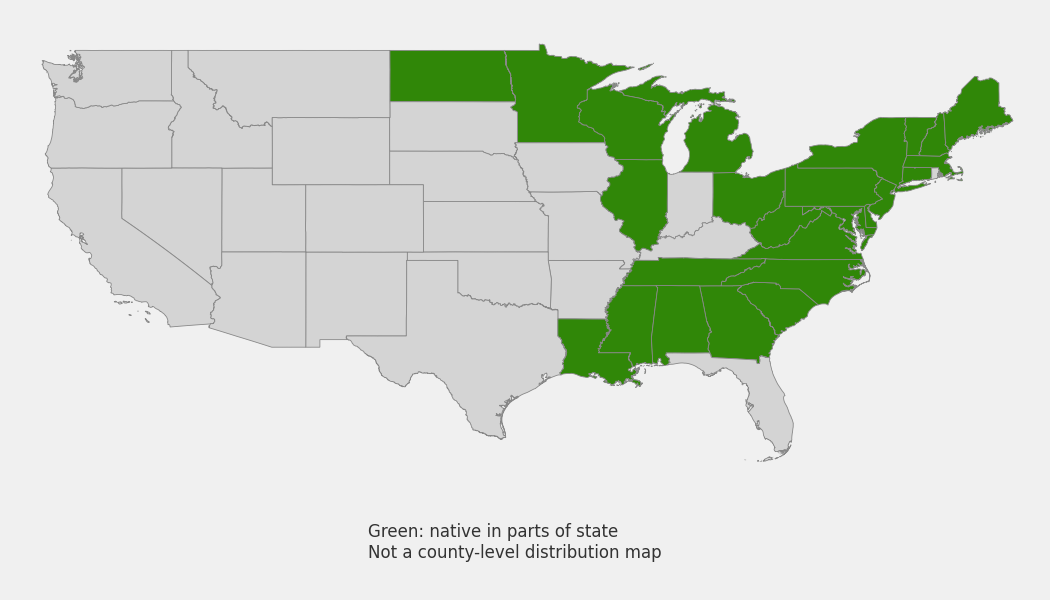
Needle-tip blue-eyed grass has an eastern North American and north-central distribution extending into Canada. State records are uneven, and some old identifications have been corrected by regional floras. This map presents documented native-range states from the cited botanical sources, not the broader range of every plant sold as “blue-eyed grass.”
In the Carolinas, the North Carolina flora recognizes the species while cautioning that several historical specimen identifications were erroneous. Its presence is associated with suitable open woods, fields, edges and similar habitats. Regional membership therefore needs to be read alongside a local flora, especially for conservation or habitat restoration work.
New England provides another useful caution: Go Botany lists the species as rare or historical in several states and does not document it in Rhode Island in its distribution account. The map does not shade Rhode Island merely because it lies between other mapped states. A state-level illustration cannot show local rarity, legal protection or the condition of a particular population.
📋 Regional plant list: North Carolina & South Carolina native plant list
Growing & Care Guide
Light
Use a sunny opening or light part shade, keeping taller plants from closing over the clump. The flowers are small, so position them where spring light and a clear sight line let them be appreciated. A lawn mower or string trimmer cannot distinguish this iris relative from the surrounding grasslike foliage; mark the planting clearly.
Soil & Water
Provide a draining soil with average moisture, allowing for occasional dry spells rather than continual drought. Habitat descriptions that include shores do not mean the crown should be submerged. Water a new planting while it establishes and compare the soil in the actual root zone with its appearance at the surface. Avoid rich fertilizer programs intended for turf.
Planting Tips
Set small nursery plants at their original depth and keep mulch from burying the leaves. A group of several documented plants makes the tiny flowers easier to see and gives a more convincing visual rhythm. Keep neighboring plants low or open enough that this modest species does not disappear after its first season. Use nursery-grown stock, especially where wild populations are rare.
Pruning & Maintenance
Allow leaves to continue functioning after bloom. If you want seed, leave a portion of the capsules until mature; if neatness matters more, remove only finished flower stems. Do not shear the whole clump like an ornamental grass simply because of its common name. Check for encroaching turf roots and remove them carefully without confusing them with the desired plant.
Propagation
Seed is an appropriate route when identity and source are documented. Follow a specialist grower’s guidance for that seed lot and regional conditions rather than assuming every Sisyrinchium species germinates the same way. Established clumps may be divided cautiously when healthy, but rare wild populations should remain undisturbed. Keep propagated plants labeled through their first flowering so the diagnosis can be checked.
Landscape Uses
- Low accents along a sunny or lightly shaded path
- Small groups in a short native meadow planting
- An open woodland edge with modest competition
- A labeled educational planting comparing grasses and iris relatives
Wildlife & Ecological Value
For Pollinators
The small open flowers offer a resource to visiting insects. Their modest size is a reason to include them in a varied planting, not to dismiss them beside larger blossoms. Observe local visits rather than promising a particular specialist species without evidence. Avoid mowing the patch during flowering and seed development.
Birds
Small seed-bearing plants add another component to a habitat garden, and extension references note bird interest in the fruits. The dry capsules are not comparable to a berry crop. Keep the ecological claim proportional: this is one low-growing contributor among the grasses, shrubs and other wildflowers that make a complete planting.
Mammals
Browsing and trampling can affect a small clump regardless of its native status. Place a trial group where its performance can be observed, especially if rabbits or deer are active. No human food or medicinal use is recommended here, and the word grass does not establish suitability as forage.
Ecosystem Role
A small perennial can occupy open spaces that tall plants leave unused. Its value depends partly on avoiding excessive competition, disturbance and mowing during reproduction. In a garden, maintaining a few open niches lets low plants persist without turning the whole site into bare soil or a single-species lawn.
Cultural & Historical Uses
The epithet mucronatum refers to a short sharp point, reflected in the pointed flower segments and the common name needle-tip. The name makes a good starting point for observation, but not a complete key: other blue-eyed grasses also have pointed-looking flowers. Reliable identification combines several characters and a botanical source.
The plant has appeared under alternative infraspecific treatments in older literature. Modern regional floras are valuable because they evaluate the specimens behind distribution claims, sometimes removing records rather than adding them. That work explains why a narrower, better-supported range can be more useful than a map containing every old report.
For a native garden, its cultural role is primarily as an accessible small wildflower and an example of botanical precision. Retain a source label, photograph the stem and leaves as well as the bloom, and share nursery-propagated plants with their identity intact. No speculative ethnobotanical narrative is needed to justify its place.
Frequently Asked Questions
Is it really a grass?
No. Sisyrinchium belongs to the iris family. Its narrow leaves resemble grass, but its flowers and fruit are those of a flowering iris relative.
Can I identify it by the blue flower alone?
No. Several species look similar. Examine the narrow, slightly winged stem, branching pattern, bracts and leaves, using a regional botanical key.
Why are the flowers closed when I visit?
Opening varies through the day and with conditions. Return in suitable light during the flowering season before concluding that the plant has finished or failed.
Can it be planted in a pond?
It is not an aquatic planting for submerged crowns. Some populations occur near shores, but a garden site still needs appropriate soil and drainage.
Should I collect plants from a local wild patch?
Use nursery-propagated plants instead. The species is rare or historical in some regions, and a small patch may be more important than it appears. Local conservation rules also differ.
Sources & Further Reading
- NC State Extension Gardener Plant Toolbox
- Native Plant Trust: Go Botany
- Vascular Plants of North Carolina
- NatureServe Explorer
Find Native Plants
Ask growers about nursery propagation and regional provenance. Browse our NC native plant nurseries, SC native plant nurseries directory for suppliers. Explore the native nursery finder.