
Water Oak (Quercus nigra)
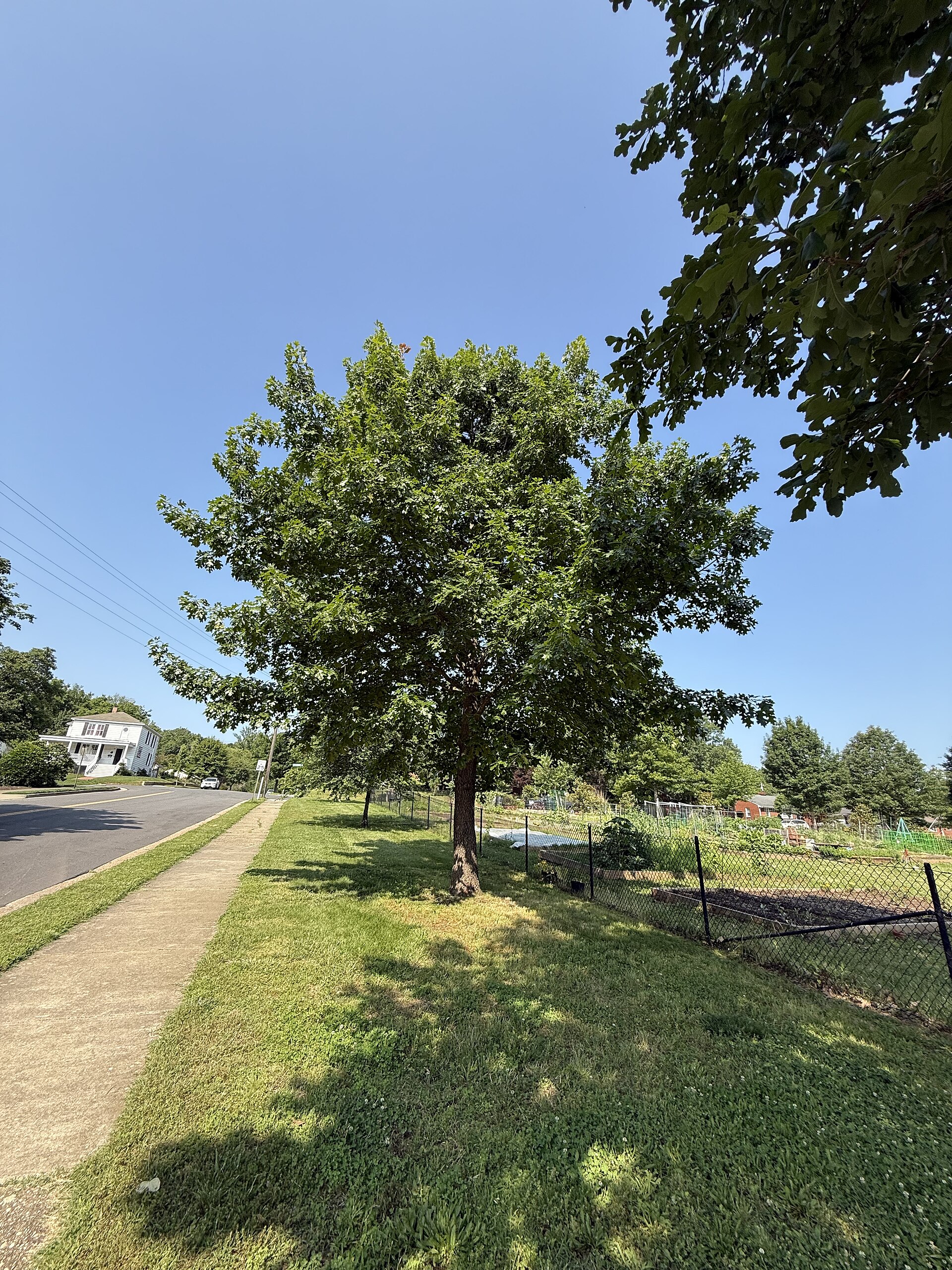
Quercus nigra, commonly called Water Oak (and sometimes Possum Oak, Spotted Oak, or Duck Oak), is a fast-growing deciduous tree in the red oak group, native to the Coastal Plain and lower Piedmont of the southeastern and south-central United States. Despite the name, water oak is not a true wetland specialist — it grows naturally along streambanks, pond margins, and low floodplains, but it also thrives in ordinary upland yards, old fields, and roadsides on soils that range from sandy to heavy clay. This adaptability, combined with quick growth, has made it one of the most familiar shade trees across the Deep South.
Water oak typically reaches 50 to 80 feet tall with a rounded to oval crown, though old specimens on good sites can top 100 feet. The spatula-shaped leaves, widest near the tip and tapering to a narrow base, are one of the easiest ways to identify the tree even from a distance, since no other common southern oak shares quite the same leaf outline. In late fall and winter, especially in the Deep South, many leaves turn dull yellow-bronze and hang on the twigs well past when other oaks have dropped theirs, a trait called marcescence.
For gardeners, water oak is a mixed bag worth understanding before planting. It grows remarkably fast for an oak — often 2 to 3 feet a year while young — and casts good shade within a couple of decades, which is why it was planted so widely along southern streets through the mid-1900s. But that speed comes from wood that is notably weaker and more decay-prone than slower oaks like white oak or live oak, and water oaks are relatively short-lived for the genus, commonly declining and shedding limbs after 50 to 80 years. It remains an excellent wildlife tree and a reasonable choice for fast shade on a large lot, but it is not the best pick for planting close to a house, driveway, or power line.
Identification
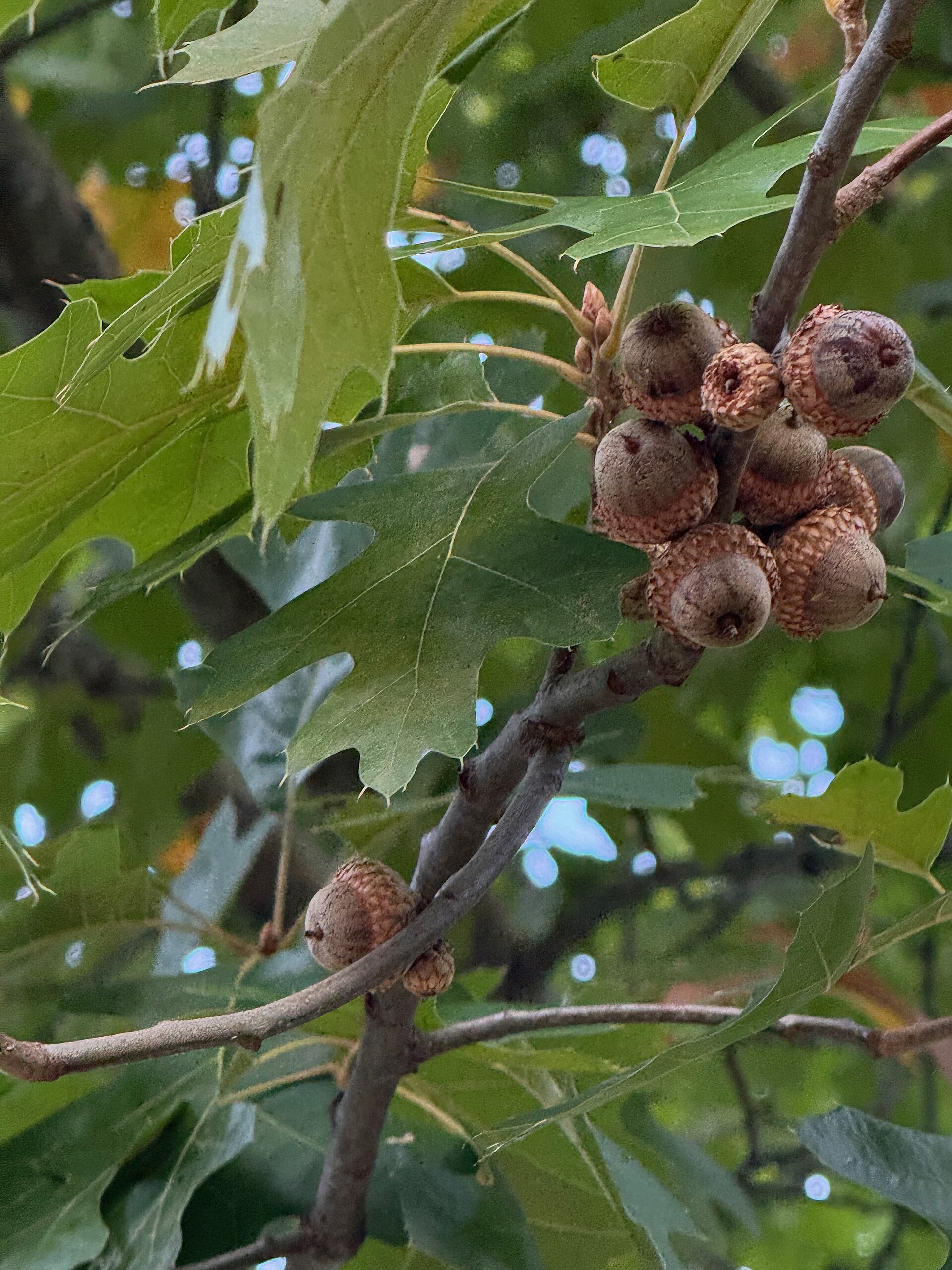
Water oak is usually identified at a glance by its distinctive leaf shape, smooth gray young bark that roughens with age, and small, nearly round acorns. It belongs to the red oak group, so its leaves and lobes (when present) end in a tiny bristle tip, and its acorns take two growing seasons to mature.
Bark & Stems
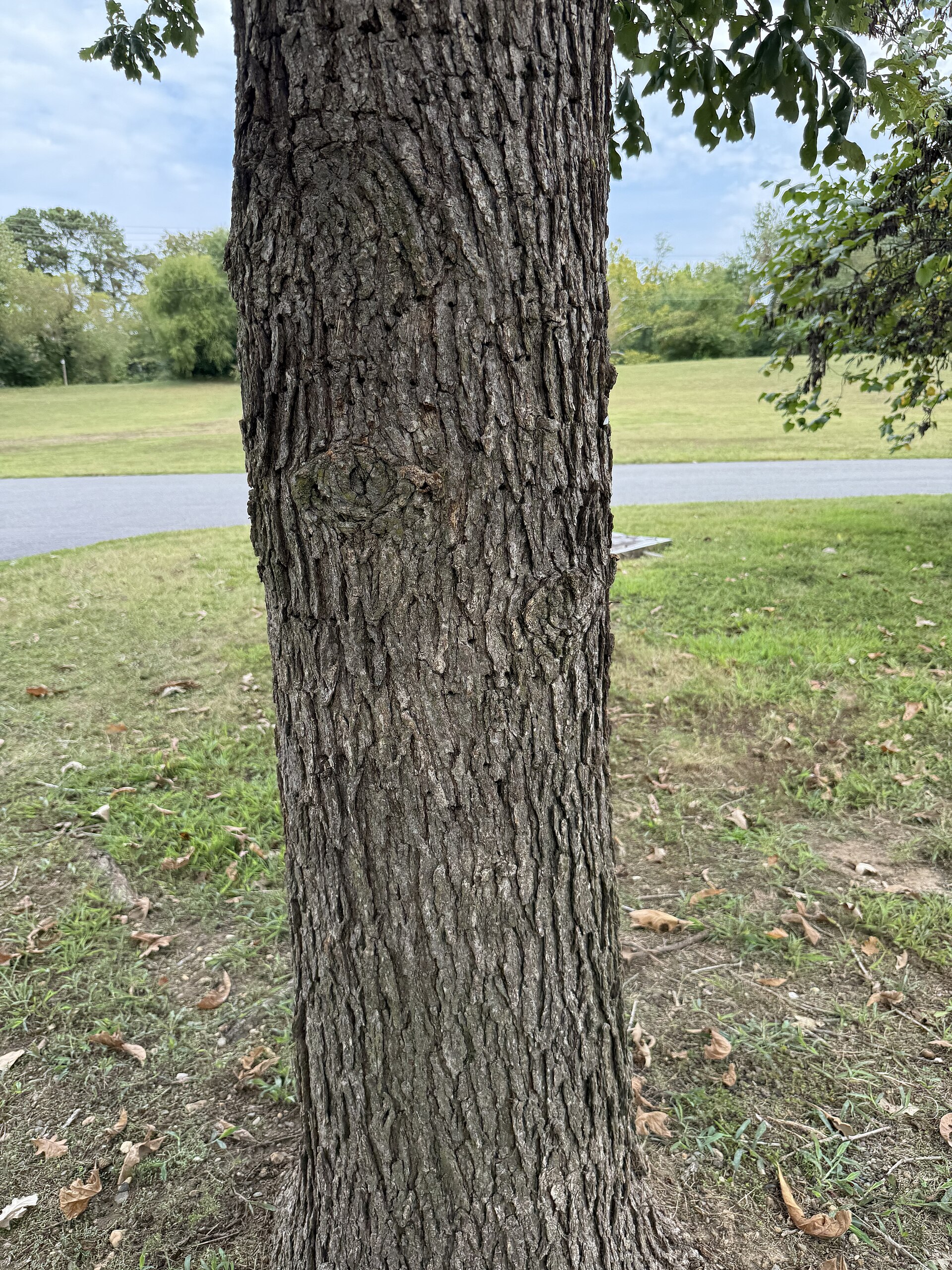
Young water oak trunks and branches are smooth and light gray to brown. As the tree matures, the bark darkens to gray-black and develops shallow, rough-textured fissures and flat-topped ridges, though it never becomes as deeply furrowed as white oak or southern red oak. Twigs are slender, reddish-brown, and hairless, with small clustered buds at the tips that are a useful winter identification feature.
Leaves
The leaves are simple, alternate, and 2 to 4 inches long, most commonly shaped like a narrow spatula or spoon — widest and often shallowly three-lobed near the rounded tip, then tapering smoothly to a slender base with almost no stalk. Some leaves on the same tree are nearly unlobed, while others on vigorous sprouts show deeper, more oak-like lobing, which can confuse beginners until they notice the consistent “water-drop” outline shared by most leaves. The upper surface is dull to glossy dark green; the underside is paler with small tufts of rusty hairs in the vein axils. Leaves emerge bronze-red in spring, mature to dark green by summer, and in much of the Deep South persist in dull yellow-brown through winter before new growth pushes them off in spring.
Flowers & Fruit
Like other oaks, water oak is wind-pollinated and monoecious, with male and female flowers on the same tree. Male flowers hang in slender yellow-green catkins 2 to 3 inches long in early spring as the new leaves unfold; female flowers are tiny and inconspicuous in the leaf axils of new growth. The acorns are small, roundish, about 3/8 to 5/8 inch long, striped with faint dark lines, and capped by a thin, shallow, saucer-like cup covering only the base of the nut. Acorns mature over two years and ripen in fall, falling in large numbers from trees that are often only 15 to 20 years old — among the earliest-bearing of the native oaks.
Quick Facts
| Scientific Name | Quercus nigra |
| Family | Fagaceae (Beech/Oak) |
| Plant Type | Deciduous tree (semi-evergreen in Deep South) |
| Mature Height | 50–80 ft (occasionally to 100 ft) |
| Mature Spread | 35–50 ft |
| Growth Rate | Fast (2–3 ft per year while young) |
| Sun Exposure | Full Sun to Part Shade |
| Water Needs | Average to moist; tolerates occasional flooding |
| Soil Type | Adaptable — sandy, loamy, or clay; tolerates poor drainage |
| Soil pH | Acidic to slightly acidic (about 5.0–6.5) |
| Bloom Time | March – April |
| Flower Color | Yellow-green (inconspicuous catkins) |
| Fall Color | Dull yellow to bronze; often holds leaves into winter |
| Fruit | Small rounded acorns, 3/8–5/8 in, maturing in 2 years |
| Deer Resistant | No (acorns and seedlings are browsed) |
| USDA Hardiness Zones | 6–9 |
Native Range
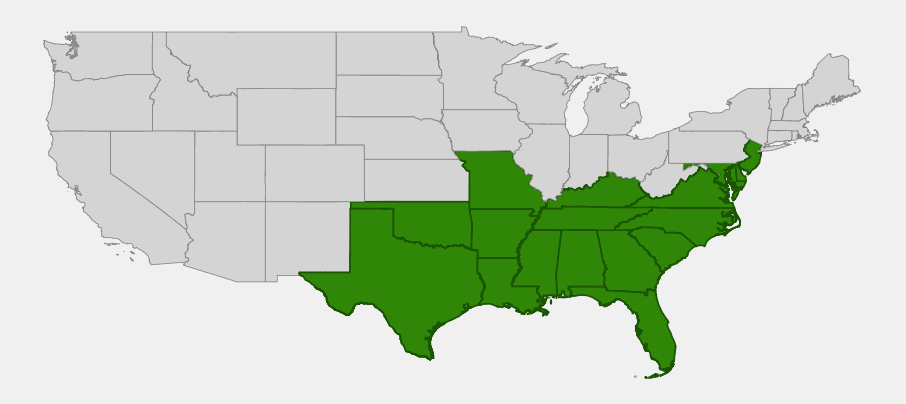
Water oak is native to the Coastal Plain and adjacent Piedmont of the southeastern and south-central United States. Its range runs along the Atlantic and Gulf coasts from southern New Jersey and Delaware south through the Carolinas, Georgia, and Florida, west through Alabama, Mississippi, Louisiana, and eastern Texas, and north up the Mississippi River valley into Arkansas, Oklahoma, Tennessee, Kentucky, and the southeastern corner of Missouri. Within this broad belt it is one of the most common and widespread oaks, found in nearly every county of the Deep South.
In the wild, water oak grows across a wide range of conditions: along streambanks, pond margins, and the edges of bottomland hardwood forests, but equally well on drier upland sites, old pastures, and disturbed ground. It is often one of the first trees to seed into abandoned fields and roadsides, where its fast growth lets it quickly outcompete many other hardwoods for light. It grows from near sea level up to about 1,000 feet in the southern Appalachian foothills.
Because it tolerates both wet and fairly dry soils, water oak has become extremely common in developed areas — street medians, parking lot islands, and suburban yards — well beyond the shadier bottomlands where it is most at home ecologically. This same adaptability, paired with heavy acorn production at a young age, means it also volunteers readily in garden beds and fence lines, so many southern gardeners know it as a prolific self-seeder as much as a landscape tree.
📋 Regional plant lists featuring Water Oak: Delaware, Southern New Jersey & Long Island, New York · Maryland, Virginia & West Virginia · North Carolina & South Carolina · Georgia, Alabama & Mississippi · Arkansas, Louisiana, Eastern Oklahoma & Eastern Texas · Kentucky & Tennessee · Illinois, Iowa & Missouri
Growing & Care Guide
Water oak is one of the easiest native oaks to establish, tolerating a wide range of soils and moisture levels with little fuss. The trade-off for that ease and speed is a shorter lifespan and weaker wood than slower-growing oaks, so siting and long-term maintenance matter more than with most trees.
Light
Water oak grows best in full sun, which produces the strongest, most balanced crown. It tolerates part shade, especially while young, but develops a more lopsided or leggy form reaching for light under a canopy. For the best structure and longest useful life, give it an open site with at least six hours of direct sun.
Soil & Water
This species is remarkably unfussy about soil — it grows in deep sand, heavy clay, and everything between, and tolerates both occasional flooding and moderately dry spells once established. It prefers acidic to slightly acidic soil and can develop chlorosis (yellowing between leaf veins) in high-pH or heavily limed soils. Consistent moisture during the first two to three years speeds establishment, after which water oak needs supplemental watering only in extended drought.
Planting Tips
Plant container-grown or balled-and-burlapped trees in fall or late winter to let roots establish before summer heat. Because mature water oaks eventually shed limbs and have a shorter safe lifespan than many shade trees, site new plantings at least 20 to 30 feet from the house, driveway, and any structure, and well clear of septic fields and foundations. It is a poor choice directly over patios or parking areas where falling acorns and limbs will be a constant nuisance.
Pruning & Maintenance
Establish a strong central leader and well-spaced scaffold branches while the tree is young, since water oak’s fast growth can produce weak, narrow branch angles if left unpruned. Remove crossing, rubbing, or co-dominant stems in the dormant season. As trees age past 40 to 50 years, inspect regularly for dead wood, cavities, and fungal conks, since this species is prone to heart rot and limb failure in older age; a certified arborist should assess large or declining trees near structures.
Propagation
Water oak is grown from acorns, which should be collected as soon as they fall in autumn and planted promptly or cold-stratified, since oak acorns lose viability quickly if allowed to dry out. Press acorns about an inch deep into moist, well-drained soil or a deep pot that accommodates the taproot; germination usually follows within weeks of a cold, moist period. Volunteer seedlings are common under existing trees and can be dug and transplanted while small.
Landscape Uses
- Fast shade for new properties or large open lawns with room to grow
- Wildlife plantings — heavy, early, and reliable acorn production feeds many species
- Naturalized woodland edges and reforestation of old fields
- Stormwater and floodplain buffers, where its flood tolerance is an asset
- Street and park plantings in large medians away from infrastructure (with awareness of its shorter service life)
Wildlife & Ecological Value
Few southern trees pull as much ecological weight as water oak, which combines fast growth with some of the earliest and most abundant acorn crops of any native oak.
For Pollinators
Water oak’s wind-pollinated catkins offer little nectar, but like other oaks it hosts enormous numbers of caterpillars — including many moth and butterfly species — that in turn feed pollinators and songbirds throughout the growing season. Few landscape trees support more insect biomass than native oaks.
For Birds
Acorns are a staple fall and winter food for wild turkeys, wood ducks, blue jays, and numerous woodpecker species, while the dense canopy provides nesting sites and cover. Because water oaks begin bearing acorns earlier than many other oaks — often by 15 to 20 years of age — they fill an important gap in mast production in young or regenerating forests.
For Mammals
White-tailed deer, gray squirrels, fox squirrels, raccoons, and black bears all feed heavily on water oak acorns, and deer also browse young seedlings and sprouts. The sheer volume of acorns produced in good mast years makes water oak an important fallback food source when other hard mast is scarce.
Ecosystem Role
As a fast colonizer of disturbed and open ground, water oak often serves as an early- to mid-successional tree that shades out sun-loving competitors and gradually gives way to longer-lived hardwoods beneath it. Its early death and limb drop, while a maintenance concern in yards, create standing dead wood and cavities in wilder settings that are valuable habitat for cavity-nesting birds and mammals.
Cultural & Historical Uses
Water oak has long been a familiar, workaday tree across the rural South rather than a species with deep ceremonial history, in part because its fast growth and relatively weak, less durable wood made it less prized than white oak or hickory for tools, furniture, or construction. Even so, it was commonly cut for firewood, fence posts, and low-grade lumber, and its acorns — like those of other oaks — were processed by leaching out bitter tannins and ground into meal by various Indigenous peoples of the Southeast as a food source in lean seasons.
In the 19th and early 20th centuries, water oak’s rapid growth made it a popular choice for quickly shading new southern towns, streets, and farmsteads, and many of the large, now-mature water oaks found in older southern neighborhoods and cemeteries date from this era of fast urban tree planting. Its tendency to decline and drop limbs as it ages has since made it one of the more frequently removed legacy street trees in the region, and many municipalities now recommend longer-lived oaks for new street plantings.
Today, water oak remains valued less as a specimen tree and more as an ecological workhorse: a prolific, reliable acorn producer that volunteers readily, grows almost anywhere in its range, and feeds an outsized share of southern wildlife relative to the effort it takes to grow.
Frequently Asked Questions
Is water oak a good tree to plant in my yard?
It depends on placement. Water oak grows fast and provides good wildlife value, but its wood is weaker and more decay-prone than most oaks, and trees commonly decline after 50 to 80 years. It’s a reasonable choice for a large, open lot if planted well away from the house, driveway, and utility lines, but not ideal for a small yard or close to structures.
Why does my water oak keep dropping branches?
Water oak is naturally fast-growing and relatively short-lived for an oak, and its wood is softer and more prone to decay and storm breakage than slower species like white oak or live oak. Regular inspection and pruning when young, and professional assessment as the tree ages past 40 to 50 years, can reduce (but not eliminate) this risk.
Is water oak the same as willow oak or pin oak?
No. All three are red oak group members commonly planted or found in the Southeast, but they’re distinct species. Water oak (Quercus nigra) has spatula-shaped, often slightly three-lobed leaves; willow oak (Quercus phellos) has narrow, unlobed, willow-like leaves; and pin oak (Quercus palustris) has deeply cut, pointed lobes and a more pyramidal form.
Why does my water oak hold brown leaves all winter?
This is marcescence, a trait common in water oak and several other oaks, especially in the warmer, southern parts of its range. Dead leaves stay attached through winter and are pushed off by new growth in spring rather than dropping in fall. It’s a normal characteristic, not a sign of disease.
Are water oak acorns edible or toxic?
Like most oak acorns, water oak acorns contain bitter tannins that make them unpalatable and mildly irritating to the digestive tract if eaten raw in quantity by people or pets; they are not a recognized hazard to established wildlife, which process them regularly, but livestock that gorge on fallen acorns can experience digestive upset. Acorns can be made edible for humans only after leaching out the tannins.

Looking for a nursery that carries Water Oak?
Browse our native plant nursery directory: Delaware, Georgia & Florida · Maryland, Mississippi, Louisiana, Kentucky & Missouri · Virginia, South Carolina, Texas & Tennessee · North Carolina, Oklahoma & New Jersey · Alabama & Arkansas