
Mexican Blue Oak (Quercus oblongifolia)
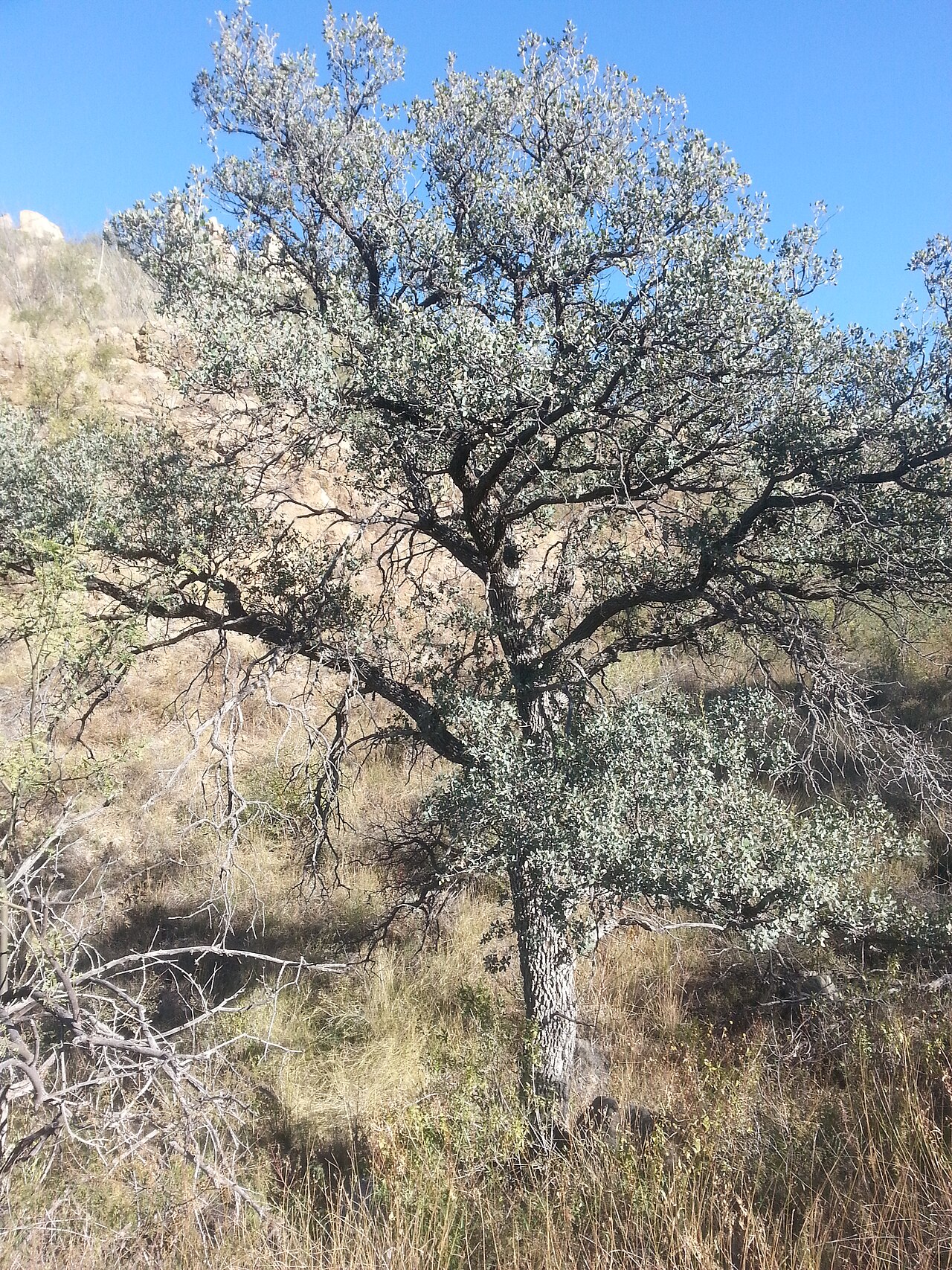
Quercus oblongifolia, the Mexican Blue Oak (also called Arizona blue oak or simply blue oak), is a small evergreen tree or large shrub of the “oak woodland” or “encinal” belt of the Southwest borderlands. It is named for its distinctive foliage: small, smooth-edged, oblong leaves with a pale, chalky blue-green cast that gives entire hillsides a soft blue-gray tone, especially noticeable against the tans and browns of the surrounding desert grassland.
Growing 15 to 25 feet tall with a rounded, often multi-trunked crown, Mexican blue oak is one of the defining trees of the grassy, boulder-strewn hills and canyons of southeastern Arizona and southwestern New Mexico, where it mixes with Emory oak and Arizona white oak to form the classic “oak grassland” scenery of that region. It is strikingly drought tolerant, holding its leaves year-round on thin, rocky soils that receive a fraction of the rainfall most oaks require.
For Southwestern gardeners, Mexican blue oak offers something few other trees can: a genuinely evergreen, low-water, cold-hardy native oak with real ornamental appeal. Its airy, silvery-blue canopy, tolerance for reflected heat and poor soil, and minimal care needs have made it an increasingly popular choice for xeriscape gardens from Tucson to the Bay Area, though gardeners outside its native range should remember it belongs to the desert Southwest, not California.
Identification
Mexican blue oak is usually a small evergreen tree 15 to 25 feet tall, occasionally reaching about 27 feet on the best sites, with a rounded crown and a trunk up to 20 inches in diameter. At higher, more exposed elevations it often grows as a large multi-stemmed shrub rather than a single-trunked tree. The twigs are slender, yellowish-brown, and hairless, with small reddish-brown buds.
Bark & Form
The bark is light gray and broken into small, dense furrows and plates, a texture that holds up well to the intense sun and heat of its native canyons and grasslands. Trees growing in the open develop a broad, rounded crown with branching low to the ground; where it grows alongside taller associates such as Arizona white oak, the crown is more upright.
Leaves
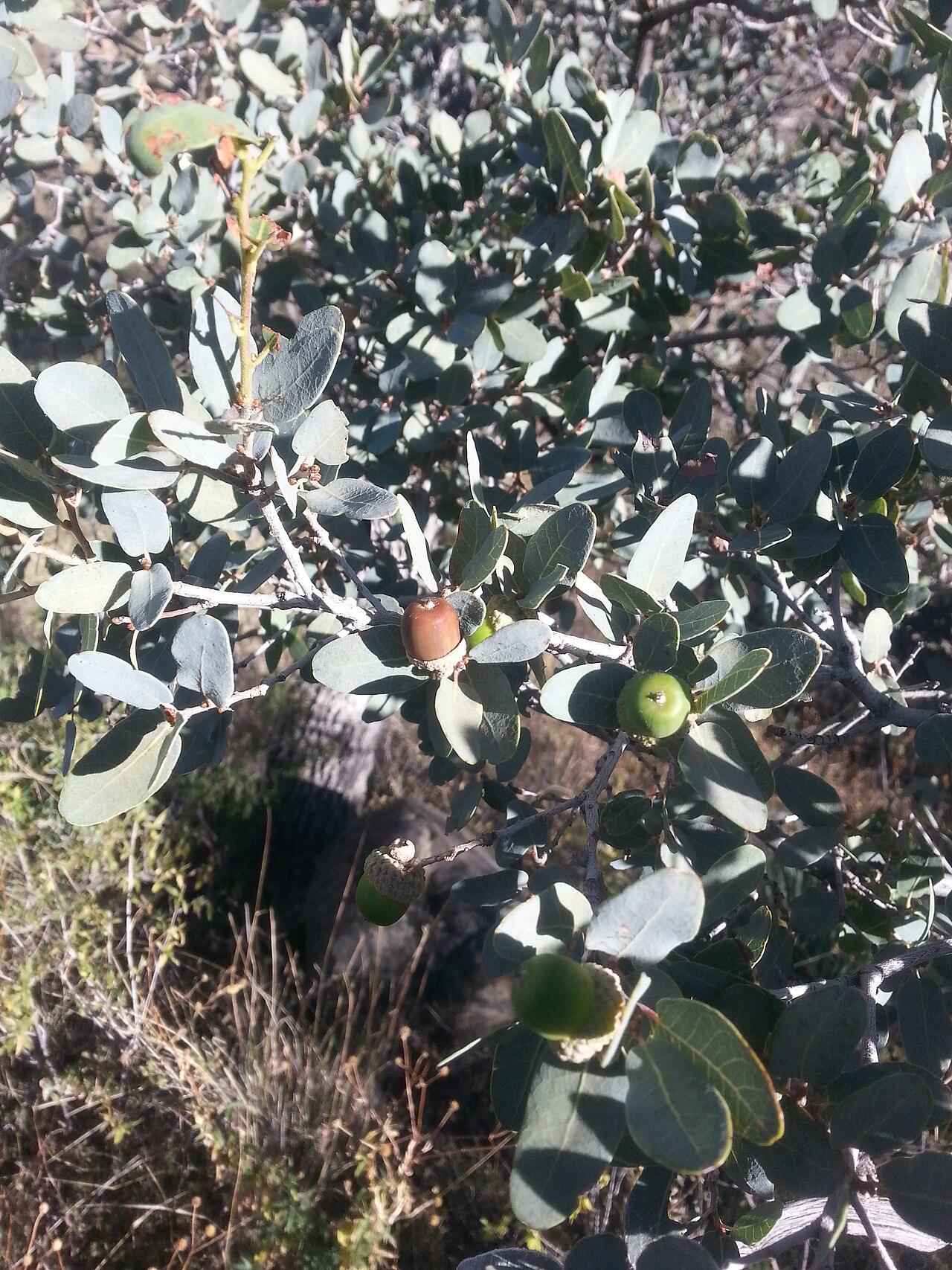
The evergreen leaves are small, oblong, 1 to 2 inches long, leathery, and generally smooth-margined rather than toothed or lobed. The upper surface is a distinctive pale, bluish-green, while the underside is a slightly deeper mid-green; the combination gives the whole canopy a soft, two-toned blue-gray look that is one of the easiest ways to identify the species from a distance. Leaves are shed gradually and replaced through the year, so the tree is never bare, though the heaviest leaf turnover happens in spring just before and during flowering.
Flowers & Fruit
Flowering occurs in spring as old leaves drop and new growth begins. Male flowers form slender, yellowish-green catkins; female flowers are small, solitary or paired, and tucked into the leaf axils. The acorns are light brown, ovoid to oblong, about ¾ inch long, and sit in shallow, scaly cups that cover roughly the lower third of the nut. Acorns mature within one growing season and are an important food source for a wide range of desert wildlife.
Quick Facts
| Scientific Name | Quercus oblongifolia |
| Family | Fagaceae (Beech) |
| Plant Type | Evergreen Tree / Large Shrub |
| Mature Height | 15–25 ft (occasionally to 27 ft) |
| Mature Spread | 15–20 ft, often as wide as tall |
| Growth Rate | Slow |
| Sun Exposure | Full Sun |
| Water Needs | Low; very drought tolerant once established |
| Soil Type | Thin, rocky or gravelly, well-drained soils |
| Soil pH | Neutral to alkaline |
| Bloom Time | March – April |
| Flower Color | Yellowish-green (inconspicuous catkins) |
| Fall Color | None (evergreen) |
| Fruit | Light brown acorns, about ¾ in, maturing in one season |
| Deer Resistant | No (browsed heavily by deer and bighorn sheep) |
| USDA Hardiness Zones | 8–10 |
Native Range
Mexican blue oak is native to the Southwest borderlands, centered on the “Sky Island” mountain ranges of southeastern Arizona — including the Santa Catalina Mountains near Tucson — and extending into the southwestern corner of New Mexico. It occurs only infrequently in far western Texas, in the Trans-Pecos canyons near the Mexican border. South of the border, scattered populations continue through Sonora, Chihuahua, and Coahuila to Sinaloa and Baja California Sur.
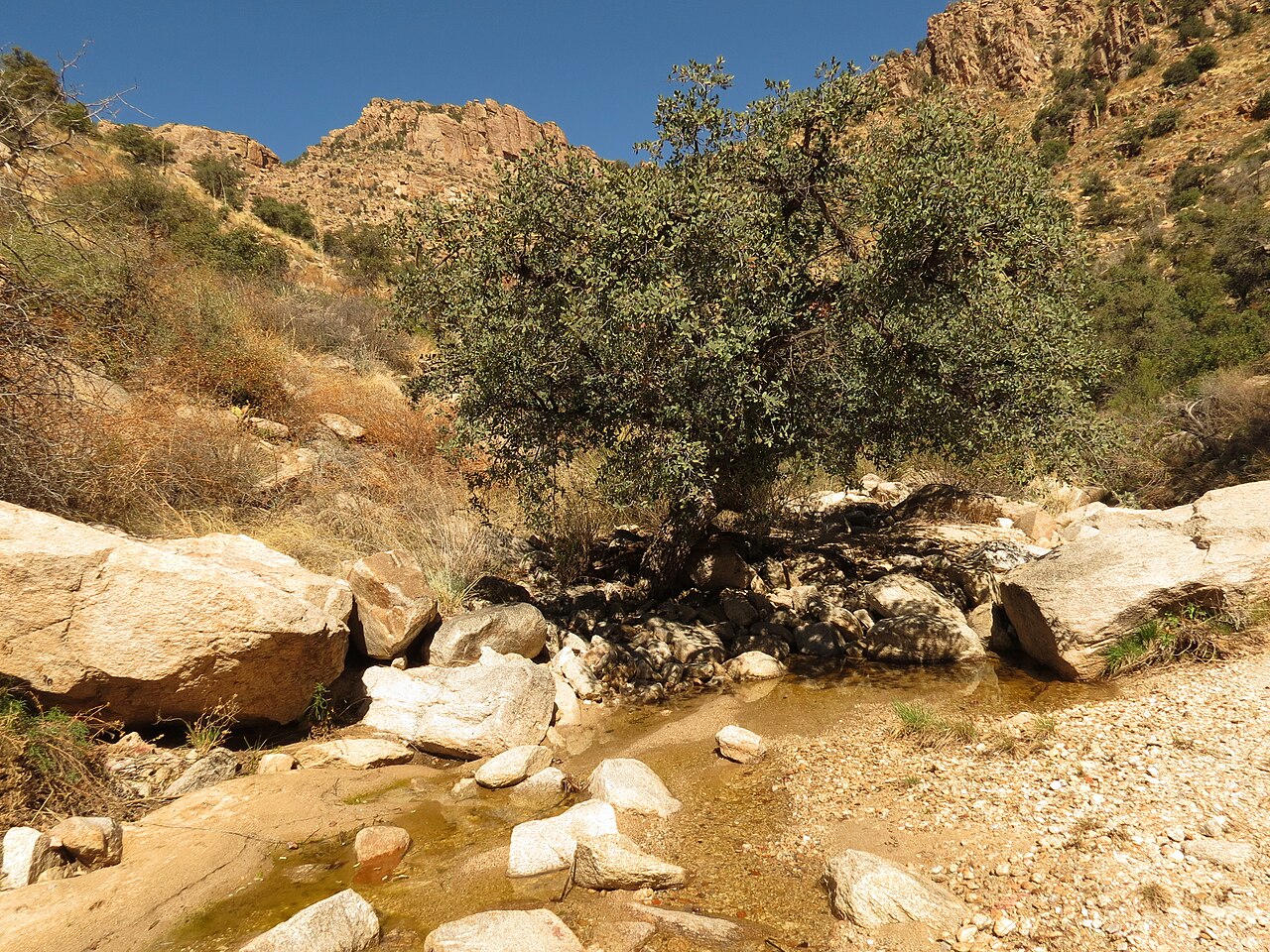
Within this range, Mexican blue oak is typically found at elevations between about 4,000 and 6,000 feet, in open oak woodlands and encinal grasslands below the pine-oak belt. It is often the dominant tree at the lower, drier edge of this zone, giving way to Arizona white oak and Emory oak as elevation and moisture increase. It also appears as a component of pinyon-juniper woodland and in mesic canyon bottoms of the Trans-Pecos, where it grows alongside gray oak.
Mexican blue oak is a true desert-grassland oak: it grows on thin, rocky, often limestone-influenced soils in a semi-arid climate where many oaks could not survive. Because its native range in the United States is narrow — essentially restricted to extreme southeastern Arizona, southwestern New Mexico, and a few far-western Texas canyons — gardeners elsewhere in the Southwest, including coastal and central California, should treat it as a regionally appropriate choice for xeriscaping rather than a native planting.
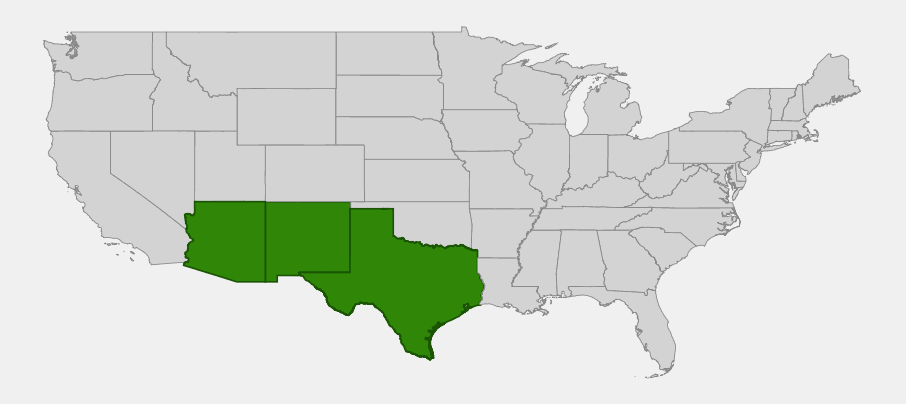
📋 Regional plant lists featuring Mexican Blue Oak: Arizona & New Mexico
Growing & Care Guide
Mexican blue oak is a low-maintenance, slow-growing tree built for heat and drought. Once established, it needs remarkably little care, which is exactly why it has become a favorite xeriscape and courtyard tree across the hot, dry Southwest.
Light
Give Mexican blue oak full sun. In the wild it grows in open grassland and on exposed rocky slopes with little overhead shade, and it performs best in a garden setting with the same strong, unfiltered light. It tolerates reflected heat from walls, pavement, and rock very well, making it a good choice near patios and driveways in hot climates.
Soil & Water
Plant Mexican blue oak in well-drained, rocky or gravelly soil; it is not suited to heavy clay or any soil that stays wet. Water young trees regularly through their first two summers to establish a deep root system, then taper off sharply. Established trees are extremely drought tolerant and generally thrive on natural rainfall alone in their native range, needing only occasional deep watering during extended drought in a garden setting. Overwatering, especially in poorly drained soil, is a far greater risk to this species than underwatering.
Planting Tips
Plant from containers in fall or early spring to allow roots to establish before the heat of summer. Because it develops a deep taproot like most oaks, smaller container stock transplants more reliably than larger field-grown trees. Choose a site with excellent drainage, ideally on a slope or raised area, and avoid low spots where water collects. Mexican blue oak tolerates poor, rocky, low-fertility soil and needs no soil amendment at planting.
Pruning & Maintenance
Minimal pruning is needed beyond removing dead or crossing branches and shaping young trees to a single trunk if a tree form (rather than a multi-stemmed shrub form) is wanted. Established trees are slow growing and rarely need corrective pruning. The species has few serious pest or disease problems in its native climate and does not need regular fertilizing.
Landscape Uses
- Xeriscape and water-wise gardens, as a true low-water, evergreen shade tree
- Courtyard and patio tree, valued for filtered shade and silvery-blue foliage
- Natural desert grassland and oak woodland restoration in southeastern Arizona and southwestern New Mexico
- Rock gardens and slopes where drainage is excellent
- Wildlife gardens, for browse and acorn production
- Screening or informal hedgerow when planted in groups as a large shrub
Wildlife & Ecological Value
As one of the dominant trees of the Southwest’s oak grasslands, Mexican blue oak supports a wide range of desert and mountain wildlife throughout the year.
For Pollinators
Mexican blue oak is wind-pollinated, so its small spring catkins attract little direct pollinator activity. Its broader value to insects comes from the leaves and canopy, which host a variety of native insects including gall-forming wasps; the distinctive growths they produce on leaves and twigs are a common and harmless sight on this species.
For Birds
Acorns provide an important food source for scrub-jays, woodpeckers, and other oak woodland birds, while the evergreen canopy offers year-round nesting and roosting cover in a landscape where dense cover is otherwise scarce. Many desert and grassland bird species rely on oak groves like those formed by Mexican blue oak as islands of shelter in open country.
For Mammals
White-tailed and mule deer browse the foliage heavily throughout the year, and in Arizona’s Pusch Ridge Wilderness, Mexican blue oak is a major browse species for desert bighorn sheep. Acorns are eaten by collared peccary (javelina), squirrels, and other rodents, as well as cattle where oak woodland is grazed. The dense multi-stemmed form of many trees also provides cover for smaller mammals.
Ecosystem Role
Mexican blue oak is a foundational species of Madrean oak woodland and semi-desert grassland, anchoring thin, rocky soils and providing one of the few sources of shade, cover, and mast in a landscape dominated by grass and scrub. Its presence marks the transition zone between desert grassland below and pine-oak woodland above, and its acorn crop is a key resource during the dry foresummer before monsoon rains arrive.
Cultural & Historical Uses
Mexican blue oak’s hard, heavy wood has long been cut in small amounts for fuel and furniture in the ranching communities of its range, though its typically small, twisted trunk limits its use as structural lumber. Like other acorn-bearing oaks of the Southwest, its nuts were historically gathered by Indigenous peoples of the borderlands region as a wild food source, though they are more bitter than those of the chinkapin oak and would have required leaching before eating.
In the ranchlands of southeastern Arizona and northern Mexico, Mexican blue oak woodland has long served as rangeland, with cattle grazing the understory grasses beneath an open canopy of oaks. The trees themselves provide valued shade for livestock in a climate where summer heat is intense.
More recently, Mexican blue oak has found a second life as an ornamental and drought-tolerant landscape tree. Its silvery-blue foliage and tolerance for heat and poor soil have made it popular in large-scale regional plantings, most notably in extensive tree plantings at corporate and civic sites in California using selections sourced from Arizona populations, which has broadened the tree’s profile among Southwestern gardeners well beyond its native range.
Frequently Asked Questions
Is Mexican blue oak native to California?
No. Mexican blue oak is native to southeastern Arizona, southwestern New Mexico, and far western Texas, along with parts of northern Mexico. It has become popular in California landscaping for its drought tolerance and blue-gray foliage, but it is not native there; California’s own true blue oak, Quercus douglasii, is a different species.
How much water does Mexican blue oak need?
Very little once established. In its native range it survives on seasonal rainfall in a semi-arid climate, and in a garden setting established trees typically need only occasional deep watering during extended drought. Regular watering is most important during the first two growing seasons after planting; overwatering or poor drainage afterward is a bigger risk than too little water.
Does Mexican blue oak lose its leaves in winter?
No, it is evergreen. Leaves are shed and replaced gradually throughout the year rather than all at once, with the heaviest leaf turnover happening in spring around flowering time, so the canopy always has some green foliage.
How fast does Mexican blue oak grow?
It is a slow-growing tree, which is typical of oaks adapted to dry, low-fertility soils. Gardeners should expect modest annual growth and plan for a long-term landscape tree rather than quick shade; the payoff is an unusually tough, long-lived, low-water specimen.
Can Mexican blue oak be grown as a shrub or hedge?
Yes. At higher, more exposed elevations it naturally grows as a large, multi-stemmed shrub rather than a single-trunked tree, and this habit can be encouraged in cultivation by leaving multiple stems and planting in groups for an informal screen or hedgerow.

Looking for a nursery that carries Mexican Blue Oak?
Browse our native plant nursery directory: Arizona · New Mexico · Texas