Poison Sumac (Toxicodendron vernix)
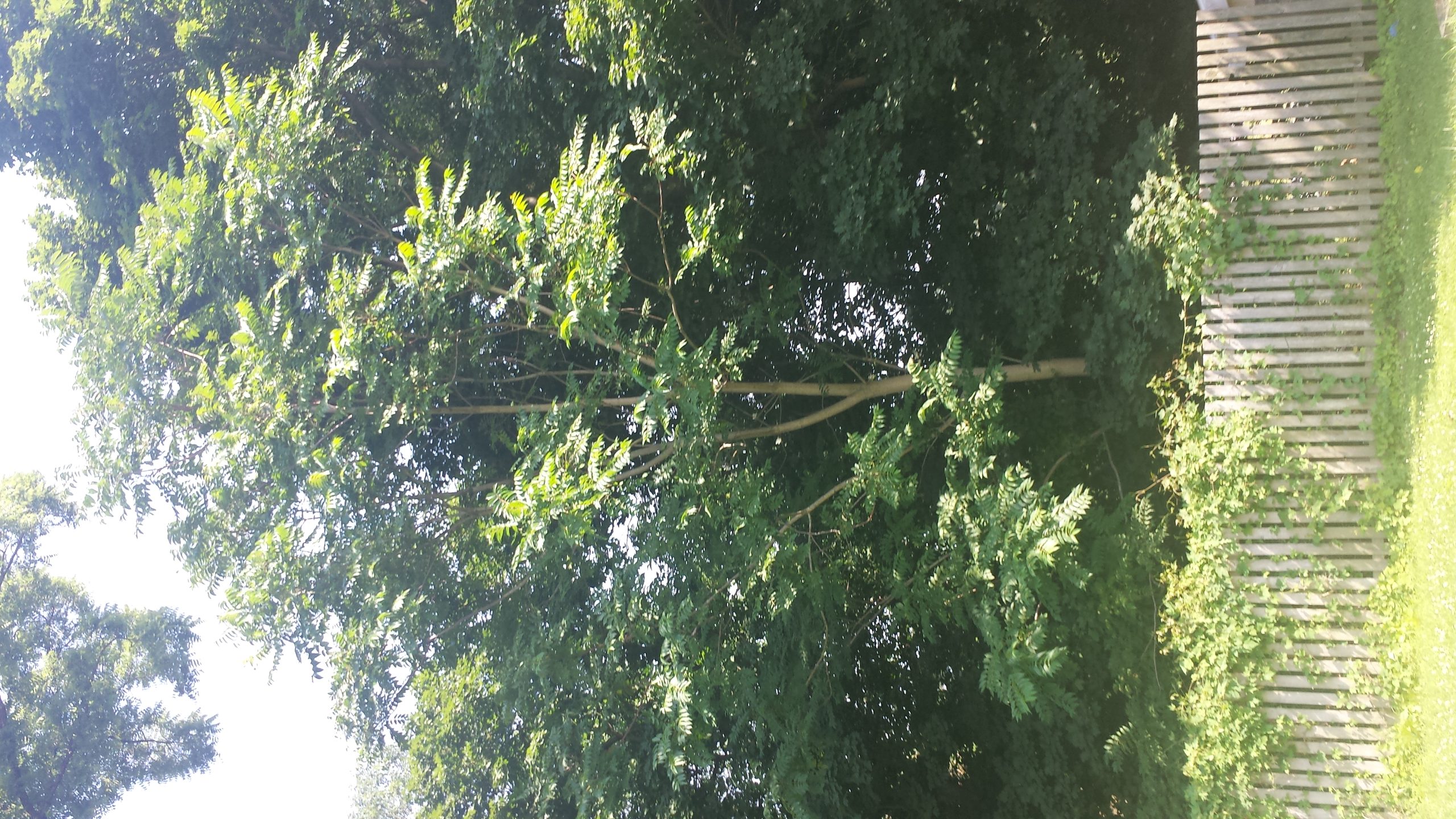
Toxicodendron vernix, commonly known as Poison Sumac, is a native wetland shrub or small tree found exclusively in swamps, bogs, and other consistently wet soils across the eastern United States. It is a true native plant with real ecological value — but it is also, by a wide margin, the most severely allergenic plant native to North America, more potent than its well-known relatives Poison Ivy and Poison Oak.
This page is included for identification and ecological context, not as a gardening recommendation: Poison Sumac is not planted or sold as an ornamental, and it should never be introduced into a home landscape. Understanding what it looks like and where it grows is nonetheless valuable for anyone working, hiking, or restoring habitat in or near wetlands within its native range, since accidental exposure can cause a severe, long-lasting skin reaction.
All parts of the plant — leaves, stems, bark, and fruit — contain urushiol, the same oily resin found in Poison Ivy and Poison Oak, but in Poison Sumac it is present in higher concentration. Despite its danger to people, the plant is a legitimate, unmanaged part of healthy wetland and bog ecosystems, and its fruit is an important winter food source for birds.
Identification
Correctly identifying Poison Sumac is a safety skill as much as a botanical one. It is most reliably told apart from harmless sumacs and other wetland shrubs by its smooth-edged leaflets, wetland habitat, and whitish fruit.
Stems & Bark
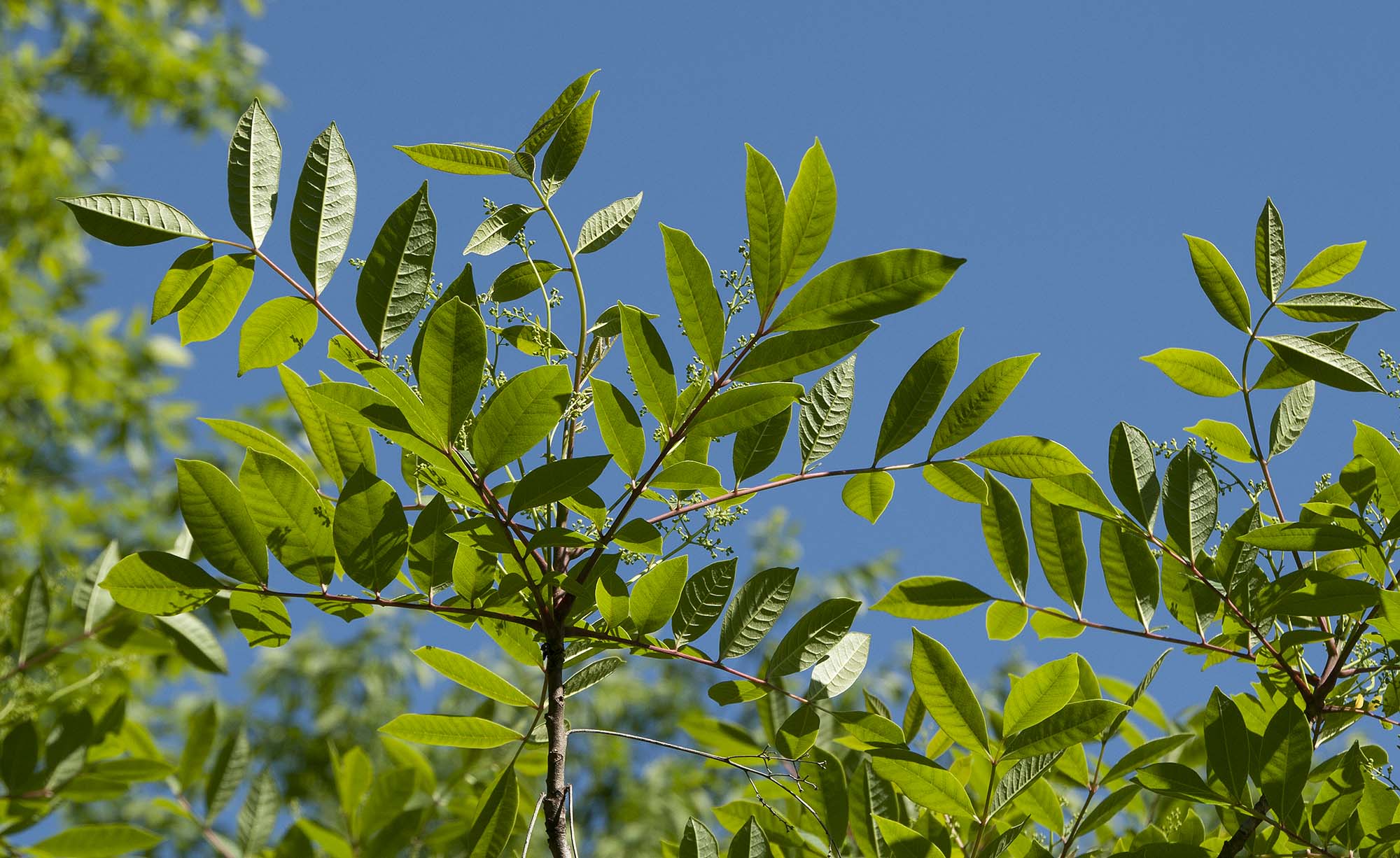
Poison Sumac grows as a many-stemmed shrub or small tree up to 30 feet tall, though most plants are considerably smaller. Young twigs and leaf stalks are often reddish, a helpful field clue. Bark on older stems is light gray and smooth, darkening and roughening somewhat with age, but it lacks the dense hairiness seen on the fruit clusters of the common, harmless staghorn sumac.
Leaves
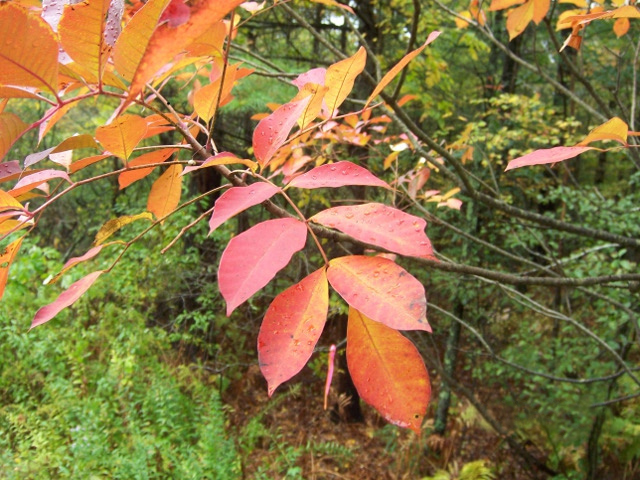
Leaves are pinnately compound, 7 to 15 inches long, with 7 to 13 leaflets arranged in pairs plus one terminal leaflet. Each leaflet is oval to oblong, 2 to 4 inches long, with a smooth (entire) margin — unlike the toothed-edge leaflets of the common, non-toxic sumacs (staghorn and smooth sumac) that often grow in the same general region. This smooth-margined leaflet is the single most useful identification trait. Foliage often has a reddish tint, especially on new growth and leaf stalks, and turns brilliant orange, red, and yellow in autumn.
Flowers & Fruit
Small, greenish flowers are borne in loose, drooping clusters from the leaf axils in late spring. These develop into clusters of small, round, whitish to grayish-tan fruits, roughly ¼ inch across, that hang in loose panicles and persist into winter. This pale, drooping fruit is another key difference from the harmless sumacs, whose fruit is a dense, upright, fuzzy red cone.
Quick Facts
| Scientific Name | Toxicodendron vernix (syn. Rhus vernix) |
| Family | Anacardiaceae (Cashew/Sumac) |
| Plant Type | Deciduous Shrub / Small Tree |
| Mature Height | 6–30 ft |
| Mature Spread | 8–15 ft |
| Growth Rate | Moderate |
| Sun Exposure | Full Sun to Part Shade |
| Water Needs | Wet; requires saturated or standing water soils |
| Soil Type | Peat, muck, or wet clay; swamps and bogs |
| Soil pH | Acidic (common in bogs and peatlands) |
| Bloom Time | May – June |
| Flower Color | Greenish |
| Fall Color | Brilliant orange, red, and yellow |
| Fruit | Whitish-gray drooping berry clusters |
| Deer Resistant | Yes (foliage is not browsed by deer) |
| USDA Hardiness Zones | 4–9 |
Native Range
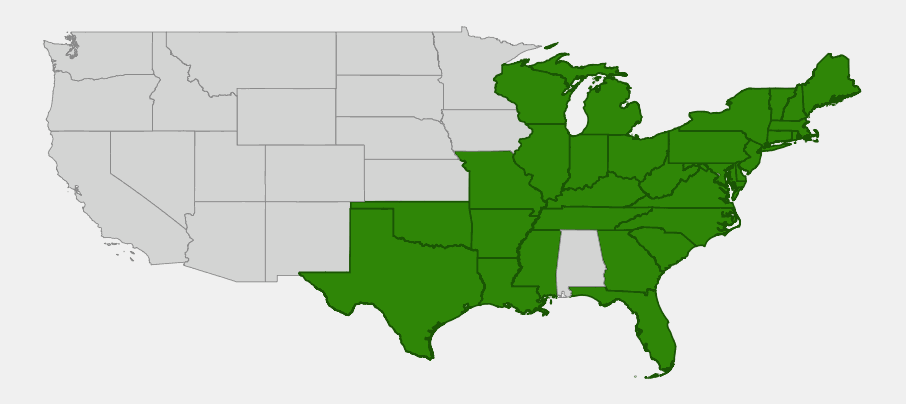
Poison Sumac is native to the eastern United States and extreme southeastern Canada, with a range that stretches from Maine and the Canadian Maritimes south to Florida and west to Texas, Missouri, Illinois, Wisconsin, and Michigan. Within this broad outline, however, it is a habitat specialist and is absent from most of any given landscape — it grows only where soils are consistently waterlogged.
Look for it specifically in sphagnum bogs, wooded swamps, pocosins, and the saturated, peaty or mucky margins of ponds and slow streams. It is typically found in standing water or soil that remains saturated for most of the growing season, a habitat requirement that sharply limits where it occurs even within states where it is present. It is notably absent from Alabama despite being documented in all of the neighboring states.
Because Poison Sumac requires true wetland conditions, it is rarely encountered on typical dry upland trails; most people who develop a reaction have been in or very near a swamp, bog, or wet woodland edge. This habitat restriction is one of the more reliable ways, alongside leaf shape, to distinguish it from harmless upland sumacs.
📋 Regional plant lists featuring Poison Sumac: New Hampshire, Maine & Vermont · Connecticut, Massachusetts & Rhode Island · New York, Pennsylvania & Northern New Jersey · Delaware, Southern New Jersey & Long Island · Maryland, Virginia & West Virginia · North Carolina & South Carolina · Georgia, Alabama & Mississippi · Arkansas, Louisiana, Eastern Oklahoma & Eastern Texas · Kentucky & Tennessee · Ohio & Indiana · Illinois, Iowa & Missouri · Michigan, Wisconsin & Eastern Minnesota
Growing & Care Guide
Poison Sumac is not a plant to grow, buy, or encourage in a garden. It is included on PlantNative for identification, safety, and ecological awareness, not as a landscaping recommendation. If you have identified it on your own property, the sections below explain how it is managed rather than cultivated.
Why It Isn’t a Garden Plant
Every part of Poison Sumac — leaves, stems, bark, roots, and fruit — contains urushiol, an oily resin that causes an allergic skin reaction (contact dermatitis) in the large majority of people who touch it, typically appearing as redness, intense itching, and blistering within 12 to 72 hours of contact. Poison Sumac’s reaction is generally considered more severe than that from Poison Ivy or Poison Oak. Burning the plant is especially dangerous: smoke can carry urushiol into the lungs, causing severe respiratory distress that has in rare cases been fatal. Never burn Poison Sumac or brush piles that may contain it.
If You Find It on Your Property
Because it only grows in truly wet, swampy soil, Poison Sumac is usually confined to specific low, saturated spots rather than scattered throughout a property. If removal is necessary, wear full protective clothing including long sleeves, gloves rated for chemical contact, and eye protection, and avoid all skin contact; cut stems and treat with an approved brush herbicide per label directions, or consult a professional applicator experienced with Toxicodendron species. Never mow or weed-whack it, since this aerosolizes urushiol-containing plant material.
Safe Coexistence
In many cases, especially in a wetland, bog, or natural area away from foot traffic, the safest and most ecologically sound approach is to identify the plant, mark or fence the area if needed, and leave it in place as a functioning part of the wetland community, simply avoiding contact.
Landscape Uses
- None recommended — this species should not be intentionally planted
- Left in place within undisturbed wetlands and bogs as part of the native plant community
- Identification training for land managers, trail crews, and hunters working in wetland habitat
Wildlife & Ecological Value
Despite its hazard to people, Poison Sumac is not toxic to wildlife and plays a legitimate, even valuable, role in wetland food webs.
For Birds
The whitish fruit clusters persist through winter and are an important food source for many bird species, including woodpeckers, bobwhite quail, eastern bluebirds, and various migrating songbirds, especially when other food is scarce in the colder months.
For Mammals
Deer and rabbits do not browse the foliage, which is part of why the species can persist undisturbed in wetland habitat. Small mammals occasionally use dense Poison Sumac thickets for cover.
For Pollinators
The small spring flowers are visited by various native bees and flies, providing a minor but real nectar source in the wetland habitats where the plant grows, at a time of year when few other wetland shrubs are in bloom.
Ecosystem Role
As an obligate wetland species, Poison Sumac is an indicator of intact bog and swamp habitat and contributes structural diversity to these increasingly rare ecosystems. Its presence alongside species like Atlantic white cedar and sphagnum moss signals a healthy, undisturbed wetland community worth protecting rather than draining or clearing.
Cultural & Historical Uses
Poison Sumac has no history of food, medicinal, or craft use among Indigenous peoples or settlers, unlike many of its relatives in the cashew family — its extreme allergenicity made it a plant to avoid rather than utilize. Early American botanical texts from the 18th and 19th centuries consistently described it as a dangerous plant to be recognized and avoided, and it appears in historical “poison plant” guides alongside Poison Ivy and Poison Oak.
One of the more notable historical accounts involves the landscape designer Frederick Law Olmsted, who as a teenager in 1836 accidentally rubbed Poison Sumac into his eyes; the resulting injury affected his vision and disrupted his early education, a disruption that biographers have linked to the unconventional path that eventually led him to landscape architecture and the design of New York’s Central Park.
Today, Poison Sumac’s main cultural relevance is practical: it remains a standard subject in wilderness safety and plant identification education, particularly for hunters, trail crews, foresters, and anyone working in or near eastern wetlands.
Frequently Asked Questions
How do I tell Poison Sumac from harmless sumacs like staghorn sumac?
Check the leaflet margins and the fruit. Poison Sumac has smooth-edged (untoothed) leaflets and pale, whitish-gray fruit that hangs in loose, drooping clusters. Harmless sumacs have toothed leaflet edges and dense, upright, fuzzy red fruit cones. Habitat is another clue: Poison Sumac grows only in standing water or saturated wetland soil, while harmless sumacs grow in dry, sunny, upland sites.
Is Poison Sumac worse than Poison Ivy?
Most sources consider its reaction more severe on a per-contact basis, due to a higher concentration of urushiol, though individual sensitivity varies. Both plants should be avoided equally and taken seriously.
What should I do if I touch Poison Sumac?
Wash the exposed skin as soon as possible with soap and cool water to remove the urushiol oil, and wash any clothing or tools that contacted the plant. Over-the-counter remedies can ease itching, but see a doctor for a severe, widespread, or facial reaction, or if you may have inhaled smoke from burning plant material.
Can I remove Poison Sumac from my property myself?
Only with full protective gear and great care, and never by burning or mowing it. Because it grows in wet, often ecologically sensitive habitat, consider leaving isolated plants in place if they pose no direct contact risk, or hire a professional experienced with Toxicodendron removal for larger infestations.
Does Poison Sumac grow in my state?
It is native to much of the eastern U.S., from Maine to Florida and west to Texas, Missouri, and Wisconsin — see the state list above — but only within true wetland habitat such as bogs and swamps. It is not found statewide even within states where it occurs, and it is notably absent from Alabama.

Looking for a nursery that carries wetland-safe native plants instead?
Browse our native plant nursery directory for your region: Kentucky, Louisiana, Maine, Maryland, Massachusetts, Michigan, Mississippi & Missouri · New Hampshire, New Jersey, New York, North Carolina, Ohio & Oklahoma · Pennsylvania, Rhode Island, South Carolina, Tennessee, Texas & Vermont · Connecticut, Delaware, Florida & Georgia · West Virginia & Wisconsin · Arkansas · Illinois & Indiana