
Fraser Magnolia (Magnolia fraseri)
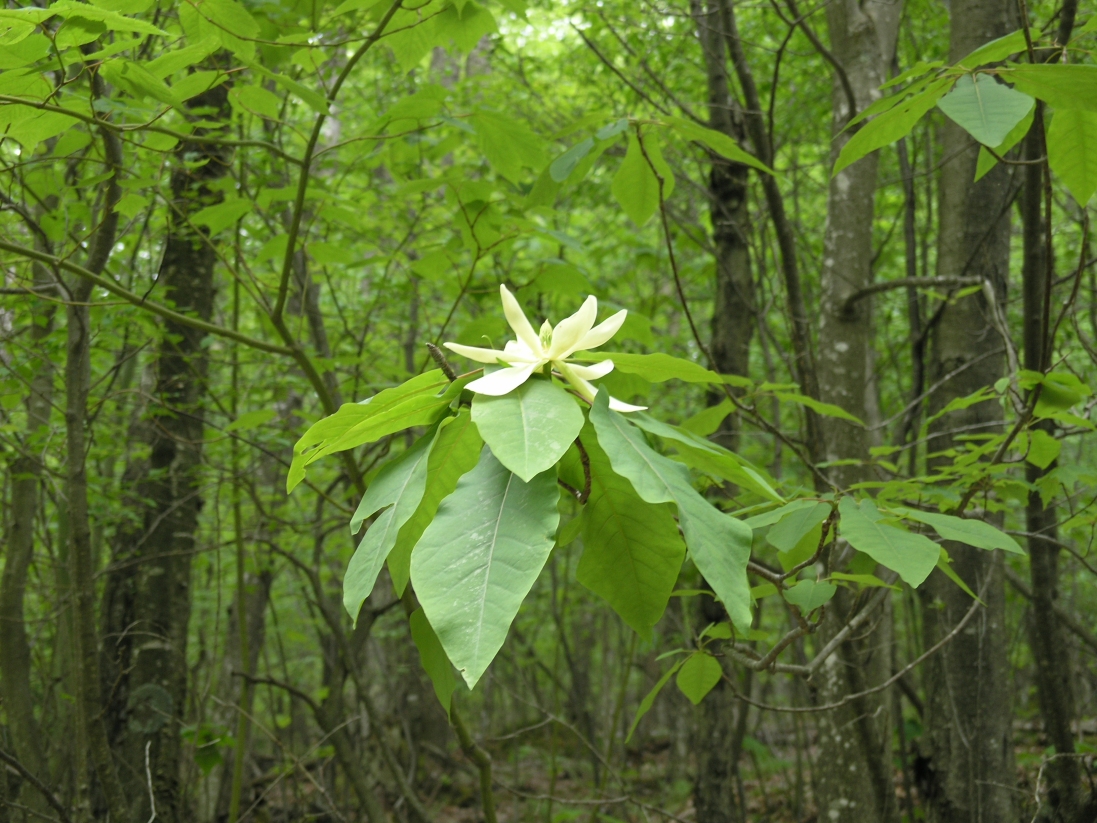
Magnolia fraseri, commonly called Fraser magnolia or mountain magnolia, is a small to medium deciduous tree found in the cove forests and mountain slopes of the southern and central Appalachians. It belongs to the Magnoliaceae family and is easy to pick out even from a distance in late spring, when its enormous creamy white flowers open above whorls of equally oversized, paddle-shaped leaves. The species name honors Scottish botanist John Fraser, who collected plants throughout the southern mountains in the late 1700s.
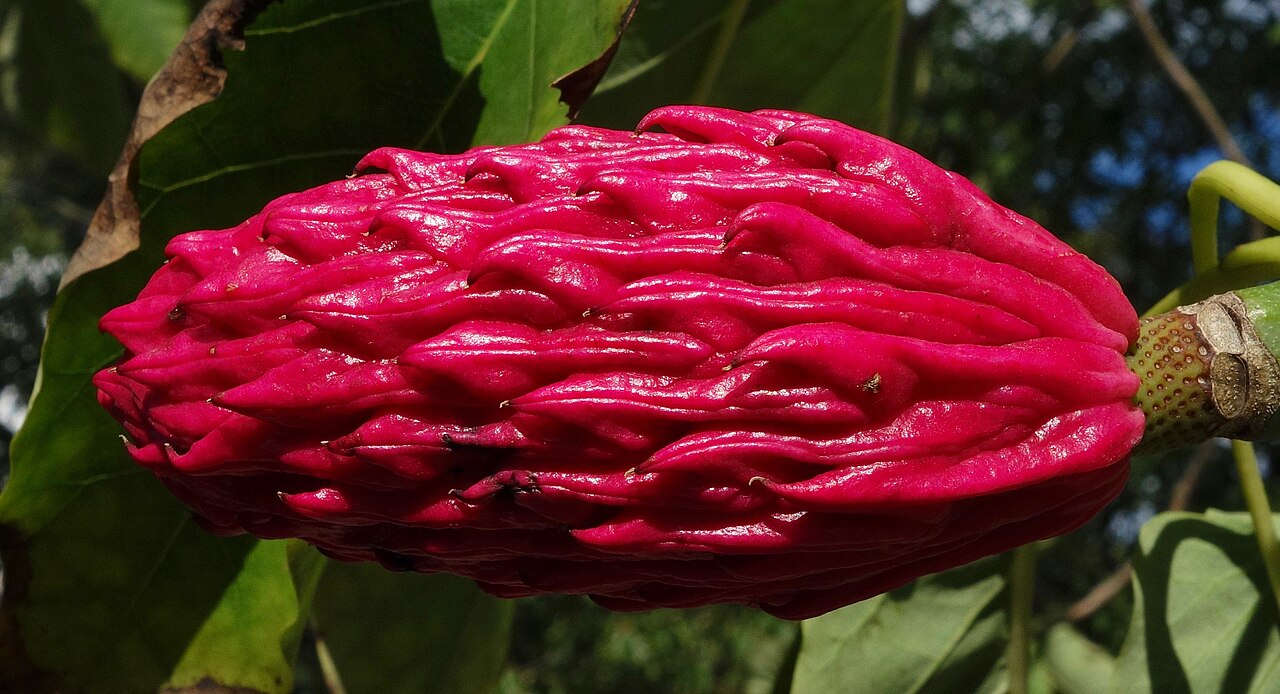
In the wild, Fraser magnolia grows as an understory or mid-canopy tree in rich, moist coves and on shaded slopes, usually reaching 30 to 50 feet, occasionally taller in old-growth conditions. Its bark is smooth and gray, its leaves are unmistakably auriculate — meaning they have two small ear-like lobes at the base — and its fruit matures into a bright rose-pink, cone-like cluster of follicles that splits open in early fall to release orange-red seeds on thin silk threads. Few native Appalachian trees put on a more dramatic fruit display.
Fraser magnolia is a good choice for a shaded or partly shaded native garden within or near its home range, where it adds a tropical-looking texture that is otherwise hard to find in cold-hardy trees. It needs rich, consistently moist soil and some protection from harsh afternoon sun and wind, which can tatter its large leaves. Outside its native mountains it is sometimes planted as an ornamental alternative to the more commonly sold southern magnolia, since it tolerates colder winters.
Identification
Fraser magnolia is a single-trunked deciduous tree, typically 30 to 50 feet tall with a rounded, somewhat open crown, though exceptional specimens in sheltered coves can reach 70 to 80 feet. Young trees often have a pyramidal shape that becomes broader and more spreading with age. The overall silhouette, especially in winter, has a coarse, open branching pattern typical of magnolias.
Bark & Stems
The bark is thin, smooth, and light gray, developing shallow ridges and a slightly warty texture with age, somewhat similar to American beech but less polished. Young twigs are stout, green to reddish-brown, and carry large, naked flower buds covered in fine silvery hairs rather than bud scales — a trait shared with other magnolias in this group.
Leaves
Leaves are among the largest of any eastern U.S. tree: 8 to 12 inches long (occasionally over 20 inches) and 4 to 8 inches wide, obovate to spoon-shaped, with smooth margins and a distinctive pair of ear-like lobes (auricles) flanking the petiole — the single best field mark for this species. Leaves are typically clustered near branch tips in whorl-like arrangements, bright green above and paler, slightly glaucous beneath. Fall color is an unremarkable yellow-bronze before the large leaves drop.
Flowers
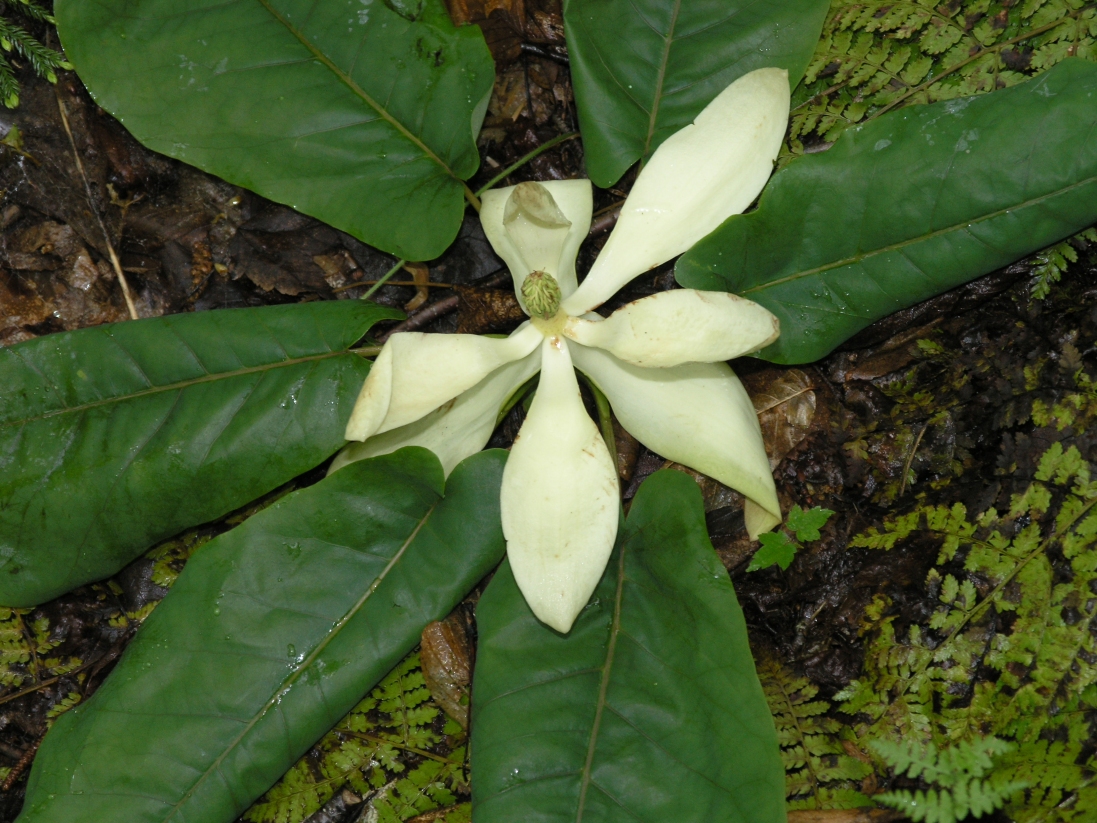
Flowers open after the leaves have expanded, from late April into June depending on elevation, and are enormous — 8 to 10 inches across — with 9 creamy white, strap-like tepals arranged around a prominent central column of pistils and stamens. The flowers carry a strong, sweet fragrance that can be noticed from a distance along mountain trails. Because they open high in the canopy of larger specimens, the blooms are often more easily smelled than seen.
Fruit & Seeds
The fruit is a cone-like aggregate of follicles, 3 to 5 inches long, that ripens from green to a vivid rose-red to magenta by late summer. In early fall the follicles split open and orange-red seeds dangle briefly on thin silk-like threads before dropping or being taken by birds and small mammals. This fruiting display is one of the most striking of any native Appalachian tree and a good reason to plant it where it can be seen in September.
Quick Facts
| Scientific Name | Magnolia fraseri Walter |
| Family | Magnoliaceae (Magnolia) |
| Plant Type | Deciduous Tree |
| Mature Height | 30–50 ft (rarely to 80 ft in coves) |
| Mature Spread | 20–35 ft |
| Growth Rate | Medium |
| Sun Exposure | Part Shade to Full Shade |
| Water Needs | Moderate to High, consistent moisture |
| Soil Type | Rich, moist, well-drained loam |
| Soil pH | 5.0–6.5 (acidic) |
| Bloom Time | Late April – June |
| Flower Color | Creamy white |
| Fall Color | Yellow-bronze |
| Fruit | Rose-pink cone-like aggregate of follicles |
| Deer Resistant | Moderate (seedlings may be browsed) |
| USDA Hardiness Zones | 5–8 |
Native Range
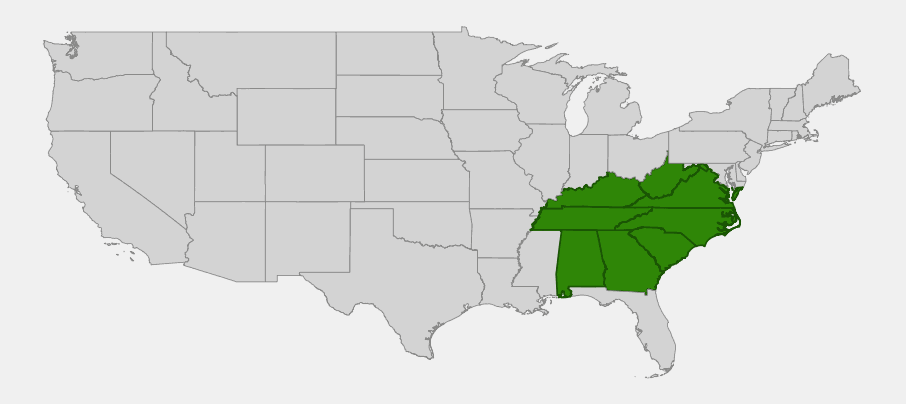
Fraser magnolia is a southern and central Appalachian endemic. Its core range runs from West Virginia and Virginia south through the mountains of Kentucky, Tennessee, North Carolina, and South Carolina to northern Georgia and Alabama, generally following the ridges and coves of the Appalachian chain rather than the surrounding lowlands. It is almost entirely a mountain species, rarely found far from elevations where cool, moist cove conditions persist through summer.
Within this range it grows on moist, well-drained slopes and in rich cove forests, often alongside other mountain hardwoods. It is most frequent at middle elevations, from roughly 1,000 to 4,500 feet, where fog and orographic rainfall keep the soil consistently moist. It is less common at the lowest elevations of its range and largely absent from the drier ridgetops.
Fraser magnolia is a true understory and mid-canopy associate of the Appalachian cove hardwood forest, a community prized for its diversity. It is not weedy or aggressive and does not spread outside this mountain range on its own; gardeners well outside the Appalachians who want to grow it should treat it as a planted ornamental rather than a locally native species.
📋 Regional plant lists featuring Fraser Magnolia: Maryland, Virginia & West Virginia · North Carolina & South Carolina · Georgia, Alabama & Mississippi · Kentucky & Tennessee
Growing & Care Guide
Fraser magnolia asks for conditions that mimic its native cove habitat: rich soil, reliable moisture, and some relief from harsh sun and wind. Given those basics it is a relatively trouble-free, long-lived tree that rewards patience with an increasingly dramatic spring and fall show as it matures.
Light
In the wild this tree grows as an understory to mid-canopy species, and it performs best in part shade, especially with some protection from intense afternoon sun. It will tolerate more sun in cooler, consistently moist sites, but in hot or dry conditions full sun can scorch the oversized leaves. Dappled light under taller canopy trees, or morning sun with afternoon shade, suits it well.
Soil & Water
Give Fraser magnolia rich, well-drained, consistently moist, slightly acidic soil. It does not tolerate standing water or heavy clay that stays saturated, but it also does not tolerate prolonged drought — the huge leaves wilt and brown at the edges quickly in dry spells. A deep organic mulch layer that mimics the leaf litter of a cove forest floor helps retain moisture and keep roots cool.
Planting Tips
Plant in fall or early spring, choosing a sheltered site out of strong wind, which can shred the large leaves. Dig a wide planting hole and amend heavy or sandy soils with compost to improve both drainage and moisture retention. Container-grown stock transplants more reliably than bare-root trees, since magnolias in general have fleshy, easily damaged roots.
Pruning & Maintenance
Little pruning is needed beyond removing dead, damaged, or crossing branches in late winter. Avoid heavy pruning, since magnolias are slow to heal large wounds and can be more vulnerable to decay afterward. Keep a consistent watering schedule through the first two or three summers while the root system establishes.
Landscape Uses
Fraser magnolia fits several native garden roles:
- Woodland garden specimen beneath taller shade trees
- Shaded native plantings where bold, tropical-looking foliage is wanted
- Streamside or cove-style plantings that echo its natural habitat
- Specimen tree for fall fruit display near a path or patio
- Wildlife garden — fruit and seeds draw birds and small mammals
Wildlife & Ecological Value
Fraser magnolia contributes to the layered structure and food web of the Appalachian cove forest in ways that extend well beyond its showy flowers.
For Pollinators
Like other magnolias, Fraser magnolia is pollinated primarily by beetles, an ancient relationship that predates bees in the fossil record of flowering plants. The large, bowl-shaped flowers and tough, leathery tepals are well suited to withstand chewing beetle visitors, while the strong fragrance draws them in from a distance.
For Birds
The bright red seeds that dangle from the split follicles in early fall are eaten by a variety of songbirds, which help disperse seeds away from the parent tree. The structure of a mature tree, with its broad leaves and open branching, also offers nesting cover in the mid-canopy of cove forests.
For Mammals
Squirrels and other small mammals feed on the seeds, and the northern flying squirrel — an animal of conservation concern in parts of the central Appalachians — is known to use Fraser magnolia cavities and branches as nest sites in some mountain forests.
Ecosystem Role
As a mid-canopy associate in diverse cove hardwood forests, Fraser magnolia adds structural and seasonal variety: large leaves that break down quickly and enrich the soil, an early-summer nectar and pollen source for beetles, and a conspicuous fall fruit crop that times its seed release to coincide with fall bird migration.
Cultural & Historical Uses
Fraser magnolia was first collected and described from the southern Appalachians in the late 18th century by the Scottish botanist John Fraser, whose extensive plant-hunting expeditions through the Carolinas and Georgia introduced many southeastern species to European horticulture. The tree’s striking flowers and foliage made it a notable discovery among the many magnolias native to the southeastern United States.
Within its mountain range, the tree has largely been valued for its ornamental qualities rather than for timber or other commercial uses — its wood is similar to other magnolias but was never harvested at any scale, and its scattered distribution in rich coves kept it out of large-scale logging operations that targeted more common hardwoods.
Today Fraser magnolia is mostly grown as a specimen ornamental, both within its native range and considerably further north, since it is more cold-hardy than many other large-flowered magnolias. It remains best known among hikers and naturalists who encounter its huge, fragrant flowers and later its scarlet-seeded fruit along Appalachian trails.
Frequently Asked Questions
How is Fraser magnolia different from southern magnolia?
Southern magnolia (Magnolia grandiflora) is evergreen with glossy leaves and is native to the warmer coastal Southeast, while Fraser magnolia is deciduous, has much larger, ear-lobed leaves, and is native to cooler Appalachian mountain forests. Fraser magnolia is considerably more cold-hardy.
Will Fraser magnolia grow in full sun?
It can, but only with consistently moist, rich soil; in drier or hotter sites the large leaves scorch badly in full sun. Part shade with protection from harsh afternoon exposure gives the most reliable results outside of a naturally moist cove setting.
How long before a young Fraser magnolia flowers?
Expect several years, often five to ten, before a young tree produces its first flowers, which is typical for magnolias grown from seed or young nursery stock. Growth and flowering both speed up once the root system is well established.
Are the seeds or fruit edible?
No. The fruit and seeds are not used as human food; they are a wildlife food source only, and no part of the plant is considered edible.
Is Fraser magnolia invasive anywhere?
No. It is a slow-growing, non-aggressive native tree that stays within its mountain cove habitat and is not known to spread as a weed, either within or outside its native Appalachian range.

Looking for a nursery that carries Fraser Magnolia?
Browse our native plant nursery directory: West Virginia · Virginia, Tennessee & South Carolina · Kentucky · North Carolina · Georgia · Alabama