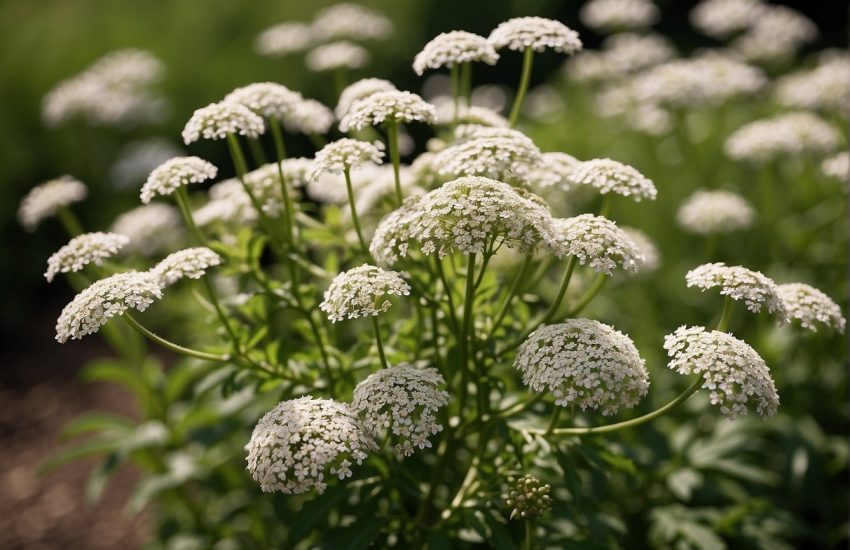
Climbing Hempvine (Mikania scandens)
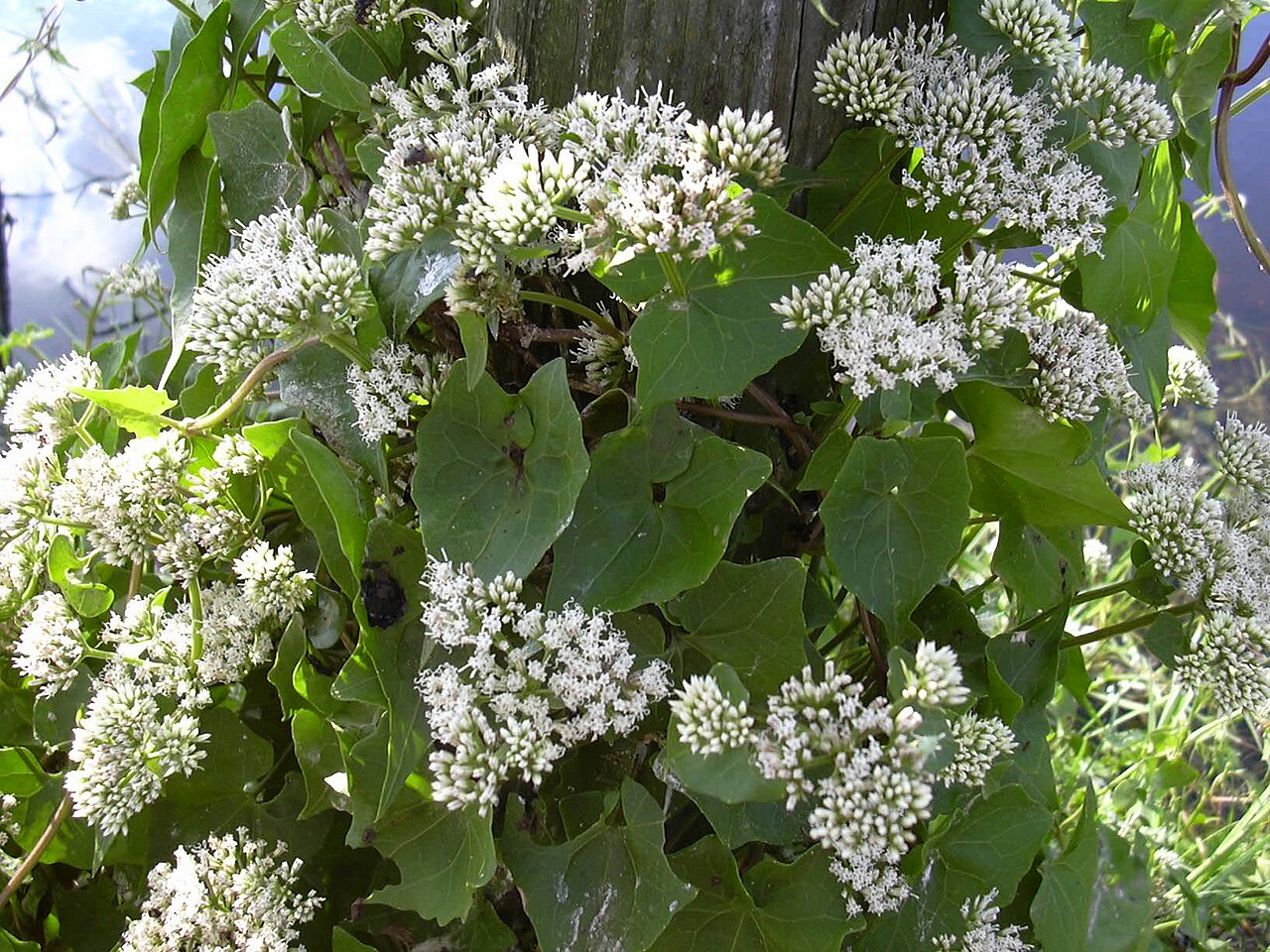
Mikania scandens, commonly known as climbing hempvine or climbing hempweed, is a fast-growing, twining perennial vine in the aster family (Asteraceae) — an unusual family for a vine, since most Asteraceae are upright herbs. It is native to wet ground across a broad swath of the eastern and central United States, where it scrambles over shrubs, fences, and streamside vegetation and produces dense, fuzzy-looking clusters of small white to pale pink flowers from summer into fall.
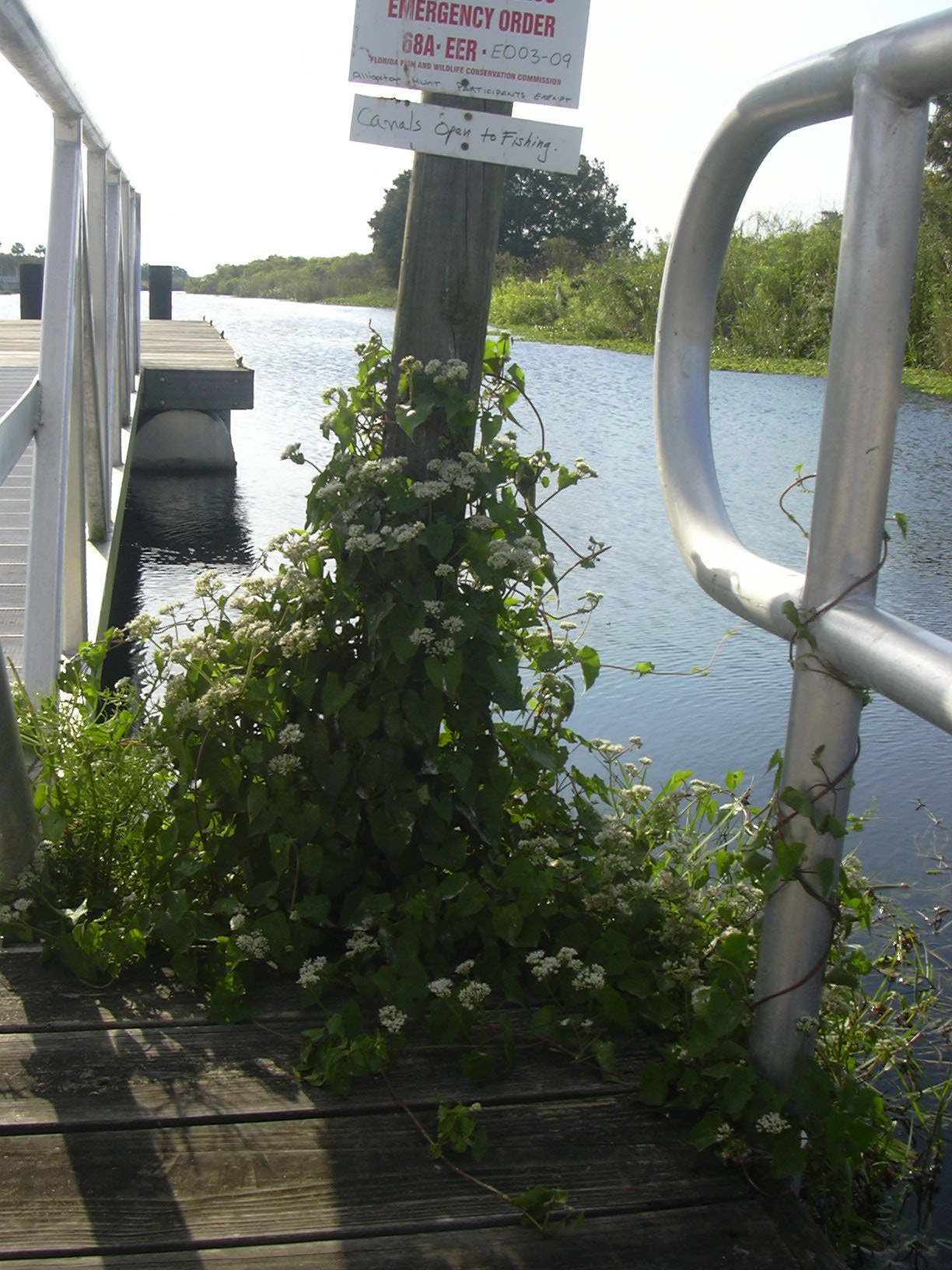
In the wild, climbing hempvine is a plant of wet feet: swamp margins, marsh edges, ditches, pond shores, and floodplain thickets. Its opposite, triangular to heart-shaped leaves and twining habit let it climb quickly over neighboring vegetation, sometimes forming a loose blanket of foliage and bloom over shrubs and fence lines by late summer. Each flower head is tiny, but they are borne in such large, rounded clusters that a flowering vine can look like it is wearing a cloud of small white blossoms.
For a native rain garden, pond margin, or wet ditch bank within its range, climbing hempvine is a useful, fast-covering vine that asks for little beyond consistently moist to wet soil. It is not a woody, permanent structure-builder like many vines; instead it dies back to the root each year in colder parts of its range and regrows vigorously from the base, making it easy to keep in bounds with an annual cutback.
Identification
Climbing hempvine is a slender, twining, herbaceous vine that can reach 10 to 20 feet in length in a single season, climbing by twining its stems around support rather than by tendrils. In colder parts of its range it behaves as a herbaceous perennial, dying back to the ground each winter and resprouting from the rootstock in spring; in the mildest parts of its range the base can become semi-woody.
Stems
Stems are slender, round, and finely ridged, often with a reddish or purplish cast, especially in sun. They twine counterclockwise around whatever support is available — shrub branches, fence wire, cattails, or other upright vegetation — and branch frequently, which lets a single plant cover a surprising amount of ground or structure by late summer.
Leaves
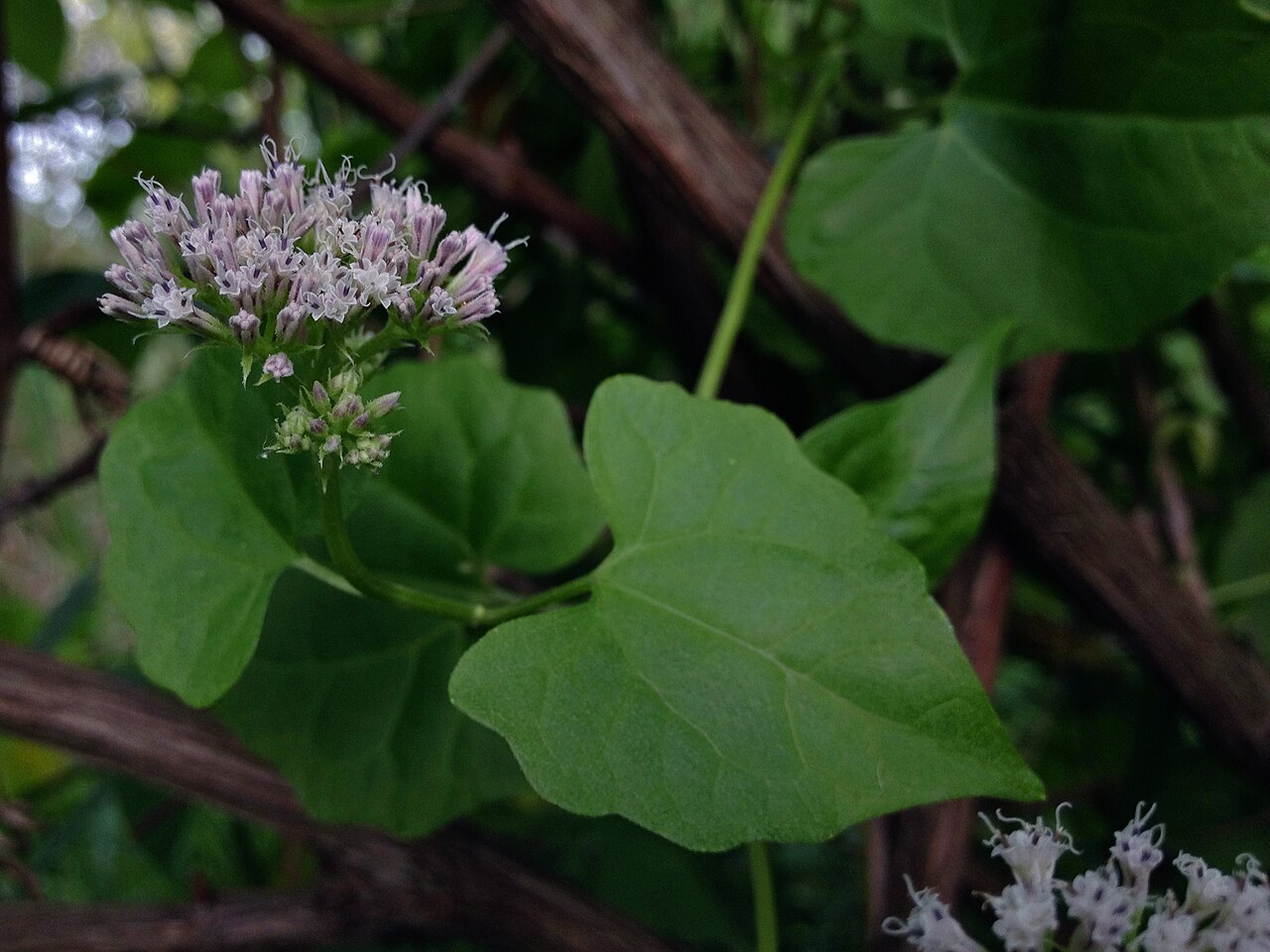
Leaves are opposite, arranged at noticeably swollen nodes, and triangular to heart-shaped (sometimes described as arrowhead-shaped), 2 to 6 inches long, with pointed tips and a toothed or wavy margin. The leaf base is often slightly lobed, echoing the shape of a small ivy leaf, which along with the twining habit is a useful quick identification cue in the field.
Flowers
Flowers bloom from midsummer into fall, in flat-topped to rounded clusters (panicles of small flower heads) at the stem tips and leaf axils. Each individual flower head is tiny — about a quarter inch — and tubular, in whitish to pale pink or lavender-tinged shades, but the sheer number of flower heads packed into each cluster gives the whole plant a frothy, almost fuzzy appearance when it is in full bloom.
Fruit & Seeds
The fruit is a small, dark, resinous achene tipped with a tuft of fine white to purplish bristles (a pappus), similar in structure to a tiny thistle or dandelion seed. These wind-dispersed seeds let the vine colonize new wet ground readily, and broken stem sections can also root at the nodes where they touch moist soil.
Quick Facts
| Scientific Name | Mikania scandens (L.) Willd. |
| Family | Asteraceae (Aster) |
| Plant Type | Herbaceous Perennial Vine |
| Mature Height | Climbing to 10–20 ft |
| Mature Spread | 6–12 ft, spreading as it climbs |
| Growth Rate | Fast |
| Sun Exposure | Full Sun to Part Shade |
| Water Needs | High; wet to consistently moist soil |
| Soil Type | Wet, poorly drained; muck, clay, or loam |
| Soil pH | 5.5–7.0 |
| Bloom Time | July – October |
| Flower Color | White to pale pink |
| Fall Color | Dies back after frost, no notable fall color |
| Fruit | Small bristle-tipped achenes (wind dispersed) |
| Deer Resistant | Moderate |
| USDA Hardiness Zones | 6–10 |
Native Range
Climbing hempvine is native across the eastern and central United States, from Maine and the southern New England coast south through the Mid-Atlantic and the Southeast to Florida and Texas, and inland through the Ohio and Mississippi valleys as far as Missouri and Illinois. Its range extends into the Gulf Coast states and west into eastern Oklahoma and eastern Texas, with scattered populations continuing into Tamaulipas, Mexico. It is one of the more wide-ranging native wetland vines in the eastern U.S.
Throughout this range it is tied closely to wet, open to partly shaded habitat: marsh and swamp edges, wet thickets, ditches, pond and lake margins, floodplain forests, and other seasonally or permanently moist ground. It is generally absent from dry upland sites and from the interior Great Plains and West, where consistently wet habitat of this kind is scarce.
Climbing hempvine is sometimes confused with its more aggressive relative, mile-a-minute weed (Mikania micrantha), which is a serious invasive species in parts of Asia and the Pacific but does not occur in the continental United States. Within its native eastern U.S. range, climbing hempvine behaves as a normal wetland component rather than an aggressive invader, though it can form dense colonies on favorable wet sites.
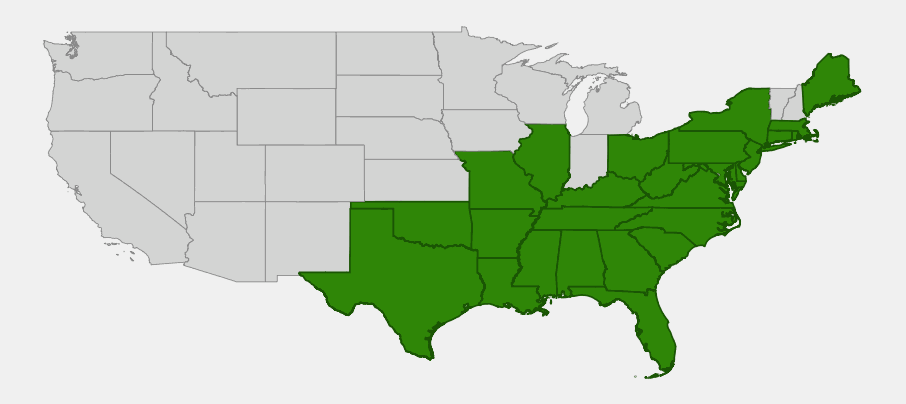
📋 Regional plant lists featuring Climbing Hempvine: New Hampshire, Maine & Vermont · Connecticut, Massachusetts & Rhode Island · New York, Pennsylvania & Northern New Jersey · Delaware, Southern New Jersey & Long Island · Maryland, Virginia & West Virginia · North Carolina & South Carolina · Georgia, Alabama & Mississippi · Arkansas, Louisiana, Eastern Oklahoma & Eastern Texas · Kentucky & Tennessee · Ohio & Indiana · Illinois, Iowa & Missouri
Growing & Care Guide
Climbing hempvine is one of the easiest native vines to grow in a consistently wet spot, since it asks for little more than the damp soil it would find at a pond edge or ditch bank in the wild. It is not a vine for dry or average garden beds; give it the wet feet it wants and it will cover a surprising amount of ground in a single season.
Light
This vine grows well in full sun to part shade. It flowers most heavily with several hours of direct sun, but tolerates lightly shaded wetland edges, where it may grow a bit looser and bloom somewhat less densely than in full sun.
Soil & Water
Climbing hempvine needs consistently wet to moist soil and is a good choice for the saturated or seasonally flooded edges of a rain garden, pond, or ditch where many other plants struggle. It tolerates periodic standing water and is not fussy about soil texture, growing in muck, clay, or loam as long as moisture stays high; it performs poorly and may die back in soil that dries out for extended periods.
Planting Tips
Plant in spring after the last frost, choosing a wet or reliably moist site with something for the twining stems to climb — shrubs, a trellis, or fencing. Because it spreads quickly from both seed and rooting stem nodes, give it room away from smaller or slower-growing wetland plants it could overtop in its first season.
Pruning & Maintenance
In colder parts of its range the vine dies back to the ground after frost and can simply be cut back in late fall or left as winter cover and cut back in early spring. Where it persists and spreads more than wanted, an annual cutback keeps it in check; it resprouts vigorously from the base each year.
Landscape Uses
Climbing hempvine suits a handful of specific wet-site roles:
- Rain garden or bioswale planting for the wettest zone
- Pond or stream margin cover over shrubs and fencing
- Wetland and marsh restoration plantings
- Butterfly garden — a nectar source and larval host in wet corners
- Erosion control on consistently damp banks
Wildlife & Ecological Value
Climbing hempvine pulls more than its visual weight in a wetland planting, offering food and habitat value through a long summer-to-fall bloom season.
For Pollinators
The dense clusters of small flowers are a strong late-season nectar source for a wide range of bees, wasps, and butterflies, blooming at a time when many other wetland plants have finished flowering. The flat-topped flower clusters make an easy landing platform for small to medium pollinators.
For Birds
Dense tangles of climbing hempvine growing over shrubs provide cover and nesting structure for marsh and thicket birds, and the small bristle-tipped seeds are eaten by some seed-eating songbirds in fall and winter.
For Insects & Caterpillars
Climbing hempvine serves as a larval host plant for the little metalmark butterfly (Calephelis virginiensis), whose caterpillars feed on the foliage while adults take nectar from the flowers — making it a genuinely useful host-and-nectar combination for butterfly gardeners within the species’ range.
Ecosystem Role
As a fast-growing vine of wet edges, climbing hempvine helps knit together marsh and swamp-margin vegetation, stabilizing damp soil with its rooting stems and adding structural complexity — and a long season of nectar — to wetland plant communities that might otherwise have a shorter bloom window.
Cultural & Historical Uses
Climbing hempvine does not have a prominent documented history of use among Indigenous peoples of its U.S. range in the way some other wetland plants do, though related Mikania species have long been used in traditional medicine in other parts of the world, particularly in South Asia, for wounds and minor ailments. Those traditional uses apply to other species and regions and are not a basis for use of the North American plant.
In the United States, climbing hempvine has mostly been noted by botanists and naturalists for its distinctive growth habit — an aster-family plant that climbs, rather than one of the many upright asters and goldenrods more familiar in American wildflower gardens — and for its value in butterfly gardening, where it has seen modest use as a host plant for the little metalmark.
The vine has also occasionally been grown as a fast, inexpensive ground or trellis cover in wet gardens and as livestock fodder in some regions, though it has never been an important agricultural crop. Its greatest ongoing value remains ecological: a reliable, easy-to-grow nectar and host plant for wet, sunny corners of a native garden.
Frequently Asked Questions
Is climbing hempvine the same as the invasive mile-a-minute weed?
No. Mile-a-minute weed (Mikania micrantha) is a different, closely related species that is invasive in parts of Asia and the Pacific but does not occur in the continental United States. Climbing hempvine (Mikania scandens) is native to the eastern and central U.S. and is not considered invasive here.
Does climbing hempvine need a trellis?
Not necessarily — it will readily climb shrubs, fencing, cattails, or other upright vegetation on its own. A simple trellis or fence works well if you want to direct its growth in a smaller garden setting.
Will it survive in a garden bed that is not wet?
Not reliably. This is a true wetland plant that needs consistently moist to wet soil; in average or dry garden soil it will struggle and likely die back without recovering the following year.
Can climbing hempvine become a nuisance in a garden?
In consistently wet, sunny spots it can spread vigorously from both seed and rooting stems, so give it room or plan on an annual cutback. It is not considered invasive within its native range but can outcompete smaller wetland plants if left unchecked.
Is climbing hempvine edible or medicinal?
No part of the North American plant is recommended for eating, and it has no established medicinal use in the United States. Treat it strictly as a wildlife and pollinator plant.

Looking for a nursery that carries Climbing Hempvine?
Browse our native plant nursery directory: Maine, Massachusetts, Maryland, Mississippi, Louisiana, Missouri & Kentucky · Connecticut, Delaware, Georgia & Florida · Rhode Island, Pennsylvania, Virginia, South Carolina, Texas & Tennessee · New York, New Jersey, North Carolina & Ohio · West Virginia · Alabama & Arkansas · Illinois