
Orange Coneflower (Rudbeckia fulgida)
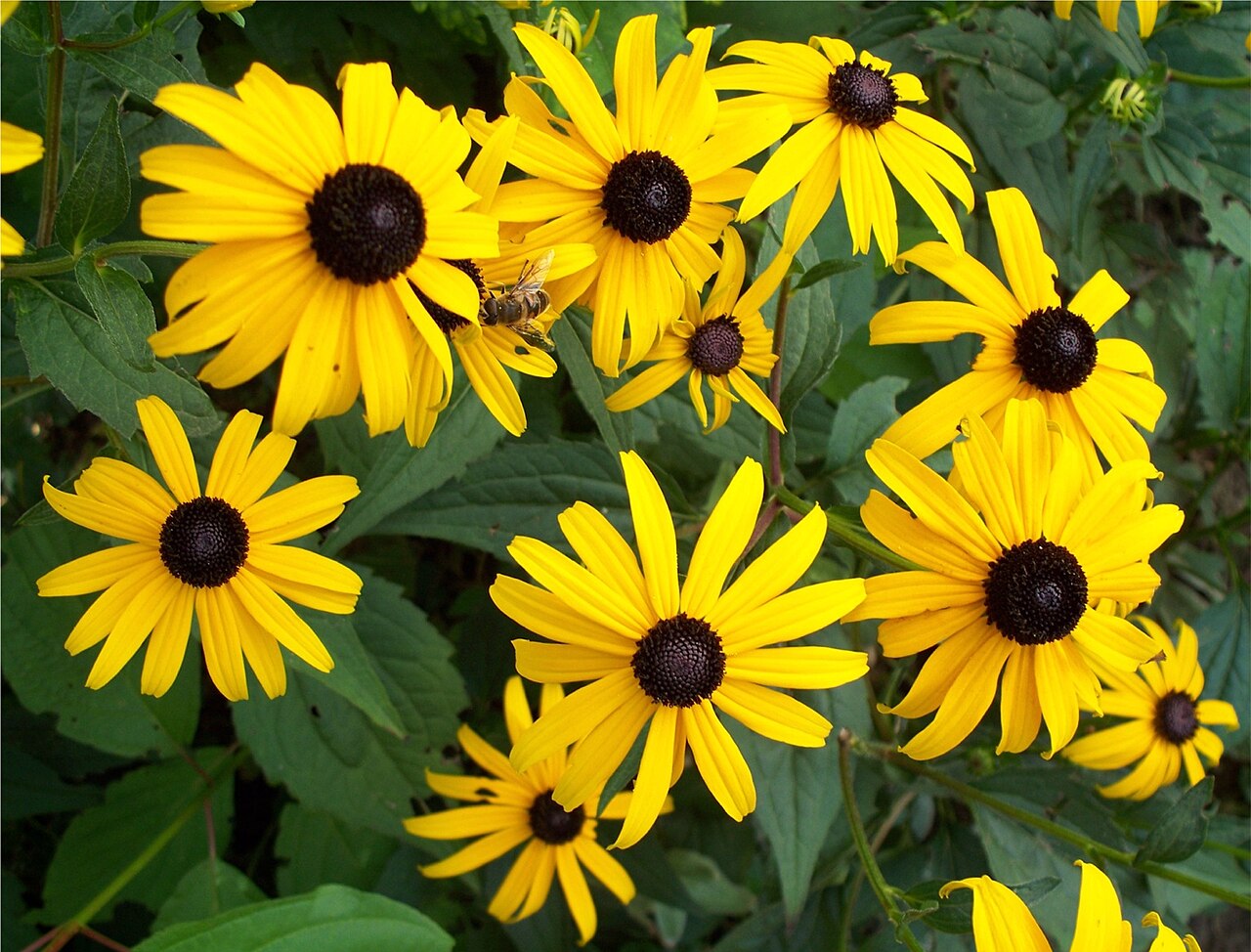
Rudbeckia fulgida, commonly called Orange Coneflower or Early Coneflower, is a tough, rhizomatous perennial wildflower native to open woods, meadows, and roadsides across the eastern and south-central United States. It belongs to the same genus as the ubiquitous Black-eyed Susan (Rudbeckia hirta), but unlike that short-lived biennial, Orange Coneflower is a true perennial that returns reliably year after year, slowly building into generous clumps by way of underground stolons. Gardeners sometimes know the popular straight-species selections under the varietal names var. sullivantii or var. fulgida, and the widely sold cultivar ‘Goldsturm’ is simply a selection of this native species.
From midsummer into fall, Orange Coneflower produces a long succession of 2- to 3-inch daisy-like flower heads: bright yellow-orange ray florets surrounding a domed, dark brown-to-black central disc. The flowering display is dependable and long-lasting, often continuing for six to eight weeks, and the plant’s modest 18- to 36-inch height and tidy clumping habit make it easy to place in both naturalistic plantings and more traditional perennial borders. Rough, bristly-hairy stems and leaves give the whole plant a slightly coarse texture that pairs nicely with grasses and finer-textured companions.
Orange Coneflower is one of the most garden-forgiving native wildflowers available: it tolerates average to poor soil, needs no fertilizer, shrugs off summer heat and humidity, and asks only for full sun and reasonably consistent moisture to perform at its best. Its combination of long bloom time, pollinator value, and low maintenance has made it a mainstay of pollinator gardens, rain gardens, and meadow plantings throughout its native range.
Identification
Orange Coneflower forms an upright, clump-forming perennial 18 to 36 inches (45–90 cm) tall, spreading slowly by short rhizomes and stolons that form new rosettes at their tips. Over a few seasons a single plant can expand into a patch 2 to 3 feet across.
Stems
Stems are green to reddish-green, ridged, and either glabrous (smooth) or moderately covered in stiff, spreading hairs depending on the variety. They branch near the top of the plant, with each branch typically carrying one to several flower heads held well above the foliage.
Leaves
Leaves are simple, dark green, and rough to the touch from scattered bristly hairs on both surfaces. Basal leaves are the largest, lance-shaped to broadly oval, 2 to 12 inches long on long petioles, with margins that are entire or shallowly serrate. Stem leaves are smaller, more sparsely toothed, and attach directly or on short petioles, becoming smaller in size higher up the stem.
Flowers
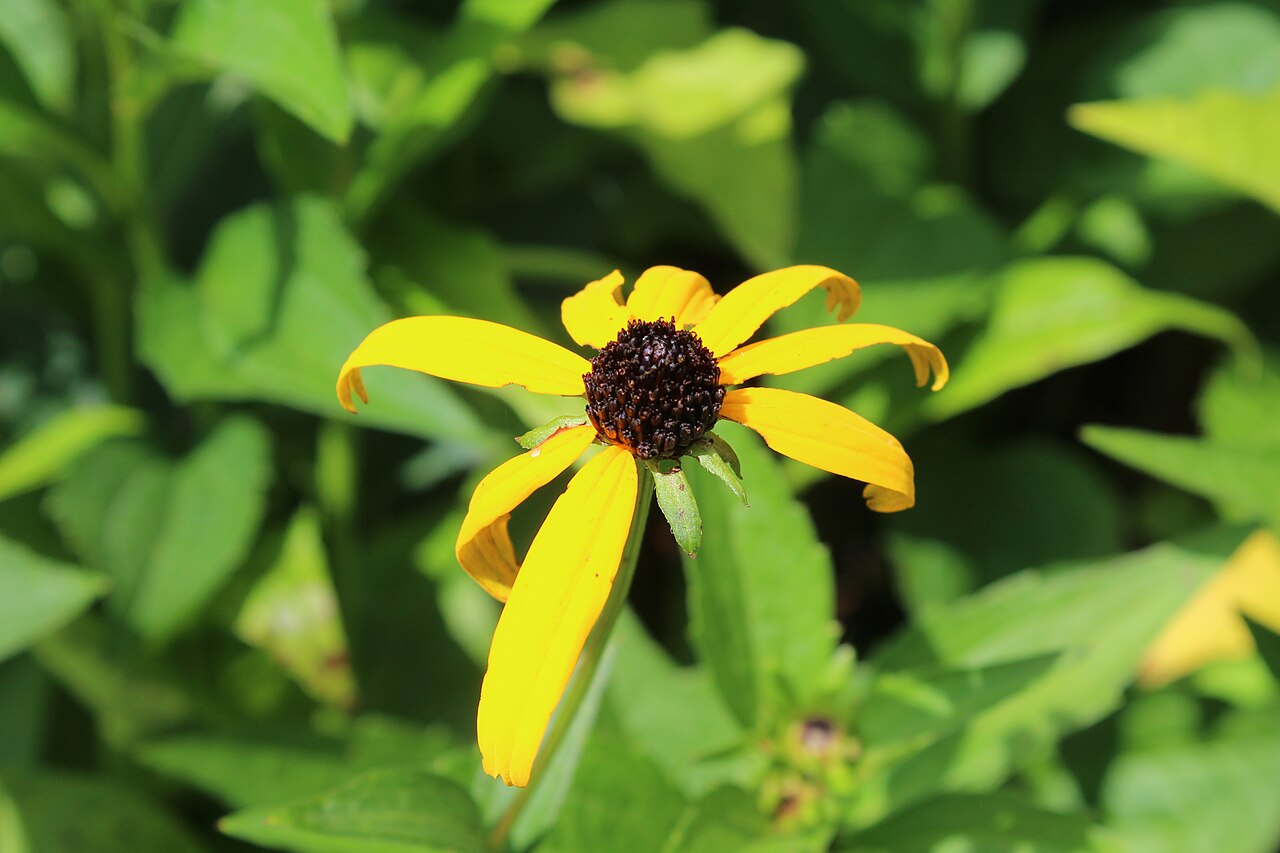
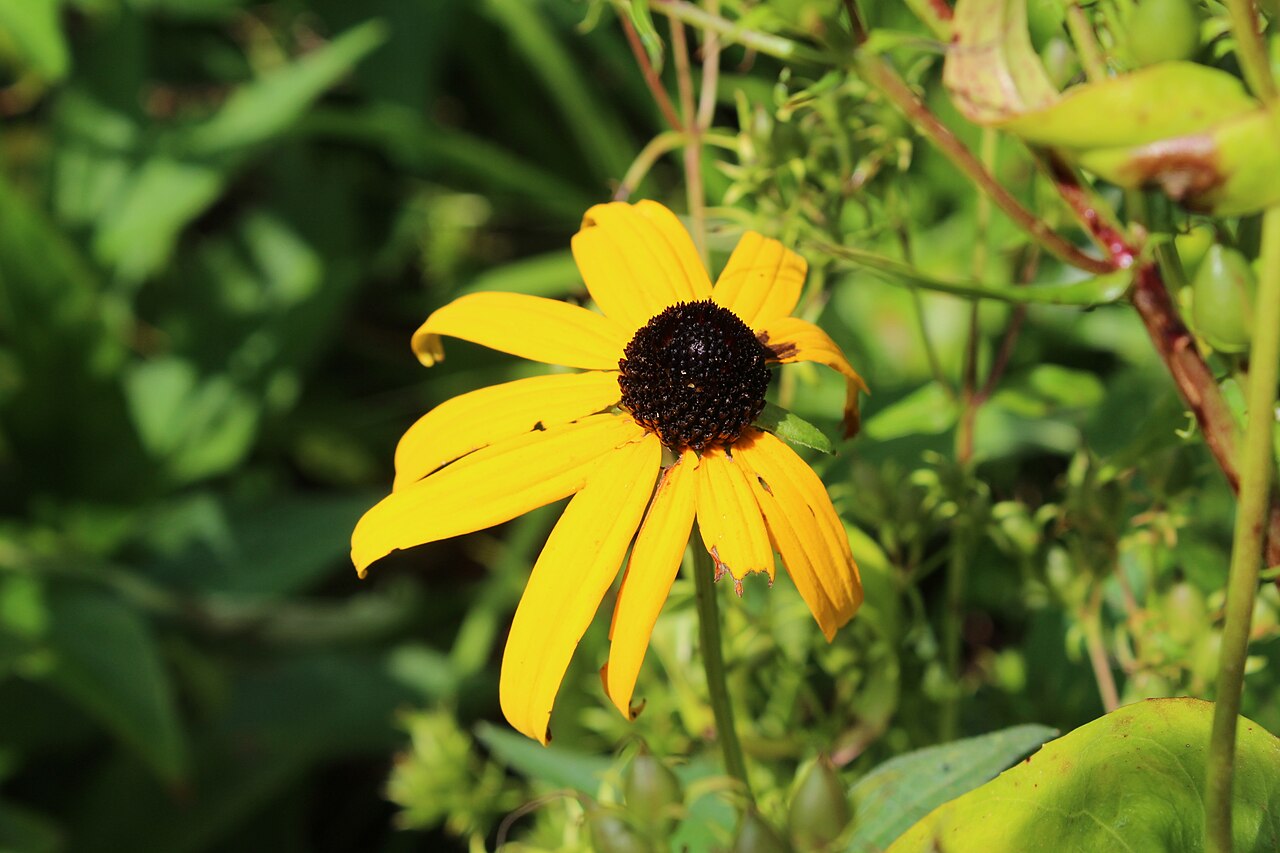
Each flower head is 2 to 3 inches across, with 10 to 15 ray florets in a rich orange-yellow surrounding a hemispheric, dark brown to black disc made up of fifty or more tiny disc florets. Flower heads are borne singly or in small clusters of two to seven atop upright stems, opening from midsummer through early fall and giving the species its “early coneflower” common name, since it often begins blooming before many other fall-blooming composites.
Fruit & Seeds
After pollination, each disc floret matures into a small, four-angled dry fruit called a cypsela (commonly, if loosely, called an achene), 2 to 4 millimeters long with only a tiny crown-like rim instead of a true pappus. The blackened, cone-shaped seedhead that remains through winter is a familiar sight in meadows and gardens, and it is an important source of winter food for finches and other seed-eating birds.
Quick Facts
| Scientific Name | Rudbeckia fulgida |
| Family | Asteraceae (Aster/Sunflower) |
| Plant Type | Herbaceous Perennial Wildflower |
| Mature Height | 18–36 in (45–90 cm) |
| Mature Spread | 18–24 in (45–60 cm), expanding slowly by rhizomes |
| Growth Rate | Moderate |
| Sun Exposure | Full Sun to Part Sun |
| Water Needs | Average to Moist |
| Soil Type | Adaptable; average garden soil, loam or clay-loam |
| Soil pH | 5.5–7.5 (slightly acidic to neutral) |
| Bloom Time | July – October |
| Flower Color | Orange-yellow with dark brown center |
| Fall Color | Foliage fades to tan; seedheads persist |
| Fruit | Small dry cypselae in a blackened cone-shaped head |
| Deer Resistant | Mostly (occasionally browsed) |
| USDA Hardiness Zones | 4–9 |
Native Range
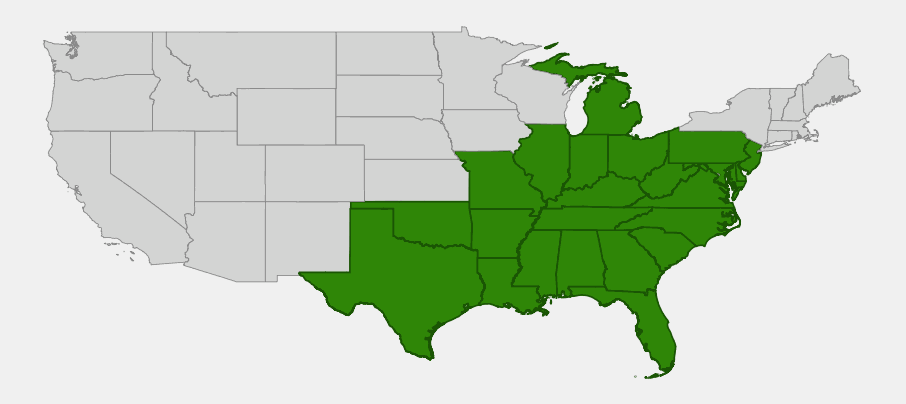
Orange Coneflower is native to the eastern and south-central United States, with a core range running roughly from New Jersey and Pennsylvania south through the Appalachians and Southeast to Florida, and west through the Ohio Valley and the Mississippi Valley to Missouri and eastern Texas. It is most abundant and most frequently encountered as a true wild plant in the Southeast and lower Midwest; populations become patchier toward the northern and western edges of this range.
The species is widely planted as an ornamental far outside this native range, including throughout New England and the upper Midwest, where garden escapes are occasionally found growing wild but the plant is not considered part of the original native flora. BONAP county-level records show only scattered, rare, or historical occurrences in New York, New England, and Wisconsin, so gardeners in those regions should treat Orange Coneflower as a well-behaved garden plant rather than a true regional native.
Within its native range, Orange Coneflower favors open woods, woodland edges, meadows, glades, prairies, and streambanks, especially on calcareous (lime-rich) soils. It also colonizes roadsides, pastures, and other disturbed open ground, which has helped it remain common in much of the Southeast even as more specialized prairie species have declined.
📋 Regional plant lists featuring Orange Coneflower: New York, Pennsylvania & Northern New Jersey · Delaware, Southern New Jersey & Long Island · Maryland, Virginia & West Virginia · North & South Carolina · Georgia, Alabama & Mississippi · Arkansas, Louisiana, Eastern Oklahoma & Eastern Texas · Kentucky & Tennessee · Ohio & Indiana · Illinois, Iowa & Missouri · Michigan, Wisconsin & Eastern Minnesota
Growing & Care Guide
Orange Coneflower is one of the easiest native perennials to succeed with, tolerating a wide range of garden conditions while still delivering a long, reliable bloom season.
Light
For the best flowering and sturdiest stems, give Orange Coneflower full sun — at least six hours of direct light daily. It will also grow in part sun or light shade, but plants there tend to be floppier and bloom less heavily, often leaning toward the nearest light source.
Soil & Water
This species is remarkably unfussy about soil, growing well in average, clay-loam, or even moderately poor soils as long as drainage is adequate. It prefers evenly moist conditions but, once established, tolerates short dry spells without complaint. Soggy, waterlogged soil over winter is its main enemy, since it can cause the rhizomes to rot.
Planting Tips
Plant container-grown Orange Coneflower in spring or fall, spacing plants 18 to 24 inches apart to allow room for clumps to spread. It transplants and divides easily, so a single nursery plant can become several garden-ready divisions within two or three growing seasons. Because the species spreads by rhizomes, give it room to roam or plan to divide it periodically to keep it in bounds.
Pruning & Maintenance
Deadheading spent flowers extends the bloom season and encourages more buds, though many gardeners leave the last round of flowers to form the attractive winter seedheads that feed finches. Divide congested clumps every three to four years in early spring to maintain vigor and control spread. Cut dried stems back in late winter before new growth emerges.
Propagation
Orange Coneflower is easy to propagate by division of the rhizomatous clumps in spring or fall, or by seed sown in fall or after three months of cold, moist stratification in the refrigerator. Divisions flower the first year; seed-grown plants typically bloom in their second year.
Landscape Uses
- Pollinator gardens — a reliable nectar and pollen source through late summer
- Perennial borders — pairs well with ornamental grasses, asters, and goldenrods
- Rain gardens — tolerates periodic moisture without rotting
- Meadow and prairie plantings — holds its own among taller grasses
- Mass plantings — its rhizomatous spread fills in quickly as a flowering groundcover
- Cut flower gardens — long stems and long vase life
Wildlife & Ecological Value
Orange Coneflower pulls significant ecological weight for a plant that asks so little of the gardener.
For Pollinators
The open, flat-faced flowers are easy landing pads for a wide range of pollinators, including honeybees, native bees, small butterflies, skippers, and beneficial wasps and flies. The long bloom season means it provides nectar and pollen at a time — late summer into fall — when many spring bloomers have finished.
For Birds
Goldfinches and other seed-eating songbirds feed heavily on the ripe cypselae held in the blackened seedheads through fall and winter. Leaving seedheads standing over winter, rather than cutting the plant back in fall, provides a valuable food source during the leanest months.
For Mammals
Rabbits and groundhogs will occasionally nibble young foliage, but the bristly-haired leaves make Orange Coneflower generally less palatable than many garden perennials, and deer browsing is usually light.
Ecosystem Role
As a rhizomatous colonizer of open and disturbed ground, Orange Coneflower helps stabilize soil on roadsides, meadow edges, and recently disturbed sites while providing structure and food resources that support a broad community of insects, which in turn feed birds and other wildlife further up the food web.
Cultural & Historical Uses
Like many members of the aster family, Orange Coneflower has a long history as a dooryard and cottage-garden plant across the rural South and Midwest, valued for its carefree nature and dependable late-summer color long before it entered the formal nursery trade. Rural gardeners traditionally shared divisions of the plant over fences and at plant swaps, a practice that helped spread particularly floriferous clones, including forms that eventually became the parent stock of commercial selections.
The species gained international horticultural fame in the twentieth century through the German-bred cultivar ‘Goldsturm,’ a selection of Rudbeckia fulgida var. sullivantii that became one of the best-selling perennials in North America and Europe and received the Royal Horticultural Society’s Award of Garden Merit. Its popularity helped introduce many gardeners to native coneflowers generally, even when they were not aware the plant in their border was a straight native species rather than an exotic hybrid.
Unlike some of its Rudbeckia relatives, Orange Coneflower does not have a well-documented history of Indigenous medicinal or culinary use; its historical importance lies chiefly in its long-standing role as an easy, reliable ornamental passed down through generations of American gardeners.
Frequently Asked Questions
Is Orange Coneflower the same plant as ‘Goldsturm’?
‘Goldsturm’ is a specific cultivated selection of Rudbeckia fulgida var. sullivantii, chosen for its compact habit and heavy bloom. The straight native species, grown from local-origin seed or divisions, is a better choice where supporting regional ecotypes matters, though both are the same species.
Is Orange Coneflower the same as Black-eyed Susan?
No. Black-eyed Susan (Rudbeckia hirta) is a related but different species — typically a biennial or short-lived perennial that self-seeds freely. Orange Coneflower is a true long-lived perennial that spreads by rhizomes rather than relying mainly on reseeding.
Will Orange Coneflower take over my garden?
It spreads steadily by rhizomes but is easy to manage. Dividing clumps every few years keeps it in bounds, and any wandering sprouts are simple to pull or transplant elsewhere.
Does Orange Coneflower need deadheading?
Deadheading is optional. Removing spent flowers encourages more blooms, but leaving the last flush to go to seed provides winter food for finches and other songbirds.
Is Orange Coneflower native to New England or the Northeast?
Only at its southern edge. It is native from New Jersey and Pennsylvania southward, but in New England and New York it is primarily a garden plant that occasionally escapes rather than part of the original native flora.

Looking for a nursery that carries Orange Coneflower?
Browse our native plant nursery directory: Alabama & Arkansas · Delaware, Florida & Georgia · Illinois & Indiana · Kentucky, Louisiana, Maryland, Michigan, Mississippi & Missouri · New Jersey, North Carolina, Ohio & Oklahoma · Pennsylvania, South Carolina, Tennessee, Texas & Virginia · West Virginia