
Wholeleaf Indian Paintbrush (Castilleja integra)
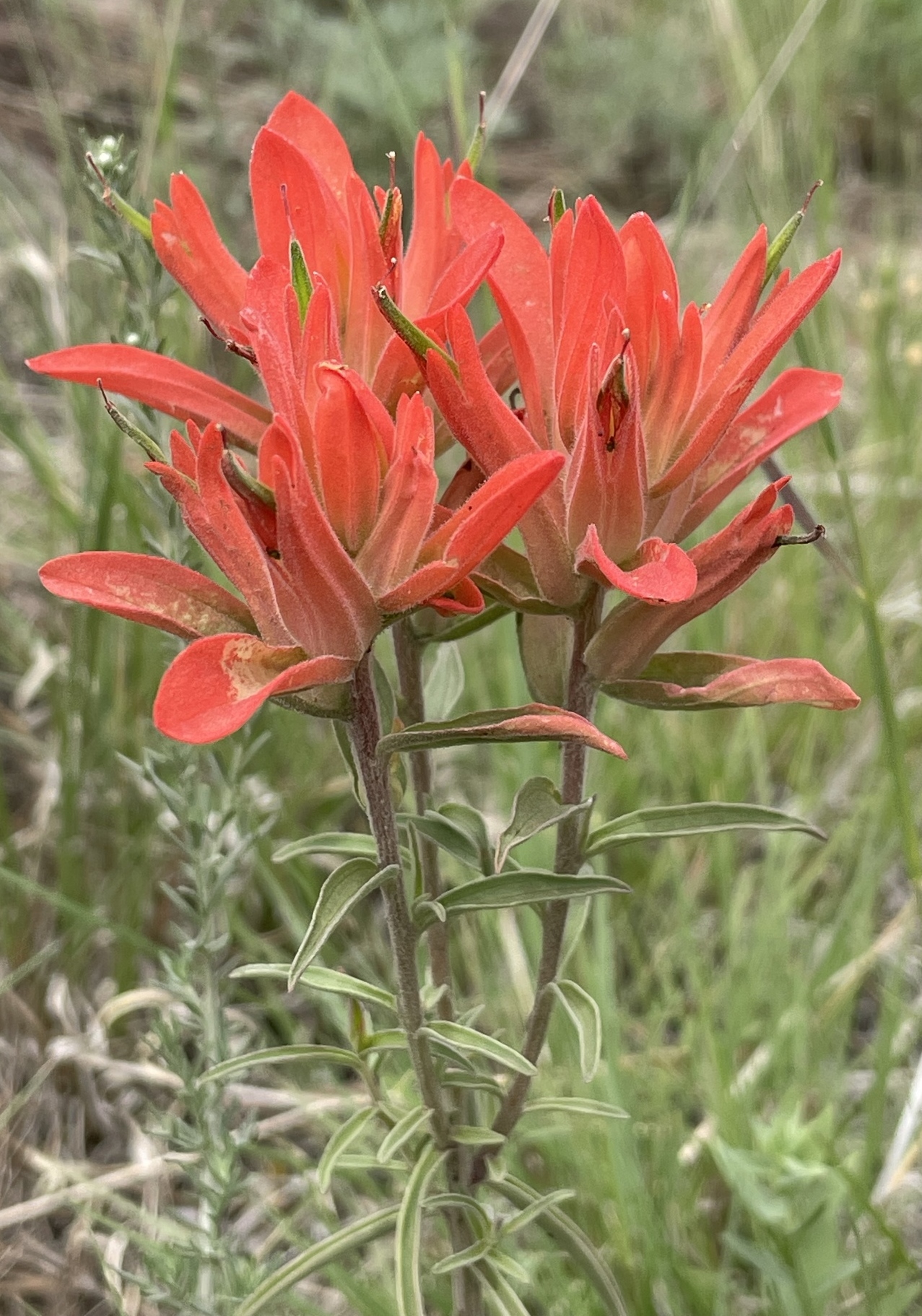
Castilleja integra, known as Wholeleaf Indian Paintbrush or orange paintbrush, is a striking perennial wildflower of the Southwestern United States whose brush-tip clusters of orange to red-orange bracts light up dry grasslands and open woodlands from spring through fall. Unlike many paintbrushes that are notoriously difficult to establish, Wholeleaf Indian Paintbrush is considered one of the easier species in its genus to grow, which has made it a favorite for xeriscape gardens and naturalistic meadow plantings across the Southwest.
The plant gets its species name, integra, from its undivided (“entire”) leaves — a identification feature that distinguishes it from many relatives whose leaves are lobed or deeply cut. Like all paintbrushes, it is a hemiparasite: while it photosynthesizes on its own, its roots also tap into the roots of neighboring plants for extra water and nutrients, a partnership that is essential to understand before attempting to grow it from seed.
In the wild, Wholeleaf Indian Paintbrush ranges from dry grasslands and sagebrush flats up into piñon-juniper woodland and open ponderosa pine forest, often alongside the very grasses and shrubs it parasitizes. Its long bloom season and heavy nectar production make it one of the best native hummingbird plants for high-desert and foothill gardens.
Identification
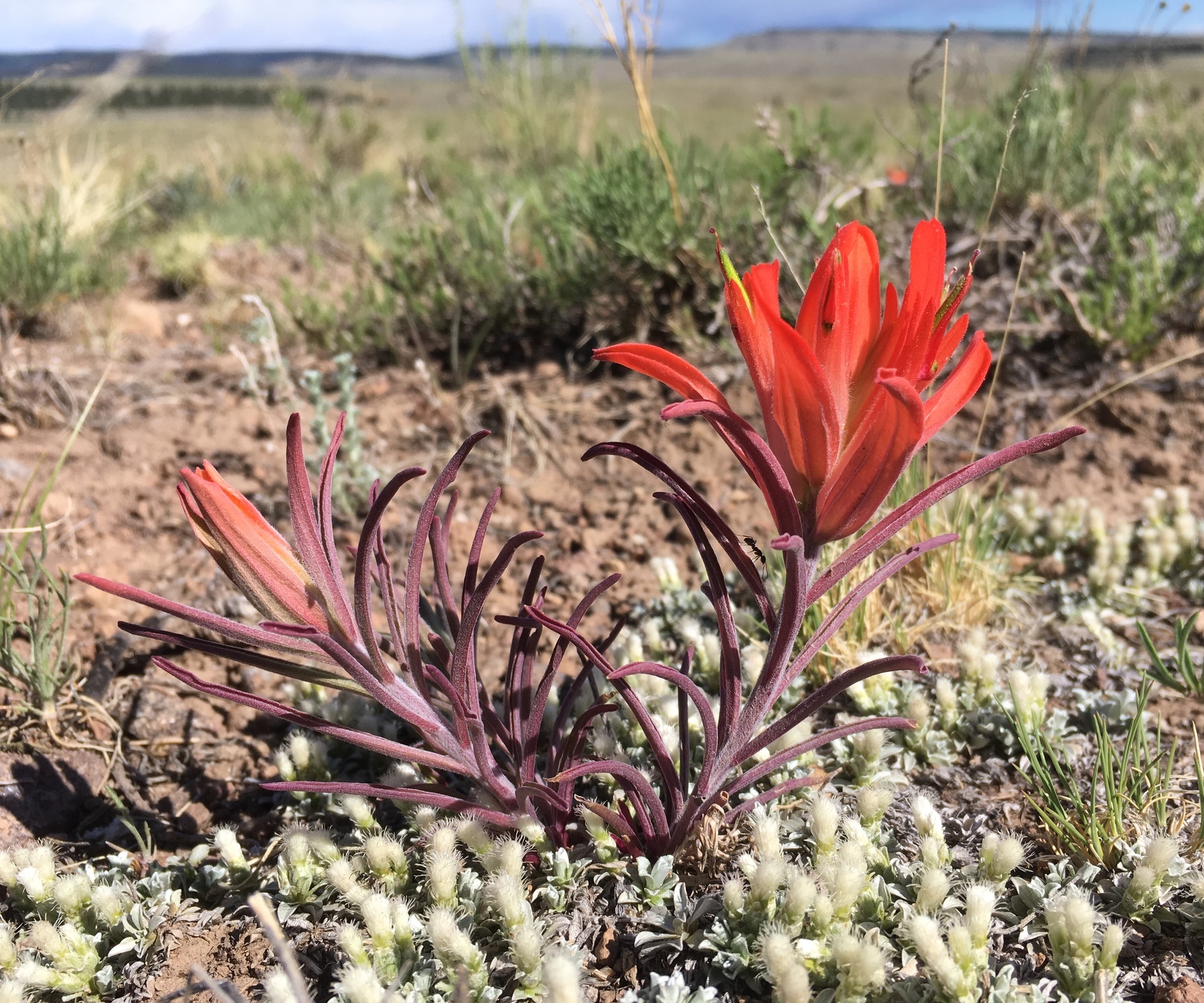
Wholeleaf Indian Paintbrush is a clump-forming perennial 3.5 to 20 inches tall (occasionally to 39 inches), with one to several unbranched or sparingly branched stems rising from a woody base (caudex) atop a stout taproot. The entire plant — leaves, stems, bracts, and flowers — is covered in a soft, pale down that gives it a slightly frosted, dusty-gray cast even where the bracts are brilliant orange.
Leaves
Leaves are narrow and undivided, ranging from thread-like (linear) to narrowly rectangular (oblong), 1 to 9 inches long, usually 2 to 7 inches. They are typically pale green to purplish, with edges that often roll slightly inward. Unlike several related paintbrush species, the leaves are rarely lobed, which is the most reliable way to separate this species from look-alikes such as Castilleja miniata.
Flowers
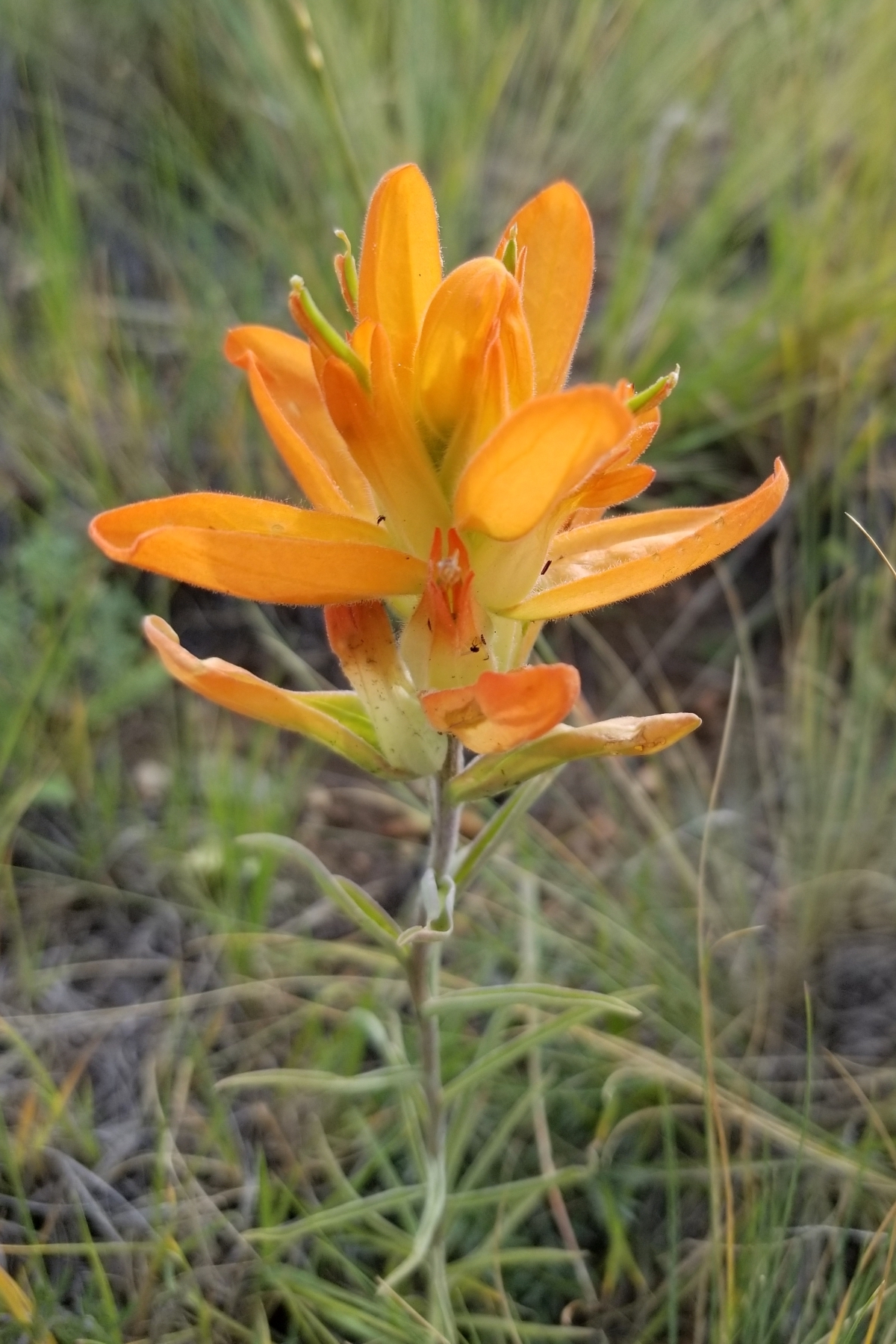
What looks like the “flower” is mostly a cluster of showy, petal-like bracts 20 to 40 millimeters long, usually intense red-orange to orange, occasionally rose, salmon, or pale yellow. The true flowers are tubular and mostly hidden within the bracts, visited readily by hummingbirds for their generous nectar. Bloom lasts from as early as January in the mildest sites through October, with peak bloom from June to August across most of the range.
Fruit
After flowering, each plant produces small capsules 12 to 16 millimeters long packed with fine seed. Like other paintbrushes, the seed is tiny and requires contact with a suitable host plant’s roots to germinate and establish successfully in the garden or wild.
Quick Facts
| Scientific Name | Castilleja integra |
| Family | Orobanchaceae (Broomrape) |
| Plant Type | Perennial Wildflower (hemiparasitic) |
| Mature Height | 0.5–1.5 ft (occasionally to 3 ft) |
| Mature Spread | 0.5–1 ft |
| Growth Rate | Slow to Moderate |
| Sun Exposure | Full Sun |
| Water Needs | Low to Moderate |
| Soil Type | Dry, well-drained; rocky, gravelly or sandy loam |
| Soil pH | 6.5–8.0 (neutral to alkaline) |
| Bloom Time | March–October (peak June–August) |
| Flower Color | Orange-red (occasionally rose, salmon or pale yellow) |
| Fall Color | None notable |
| Fruit | Small dry seed capsules |
| Deer Resistant | Yes (generally avoided) |
| USDA Hardiness Zones | 4–9 |
Native Range
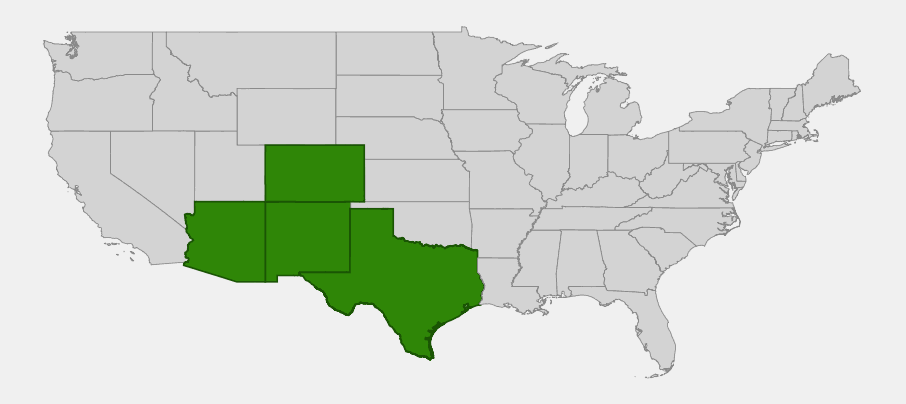
Wholeleaf Indian Paintbrush is native to the Southwestern United States and northern Mexico. Within the U.S. it occurs in Arizona, New Mexico, western and southwestern Texas, and the western, drier counties of Colorado; it is not native to California or Nevada despite being planted ornamentally in parts of the West. In Colorado its range is concentrated in the southwestern part of the state, roughly the San Juan Mountains and Four Corners region, rather than the eastern plains.
Habitat ranges from dry grasslands and sagebrush flats at lower elevations up through piñon-juniper woodland and into open ponderosa pine forest at higher elevations, reflecting the wide elevational span over which it blooms from winter through fall. It is almost always found growing alongside grasses, sagebrush, or other shrubs that serve as host plants for its semi-parasitic roots.
South of the border, the species continues through much of northern Mexico, including Baja California, Sonora, Chihuahua, Coahuila, Nuevo León, Tamaulipas, and Durango, making it a true binational species of the Chihuahuan and Sonoran borderlands.
📋 Regional plant lists featuring Wholeleaf Indian Paintbrush: Arizona & New Mexico · Utah & Western Colorado
Growing & Care Guide
Wholeleaf Indian Paintbrush is more forgiving than most of its genus, but success still depends on understanding its hemiparasitic nature and giving it the lean, dry conditions it experiences in the wild.
Light
This paintbrush needs full sun to perform well and bloom heavily. It is a plant of open grasslands and woodland edges rather than dense shade, and will become leggy and bloom poorly if crowded out by taller vegetation or planted in shade.
Soil & Water
Give it dry, well-drained, rocky or gravelly soil — rich garden soil and regular irrigation tend to shorten its life. Established plants need only occasional deep watering during the driest stretches of summer; overwatering, especially in heavier soils, is the most common reason garden plantings fail. Neutral to alkaline soils that mimic its native limestone and volcanic substrates suit it best.
Planting Tips
Because Wholeleaf Indian Paintbrush is hemiparasitic, it establishes far more reliably when planted near a compatible host — native bunchgrasses such as grama grasses, or shrubby composites and legumes, work well. Sow seed or set out small plants adjacent to an already-established host plant rather than alone in bare soil; direct-seeding into an existing native grass or wildflower meadow typically gives better results than isolated nursery transplants.
Propagation
Propagation from seed is possible but slow and requires a nearby host for the seedling roots to connect with; cold-moist stratification over winter improves germination. Because of the host relationship, container-grown nursery plants are often started with a host grass seeded into the same pot, and gardeners should keep that companion grass when transplanting.
Landscape Uses
- Xeriscape and dry meadow plantings paired with native grasses
- Hummingbird gardens in high-desert and foothill climates
- Naturalistic wildflower meadows seeded alongside bunchgrasses
- Rock gardens with gravelly, fast-draining soil
- Pollinator strips along dry roadside or slope plantings
Wildlife & Ecological Value
Wholeleaf Indian Paintbrush is one of the better native nectar plants for hummingbirds in the dry Southwest, and its long bloom season makes it valuable across much of the warm-weather year.
For Pollinators & Hummingbirds
The tubular flowers produce an unusually large volume of nectar for a wildflower of this size, making the species especially attractive to hummingbirds, which are its primary pollinators. Bees and other insects also visit the flowers, though less effectively than hummingbirds given the flower’s shape.
For Insects
Caterpillars of several checkerspot butterflies, including the Leanira checkerspot, feed on paintbrush foliage. Interestingly, the plant’s hemiparasitic habit lets it absorb defensive alkaloids from its host plants — compounds such as senecionine from gayfeather or ragwort hosts — which it passes on to its own tissues and which appear to slow the growth of herbivorous caterpillars that eat it.
Ecosystem Role
As a root hemiparasite, Wholeleaf Indian Paintbrush draws water and some nutrients from neighboring plants without typically killing its hosts, and in doing so it adds structural and chemical diversity to grassland and woodland plant communities. Its bright, early and late-season blooms help extend the nectar season in dry habitats where few other wildflowers are in flower.
Cultural & Historical Uses
The Zuni people have long called this plant Tsu’yaa’wa tsi’sinakĭa, a name that translates roughly to “hummingbird all sucking-food,” a direct reference to the hummingbirds the flowers attract — a piece of traditional ecological knowledge recorded well before Western science described the plant’s nectar production in detail.
The species was first scientifically collected in the Organ Mountains of southern New Mexico, near present-day El Paso, Texas, by botanist Charles Wright, and formally described by Asa Gray in 1858. An older common name, “painter’s brush,” was recorded by botanist Alice Eastwood in 1893, a precursor to the modern “paintbrush” name used for the genus.
Today the plant’s main cultural role is horticultural: because it establishes more readily than most paintbrush species, it has become a go-to choice for xeriscape gardens, native plant demonstration gardens, and naturalistic meadow restorations across the Southwest, valued as much for its drought tolerance as for its brilliant color.
Frequently Asked Questions
Why is my Indian Paintbrush dying even though I’m watering it?
Wholeleaf Indian Paintbrush is adapted to dry, lean soil, and overwatering — especially in heavy or poorly drained soil — is one of the most common reasons it fails in gardens. It generally performs best with infrequent, deep watering rather than regular irrigation.
Do I need to plant something else with my paintbrush?
Yes, for best results. As a hemiparasite, this species draws some water and nutrients from the roots of neighboring plants, particularly native grasses. Planting it near an established bunchgrass or similar host significantly improves its chances of thriving long-term.
Is Wholeleaf Indian Paintbrush native to California?
No. Despite being planted in xeriscape gardens throughout the West, its natural range is limited to Arizona, New Mexico, western Texas, and the drier parts of western Colorado, along with northern Mexico. It does not occur naturally in California or Nevada.
What pollinates Indian Paintbrush?
Hummingbirds are the primary pollinators, drawn by the flower’s generous nectar reward. Bees and other insects visit occasionally, but the tubular flower shape is best suited to a hummingbird’s long bill and tongue.
Can I eat or use Indian Paintbrush medicinally?
No. Paintbrush species can absorb and concentrate toxic compounds, including selenium and alkaloids, from the roots of host plants they parasitize, so the plant should not be eaten or used as a home remedy.

Looking for a nursery that carries Wholeleaf Indian Paintbrush?
Browse our native plant nursery directory: Arizona · Colorado · New Mexico · Texas