
Wild Potato Vine (Ipomoea pandurata)
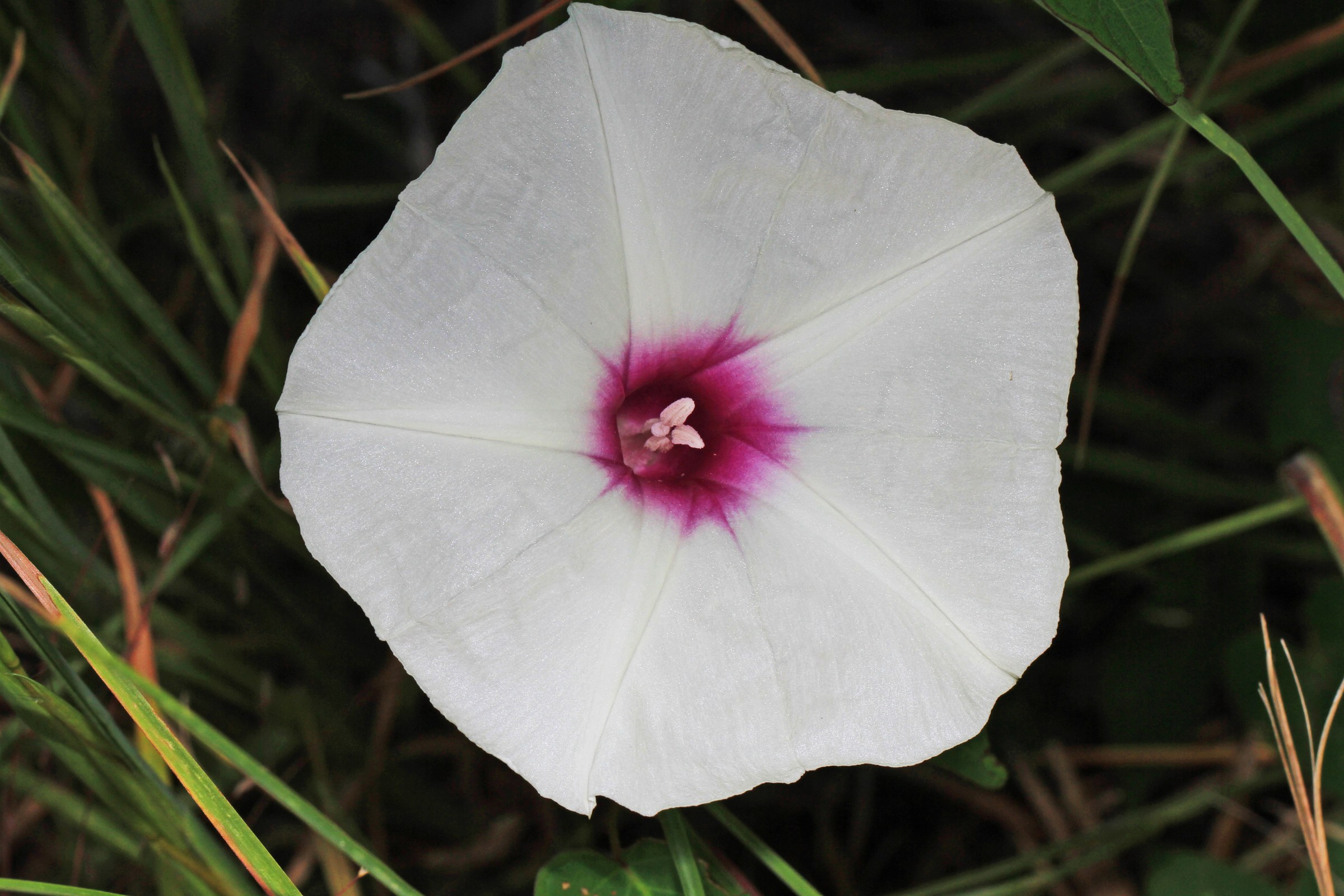
Ipomoea pandurata, commonly known as Wild Potato Vine, Man-of-the-Earth, or Wild Sweet Potato, is a trailing and twining herbaceous perennial native to the eastern and central United States. A member of the morning glory family (Convolvulaceae), it is immediately recognizable in summer by its large, funnel-shaped white flowers, each marked with a deep pink to crimson-purple throat, opening in succession along the vine from late spring into early fall.
The vine itself is unassuming — a twining, sprawling plant of woodland edges, fencerows, and open thickets that rarely climbs more than a few feet onto fences or shrubs, often sprawling along the ground instead. Its real distinction lies underground: a single plant develops an enormous tuberous root that can grow two feet long or more and weigh twenty pounds or more within a few years, anchoring the plant so securely that the vine is notoriously difficult to remove once established, which is also why it has never become a serious garden thug — the top growth dies back every winter, but the root persists and resprouts.
Wild Potato Vine is a long-lived, low-maintenance native for a sunny fence line or naturalized meadow edge, valued for its large, showy flowers and its usefulness to native bees and sphinx moths. It spreads slowly from its single deep root system rather than by aggressive rhizomes, making it a well-behaved choice compared to many vining plants.
Identification
Wild Potato Vine is a herbaceous perennial vine with slender, twining or trailing stems that die back to the ground each winter and regrow from the same tuberous root the following spring. Stems are typically smooth and can reach 10 to 16 feet in a season, though the plant often sprawls along the ground rather than climbing high.
Leaves
Leaves are alternate, heart-shaped (cordate) with a pointed tip, smooth-margined, and 2 to 6 inches long on long petioles. They are a deep, somewhat glossy green and provide a dense, attractive backdrop for the large flowers.
Flowers
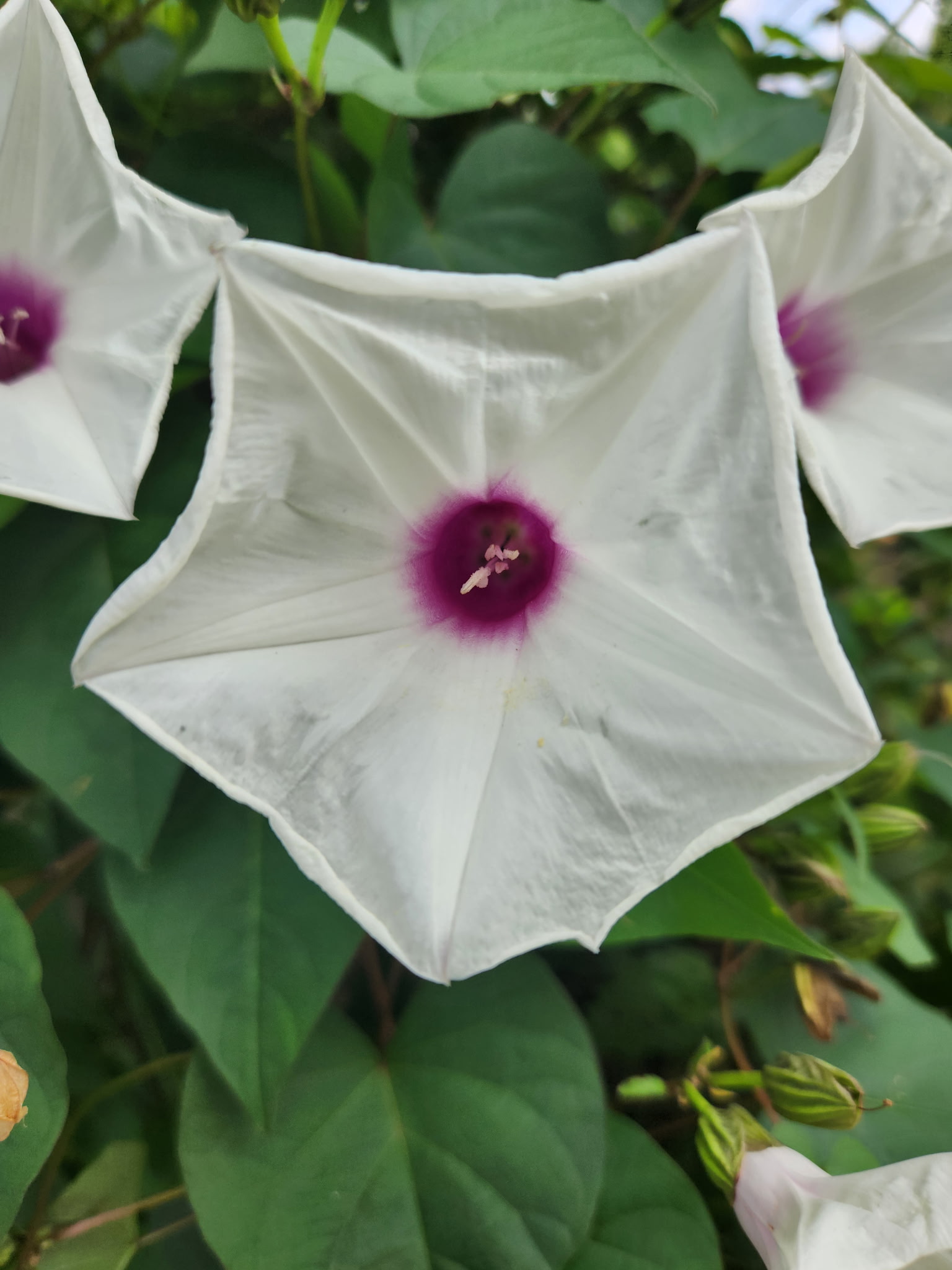
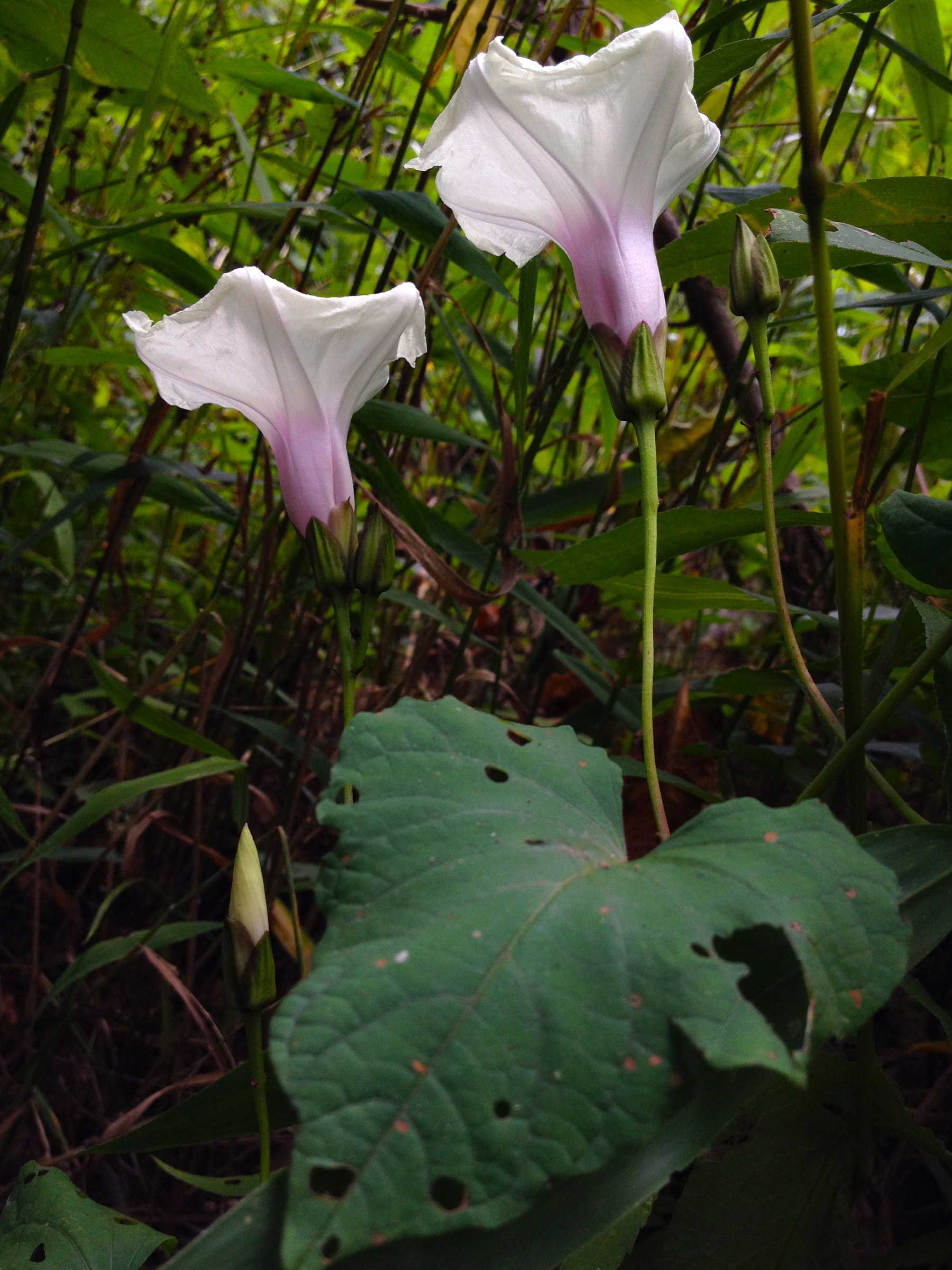
The flowers are the plant’s signature feature: large, funnel-shaped (salverform) blooms 2 to 3 inches across, white with a dark pink to purplish-crimson throat, borne singly or in small clusters of up to seven on long stalks (peduncles) arising from the leaf axils. Each flower opens in the morning and typically closes by early afternoon, with the vine producing a steady succession of new blooms from June through September.
Fruit & Seeds
After flowering, the plant forms a small, rounded, two-celled seed capsule that dries and splits open to release a few large, dark brown seeds. Seed capsules are inconspicuous compared to the flowers and are typically hidden among the foliage.
Quick Facts
| Scientific Name | Ipomoea pandurata |
| Family | Convolvulaceae (Morning Glory) |
| Plant Type | Herbaceous Perennial Vine |
| Mature Height | Trailing/climbing to 10–16 ft |
| Mature Spread | 3–6 ft at the base |
| Growth Rate | Moderate to Fast |
| Sun Exposure | Full Sun to Part Shade |
| Water Needs | Low to Moderate |
| Soil Type | Well-drained; sandy, loamy, or rocky |
| Soil pH | 5.5–7.5 (acidic to neutral) |
| Bloom Time | June – September |
| Flower Color | White with dark pink-purple throat |
| Fall Color | Foliage yellows before dieback |
| Fruit | Small dry seed capsule |
| Deer Resistant | Yes |
| USDA Hardiness Zones | 5–9 |
Native Range
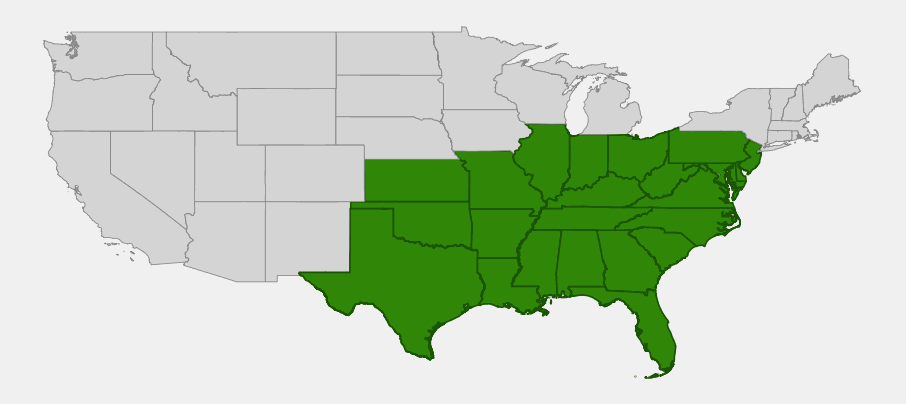
Wild Potato Vine is native across much of the eastern and south-central United States, from the Mid-Atlantic states west through the Ohio Valley and lower Midwest, and south through the Southeast and into the lower Great Plains and Texas. It is most common in the Piedmont and coastal plain of the Southeast, the limestone woodlands of the Ohio Valley, and the prairie-woodland margins of the lower Midwest.
Its range does not extend into New England or the Upper Midwest — it is absent from New York, Connecticut, Massachusetts, Rhode Island, Michigan, Wisconsin, Minnesota, and Iowa, where the growing season and soils do not suit its deep-rooted habit. It is likewise absent from the arid Great Plains west of Kansas and Texas and does not occur west of the Rocky Mountains.
Throughout its native range, Wild Potato Vine favors dry to medium, well-drained soils in full sun to part shade — woodland edges, fencerows, roadsides, railroad embankments, old fields, and open thickets. It tolerates poor, sandy, or rocky soils better than most showy native vines, and its deep taproot makes it notably drought-tolerant once established.
📋 Regional plant lists featuring Wild Potato Vine: Arkansas, Louisiana, Eastern Oklahoma & Eastern Texas · Delaware, Southern New Jersey & Long Island, New York · Illinois, Iowa & Missouri · Ohio & Indiana · Kentucky & Tennessee · Maryland, Virginia & West Virginia · North Carolina & South Carolina · Nebraska, Kansas & Eastern Colorado · New York, Pennsylvania & Northern New Jersey
Growing & Care Guide
Wild Potato Vine is one of the easiest native vines to grow once sited correctly, thriving on neglect in lean, dry soil where showier garden vines struggle. Its deep taproot makes it extremely drought-tolerant but also means it should be planted in its permanent spot — it does not transplant well once established.
Light
Give it full sun for the heaviest bloom, though it tolerates light to part shade along a woodland edge, where it will flower somewhat less but still perform reliably.
Soil & Water
Wild Potato Vine prefers well-drained, even lean or sandy soil and strongly dislikes wet feet — soggy or heavy clay soils promote root rot in the large tuber. Once established, it needs little supplemental water and is an excellent choice for a dry, sunny fence line or bank.
Planting Tips
Start from seed (scarified to improve germination) or small nursery starts planted in their permanent location in spring, since the deep tuberous root resents disturbance. Give it a fence, low trellis, or shrub to sprawl over, or let it trail as a loose groundcover along a sunny bank. Allow it room — while not aggressive, an established plant’s root system persists for decades.
Pruning & Maintenance
Top growth dies back completely with the first hard frost and can be cut away or left as winter cover; new shoots emerge from the root in late spring. Established plants need essentially no maintenance beyond occasional tidying, and the plant resents being dug up or moved.
Landscape Uses
Wild Potato Vine fits naturalistic and low-water gardens particularly well:
- Dry fence line or split-rail fence cover
- Pollinator garden accent for its large, showy flowers
- Meadow or prairie-edge plantings
- Erosion control on dry banks and slopes
- Low-water, low-maintenance native landscaping
Wildlife & Ecological Value
Wild Potato Vine’s large, nectar-rich flowers make it a magnet for a specific and valuable set of pollinators during the heat of summer.
For Pollinators
The deep-throated flowers are especially attractive to long-tongued bees, including bumblebees and the specialist morning-glory bee (Cemolobus ipomoeae), as well as sphinx moths that visit at dusk and in early morning when the flowers are freshest. Hummingbirds occasionally visit as well.
For Birds
Seed-eating birds take the small seeds from mature capsules in fall, though the plant produces seed in modest quantity compared to its showy floral display.
For Mammals
The foliage and especially the large tuberous root have a bitter, purgative sap that most mammals avoid, making this a reliably deer- and rabbit-resistant plant for the garden.
Ecosystem Role
As a long-lived perennial of dry, open, and often disturbed ground, Wild Potato Vine helps stabilize soil on banks and field edges while its deep taproot draws water and nutrients from well below the reach of shallow-rooted grasses, making it a resilient component of dry meadow and woodland-edge plant communities.
Cultural & Historical Uses
The large tuberous root that gives this plant its common names was historically dug and used as a food source by Indigenous peoples and early settlers in parts of its range, though accounts describe it as a famine or emergency food requiring careful preparation — the raw root and uncooked plant material have strong purgative properties. The root’s resemblance to a sweet potato, paired with its unpalatability when mishandled, is reflected in the name “Man-of-the-Earth.”
Nineteenth-century botanical and medical references record the dried root being used in traditional preparations as a cathartic, a use consistent with its purgative chemistry, but these were historical practices rather than guidance for modern use — the plant is not a food crop and should not be eaten.
Today, Wild Potato Vine is grown almost exclusively as an ornamental native vine, valued by gardeners for its drought tolerance, large flowers, and low-maintenance persistence rather than for any practical harvest.
Frequently Asked Questions
Can you eat the root of Wild Potato Vine?
No. Despite its sweet-potato-like appearance and historical use as a famine food after extensive processing, the raw root and plant sap have strong purgative properties and can cause significant digestive upset. It should not be treated as an edible garden plant.
Is Wild Potato Vine invasive?
No — it is a native plant within its eastern and south-central U.S. range. It spreads slowly from a single deep taproot rather than aggressive rhizomes or runners, so it does not form the dense colonies associated with invasive vines.
How do I get rid of Wild Potato Vine if I don’t want it?
Because of its deep, large taproot, mature plants are very difficult to remove by hand-pulling; repeated cutting of top growth over a season or two will eventually exhaust a young root, but an established tuber may need to be dug out.
Why isn’t my Wild Potato Vine blooming?
Too much shade is the most common cause — give it more direct sun. Very rich or constantly moist soil can also push the plant toward vegetative growth at the expense of flowers; lean, well-drained soil typically blooms best.
Will Wild Potato Vine climb a trellis?
It will twine lightly onto a trellis, fence, or nearby shrub, but it is not a vigorous climber like morning glory or hops — expect a loose, sprawling habit more than a dense vertical cover.

Looking for a nursery that carries Wild Potato Vine?
Browse our native plant nursery directory: AR region · DE/GA/FL/AL region · IL/IN/KS region · MO/MD/KY/LA/MS region · OH/NJ/NC/OK region · PA/VA/TN/SC/TX region · WV region