
Shin-dagger Agave (Agave schottii)
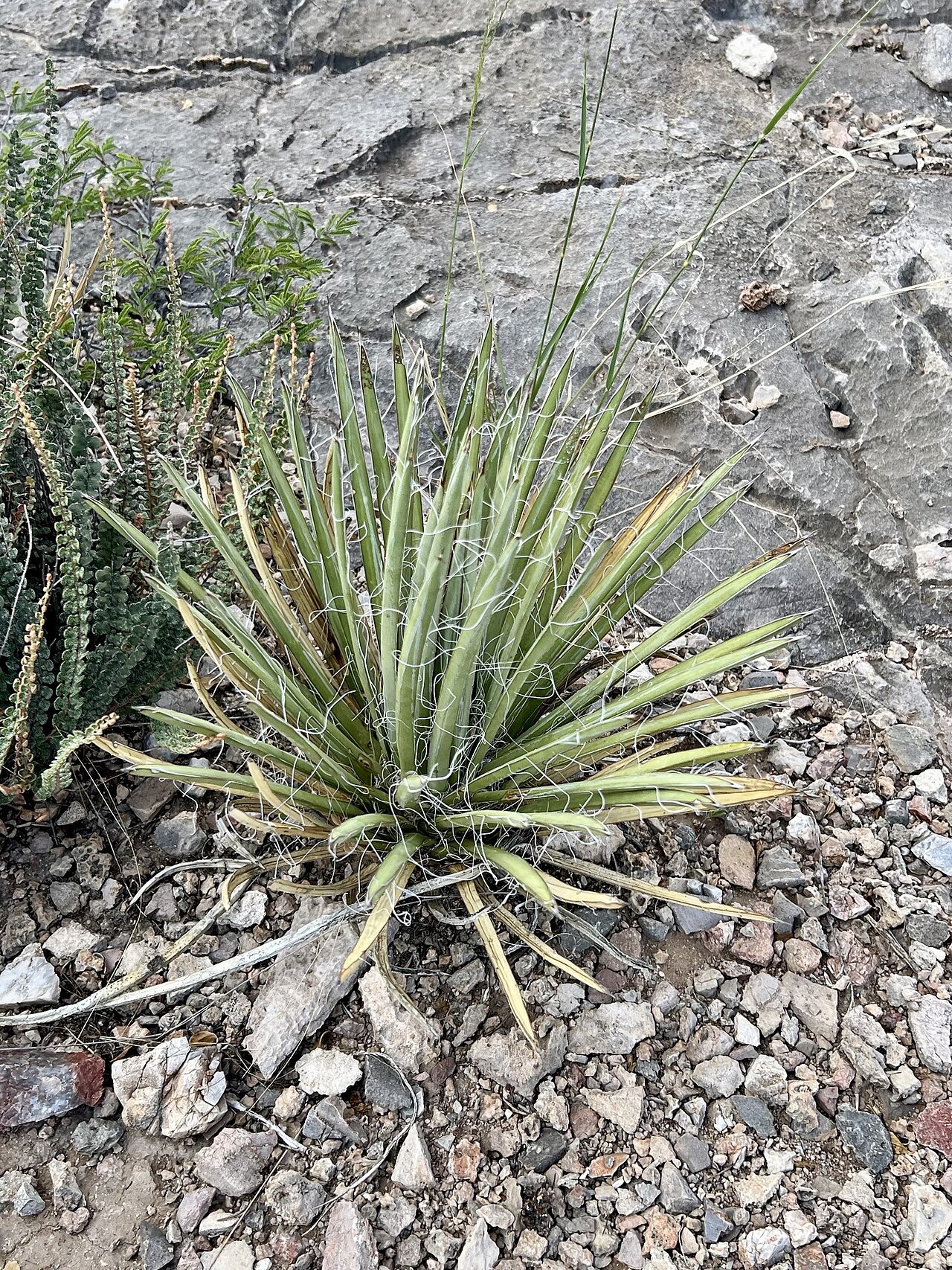
Agave schottii, commonly called Shin-dagger Agave or Schott’s Century Plant, is a small, clump-forming succulent of the rocky foothills and grasslands of southeastern Arizona and the bootheel of New Mexico. Its common name is a warning as much as a description: the stiff, narrow leaves end in a single sharp spine held at roughly shin height, hidden low in grass and brush where a hiker’s leg finds it before the eye does. Unlike most agaves, its leaf margins are smooth, lacking the hooked marginal teeth typical of the genus — the leaf’s defense is concentrated entirely in that one terminal point.
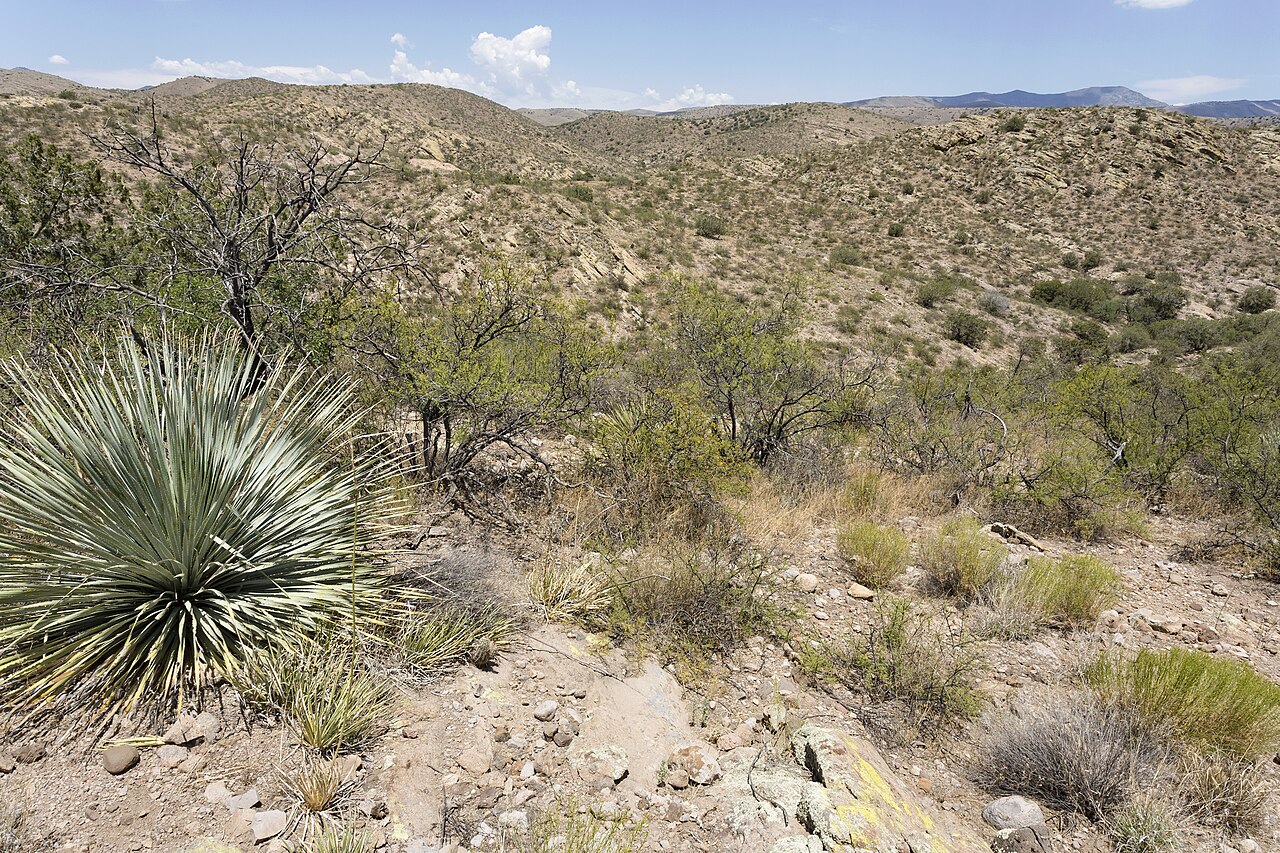
Shin-dagger is a plant of true desert grassland and oak woodland edges, most often seen on open, gravelly slopes between about 3,600 and 6,600 feet in Arizona’s “sky island” country. It spreads by underground rhizomes into dense, multi-rosette colonies that can carpet a hillside, each individual rosette eventually sending up a single tall flower spike, setting seed, and dying — while the clone as a whole lives on through its offsets.
Because of its ecological value and the pressure wild agaves face from collection, Shin-dagger Agave is designated a Protected Native Plant under Arizona’s native plant law, and digging or removing wild plants without a permit is illegal. Gardeners in its native range should buy only nursery-propagated plants and should never collect material from the wild.
Identification
Shin-dagger Agave forms a dense, stemless rosette of narrow, rigid, blue-green to gray-green leaves, each leaf typically growing to about 16 inches (41 cm) long. The rosettes cluster and spread by rhizomes, often forming substantial colonies of dozens of individual rosettes over time.
Leaves
Leaves are narrowly linear and channeled, tapering to a single stiff, sharp terminal spine capable of easily piercing skin or clothing. Unlike most other agaves, the leaf margins carry no hooked teeth; instead they fray into pale, curling, thread-like fibers that give the rosette a somewhat yucca-like, shaggy appearance. This combination — toothless margins, fibrous edges, and a single terminal spike — places the species in the subgenus Littaea and is the easiest way to separate it from spinier, broader-leaved agaves such as Parry’s Agave.
Flowers
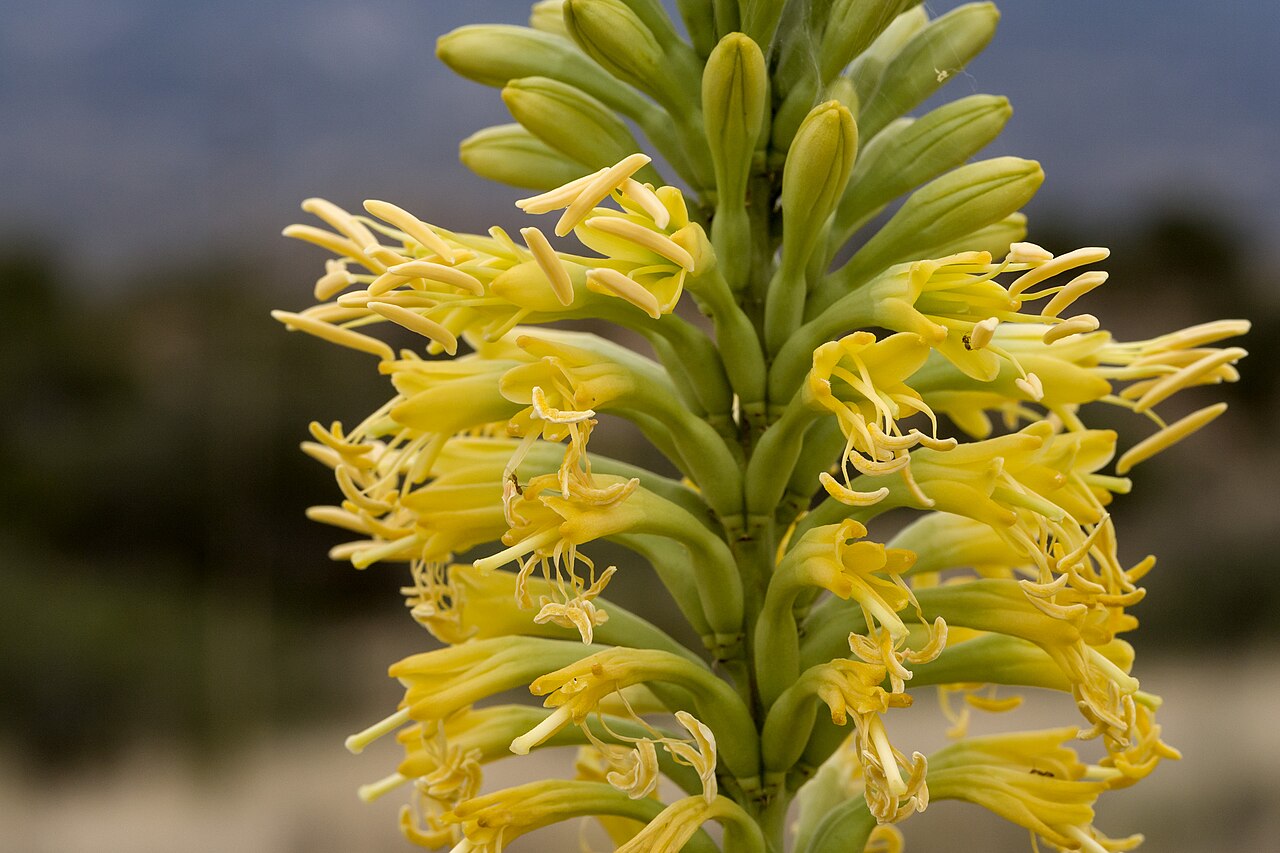
Each rosette flowers only once, in late spring to summer, sending up a tall, narrow, unbranched flower spike to about 9 feet (2.7 m). The spike bears numerous small, tubular, pale to bright yellow flowers, about 1 inch (2.5 cm) across and 2.5 inches (6.4 cm) long, that open with a light, sweet fragrance. After flowering and setting seed, the individual rosette dies, but the surrounding colony of offsets continues growing.
Fruit & Seeds
Pollinated flowers develop into dry, three-chambered capsules that split open at maturity to release flattened black seeds. Because each rosette is monocarpic (it flowers and fruits only once, then dies), seed production marks the end of that individual’s life cycle, even as the clonal colony persists through its root-sprouted offsets.
Quick Facts
| Scientific Name | Agave schottii |
| Family | Asparagaceae (Agave subfamily) |
| Plant Type | Evergreen Perennial Succulent |
| Mature Height | Rosette to 16 in (41 cm); flower spike to 9 ft (2.7 m) |
| Mature Spread | 1–2 ft per rosette; colonies spread several feet by rhizome |
| Growth Rate | Slow |
| Sun Exposure | Full Sun |
| Water Needs | Low; excellent drought tolerance once established |
| Soil Type | Rocky, gravelly, fast-draining |
| Soil pH | Neutral to alkaline |
| Bloom Time | Late spring – summer (individual rosette blooms once) |
| Flower Color | Pale to bright yellow |
| Fall Color | None; evergreen blue-green foliage year-round |
| Fruit | Dry, three-chambered capsule with flat black seeds |
| Deer Resistant | Yes; sharp spines and bitter sap deter browsing |
| USDA Hardiness Zones | 8–11 |
Native Range
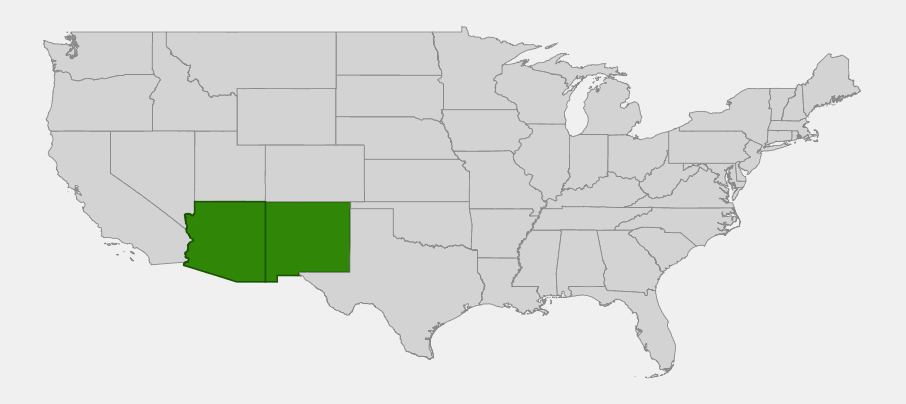
Shin-dagger Agave has a tight native range confined to the sky-island mountains and grasslands of the southwestern borderlands. In Arizona it occurs only in the southern part of the state, in Pima, Santa Cruz, Graham, and Cochise counties; in New Mexico it is found solely in the far southwestern corner, in Hidalgo County. The species continues south into the Mexican states of Sonora, Chihuahua, and Baja California, where its range is considerably broader than on the U.S. side of the border.
Within this range it grows on sunny, open, gently sloping rocky ground and in small drainages, typically at elevations of about 3,600 to 6,600 feet (1,100–2,000 m), in desert grassland, high desert scrub, and juniper-oak woodland on gneiss and similar rocky substrates. It tends to favor north- and east-facing slopes, where temperatures stay somewhat milder than on the hottest, most sun-exposed ground.
A second taxon, Agave schottii var. treleasei, is far more narrowly restricted — found only in Pima County, Arizona — and carries the stricter “Highly Safeguarded” legal designation in addition to salvage restriction. Gardeners and land managers should not confuse plants from outside this native range (including agaves sold simply as “century plants” in general nursery trade) with true wild-collected or locally sourced A. schottii.
📋 Regional plant lists featuring Shin-dagger Agave: Arizona & New Mexico
Growing & Care Guide
Shin-dagger Agave is a low-maintenance, long-lived accent for a xeric or native garden anywhere within its hardiness range, provided it gets the sharp drainage and full sun its native rocky grassland habitat demands.
Light
Full sun is required for a compact, healthy rosette true to its wild form. Plants grown in too much shade stretch, lose their tight form, and flower poorly.
Soil & Water
Fast-draining, rocky or gravelly soil is essential — standing water or heavy clay will quickly rot the roots and crown. Once established, Shin-dagger Agave needs very little supplemental water and is an excellent choice for a true xeriscape planting; occasional deep watering during the hottest, driest stretches of summer is enough. Good air circulation around the base also helps prevent crown rot in humid spells.
Planting Tips
Plant in spring or early fall, siting rosettes well away from walkways, patios, and play areas given the plant’s sharp terminal spines. A raised bed, berm, or rock garden with coarse, mineral soil mimics its native slope habitat and improves drainage. Space colonies 2 to 3 feet apart to allow for natural spread by offsets over time. Always source nursery-propagated stock; this species is a legally Protected Native Plant in Arizona, and removing wild plants without authorization is prohibited.
Pruning & Maintenance
Little pruning is needed. Remove the spent flower stalk after an individual rosette finishes blooming and dies back, and trim dead or damaged leaves at the base as needed, wearing thick gloves because of the terminal spines. Established colonies are otherwise essentially maintenance-free.
Propagation
The easiest method is division of rooted offsets (“pups”) from the base of a mature colony, which can be separated and transplanted at almost any time of year in a mild climate. Seed propagation is possible after a rosette flowers and sets capsules, though seedlings grow slowly and take years to reach flowering size.
Landscape Uses
Shin-dagger Agave fits naturally into several dry-garden settings:
- Xeriscape and rock gardens — thrives in lean, fast-draining, sun-baked sites
- Natural or barrier plantings — its spines discourage foot traffic along informal property edges
- Desert grassland restoration — a true native component of southeastern Arizona grassland and woodland-edge plant communities
- Container specimen — a single rosette makes a striking, long-lived accent in a large pot
Wildlife & Ecological Value
Shin-dagger Agave is a meaningful nectar and shelter resource in the arid grasslands and woodlands where it grows, despite its modest size compared to larger agave species.
For Pollinators
The fragrant, pale yellow flowers attract a wide range of visitors, including bumblebees, honeybees, butterflies, and moths. Flowers produce a relatively small daily volume of nectar, released mostly at night, and the combination of yellow color, sweet scent, and low-protein nectar points to both nocturnal and diurnal pollination by a mix of insects and, in some populations, nectar-feeding bats.
For Birds
Hummingbirds visit the tubular flowers for nectar during the brief flowering period, and the dense, spiny rosettes provide secure nesting and refuge habitat for ground-dwelling and brush-nesting birds that benefit from a barrier few predators will cross.
For Mammals
Javelina and some rodents occasionally feed on the base of flower stalks or fallen fruit, and the dense, spine-armored colonies provide secure shelter for small mammals seeking protection from larger predators and the desert sun.
Ecosystem Role
As a long-lived, clonal component of desert grassland and oak-juniper woodland, Shin-dagger Agave helps stabilize rocky slopes with its root systems and contributes structural diversity to otherwise open grassland, offering cover that grasses and small forbs cannot provide. Its periodic, synchronized-looking flowering (though actually driven by each rosette’s individual age) supplies a reliable, if modest, nectar pulse in a landscape where flowering resources can be sparse for long stretches of the year.
Cultural & Historical Uses
The Seri people of Sonora, Mexico, whose traditional territory overlaps the southern part of this species’ range, historically used Shin-dagger Agave as a source of soap: the plant’s steroidal sapogenin compounds, concentrated in the pulp, produce a sudsing lather when crushed in water. The resulting soap, known regionally as “amole,” “maguey,” or “amolillo,” was used by the Seri — who called the plant “ikapanniim,” meaning roughly “to wash hair with” — to clean and soften hair and to wash clothing.
Unlike the larger agaves historically roasted for food or distilled for mezcal and tequila, Shin-dagger Agave’s pulp is notably bitter and was not used as a food source for people or livestock. Its sapogenin compounds have also drawn modern pharmacological research interest for potential anti-cancer applications, though this remains a subject of laboratory study rather than any established medical use.
Today the species is grown primarily as a xeriscape and native-garden ornamental, valued in the Southwest for its toughness, year-round structure, and role as a genuinely local native plant in gardens around Tucson and other borderland communities within its range.
Frequently Asked Questions
Is Shin-dagger Agave dangerous?
Its sharp, rigid terminal leaf spines can easily puncture skin, and because the rosettes sit at roughly shin height and often hide in grass, they are a well-known hazard to hikers in southeastern Arizona’s grasslands — hence the common name. The sap can also cause skin irritation in sensitive individuals. Wear sturdy boots and long pants when hiking through its habitat, and use thick gloves when handling or pruning the plant.
Can I dig up Shin-dagger Agave from the wild?
No. It is designated a Protected Native Plant (Salvage Restricted) under Arizona’s native plant law, and a related variety, Agave schottii var. treleasei, is Highly Safeguarded. Removing wild plants without the required permits is illegal. Always buy nursery-propagated plants for your garden.
Does the whole plant die after it flowers?
Only the individual rosette that flowers dies; this is called being monocarpic. Because Shin-dagger Agave spreads by underground rhizomes into colonies of many rosettes, the clump as a whole survives and keeps producing new rosettes even as older ones flower, set seed, and die back.
Is Shin-dagger Agave the same as Century Plant?
“Century plant” is a common nickname applied loosely to many Agave species, including this one — “Schott’s Century Plant” is one of its alternate names. It is a distinct, much smaller species than the large, broad-leaved Agave americana often sold generically as “century plant,” and unlike that widely cultivated species, Shin-dagger Agave is genuinely native to the United States.
How much water does Shin-dagger Agave need?
Very little once established. It is adapted to arid desert grassland with sharp drainage and tolerates long dry periods well; the most common way to kill it in cultivation is overwatering or planting it in soil that stays wet, which leads to crown and root rot.

Looking for a nursery that carries Shin-dagger Agave?
Browse our native plant nursery directory: Arizona · New Mexico