Western Maidenhair Fern (Adiantum aleuticum)
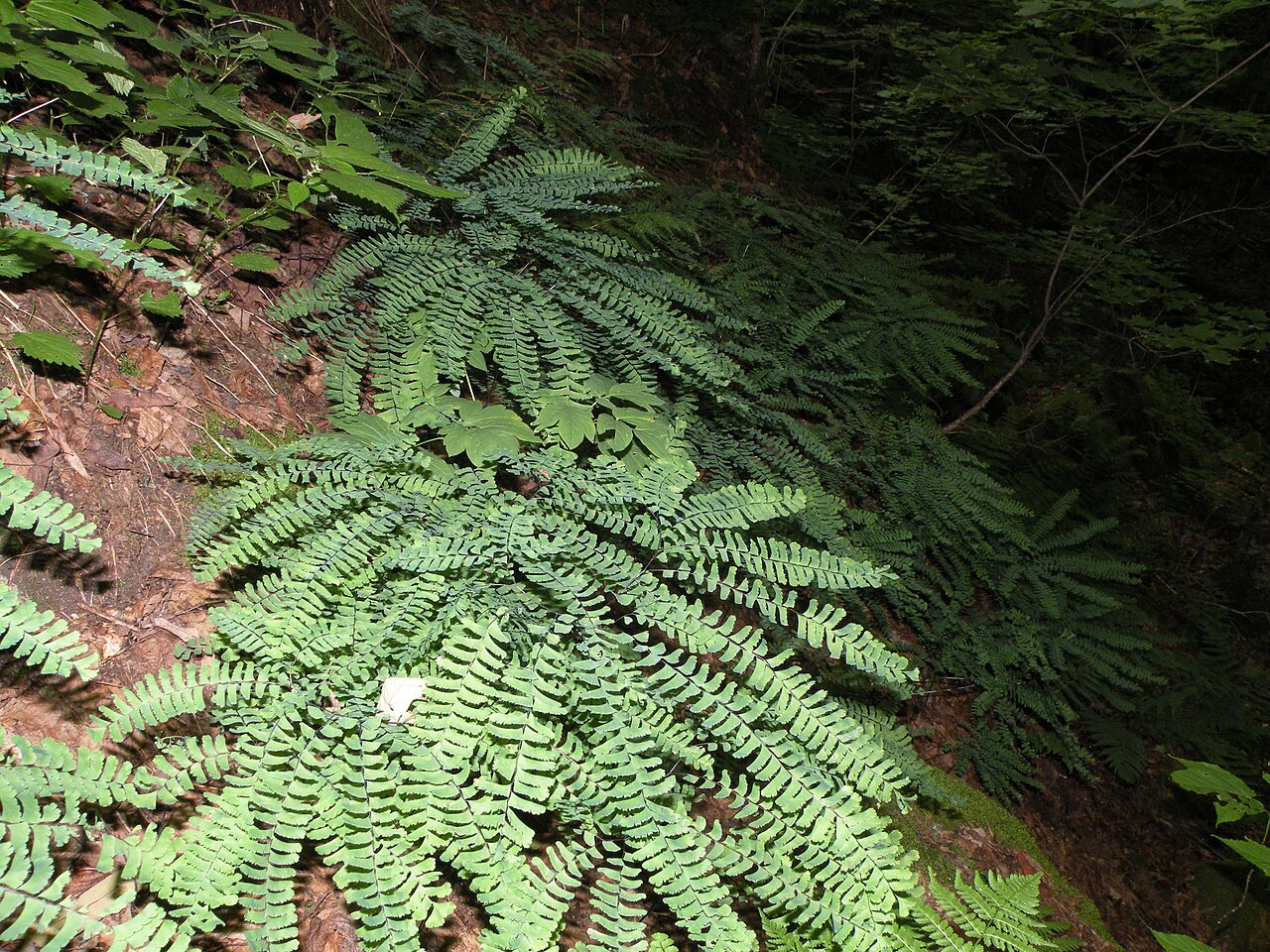
Adiantum aleuticum, the Western Maidenhair Fern (also called Aleutian maidenhair or serpentine maidenhair), is one of the most elegant native ferns found anywhere in North America. Its wiry, near-black stems hold up a fan of light to medium green fronds divided into fingerlike, forking segments — a shape so distinctive that no other native fern of the West is likely to be confused with it. The genus name Adiantum comes from the Greek adiantos, “unwetted,” because the fronds shed raindrops rather than holding a film of water on their surface.
Though commonly called “western” maidenhair, this species actually has an unusual split range: it is common across the mountains and coastal forests of western North America, from the Aleutian Islands of Alaska south through British Columbia, the Pacific states, and the Rockies into the desert ranges of Arizona, and it also turns up as scattered, disjunct colonies on serpentine and calcium-rich outcrops in the Northeast, from Newfoundland to Pennsylvania and Maryland. Until 1991 it was treated as a variety of the eastern Northern Maidenhair Fern (Adiantum pedatum); botanists Cathy Paris and Michael Windham showed the two are reproductively isolated and morphologically distinct enough to stand as separate species, even though they can be hard to tell apart without close comparison.
In the garden, Western Maidenhair Fern is prized for the same reasons it stands out in the wild: a graceful, airy silhouette, tolerance of a wide range of shade, and genuine toughness once it is established in a cool, humusy site. It is an outstanding choice for a native woodland garden, a shaded rock garden, or a planting along a shaded streambank, anywhere in its native range.
Identification
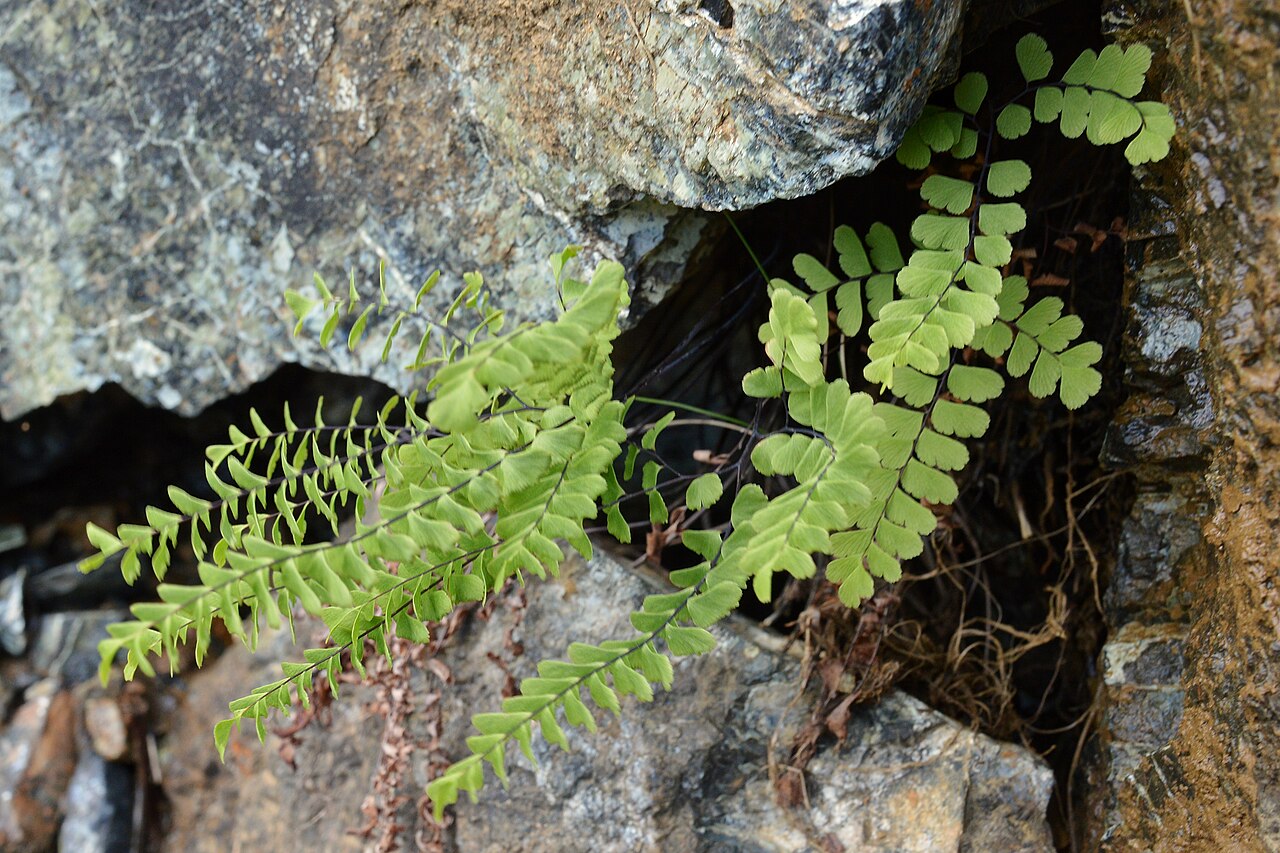
Western Maidenhair Fern grows from a short-creeping to nearly upright rhizome covered in bronzy-yellow scales. Fronds, including their stalks, typically reach 1 to 3 feet (30–90 cm) tall, though plants in deep, moist ravines can be taller and those on exposed rock are often much shorter and stiffer. The overall silhouette — a half-circle or fan of fronds radiating from the top of a slender, nearly black stalk — is the single best field mark for the genus.
Stems
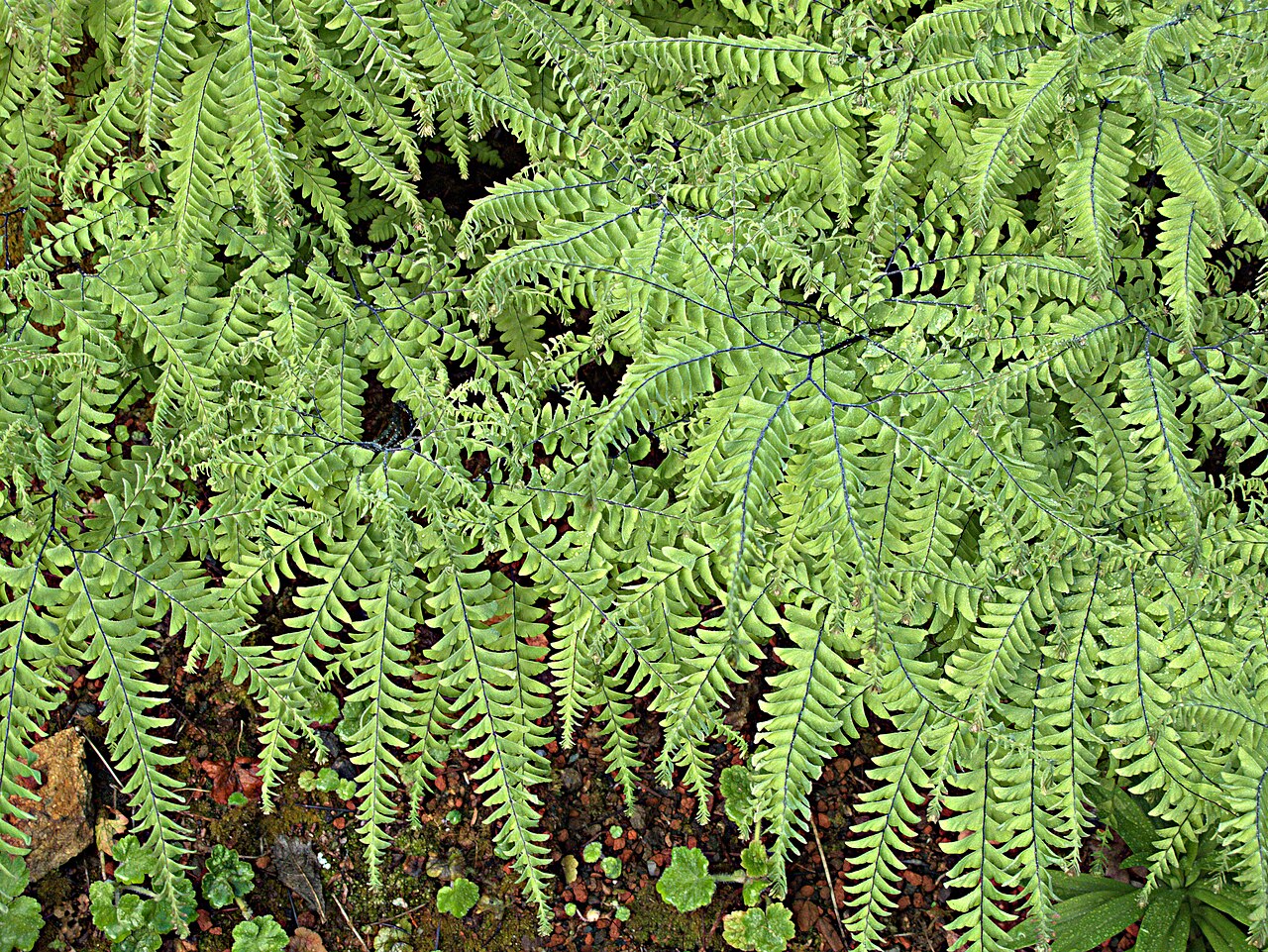
The stalk (stipe) is wiry, glossy, and dark purplish-black to nearly black, often with a waxy, glaucous bloom. It forks near the top into two main branches, each of which bears a row of finger-like pinnae along one side, giving the frond its “palmately branched, pedately divided” architecture — hence the old description of it as “five-fingered fern.” This forking, one-sided arrangement of the pinnae is a key difference from the superficially similar A. pedatum, whose pinnae circle the frond’s fork on both sides more evenly.
Leaves
The blade is fan- to funnel-shaped, 2 to 18 inches (5–45 cm) across, divided into narrow, oblong to fan-shaped ultimate segments with finely toothed outer edges. Foliage is light to medium green and thin-textured, held horizontally in shade but often angled upright in sunnier, rockier sites — an adaptation that reduces the leaf surface exposed to direct sun at midday. New fronds unfurl from a tight fiddlehead-like coil (circinate vernation) in spring. The fern is deciduous, with fronds dying back to the rhizome at the first hard frost and turning papery tan before collapsing.
Spores
Like all ferns, Western Maidenhair reproduces by spores rather than flowers or seeds. The spore-producing structures (sori) are hidden beneath the curled-under tips of the leaf segments, forming oblong to crescent-shaped false indusia visible from below in summer and fall. There is no flower, fruit, or seed to look for at any time of year.
Quick Facts
| Scientific Name | Adiantum aleuticum |
| Family | Pteridaceae (Maidenhair Fern) |
| Plant Type | Deciduous Perennial Fern |
| Mature Height | 1–3 ft (30–90 cm) |
| Mature Spread | 1–2 ft (30–60 cm), slowly expanding by rhizome |
| Growth Rate | Slow to moderate |
| Sun Exposure | Full Shade to Full Sun (best in part shade) |
| Water Needs | Moderate to High; consistent moisture preferred |
| Soil Type | Humus-rich, rocky or loamy; well-drained but moisture-retentive |
| Soil pH | Neutral to alkaline; tolerates serpentine and limestone |
| Bloom Time | None — ferns reproduce by spores, not flowers |
| Flower Color | None |
| Fall Color | Fronds fade to tan and collapse after frost |
| Fruit | None (spore-bearing, not seed-bearing) |
| Deer Resistant | Yes, generally avoided by deer and rabbits |
| USDA Hardiness Zones | 3–8 |
Native Range
Western Maidenhair Fern has one of the more unusual distributions of any North American fern. Its main range runs the length of the West: from the Aleutian Islands and coastal southeast Alaska, south through British Columbia and the Pacific Coast states, east into the northern and central Rocky Mountains of Montana, Wyoming, Idaho, Utah, and western Colorado, and south into the sky-island mountains of Arizona and northern Mexico’s Chihuahua. A second, much smaller set of populations occurs far to the east, disjunct on calcium- or magnesium-rich (often serpentine) rock outcrops from Newfoundland and Quebec south through Maine, Vermont, Pennsylvania, and Maryland.
Across this range the fern is consistently a plant of rock: shaded ravines, talus slopes, streamside ledges, and cliff seeps where roots can reach constant moisture even though the surface may look dry. In the Pacific states it is common in moist, mixed coniferous-deciduous forest on rocky slopes and streambanks from sea level into the mountains; in the Rockies and Southwest it is restricted to shaded canyon walls, seeps, and spring-fed rock crevices, often the only fern present for miles in an otherwise arid landscape. The eastern, serpentine-barren populations occupy a very different, much more exposed habitat, but share the same requirement for a mineral-rich, well-drained rooting zone.
Because the eastern outliers are tied to a scarce and specific rock chemistry, they are considered rare or watch-listed in several Northeastern states even though the species as a whole is secure. Gardeners in the East should not expect this fern to thrive in ordinary acidic woodland soil the way its eastern cousin, the Northern Maidenhair Fern (Adiantum pedatum), does; Western Maidenhair is markedly more particular about mineral content and drainage.
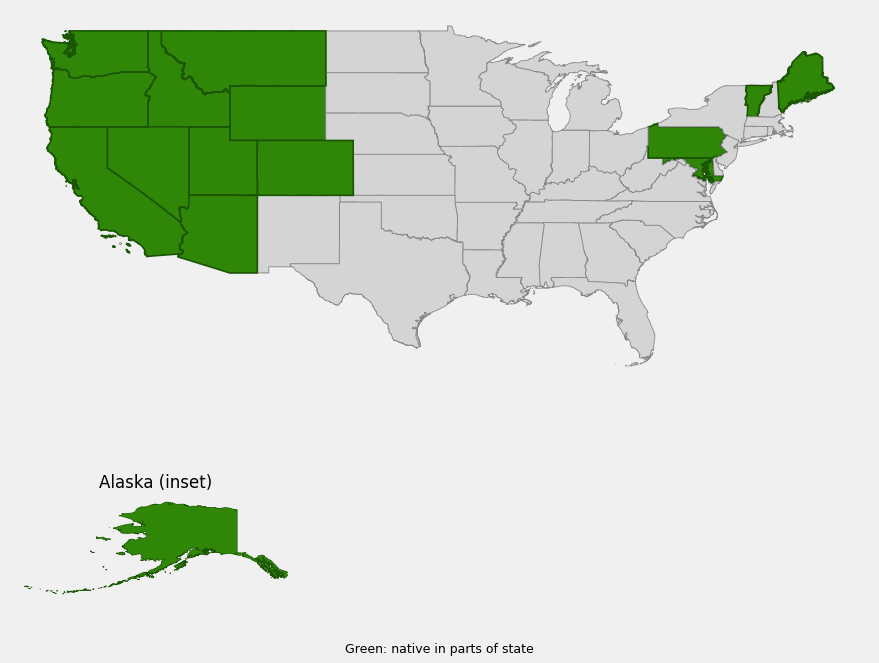
📋 Regional plant lists featuring Western Maidenhair Fern: Alaska · New Hampshire, Maine & Vermont · Maryland, Virginia & West Virginia · Arizona & New Mexico · Utah & Western Colorado · Montana & Wyoming · Western Oregon & Western Washington · Idaho, Eastern Oregon & Eastern Washington · New York, Pennsylvania & Northern New Jersey
Growing & Care Guide
Western Maidenhair Fern has a reputation for being finicky, but most failures trace back to one mistake: planting it in ordinary, acidic woodland soil and expecting it to behave like the eastern maidenhair. Give it the mineral-rich, well-drained, consistently moist rooting zone it evolved for, and it is a long-lived, trouble-free garden plant.
Light
Part shade to full shade suits most garden situations and produces the largest, most horizontally held fronds. In its native mountains the fern also grows in nearly full sun on open, rocky slopes, but there the fronds are held more upright and are noticeably shorter and stiffer — a strategy that limits direct sun exposure at midday. In a garden setting, morning sun with afternoon shade is a good compromise where full shade is not available.
Soil & Water
This fern wants a gritty, humus-rich soil that drains quickly at the surface but stays damp at the root zone — the conditions found naturally among rock fragments next to a seep or stream. Unlike many ferns, it prefers a neutral to slightly alkaline soil and performs best with added lime, dolomite chips, or a limestone or serpentine rock mulch in regions where the native soil is strongly acidic. Consistent moisture through the growing season is important; established plants tolerate brief dry spells better than young ones, but prolonged drought will scorch and collapse the fronds early.
Planting Tips
Plant container-grown Western Maidenhair Fern in spring after the last frost, siting it among rocks, at the base of a shaded wall, or along a streambank where water naturally collects. Mix crushed limestone or dolomite gravel into the planting hole if your native soil is acidic. Space plants 12 to 18 inches apart to allow the fan-shaped fronds room to arch without crowding. A top-dressing of leaf mold or fine bark mulch helps retain the moisture the roots need, but keep mulch away from the crown itself.
Pruning & Maintenance
Cut back dead fronds in late winter or early spring, before new fiddleheads emerge, to tidy the clump and reduce overwintering fungal spores. No other pruning is required. Divide congested clumps in early spring if you want to propagate or control spread; otherwise this fern is low-maintenance once its moisture and mineral needs are met.
Propagation
The easiest method for gardeners is division of the rhizome in early spring, replanting sections with at least one growing point. Spore propagation is possible but slow and best left to fern specialists: ripe spores are collected from the undersides of mature fronds in late summer and sown on sterile, moist medium, where they take months to develop into transplantable sporelings.
Landscape Uses
Western Maidenhair Fern earns a place in several garden settings:
- Shaded rock gardens — tucked into crevices with other moisture-loving rock plants
- Streambank and seep plantings — thrives where water seeps through rock year-round
- Woodland gardens — paired with sword fern, bigleaf maple, and other shade natives
- Container and trough gardens — well suited to a shaded, gritty mix in a shallow pot
- Specimen planting — its fan-shaped silhouette reads as a focal point even as a single clump
Wildlife & Ecological Value
As a fern, Western Maidenhair Fern does not offer the nectar, pollen, or fruit that flowering natives provide, but it still fills a real ecological niche in the shaded, rocky habitats where it grows.
For Pollinators
Because it reproduces by spores rather than flowers, this species offers no nectar or pollen resource and plays no direct role in supporting pollinators.
For Birds
The dense fan of fronds provides small songbirds and wrens with cover and foraging habitat for the insects and spiders that live among damp rock and leaf litter, though the fern itself is not a food source.
For Other Wildlife
The moist, shaded microhabitats this fern favors — rock seeps, talus crevices, and streambank ledges — also support salamanders, snails, and other moisture-dependent invertebrates that shelter among the fronds and rhizomes. Deer and rabbits generally leave the foliage alone, which makes it a reliable choice in gardens with browsing pressure.
Ecosystem Role
By rooting into cracks and crevices in bare rock, Western Maidenhair Fern is among the first vascular plants to colonize fractured talus and seep faces, helping trap leaf litter and fine sediment that other plants can later establish in. Its presence is also a useful indicator of a reliable, mineral-rich moisture source in otherwise dry landscapes such as the canyon country of the Southwest.
Cultural & Historical Uses
Several Indigenous peoples across the fern’s wide range used maidenhair fronds and stems in craftwork. The glossy black stalks (stipes) were especially valued for basketry: Pacific Northwest weavers, including Chehalis and other Coast Salish basket makers, split and used the dark, nearly black stems of Western Maidenhair Fern to create fine black decorative patterns in woven baskets, prized for their durability and color that did not fade with age.
The common name “maidenhair” is tied to old-world folklore about the related European species, in which the delicate, hair-fine black stems were likened to a woman’s hair; by extension the fern was associated in herbal tradition with hair and scalp remedies, though these uses belong to history and folklore rather than any established or recommended treatment.
Today the species is grown almost exclusively as an ornamental, valued by native-plant gardeners and fern collectors for its refined texture and the technical challenge of matching its particular soil chemistry. It has also received the Royal Horticultural Society’s Award of Garden Merit, a recognition of its reliability and garden value where its needs are met.
Frequently Asked Questions
Is Western Maidenhair Fern the same plant as Northern Maidenhair Fern?
No. They were treated as one species for over a century, with Western Maidenhair classified as a variety of Adiantum pedatum, but research published in 1991 confirmed they are reproductively isolated, separate species. Western Maidenhair (A. aleuticum) is generally shorter and stiffer, prefers neutral to alkaline soil, and has a western-plus-disjunct-eastern range, while Northern Maidenhair (A. pedatum) is taller, softer-textured, and common across the acidic woodland soils of the East.
Why is a fern with “western” in its name found in Maine and Pennsylvania?
The eastern populations are genuine outliers, restricted to rare serpentine or other calcium-rich rock outcrops left over from past geological conditions that happen to match the mineral-rich soils common across its main western range. They are not escaped garden plants, but naturally disjunct native populations, and in several Northeastern states they are considered rare.
Can I grow Western Maidenhair Fern in ordinary acidic garden soil?
It will struggle. Unlike most ferns, this species wants a neutral to slightly alkaline, mineral-rich soil similar to its native limestone or serpentine rock habitats. Amending the soil with crushed limestone or dolomite chips, or siting it near a concrete or masonry foundation that leaches lime, markedly improves its performance in acidic regions.
Does Western Maidenhair Fern need full shade?
Not necessarily. While it thrives in part to full shade in most gardens, wild plants on open rocky slopes in the mountains tolerate considerable direct sun as long as their roots stay cool and moist. The deciding factor is consistent moisture at the root zone, not light level.
Is Western Maidenhair Fern deer resistant?
Yes, it is rarely browsed by deer or rabbits, making it a dependable choice for shaded gardens where other plants are regularly grazed.

Looking for a nursery that carries Western Maidenhair Fern?
Browse our native plant nursery directory: Oregon · Washington · California · Alaska