
Puakala (Argemone glauca)
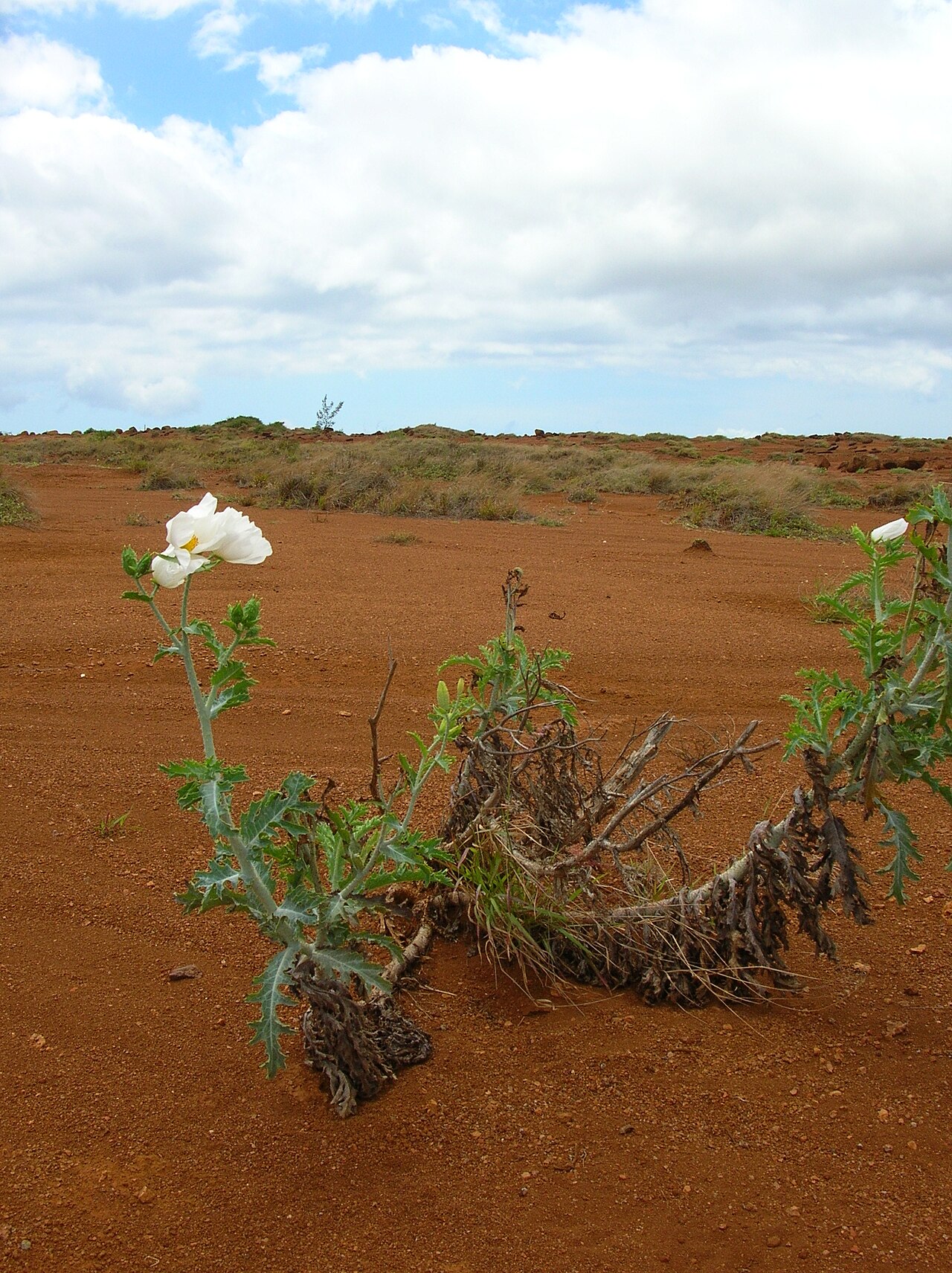
Argemone glauca, known in Hawaiian as Puakala (also written pua kala, meaning roughly “thorny flower”), is a prickly, blue-gray-leaved perennial poppy found only in the Hawaiian Islands. It belongs to the Papaveraceae, the poppy family, and is one of a small number of native Hawaiian plants that is armed with sharp spines — an adaptation that, along with its bitter, toxic sap, helps it survive in some of the driest, most exposed, and most heavily grazed habitats in the islands.
Puakala forms a sprawling, blue-green clump of deeply lobed, spiny leaves topped by large, crepe-paper-textured white flowers with a bright golden-orange center of stamens. It thrives in harsh, disturbed, sun-baked ground — lava fields, dry coastal plains, overgrazed pasture, and roadside cuts — where few other native plants persist, which has sometimes led people to dismiss it as a weed rather than recognize it as one of Hawai’i’s true botanical natives.
For a xeric or dryland Hawaiian garden, puakala is an easy, strikingly architectural plant that asks for almost nothing once established. Its combination of silvery, prickly foliage and large white blooms makes it a dramatic accent, and because livestock and most grazing animals avoid it, it has a long history of use as a living, thorny hedge to protect more tender plants. Every part of the plant is toxic if eaten, so it is a plant to admire rather than to handle carelessly or let children or pets chew on.
Identification
Puakala is a short-lived perennial, usually growing 1 to 4 feet tall and about as wide, with a somewhat sprawling, multi-branched habit. The whole plant has a distinctive blue-gray, waxy (“glaucous”) cast, and every part — stems, leaf midribs, and flower buds — bears scattered, sharp yellow spines.
Leaves
The leaves are deeply and irregularly lobed, with each lobe tipped by a stiff yellow spine, giving the foliage a thistle-like silhouette. Their blue-gray, glaucous surface is one of the easiest field marks for the species — few other Hawaiian dryland plants combine this coloring with such obviously spiny leaves. If a stem or leaf is broken, it exudes a bright yellow latex (sap).
Flowers
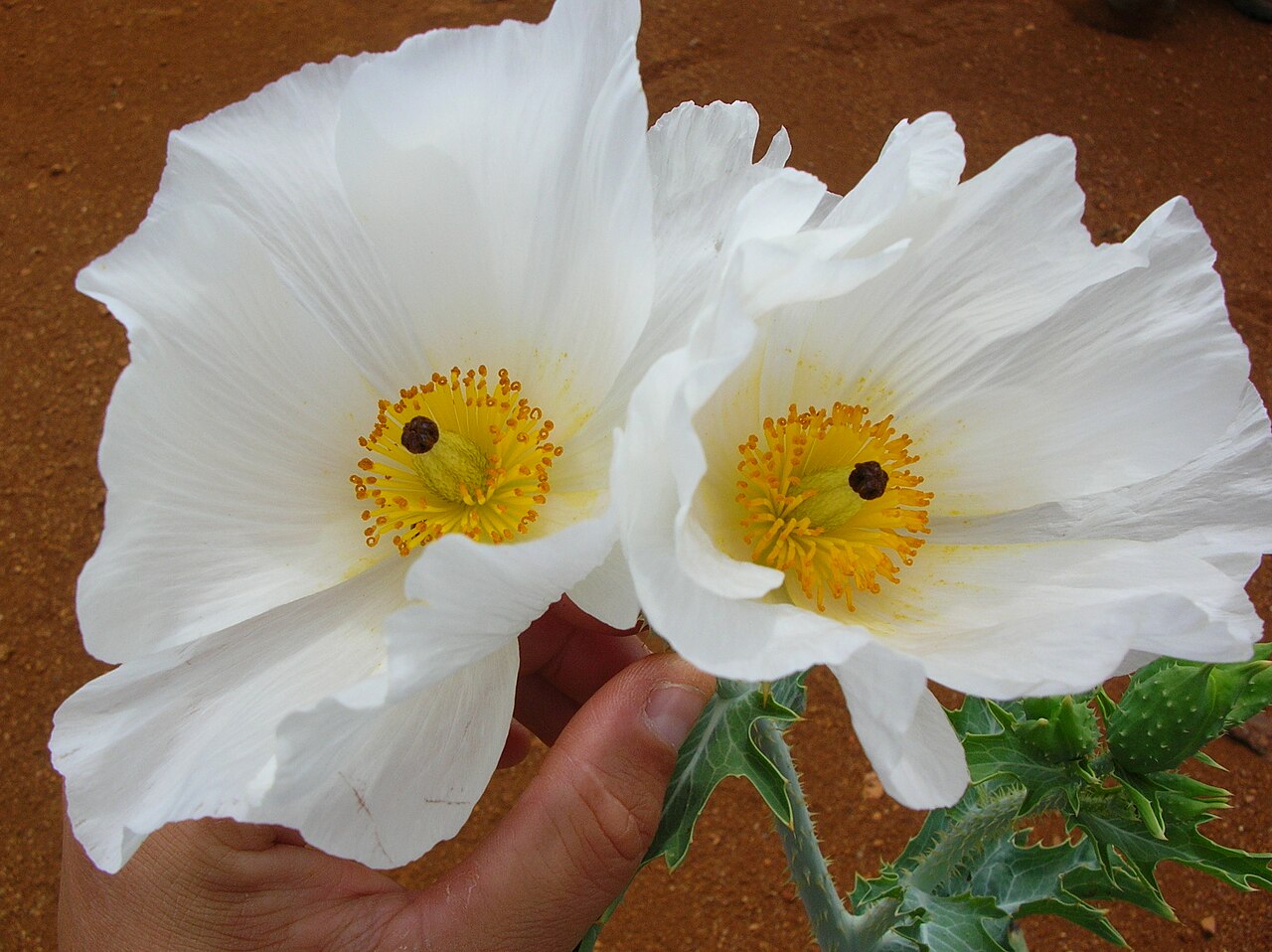
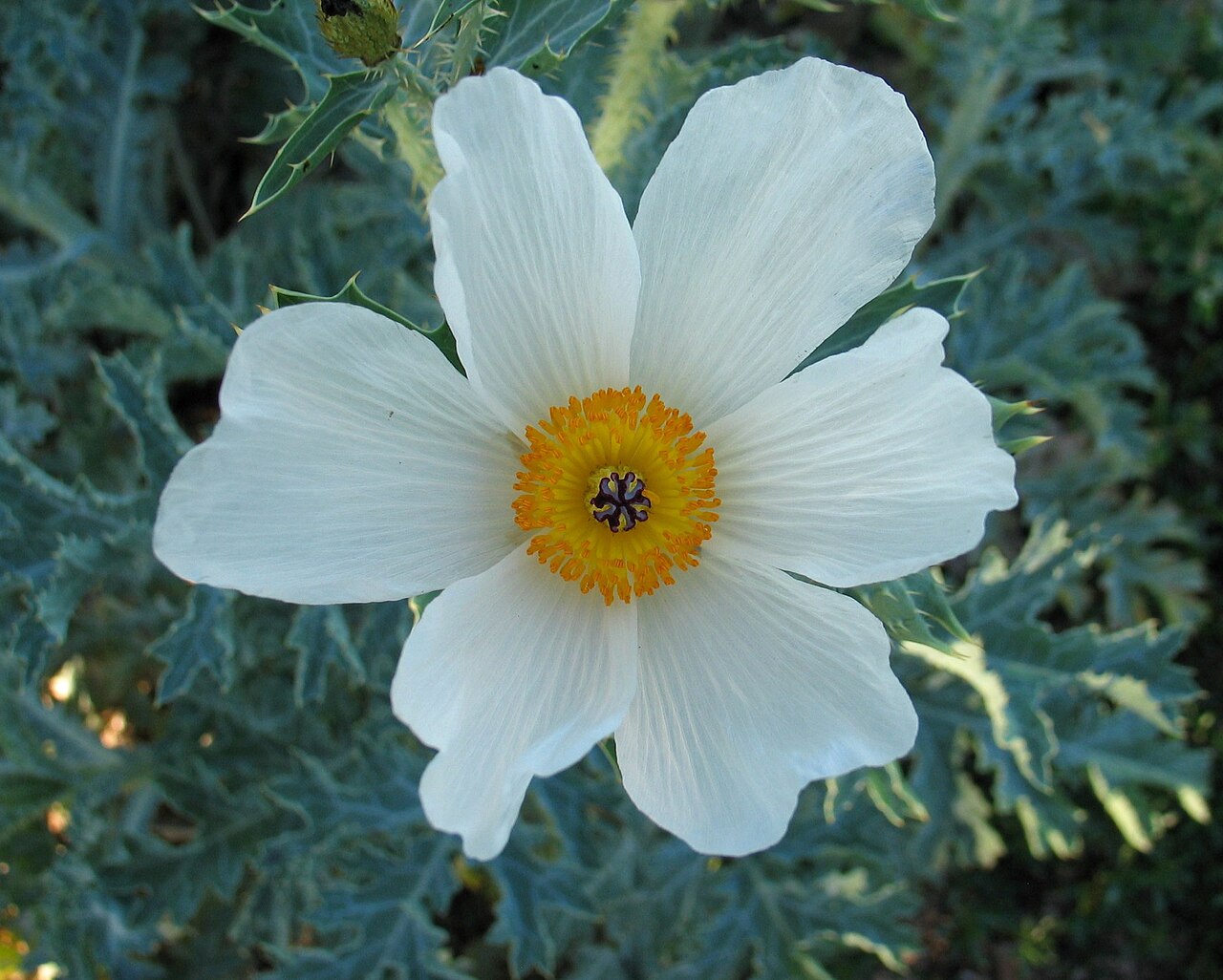
Flowers are large and showy, 3 to 4 inches across, with four to six crinkled, crepe-paper-like white petals surrounding a dense cluster of yellow-orange stamens and a central, often purplish stigma. They open readily and are visible from a distance against the plant’s gray-green foliage, blooming more or less year-round in Hawai’i’s mild climate with little seasonal pause.
Fruit & Seeds
The flowers are followed by spiny, oval seed capsules that split open to release numerous small, round, dark brown to black seeds. Both the capsules and the seeds carry the plant’s defensive spines and toxic alkaloids, and the seeds should never be gathered for food.
Quick Facts
| Scientific Name | Argemone glauca |
| Family | Papaveraceae (Poppy) |
| Plant Type | Perennial forb / subshrub |
| Mature Height | 1–4 ft |
| Mature Spread | 2–3 ft |
| Growth Rate | Moderate to fast |
| Sun Exposure | Full Sun |
| Water Needs | Low; prefers dry soil between waterings |
| Soil Type | Lean, rocky or sandy, well-drained; tolerates disturbed and lava soils |
| Soil pH | Wide tolerance |
| Bloom Time | Nearly year-round |
| Flower Color | White with golden-yellow stamens |
| Fall Color | None (blue-gray foliage year-round) |
| Fruit | Spiny seed capsules with numerous small black seeds |
| Deer Resistant | Yes (spines and toxic sap deter grazing animals) |
| USDA Hardiness Zones | 10–11 |
Native Range
Puakala is endemic to the Hawaiian Islands, meaning it occurs naturally nowhere else on Earth. It has been recorded on all of the main Hawaiian Islands, from sea level up to roughly 6,200 feet in elevation, and is treated as the only true Argemone species native to Hawai’i.
Across the islands, puakala favors dry, open, disturbed ground: coastal plains, lava flows and cinder fields, dry pasture, roadsides, and other sun-exposed sites with poor, rocky soil. Its tolerance of disturbed ground has helped it persist even as much of Hawai’i’s native dryland vegetation has been lost to development, agriculture, and grazing, though it is now locally common in some areas and uncommon in others.
Because puakala is adapted to intense sun, heat, and drought, it is not a plant for shaded, wet, or frost-prone sites, and it is best grown in Hawai’i or similarly warm, dry, frost-free climates rather than attempted as a cold-climate garden plant.
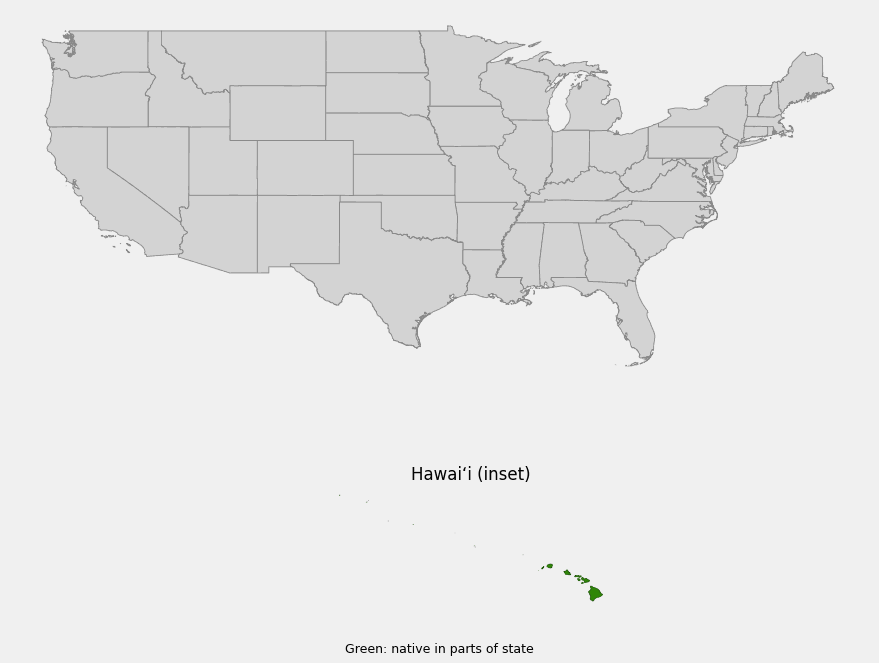
📋 Regional plant lists featuring Puakala: Hawai’i
Growing & Care Guide
Puakala is an easy, low-maintenance plant for warm, dry Hawaiian gardens, as long as it is given the sun and sharp drainage it needs — and given space away from paths, play areas, and curious hands because of its spines and toxic sap.
Light
Plant puakala in full sun. It is adapted to open, exposed dryland sites and does not perform well, nor flower as freely, in shade.
Soil & Water
Puakala thrives in lean, rocky, or sandy soil with excellent drainage, including cinder and young lava soils that few other plants tolerate. It is drought tolerant once established and prefers to dry out between waterings; soggy or heavy clay soils that stay wet will quickly cause problems. In cultivation, occasional deep watering during extended dry spells will keep the plant looking its best, but regular irrigation is not required.
Planting Tips
Choose a sunny, well-drained spot such as a rocky slope, dry bank, or xeriscape bed. Space plants 2 to 3 feet apart to allow for their sprawling habit. Because of the spines, keep puakala away from paths, seating areas, and anywhere small children or pets play.
Pruning & Maintenance
Little pruning is needed; remove spent flower stalks and any dead growth as desired, wearing thick gloves because of the spines on stems and leaves. The sap stains and irritates skin, so avoid letting the broken latex contact bare skin or eyes.
Landscape Uses
Puakala’s toughness and defensive spines make it useful in several dryland garden roles:
- Xeriscape and dryland gardens needing little supplemental water
- Living barrier hedge — its spines and bitter sap deter grazing animals and foot traffic
- Lava-rock and cinder landscaping where few other plants will establish
- Coastal dryland restoration on disturbed or eroded ground
- Specimen or accent planting for its striking blue-gray foliage and large white flowers
Wildlife & Ecological Value
Puakala plays a modest but distinctive role in Hawai’i’s dryland ecosystems, particularly as one of the few spiny, toxic native plants able to persist on heavily disturbed or grazed ground.
For Pollinators
The large, pollen-rich flowers attract native and introduced bees, which forage on the abundant yellow-orange stamens. Because puakala often blooms in otherwise sparse dryland habitat, it can be a locally important nectar and pollen source where little else is flowering.
For Birds
Puakala does not offer a notable fruit or berry crop for birds, but the open, sprawling clumps provide some cover in exposed dryland habitat, and seed-eating birds may take fallen seed from the spiny capsules.
For Mammals
Cattle, goats, and other grazing animals generally avoid puakala because of its spines and bitter, toxic latex, which is precisely why the plant has historically been used as a natural barrier hedge. This unpalatability also allows puakala to persist and even spread on pastureland where more palatable native plants have been grazed out.
Ecosystem Role
As a hardy colonizer of bare lava, cinder, and disturbed dry ground, puakala helps stabilize soil and provide an early vegetative cover on sites too harsh for many other plants, native or introduced. Its presence is often a sign of a dry, open, sun-exposed site within Hawai’i’s lowland dry ecosystems.
Cultural & Historical Uses
Puakala holds a documented place in Hawaiian ethnobotanical history, despite — or because of — its toxicity. Native Hawaiians historically applied the plant’s bright yellow sap in traditional remedies for toothache pain, nerve pain (neuralgia), and skin ailments such as ulcers and warts. This is a record of historical practice, not a recommendation for use today: puakala’s sap and seeds are toxic, and the plant should never be ingested or self-administered medicinally.
Notably, puakala does not contain the opioid alkaloids found in the cultivated opium poppy; its toxicity instead comes from isoquinoline alkaloids characteristic of the genus Argemone, which are irritant to skin and mucous membranes and toxic if the sap, seeds, or plant material are consumed. The common name “puakala” reflects the plant’s defining spiny character — “kala” referring to its sharp, thorny texture.
Beyond medicine, early Hawaiian ranchers and farmers recognized that livestock would not eat puakala, and the plant was sometimes left standing or even encouraged along pasture edges as a natural, thorny deterrent to animal movement — a practical use that persists informally in some dryland areas today.
Frequently Asked Questions
Is puakala poisonous?
Yes. The yellow sap and the seeds are toxic if ingested and can irritate skin and eyes on contact. Handle the plant with gloves, keep it away from children and pets, and never attempt to eat any part of it.
Why does puakala grow where nothing else will?
Its spines and toxic sap make it unpalatable to grazing animals, and it tolerates the lean, rocky, and disturbed soils of lava fields and overgrazed pasture that few other plants can establish in. This toughness is also why it is sometimes mistaken for an introduced weed rather than recognized as a native Hawaiian endemic.
Does puakala need regular watering?
No. Once established, it is quite drought tolerant and prefers soil that dries out between waterings. Overwatering in heavy or poorly drained soil is more likely to cause problems than underwatering.
Can puakala be grown outside Hawai’i?
It is adapted to Hawai’i’s warm, frost-free, dry lowland climate and is best suited to similar subtropical or tropical dryland conditions; it is not a candidate for cold-winter climates.
Is puakala related to the opium poppy?
It is in the same broad poppy family (Papaveraceae) but a different genus, and it does not contain opium’s narcotic alkaloids. Its toxicity comes from a different group of alkaloids typical of the prickly poppy genus Argemone, and it has no legitimate recreational or medicinal use today.

Looking for a nursery that carries Puakala?
Browse our native plant nursery directory: Hawai’i