
Southern Catalpa (Catalpa bignonioides)
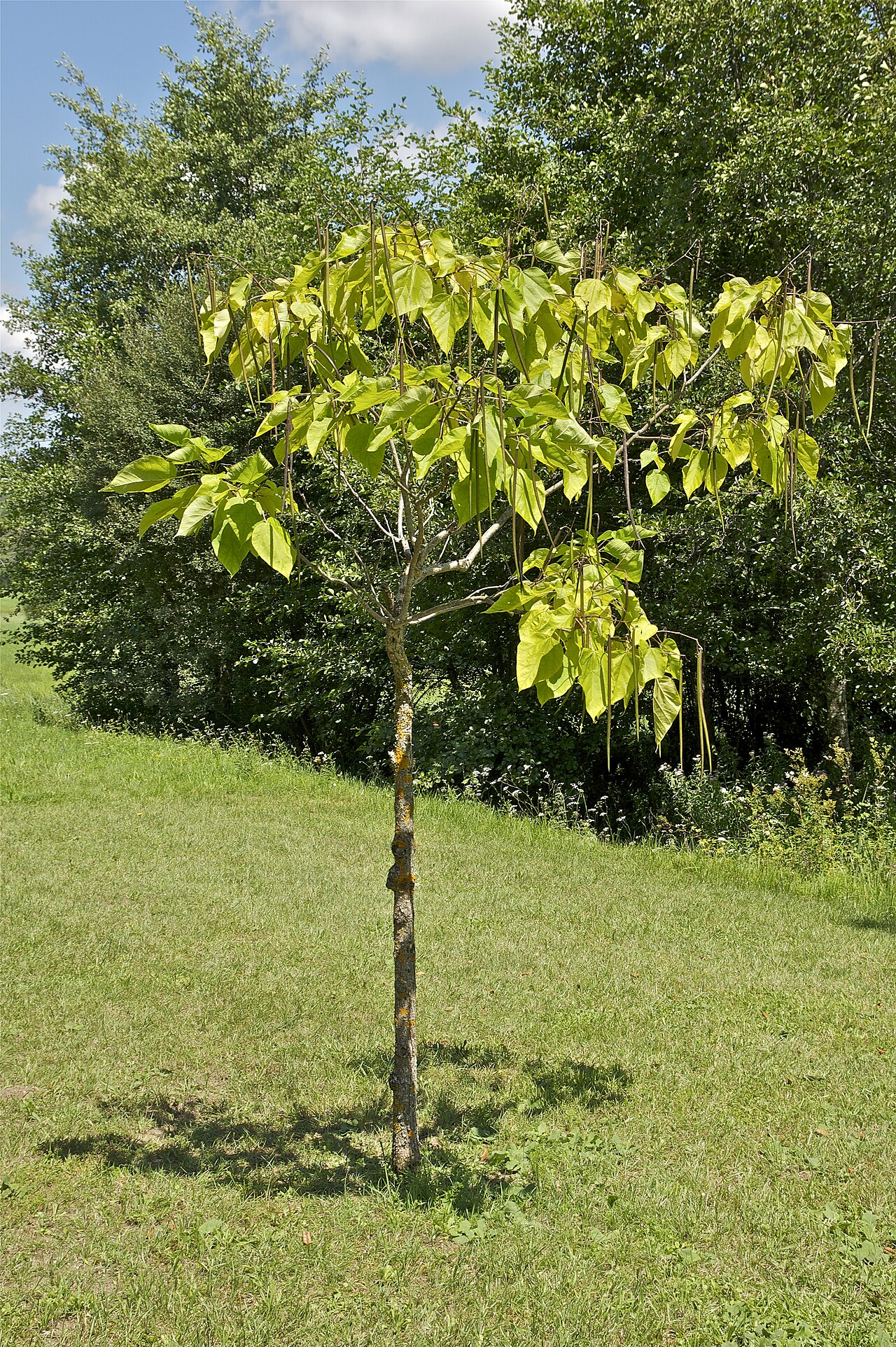
Catalpa bignonioides, commonly called Southern Catalpa, Cigar Tree, or Indian Bean Tree, is a fast-growing deciduous tree in the Bignoniaceae (trumpet creeper) family, known for its huge heart-shaped leaves, showy orchid-like white flowers, and long, dangling seed pods that resemble cigars. It is a true native of only a small corner of the Gulf Coast — but thanks to more than a century of ornamental planting, it is now one of the most widely recognized trees across the eastern and central United States, far beyond the handful of states where it actually belongs.
In its native range, Southern Catalpa grows along streambanks, in bottomland woods, and at the edges of swamps and floodplain forests, where its tolerance for wet soils and periodic flooding gives it an edge over less adaptable trees. Left to its own devices it reaches 30 to 40 feet tall with a short trunk and a broad, irregular, rounded crown that often looks too big for the tree beneath it. In early summer it produces large, showy clusters of white, trumpet-shaped flowers marked with yellow stripes and purple speckling in the throat — a magnet for bumblebees and a genuine highlight of the Southern landscape.
Gardeners prize Southern Catalpa for its dramatic tropical-looking foliage and rapid shade, but it is not a tidy tree: it drops large leaves, long bean-like pods, and twigs through the growing season, and it reseeds itself readily. It is best used where its coarse texture and generous size are an asset — as a specimen shade tree, a wildlife tree, or (for anglers in the South) as a living bait farm, since its leaves are the sole food source for the catalpa worm, one of the best-known live fishing baits in the region.
Identification
Southern Catalpa is unmistakable once it leafs out or flowers: no other common native or naturalized tree in the East combines dinner-plate-sized heart-shaped leaves with cigar-like seed pods a foot or more long. Young trees often look gawky, with an open crown and oversized leaves; mature trees fill out into a broad, rounded canopy.
Bark & Stems
Bark on young trees is thin, smooth, and gray-brown, becoming thicker, scaly, and irregularly ridged with age, breaking into thin plates. Twigs are stout, brittle, and gray to brown, with a chambered pith and a strong, somewhat unpleasant odor when cut or crushed — a useful identification clue when the tree is out of leaf.
Leaves
Leaves are large and heart-shaped (cordate), 4 to 10 inches long and nearly as wide, with a pointed tip and smooth (entire) margins. They are arranged oppositely or in whorls of three along the stem — unusual among broadleaf trees and a quick way to separate Catalpa from superficially similar big-leaved trees. The upper surface is light to medium green and slightly fuzzy when young; leaves emerge late in spring and drop early, often blackening with the first hard frost. Crushed leaves give off a disagreeable, slightly skunky odor.
Flowers
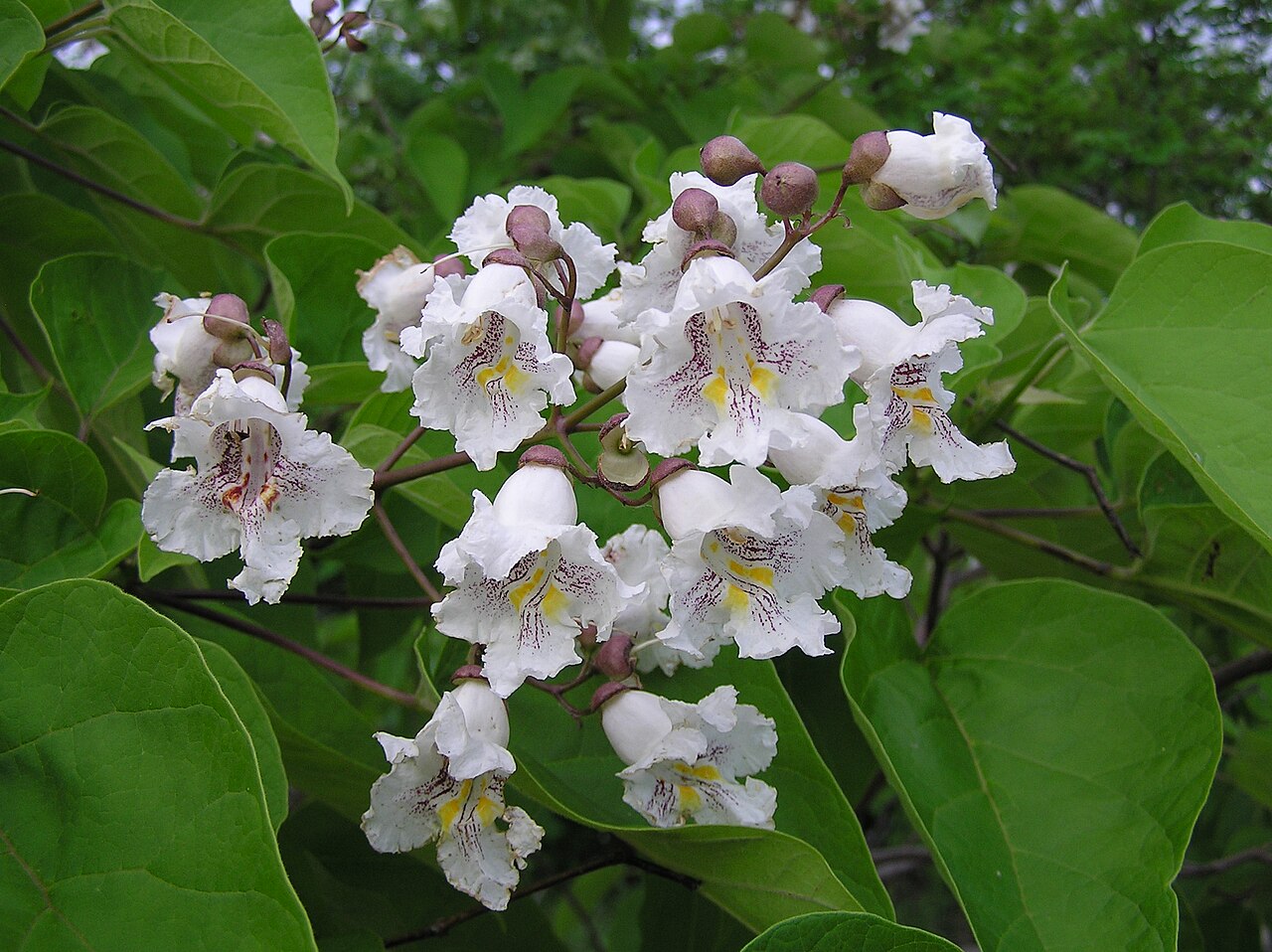
In late spring to early summer (May into June, later northward), Southern Catalpa produces upright, branched clusters (panicles) of 20 to 40 flowers at the branch tips. Each flower is bell- or trumpet-shaped, about 1 to 2 inches across, white with two yellow stripes down the throat and a scatter of purple-brown spots and streaks inside the lower lip — markings that guide pollinating bees directly to the nectar. The floral display is brief but spectacular, often lasting only one to two weeks.
Fruit & Seeds
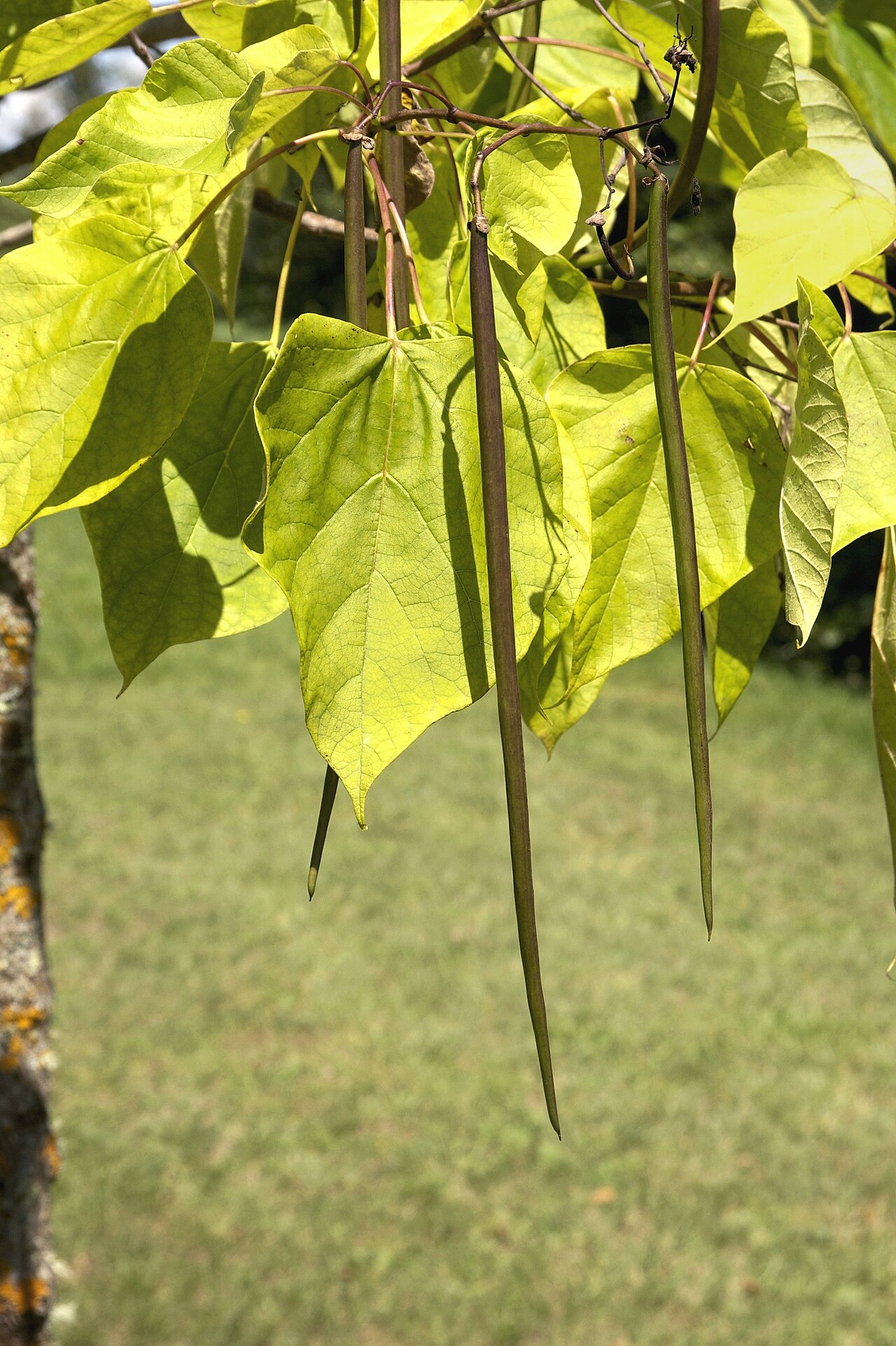
The fruit is a long, slender, bean-like capsule — the “cigar” that gives the tree its common names — typically 8 to 20 inches long and about ⅜ inch thick, hanging singly or in clusters. Pods ripen in autumn, turn dark brown, and often persist on the bare tree through winter before splitting lengthwise to release dozens of flat, papery, winged seeds with tufts of hair at each end, built for wind dispersal.
Quick Facts
| Scientific Name | Catalpa bignonioides |
| Family | Bignoniaceae (Trumpet Creeper) |
| Plant Type | Deciduous Tree |
| Mature Height | 30–40 ft (occasionally to 60 ft) |
| Mature Spread | 20–40 ft |
| Growth Rate | Fast |
| Sun Exposure | Full Sun to Part Shade |
| Water Needs | Average to moist; tolerates occasional flooding |
| Soil Type | Adaptable; moist, deep soils preferred |
| Soil pH | 5.5–7.5 |
| Bloom Time | May – June |
| Flower Color | White with yellow and purple throat markings |
| Fall Color | Yellow-green, often blackened by frost |
| Fruit | Long bean-like capsules (“cigars”), 8–20 in |
| Deer Resistant | Yes, generally |
| USDA Hardiness Zones | 5–9 |
Native Range
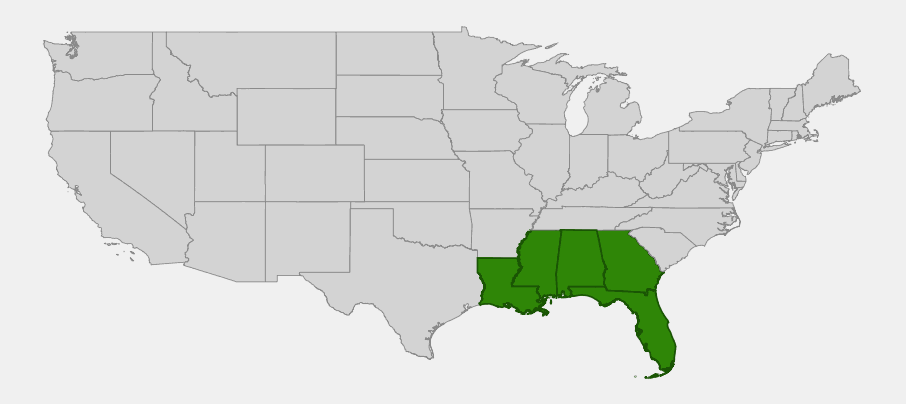
Southern Catalpa’s true native range is surprisingly small: it is native only to a limited area of the Gulf Coast, in Louisiana, Mississippi, Alabama, Georgia, and the Florida panhandle, where it grows naturally along rivers, in bottomland hardwood forests, and at the margins of swamps. Despite the “southern” in its common name, this native footprint does not extend into the Carolinas, Tennessee, Texas, or peninsular Florida.
Southern Catalpa is not native to the vast majority of places it is now found growing. It has been planted so widely as an ornamental and shade tree — and self-seeds so readily from those plantings — that it has naturalized across most of the eastern and central United States, from New England and the Great Lakes south to Texas and west into the Plains. If you see a catalpa tree outside the five-state Gulf Coast area described above, it almost certainly descends from cultivated stock rather than a wild population, and in some regions it behaves as a mildly weedy escape that out-competes slower-growing native trees along disturbed ground and fencerows.
Within its native range, Southern Catalpa is a true bottomland species, most often found on moist, rich, alluvial soils near streams and rivers where periodic flooding keeps competition from longer-lived climax trees in check. It tolerates wet feet far better than compacted or chronically dry soils, which is one reason it struggles in some of the places it has been planted far outside its native range.
📋 Regional plant lists featuring Southern Catalpa: Georgia, Alabama & Mississippi · Arkansas, Louisiana, Eastern Oklahoma & Eastern Texas
Growing & Care Guide
Southern Catalpa is an easy, forgiving tree to grow — arguably too easy, since it seeds in readily on its own. Within its native Gulf Coast range it is a genuine asset for naturalistic plantings near water; elsewhere, gardeners should weigh its vigorous self-seeding against its fast shade and showy bloom.
Light
Plant in full sun for the densest crown and heaviest bloom, though Southern Catalpa tolerates light to part shade, especially as a younger tree establishing beneath an open canopy. Deep shade produces a sparse, leggy habit and little flowering.
Soil & Water
This tree is adaptable to a wide range of soils, including clay, but performs best in moist, deep, fertile soil similar to its native bottomland habitat. It tolerates occasional flooding and wet soils far better than most ornamental trees, but also handles average garden moisture once established. Avoid droughty, shallow soils, which stress the tree and shorten its lifespan.
Planting Tips
Give Southern Catalpa plenty of room — a mature crown can spread 30 feet or more — and site it away from patios, walkways, and parking areas, since it drops large leaves, twigs, and foot-long seed pods through the growing season and into winter. Plant balled-and-burlapped or container stock in early spring or fall. Within its native Gulf Coast range it is an excellent choice for streamside restoration and low, periodically wet ground.
Pruning & Maintenance
Prune young trees to establish a strong central leader and remove weak, narrow-angled branches, which are prone to storm damage on this fast, somewhat brittle-wooded species. Little other maintenance is needed. Southern Catalpa is generally pest-tolerant — even its main defoliator, the catalpa sphinx moth caterpillar, rarely kills an established tree and is often left alone or even encouraged by gardeners who fish.
Landscape Uses
Southern Catalpa’s bold texture and fast growth suit a specific set of landscape roles:
- Specimen shade tree where its coarse, tropical-looking foliage can be appreciated up close
- Streamside and bottomland restoration within its native Gulf Coast range
- Wildlife and pollinator plantings — flowers draw bumblebees; foliage feeds catalpa sphinx moth larvae
- “Bait tree” plantings by anglers who harvest catalpa worms for fishing
- Quick shade for new properties willing to accept its litter and reseeding
Because it self-seeds freely and has naturalized across much of the eastern U.S., gardeners outside its native Gulf Coast range should plant it thoughtfully — deadhead spent flower clusters if seedling volunteers become a nuisance, and avoid planting near natural areas where it could crowd out locally native trees.
Wildlife & Ecological Value
Southern Catalpa plays an outsized ecological role for a single tree species, almost entirely through one close relationship with an insect that depends on it completely.
For Pollinators
The large, showy flower clusters are heavily visited by bumblebees and other native bees, which are strong enough to force their way past the flower’s landing-pad lower lip to reach the nectar — the purple throat markings act as a visual guide (“nectar guides”) straight to the reward. Hummingbirds occasionally visit as well.
For Insects & Birds
Southern Catalpa is the exclusive larval host plant for the catalpa sphinx moth (Ceratomia catalpae), whose caterpillars — the famous “catalpa worms” — can defoliate entire branches in heavy years, usually without killing the tree, which typically refoliates. Those caterpillars are themselves an important food source for birds, and the trees’ large size and cavities (in older specimens) provide nesting sites for cavity-nesting species.
Ecosystem Role
Within its native bottomland range, Southern Catalpa helps stabilize streambanks and contributes to the structure of floodplain forest, tolerating the periodic flooding that limits many other trees. Outside that range, its ecological role is more complicated: because it naturalizes easily, it can compete with regionally native trees in disturbed bottomlands and fencerows far from the Gulf Coast.
Cultural & Historical Uses
Southern Catalpa has a long history as a utility and ornamental tree across the South. Its wood is lightweight, soft, and notably rot-resistant, which made it a traditional choice for fence posts, rails, and railroad ties in parts of the rural South — farmers often grew small catalpa groves specifically to supply durable, long-lasting fence posts without needing to treat the wood.
The tree’s most enduring cultural association, though, is with recreational fishing. The catalpa worm — the larval stage of the catalpa sphinx moth — has been prized bait for generations of Southern anglers, especially for catfish and bream, and some families still plant or maintain catalpa trees specifically to have a reliable summer supply. Pods and leaves have occasionally appeared in older folk remedies, but these are historical practices rather than guidance, and the tree’s parts are not considered food.
Ornamentally, Southern Catalpa and its golden-leaved cultivar ‘Aurea’ have been planted across American towns and parks since the 19th century for fast shade and summer flowers, which is the main reason the species is now so widely naturalized far outside its small native Gulf Coast range.
Frequently Asked Questions
Is Southern Catalpa native to my state?
Only if you are in Louisiana, Mississippi, Alabama, Georgia, or the Florida panhandle. Despite being common across much of the eastern and central United States, Southern Catalpa is planted and naturalized — not native — everywhere else it grows, including the rest of Florida, the Carolinas, Tennessee, Texas, and points north.
What are those long, hanging pods?
They are the tree’s seed capsules, often called “cigars” or “Indian beans.” They ripen in fall, turn dark brown, and split open over winter to release flat, winged seeds.
What is a catalpa worm, and is it harmful to the tree?
It’s the caterpillar of the catalpa sphinx moth, which feeds exclusively on catalpa leaves and can strip branches bare in a bad year. Established trees almost always refoliate and survive; many Southern anglers consider a catalpa worm outbreak a bonus rather than a problem.
Is Southern Catalpa messy?
Yes — it drops large leaves, twigs, and long seed pods throughout the growing season and winter. Site it away from patios, driveways, and walkways, and expect some cleanup.
Is Southern Catalpa invasive?
It is not listed as a noxious weed, but it self-seeds aggressively and has naturalized across most of the eastern U.S. well beyond its small native range. Gardeners outside the Gulf Coast native range should keep an eye on volunteer seedlings, especially near natural areas.

Looking for a nursery that carries Southern Catalpa?
Browse our native plant nursery directory: Alabama · Florida & Georgia · Louisiana & Mississippi