
Zigzag Iris (Iris brevicaulis)
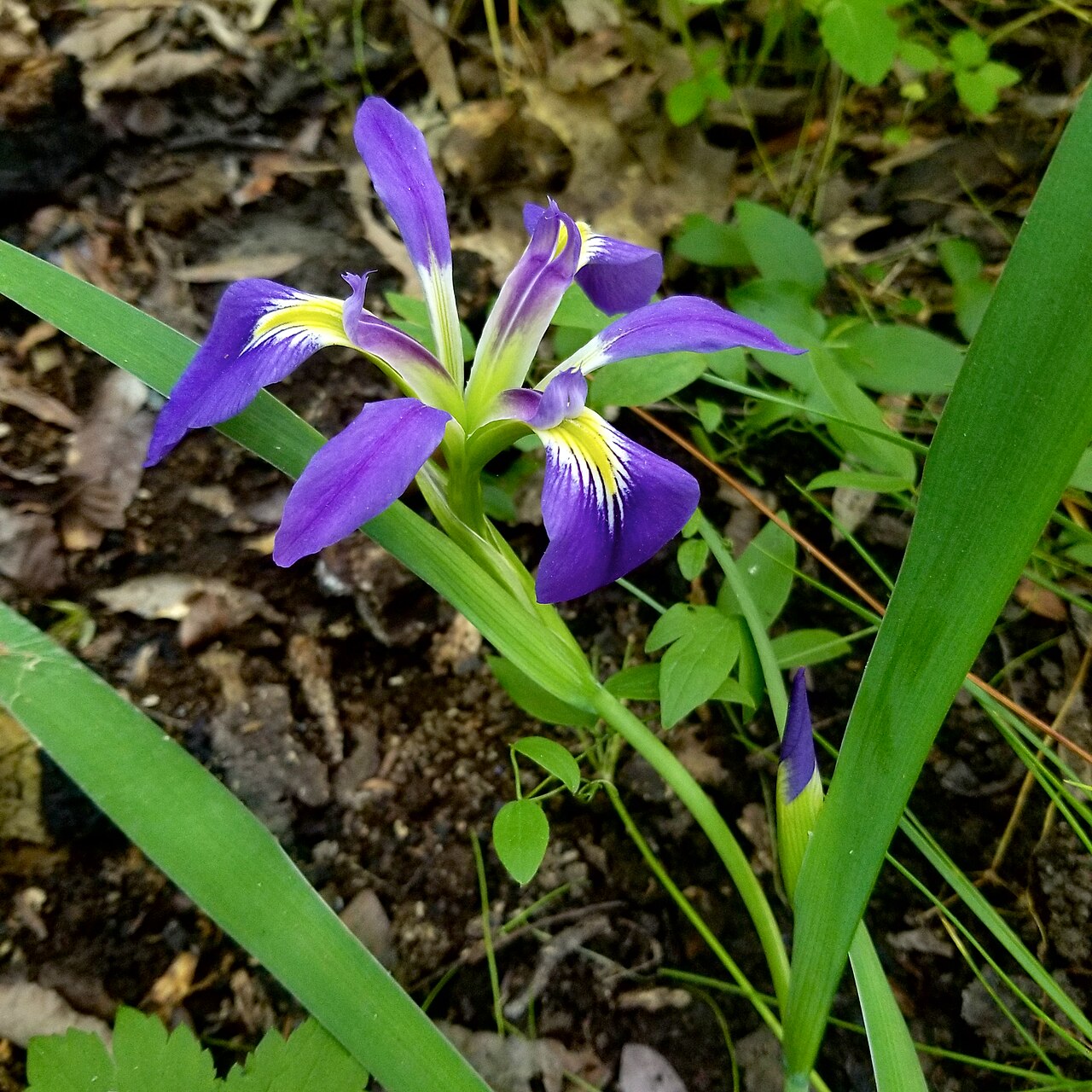
Iris brevicaulis, commonly called Zigzag Iris (also sold as Short-Stem Iris or Leafy Blue Flag), is a tough, shade-tolerant native iris of the central and southeastern United States, named for its distinctively bent, zigzagging flower stalk. It is one of the five wild “Louisiana iris” species — the group of closely related, interfertile beardless irises native to the lower Mississippi River Valley and surrounding region — though zigzag iris ranges much farther inland and tolerates drier, shadier sites than its showier coastal relatives.
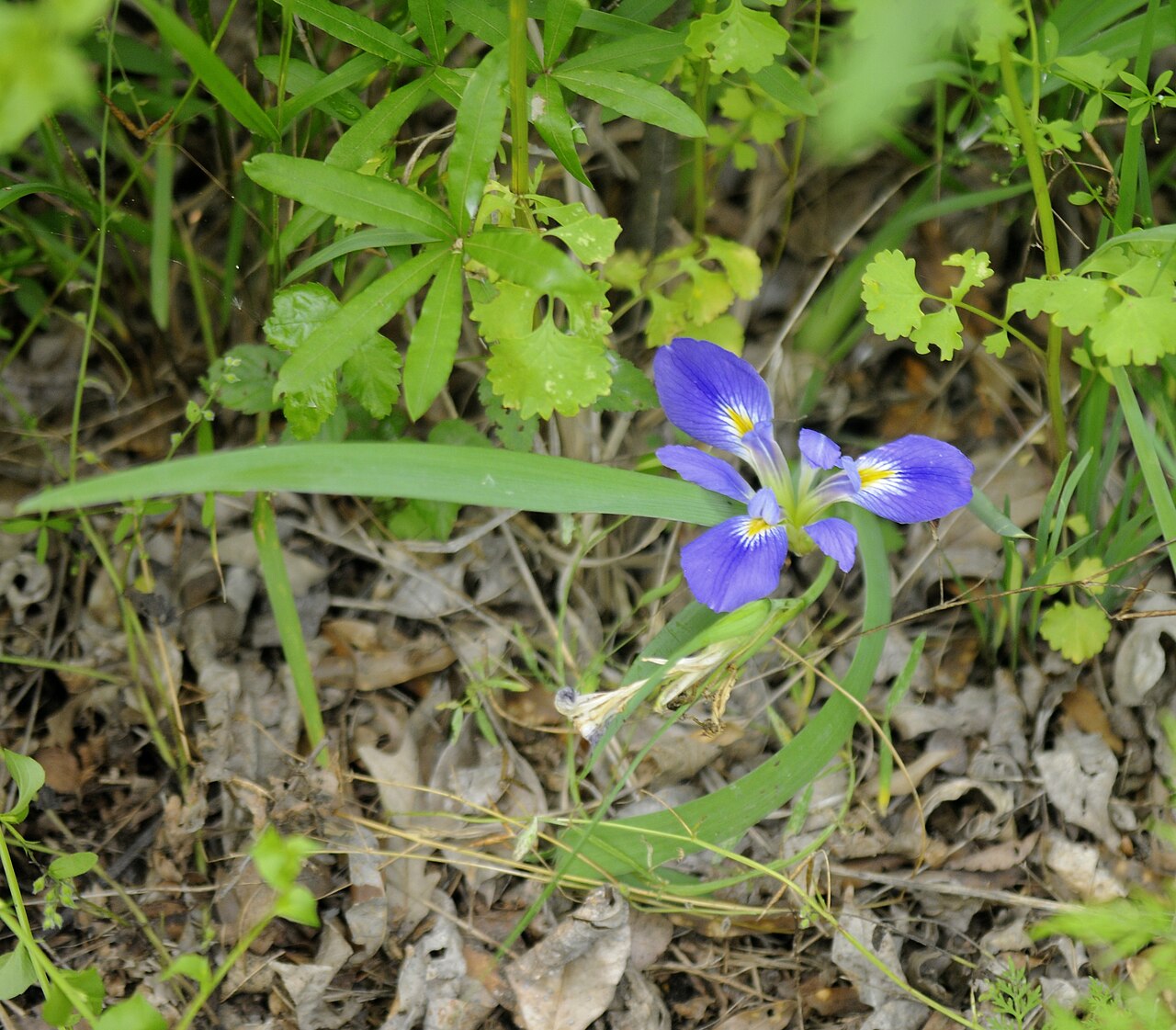
Zigzag iris typically grows just 8 to 20 inches tall, shorter and sturdier than other Louisiana irises, with broad, dark green sword-like leaves and large violet-blue flowers marked with a bold white-and-yellow signal patch at the base of each fall petal. Its common name comes from the flower stem itself, which bends sharply at each node rather than growing in a straight line — an easy field mark that separates it from similar wild irises.
Unusually for a wetland iris, zigzag iris is comfortable in both consistently wet, shaded bottomland soils and in garden beds that only occasionally flood, making it one of the most adaptable native irises for rain gardens, pond margins, and woodland edges across a broad swath of the country from the Great Lakes states to the Gulf Coast.
Identification
Zigzag iris forms clumps 1 to 2 feet tall and wide, spreading slowly by thick, creeping rhizomes just beneath the soil surface. It is shorter and more compact than most other wild irises in its group, with flower stems that rarely exceed 20 inches.
Stems
The flowering stem is the plant’s signature feature: it bends sharply, almost at a right angle, at each point where a leaf or branch arises, creating a visibly zigzagging path from base to bloom. This angular growth habit is the source of both the common name and a reliable identification clue in the field.
Leaves
Leaves are sword-shaped, flat, and broad — typically ½ to 1 inch wide — arranged in a fan at the base of the plant and arching gracefully outward. They are a rich medium to dark green, somewhat glaucous (lightly waxy-coated), and persist through much of the growing season before dying back in late fall.
Flowers
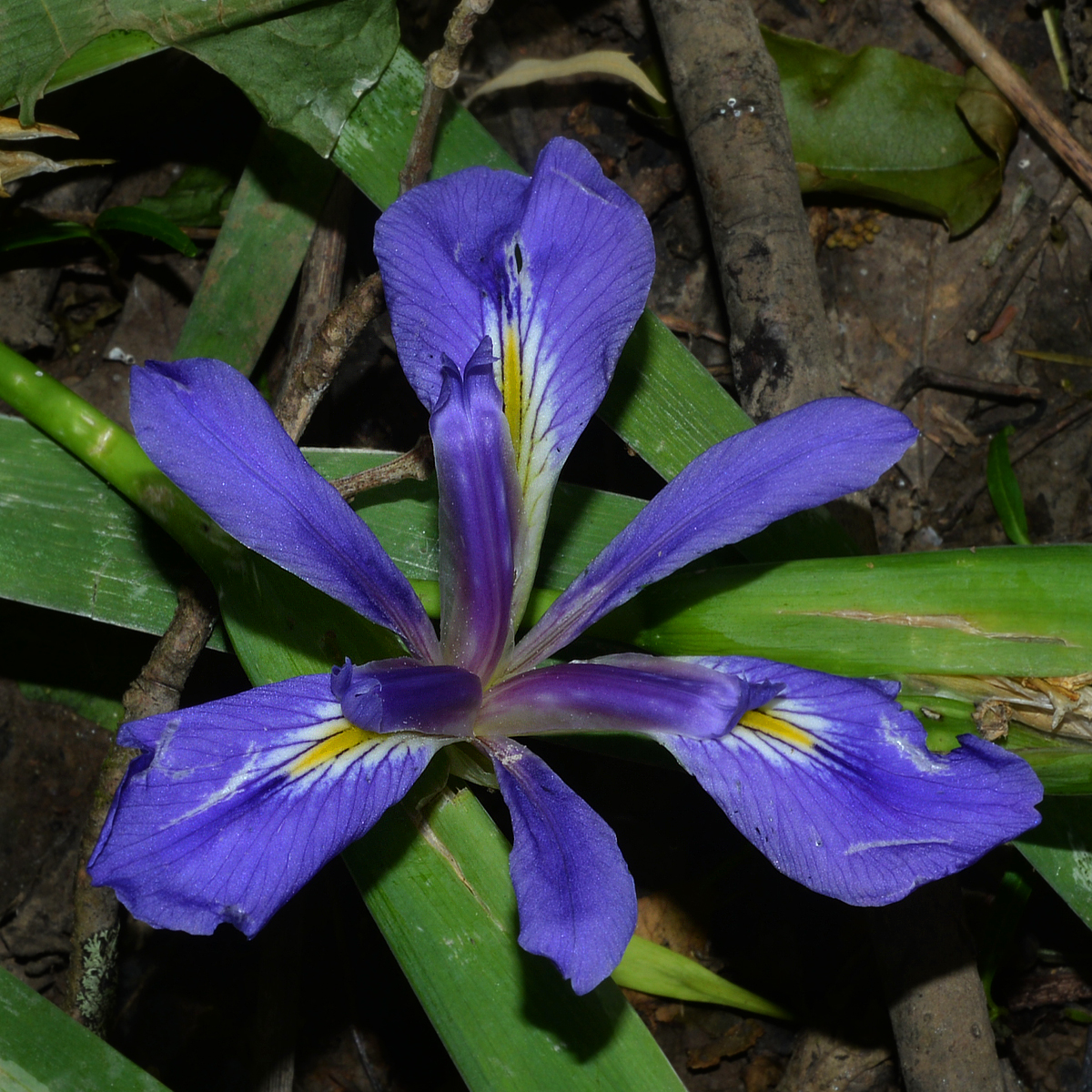
Each stem carries one to three large flowers, 3 to 4 inches across, in rich violet-blue to blue-purple. The three drooping “fall” petals each bear a conspicuous white patch streaked with yellow and fine purple veining at the base — a landing pad and nectar guide for pollinators — while the three upright “standard” petals are narrower and a slightly paler blue-violet. Bloom occurs in mid-to-late spring, generally a few weeks later than other Louisiana iris species, which helps extend the regional bloom season when planted alongside them.
Fruit & Rhizomes
After flowering, the plant produces a three-angled seed capsule that dries and splits to release flattened seeds. The thick, fleshy rhizomes spread horizontally just under the soil, slowly expanding the clump. All parts of zigzag iris — especially the rhizomes — are toxic if ingested and can cause skin irritation in sensitive people on contact; handle rhizomes with gloves when dividing, and keep the plant away from grazing livestock and curious pets.
Quick Facts
| Scientific Name | Iris brevicaulis Raf. |
| Family | Iridaceae (Iris) |
| Plant Type | Herbaceous Perennial (rhizomatous) |
| Mature Height | 8–20 in (20–50 cm) |
| Mature Spread | 1–2 ft, spreading slowly by rhizome |
| Growth Rate | Moderate |
| Sun Exposure | Full Sun to Part Shade |
| Water Needs | Moderate to High; tolerates both wet and seasonally dry soil |
| Soil Type | Rich, moist loam or clay; tolerates heavy soils |
| Soil pH | 5.5–7.0 (slightly acidic to neutral) |
| Bloom Time | Mid to late spring |
| Flower Color | Violet-blue with white and yellow signal patches |
| Fall Color | Foliage dies back; no notable fall color |
| Fruit | Three-angled seed capsule; rhizomes toxic if ingested |
| Deer Resistant | Yes |
| USDA Hardiness Zones | 4–9 |
Native Range
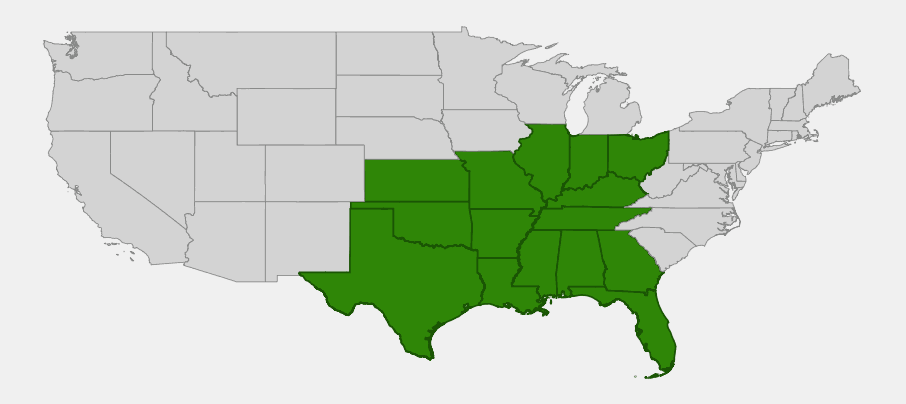
Zigzag iris has one of the broadest native ranges of any Louisiana iris species, extending from Illinois, Indiana, and Ohio in the north, south through Kentucky, Tennessee, Missouri, Arkansas, Oklahoma, and Kansas, and on into the Gulf Coast states of Texas, Louisiana, Mississippi, Alabama, Georgia, and Florida. It also occurs locally in Ontario, Canada, at the far northern edge of its range.
Across this wide territory, zigzag iris is typically found in bottomland hardwood forests, wet woodland edges, ditches, swales, and the margins of sloughs and bayous — sites that flood seasonally but are not permanently inundated. It tolerates more shade and a wider range of soil moisture than most of its Louisiana iris relatives, which is part of why its native range extends so much farther inland and northward.
In the Mississippi River basin and the bayous of southern Louisiana, zigzag iris often grows alongside the showier giant blue iris and other wild Louisiana iris species, and the two readily hybridize where their ranges overlap — a trait that has made zigzag iris a parent of countless ornamental Louisiana iris cultivars prized for cold hardiness and shade tolerance.
📋 Regional plant lists featuring Zigzag Iris: Georgia, Alabama & Mississippi · Arkansas, Louisiana, Eastern Oklahoma & Eastern Texas · Kentucky & Tennessee · Ohio & Indiana · Illinois, Iowa & Missouri · Nebraska, Kansas & Eastern Colorado
Growing & Care Guide
Zigzag iris is one of the easier wild irises to please in a home garden, thanks to its tolerance for both occasional flooding and ordinary garden moisture once established.
Light
Zigzag iris flowers best in full sun but tolerates part shade better than most other Louisiana irises, making it a good choice for the dappled light under deciduous trees at a pond or stream edge. In hotter, more southern parts of its range, afternoon shade helps keep the foliage looking fresh through summer.
Soil & Water
Give zigzag iris rich, moisture-retentive soil — it is naturally found in bottomland soils that flood seasonally and dry out between events. In the garden it adapts well to average garden soil with regular watering and does not require standing water the way some wetland irises do, though it will tolerate shallow, temporary flooding without trouble.
Planting Tips
Plant rhizomes in fall or early spring, setting them shallowly with the top of the rhizome just at or barely below the soil surface. Space plants 12 to 18 inches apart to allow clumps to fill in. Zigzag iris combines beautifully with other Louisiana iris species and bloom times can be staggered since it typically flowers a few weeks later than its relatives.
Pruning & Maintenance
Remove spent flower stalks after bloom and cut back dead foliage in late fall or early spring. Divide congested clumps every 3 to 4 years in late summer after flowering has finished, replanting divisions immediately so the rhizomes do not dry out. Wear gloves when handling rhizomes, since the plant’s toxic compounds can irritate skin.
Landscape Uses
- Rain gardens and bioswales that cycle between wet and dry
- Pond and stream margins in part shade to full sun
- Woodland edge plantings where other irises would struggle with shade
- Native perennial borders for extended spring bloom alongside earlier Louisiana iris species
- Wildlife and pollinator gardens
Wildlife & Ecological Value
Zigzag iris supports a range of wildlife across its broad native range, especially in the bottomland forests and wet woodlands where it is most common.
For Pollinators
Large bees, especially bumblebees, are the primary pollinators, strong enough to push past the flower’s hinged falls to reach the nectar and pollen inside. The bold white-and-yellow signal patches on the falls function as visual nectar guides, directing pollinators to the flower’s reproductive parts.
For Birds
The dense clumps of sword-like foliage provide cover for ground-nesting and understory birds in wet woodlands, while the seed capsules, once dried, occasionally provide a minor food source for some seed-eating songbirds.
For Mammals
Because the foliage and rhizomes are toxic, zigzag iris is rarely browsed by deer or other mammals, which makes it a reliable choice in areas with heavy deer pressure. Small mammals may use the dense clumps for cover.
Ecosystem Role
In bottomland forests and wet meadows, zigzag iris’s spreading rhizomes help stabilize soil along stream banks and slough margins subject to seasonal flooding, while its early-to-mid spring bloom provides a nectar source before many summer wildflowers have begun flowering.
Cultural & Historical Uses
Zigzag iris is one of the key wild parents behind the modern Louisiana iris cultivars grown in gardens worldwide. Its natural tolerance for drier soil, partial shade, and colder winters than its more tropical relatives made it an especially valuable breeding partner when horticulturists began hybridizing the Louisiana iris species in the early-to-mid twentieth century, aiming to combine the group’s spectacular flower color with wider garden adaptability.
Indigenous peoples across the plant’s extensive range were familiar with wild irises growing in bottomland forests and wetlands, though, as with other toxic irises, there is little documented history of the plant being used internally; irises in general were more often noted for caution than for use. The rhizomes and other plant parts are toxic if ingested and should never be eaten or used as a home remedy.
Today, zigzag iris is valued primarily by native plant gardeners and iris breeders for its hardiness, shade tolerance, and role as a genetic resource for new Louisiana iris cultivars — a living link between the showy hybrid irises sold at garden centers and the wild bottomland forests where the species has grown for millennia.
Frequently Asked Questions
Is zigzag iris the same as Louisiana iris?
Zigzag iris is one of five wild species that make up the “Louisiana iris” group, along with giant blue iris, copper iris, and others. “Louisiana iris” by itself usually refers to this whole group or to the many garden hybrids bred from them, not to zigzag iris specifically.
Can you eat any part of zigzag iris?
No. The rhizomes and other plant parts are toxic if ingested and can also irritate skin on contact. It is grown strictly as an ornamental.
Does zigzag iris need standing water to grow?
No. Unlike some wetland irises, zigzag iris tolerates average garden soil with regular moisture and does not require permanently wet or boggy conditions, though it handles occasional flooding without issue.
Why is it called “zigzag” iris?
The flowering stem bends sharply at each node instead of growing in a straight line, creating a visibly zigzagging path from the base of the plant to the flower — a distinctive and reliable field mark.
Will zigzag iris spread aggressively in my garden?
It spreads slowly by rhizome, forming expanding clumps over several years rather than running aggressively. Established clumps benefit from division every 3 to 4 years to keep them vigorous, but it is not considered an aggressive spreader.

Looking for a nursery that carries Zigzag Iris?
Browse our native plant nursery directory: Alabama & Arkansas · Florida & Georgia · Illinois, Indiana & Kansas · Kentucky, Louisiana, Mississippi & Missouri · Ohio & Oklahoma · Tennessee & Texas