
Littleleaf Sensitive-briar (Mimosa microphylla)
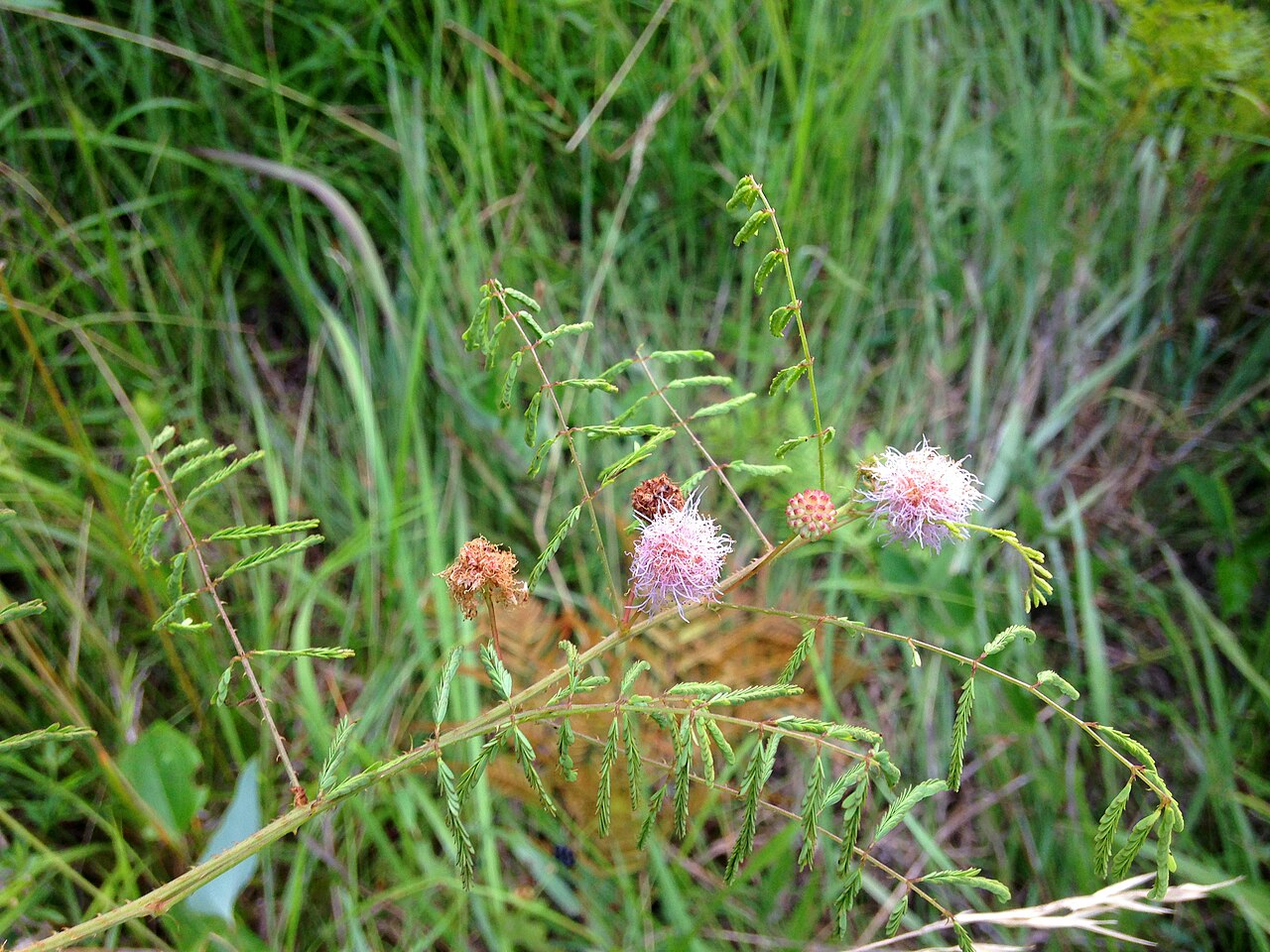
Mimosa microphylla, known as Littleleaf Sensitive-briar (also Eastern Sensitive-briar or just Sensitive Briar), is a scrambling, thorny-stemmed perennial legume of the southeastern United States that rewards a closer look. Its finely divided, fern-like leaves fold shut within seconds of being brushed or touched — a genuinely startling bit of plant behavior for anyone meeting it for the first time — and in summer it produces small, fragrant, bright pink pom-pom flower heads that look more like something from a tropical greenhouse than a roadside prairie.
Littleleaf Sensitive-briar doesn’t stand upright; instead it trails and sprawls along the ground or scrambles weakly up through neighboring grasses and low shrubs, anchoring itself with rows of small recurved prickles along its stems. It’s a plant of dry, open, sun-baked ground — pine savannas, rocky glades, old fields, and roadsides — where competition is low and the soil is often thin, sandy, or rocky. As a legume, it also fixes its own nitrogen, letting it thrive in the kind of poor soil that discourages less self-sufficient plants.
In a native garden, Littleleaf Sensitive-briar is less a centerpiece than a textural, interactive groundcover for a hot, dry, well-drained spot — ideal scrambling through a gravel bed, over a sunny bank, or at the front of a prairie-style planting where visitors can discover its touch-sensitive leaves for themselves.
Identification
Littleleaf Sensitive-briar is a trailing to sprawling herbaceous perennial with stems that can reach 3 to 6 feet in length but stay low, usually under a foot tall unless they find something to scramble over. The stems are angled or ridged and armed with numerous small, hooked or recurved prickles that help the plant catch onto adjacent vegetation as it spreads.
Leaves
The leaves are bipinnately compound — twice-divided into many small, narrow leaflets — giving the foliage a delicate, fern- or mimosa-tree-like texture that is the plant’s most memorable feature. True to the common name “sensitive briar,” the leaflets fold together and the whole leaf droops within a few seconds of being touched, jostled, or exposed to intense heat, reopening gradually once disturbance stops. This rapid movement (thigmonasty) is thought to startle browsing insects and may reduce water loss during the hottest part of the day.
Flowers
From late spring through summer, Littleleaf Sensitive-briar produces round, fluffy flower heads about ¾ to 1 inch across, made up of dozens of tiny individual flowers whose long pink stamens give the whole head its soft, pom-pom appearance. The flowers are mildly fragrant and are held on stalks that rise just above the foliage, often appearing in pairs at the leaf axils along the trailing stems.
Fruit & Seeds
The flowers give way to narrow, flattened, prickly seedpods roughly 2 to 4 inches long, constricted between the seeds and covered in small bristles or barbs similar to the stem prickles. The pods split open at maturity to release several hard, flattened seeds. The bristly pods can catch readily on clothing and animal fur, aiding seed dispersal.
Quick Facts
| Scientific Name | Mimosa microphylla |
| Family | Fabaceae (Legume) |
| Plant Type | Trailing Herbaceous Perennial |
| Mature Height | 6–12 in (trailing) |
| Mature Spread | 3–6 ft, trailing or scrambling |
| Growth Rate | Moderate to fast in a full-sun season |
| Sun Exposure | Full Sun |
| Water Needs | Low; drought tolerant once established |
| Soil Type | Dry, sandy or rocky, well-drained; tolerates poor soil |
| Soil pH | 5.5–7.0 (acidic to neutral) |
| Bloom Time | May – August |
| Flower Color | Bright pink |
| Fall Color | None notable; foliage dies back with frost |
| Fruit | Narrow, bristly, flattened seedpods |
| Deer Resistant | Good (prickly stems discourage browsing) |
| USDA Hardiness Zones | 7–9 |
Native Range
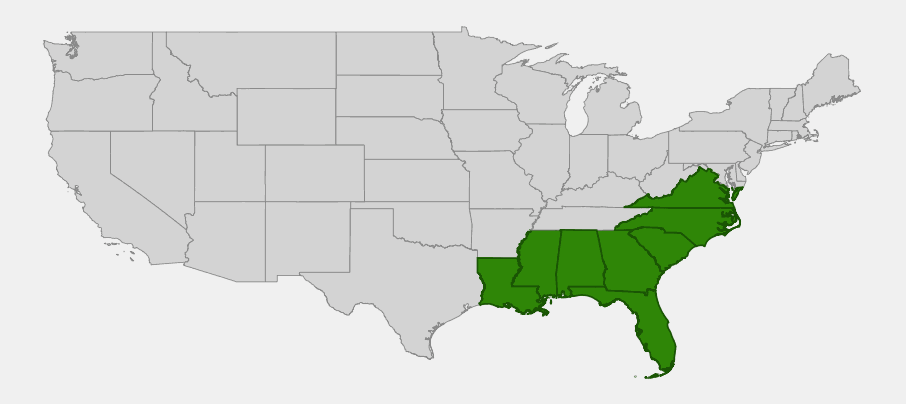
Littleleaf Sensitive-briar is native to the southeastern Coastal Plain and Piedmont, found from Virginia and North Carolina south through South Carolina, Georgia, Florida, Alabama, and Mississippi, west into Louisiana. Within this region it favors open, sun-exposed ground: longleaf pine savannas and sandhills, dry upland woods edges, rocky glades and outcrops, old fields, and roadsides — almost always on well-drained, often sandy or rocky soil.
It is a true sun lover and is rarely found under closed forest canopy; look for it along trail edges, utility right-of-ways, and the margins of pine woodlands where periodic disturbance or fire keeps the ground open. Fire-maintained longleaf pine ecosystems, in particular, provide some of its best remaining habitat, since regular burning keeps woody competition down and exposes the bare, sandy soil this species prefers for germination.
Littleleaf Sensitive-briar should not be confused with the more widespread Catclaw Sensitive-briar (Mimosa quadrivalvis, formerly Mimosa nuttallii in part), a related species found further west and across much of the Great Plains; the two overlap only at the western edge of Littleleaf Sensitive-briar’s range and are best told apart by pod and leaflet details.
📋 Regional plant lists featuring Littleleaf Sensitive-briar: Maryland, Virginia & West Virginia · North Carolina & South Carolina · Georgia, Alabama & Mississippi · Arkansas, Louisiana, Eastern Oklahoma & Eastern Texas
Growing & Care Guide
Littleleaf Sensitive-briar is an easygoing, low-input plant for the right spot — essentially maintenance-free once it’s established in full sun and sharp drainage, and a poor fit anywhere shadier or wetter.
Light
Full sun is essential. This is a plant of open ground, and it will grow weak, sparse, and reluctant to flower in anything less than six or more hours of direct sun daily. Give it the hottest, most exposed spot available.
Soil & Water
Sandy, rocky, or otherwise lean, fast-draining soil suits it best; rich garden loam that stays moist encourages rot and disease rather than vigorous growth. As a nitrogen-fixing legume, it needs little to no fertility input and actually performs best where soil is too poor for many other plants. Water occasionally to establish young plants, then let it be — mature plants are quite drought tolerant and resent regular watering or heavy mulch, which can hold too much moisture against the crown.
Planting Tips
Start from nursery-grown container plants or direct-sown scarified seed in spring, after the soil has warmed. Choose a site with excellent drainage — a slope, raised bed, or gravelly area works well — and give the trailing stems 3 to 4 feet of open ground or a low structure to scramble over. Avoid heavy mulch; bare or gravelly soil better suits its germination and growth habit.
Pruning & Maintenance
Essentially none is required. The prickly trailing stems can be trimmed back in late winter if they’ve wandered further than wanted, but otherwise the plant is best left alone. Wear gloves when handling it directly, since both stems and seedpods carry small recurved prickles.
Landscape Uses
Littleleaf Sensitive-briar fills a specific but valuable niche:
- Interactive gardens where visitors can touch the sensitive leaves
- Dry gravel or rock gardens with sharp drainage
- Sunny bank and slope cover on poor, well-drained soil
- Longleaf pine savanna restorations and fire-maintained natural areas
- Pollinator gardens paired with other dry-prairie natives
- Low-input xeriscaping in hot, sandy sites
Wildlife & Ecological Value
As a nitrogen-fixing legume of fire-maintained, open-ground habitats, Littleleaf Sensitive-briar punches above its weight ecologically for a low, inconspicuous trailing plant.
For Pollinators
The fragrant pink flower heads attract a range of native bees and other pollinating insects drawn to the abundant pollen on the long, showy stamens. Because it blooms through much of the summer, it provides a steady nectar and pollen source during a season when many spring wildflowers have finished.
For Birds & Mammals
Northern Bobwhite quail and other ground-feeding birds eat the seeds, and the dense, prickly, trailing growth offers low cover for small wildlife in otherwise open, sun-exposed habitat. Deer and other large browsers generally avoid the plant because of its recurved prickles.
Ecosystem Role
By fixing atmospheric nitrogen, Littleleaf Sensitive-briar improves soil fertility in the nutrient-poor sandy and rocky ground it favors, benefiting neighboring plants over time. It is also a characteristic member of fire-dependent longleaf pine groundcover communities, and its presence is often an indicator of healthy, periodically burned, open-canopy habitat.
Cultural & Historical Uses
Littleleaf Sensitive-briar does not have a well-documented history as a food, medicinal, or craft plant among Indigenous or settler communities in the Southeast; period botanical and ethnobotanical sources are largely silent on practical uses, in contrast to some of its showier or more useful legume relatives. Its historical notability instead rests almost entirely on its unusual touch-sensitive leaves, a trait that made it a frequently remarked-upon curiosity among 19th-century naturalists and collectors exploring the southeastern pine belt.
The genus name Mimosa itself derives from the Greek for “mimic,” a reference to the way these touch-sensitive legumes appear to imitate animal behavior by flinching from contact — a feature Littleleaf Sensitive-briar shares with its more famous relative, the “sensitive plant” (Mimosa pudica) of the tropics.
Today the plant is primarily of interest to native plant enthusiasts, pollinator gardeners, and restoration ecologists working in longleaf pine systems, valued for its ecological role and its novelty appeal rather than for any traditional practical use.
Frequently Asked Questions
Why do the leaves of Littleleaf Sensitive-briar close when touched?
This rapid leaf-folding response, called thigmonasty, is triggered by a sudden loss of water pressure in specialized cells at the base of each leaflet. It’s thought to startle or deter feeding insects and may also help the plant conserve moisture during intense heat.
Is Littleleaf Sensitive-briar the same as the “sensitive plant” houseplant?
No. The common houseplant “sensitive plant” is usually Mimosa pudica, a tropical species from Central and South America. Littleleaf Sensitive-briar (Mimosa microphylla) is a cold-hardier, trailing native perennial of the southeastern U.S. with a similar touch response but different growth habit and range.
Does Littleleaf Sensitive-briar have thorns that hurt?
Its stems and seedpods carry small, recurved prickles rather than large thorns. They’re not dangerous but can scratch or catch on clothing and skin, so gloves are a good idea when handling or weeding around established plants.
Can I grow Littleleaf Sensitive-briar in regular garden soil?
It prefers lean, sandy, or rocky, well-drained soil over rich garden loam. In fertile, consistently moist beds it tends to grow lanky and is more prone to rot; a dry, sunny, poor-soil site produces a sturdier, better-flowering plant.
Is Littleleaf Sensitive-briar invasive?
No. It is a native species within its southeastern range and is not considered invasive or weedy there. Outside its native range it is not known to have naturalized or become a landscape problem.

Looking for a nursery that carries Littleleaf Sensitive-briar?
Browse our native plant nursery directory: Virginia & South Carolina · North Carolina · Georgia & Florida · Alabama · Mississippi & Louisiana