American Wild Mint (Mentha arvensis)
Mentha arvensis, known in North America as American Wild Mint (also Field Mint or Corn Mint), is one of the very few truly native mints of the United States and Canada — a distinction that surprises many gardeners, since most mints sold in nurseries are Eurasian imports with a well-earned reputation for taking over a bed. Wild Mint spreads by rhizome like its garden relatives, but it does so as a long-standing member of North American wetland plant communities rather than as an escaped ornamental, filling a genuine ecological role in the wet meadows, streambanks, and pond edges where it grows.
Taxonomically, this is a nuanced case. Mentha arvensis in the broad sense is a circumboreal species complex found across North America, Europe, and Asia. Some floras split the North American native populations out as Mentha canadensis, treating the Eurasian plant as a separate (and in places naturalized) entity; USDA PLANTS, by contrast, treats Mentha canadensis as a synonym and keeps the whole complex under Mentha arvensis, listing it as native to the Lower 48, Alaska, and Canada. This page follows that USDA treatment while noting the alternate naming, since gardeners are likely to encounter the plant under either name.
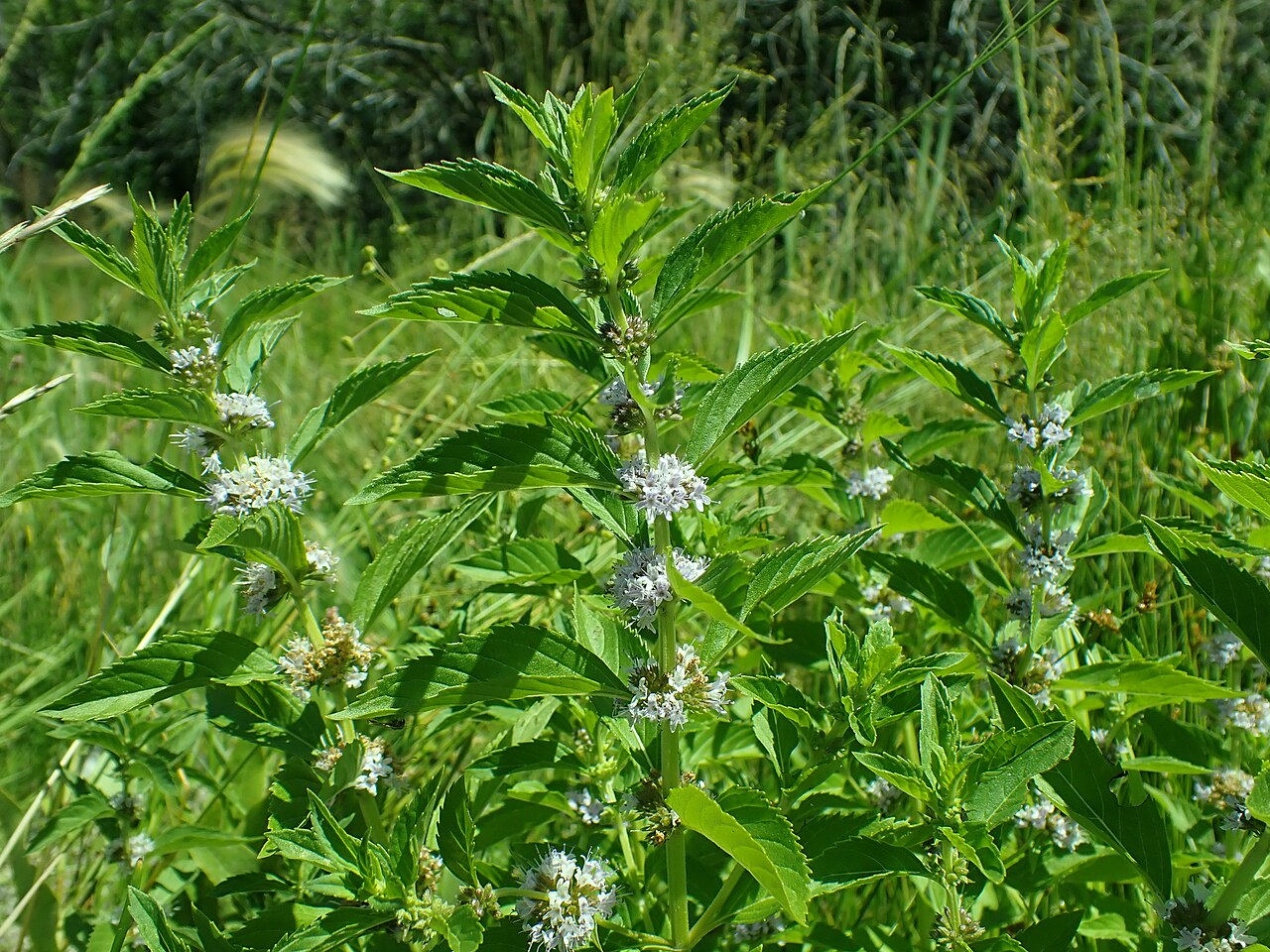
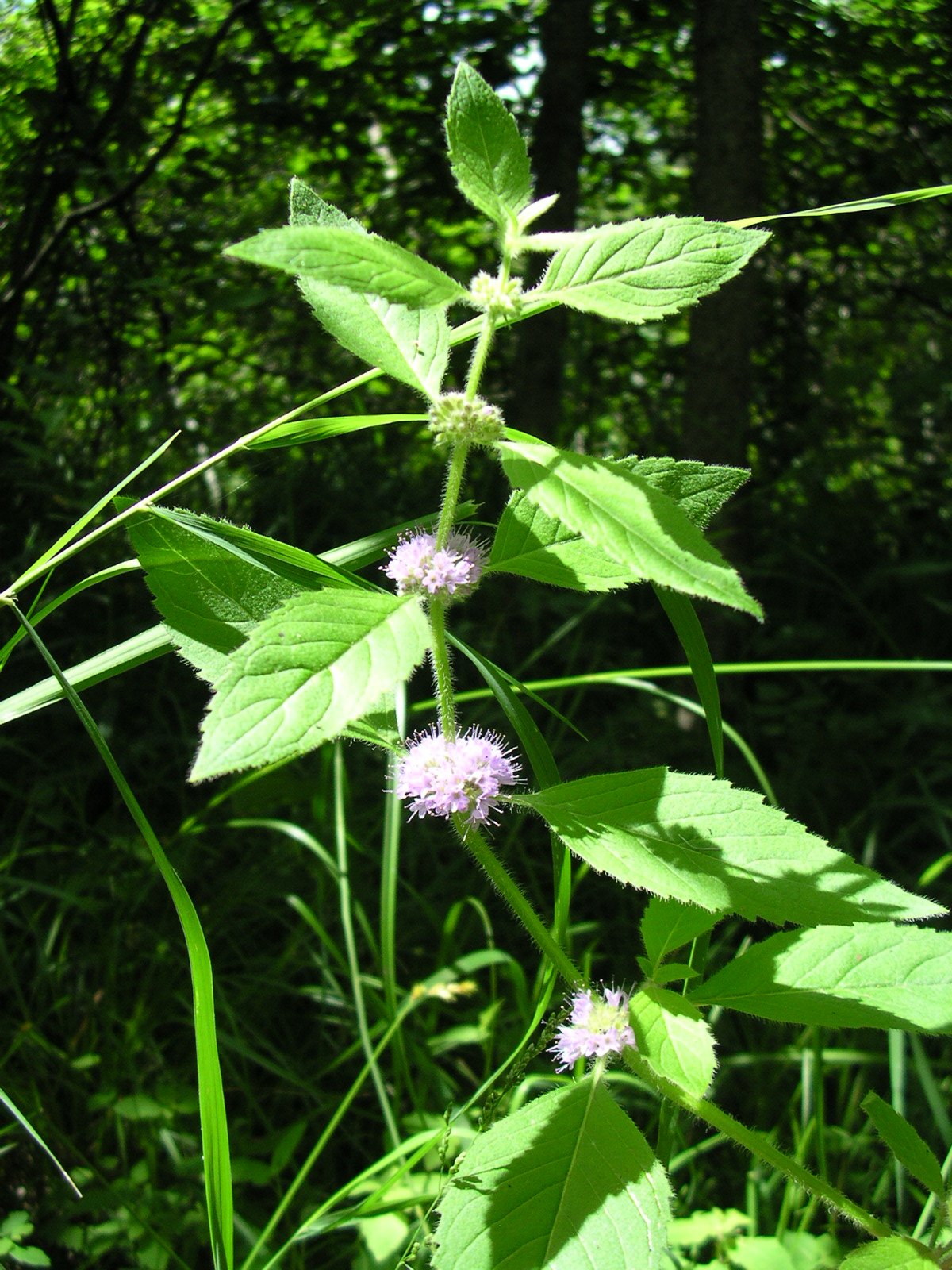
However you name it, the plant itself is easy to enjoy: square, often purplish stems; soft, toothed, strongly mint-scented leaves; and tight whorls of small, pale lavender to white flowers clustered right at the leaf joints rather than in a showy terminal spike. It’s a plant for a damp, semi-contained spot — a pond edge, rain garden, or low wet meadow — where its running habit is an asset rather than a nuisance.
Identification
American Wild Mint is an herbaceous perennial reaching roughly 6 inches to 2 feet tall, spreading by shallow rhizomes to form loose to dense colonial patches. Like all mints, the stems are square in cross-section, a quick and reliable field character, and the whole plant releases a sharp, minty fragrance when the foliage is crushed or brushed against.
Leaves
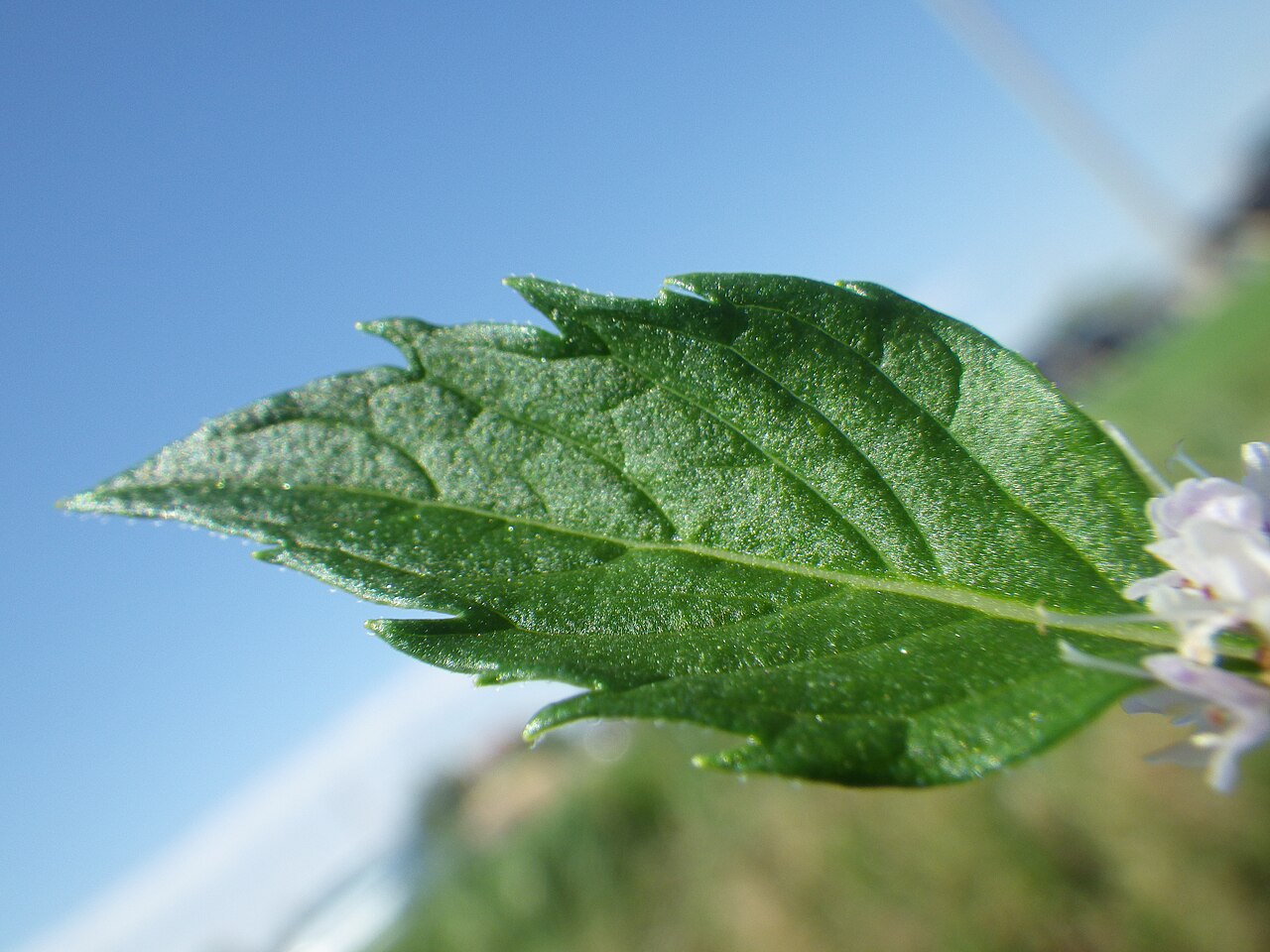
Leaves are opposite, oval to lance-shaped, 1 to 3 inches long, with coarsely toothed margins and a texture ranging from softly hairy to nearly smooth depending on the population. They are short-stalked and arranged in pairs up the stem, each pair rotated 90 degrees from the one below — the classic opposite-decussate arrangement common throughout the mint family.
Flowers
Unlike many showier mints, American Wild Mint does not carry its flowers in a terminal spike. Instead, small, tubular, pale lavender, pink, or white flowers cluster in dense whorls directly in the leaf axils at several points along the upper stem, giving the plant a distinctive “beaded” look rather than a single flower head. Individual flowers are small, roughly ¼ inch, with four shallow, nearly equal lobes — a nearly radial symmetry that is unusual in the mint family and a helpful trait for distinguishing this species from more bilaterally symmetric mint relatives. Bloom time runs from mid-summer into early fall.
Fruit & Seeds
Following flowering, each flower produces four small, smooth nutlets held within the persistent calyx. The nutlets are tiny and inconspicuous; the plant relies at least as much on rhizome spread as on seed for its persistence and local expansion.
Quick Facts
| Scientific Name | Mentha arvensis (syn. Mentha canadensis) |
| Family | Lamiaceae (Mint) |
| Plant Type | Herbaceous Perennial (rhizomatous) |
| Mature Height | 6 in – 2 ft |
| Mature Spread | Spreading, forms colonies 2+ ft wide |
| Growth Rate | Fast; spreads readily by rhizome in wet soil |
| Sun Exposure | Full Sun to Part Shade |
| Water Needs | High; moist to wet soil, tolerates shallow standing water |
| Soil Type | Rich, moisture-retentive; tolerates clay and muck |
| Soil pH | 6.0–7.5 (neutral) |
| Bloom Time | July – September |
| Flower Color | Pale lavender, pink, or white |
| Fall Color | None; foliage dies back with frost |
| Fruit | Tiny dry nutlets (4 per flower) |
| Deer Resistant | Excellent (aromatic foliage deters browsing) |
| USDA Hardiness Zones | 2–8 |
Native Range
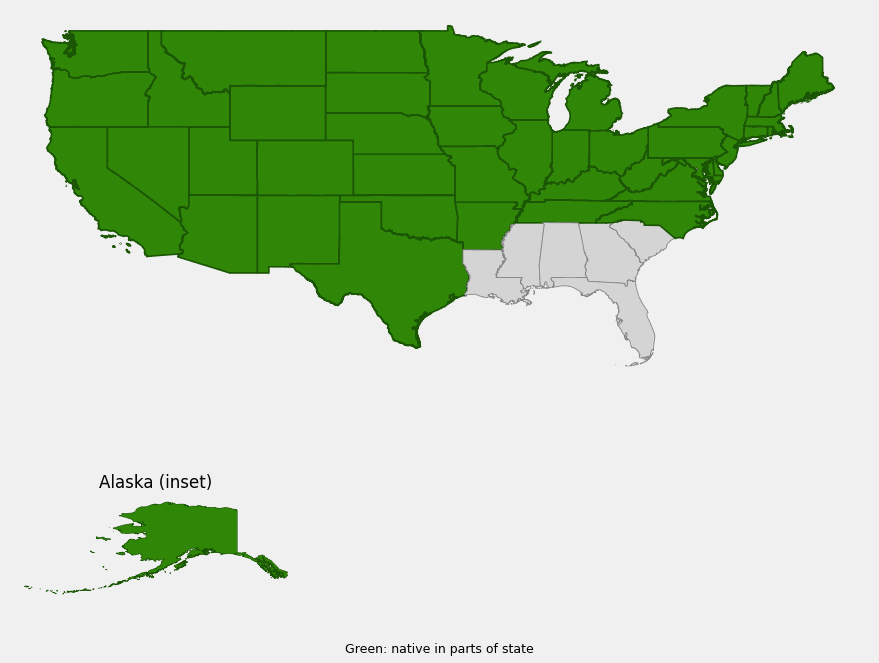
American Wild Mint is one of the most widely distributed native wildflowers in North America, occurring across nearly the entire continent: Alaska, Canada, and most of the Lower 48 states, from New England and the upper Midwest across the Great Plains and Rocky Mountains to the Pacific states and the Southwest. It is conspicuously absent as a native plant from the Deep South and Gulf Coast — Alabama, Florida, Georgia, Louisiana, Mississippi, and South Carolina — where it does not occur naturally, though garden mints of various species are sometimes grown or escape there.
Across its native range, look for American Wild Mint in consistently wet ground: pond and lake margins, stream and ditch banks, wet meadows, marsh edges, and seasonally flooded low spots. It tolerates both full sun and the dappled light of streamside willow and alder thickets, and it is often among the first native wetland perennials to colonize disturbed or newly exposed wet soil.
Because the species is so broadly distributed and the native/naturalized boundary with Eurasian mint populations can blur in disturbed wetlands, gardeners planting for habitat value should favor regionally sourced, nursery-propagated stock of confirmed native origin rather than wild-collected material of uncertain background.
📋 Regional plant lists featuring American Wild Mint: New Hampshire, Maine & Vermont · Connecticut, Massachusetts & Rhode Island · New York, Pennsylvania & Northern New Jersey · Maryland, Virginia & West Virginia · North Carolina & South Carolina · Arkansas, Louisiana, Eastern Oklahoma & Eastern Texas · Kentucky & Tennessee · Ohio & Indiana · Illinois, Iowa & Missouri · Michigan, Wisconsin & Eastern Minnesota · North Dakota, South Dakota & Western Minnesota · Nebraska, Kansas & Eastern Colorado · Utah & Western Colorado · Montana & Wyoming · Arizona & New Mexico · Idaho, Eastern Oregon & Eastern Washington · Western Oregon & Western Washington · Alaska
Growing & Care Guide
American Wild Mint is an easy, vigorous plant for a wet garden spot — the main task is giving it a place where its spreading habit is welcome rather than fighting it in a mixed border.
Light
It grows well in full sun along open pond and stream margins, and equally well in the part shade of streamside shrub thickets. Sunnier sites generally produce denser, more compact, more floriferous growth, while shadier spots yield taller, more open plants.
Soil & Water
Consistent moisture is the single most important factor. American Wild Mint thrives in rich, constantly moist to wet soil and tolerates brief shallow flooding, making it a natural choice for rain garden basins, pond margins, and low spots that stay soggy after rain. It does not tolerate drought well and will decline quickly if the soil is allowed to dry out for extended periods.
Planting Tips
Plant divisions or container stock in spring or early fall directly into consistently moist soil. Because it spreads by rhizome, consider a contained bed, a naturally bounded wet area, or a buried barrier if you want to keep its spread in check; in an open wet meadow or restoration planting, let it run and use it as an effective living mulch and erosion-control groundcover.
Pruning & Maintenance
Little maintenance is needed beyond controlling spread where desired. Cutting plants back by half in early summer can produce a bushier, later-blooming second flush. In formal settings, an annual edge-trim along the rhizome front keeps the colony within bounds.
Landscape Uses
American Wild Mint earns its keep in several specific garden roles:
- Rain gardens and bioswales that need a tough, spreading wet-soil groundcover
- Pond and stream bank stabilization where erosion control matters
- Wetland and marsh restorations as a genuinely native component
- Herb gardens seeking a native alternative to imported mint species
- Pollinator plantings in consistently wet soil
- Naturalized low spots that are difficult to keep anything else alive in
Wildlife & Ecological Value
As one of relatively few true native mints, American Wild Mint plays a quiet but genuine role in North American wetland ecosystems, distinct from the Eurasian mints that dominate most gardens.
For Pollinators
The small flower clusters draw a wide range of short-tongued native bees, hoverflies, and small butterflies and skippers, which can access the shallow, open flowers easily. Because the nearly radial flower shape and dense clustering make nectar and pollen easy to reach, a blooming patch often hosts a steady stream of small pollinators through late summer.
For Birds & Mammals
The dense, aromatic foliage offers cover for small wetland wildlife, and muskrats and other marsh-edge mammals move through established colonies as part of the broader wetland vegetation structure. The strong mint oils in the leaves make it unpalatable to most mammalian browsers, including deer.
Ecosystem Role
American Wild Mint is often an early colonizer of bare, saturated soil at pond and stream margins, where its spreading rhizomes help stabilize sediment and outcompete some more aggressive non-native wetland weeds. Its presence is also considered a modest indicator of intact, functioning wetland plant communities in parts of its range.
Cultural & Historical Uses
Several Indigenous nations across the plant’s wide range have a documented history of using American Wild Mint and its close relatives, primarily as a flavoring for food and as an ingredient in traditional teas and infusions, drawing on the same aromatic oils that make all mints fragrant. Historical ethnobotanical records describe the dried or fresh leaves being steeped for beverages among various Plains and northern tribes, a use broadly paralleling the long history of mint teas in other cultures worldwide.
Early European settlers and botanists, encountering the plant across its huge range, often simply assumed it was the same “corn mint” or “field mint” they knew from Europe — a mix-up rooted in the same taxonomic overlap discussed above, and part of why the plant carries both an “American Wild Mint” and more generic “field mint” identity in common usage today.
Modern use is overwhelmingly culinary and ornamental rather than medicinal; this page does not describe medicinal uses, and readers interested in using the plant as a tea or seasoning should rely on current foraging guides and confirm positive identification, since it closely resembles other mint species in the field.
Frequently Asked Questions
Is American Wild Mint the same as the mint I buy at a nursery?
No. Most nursery mints — spearmint, peppermint, and their many cultivars — are Eurasian species or hybrids. American Wild Mint (Mentha arvensis) is a distinct, native North American wetland wildflower, though it belongs to the same genus and smells similarly minty.
Will American Wild Mint take over my garden like other mints?
It does spread by rhizome and can form substantial colonies in consistently wet soil, so it’s best suited to a contained wetland feature, rain garden, or naturalized area rather than a mixed perennial border, unless its spread is actively managed.
Why is it sometimes called Mentha canadensis instead?
Some botanical references split North American wild mint populations into a separate species, Mentha canadensis, distinct from Eurasian Mentha arvensis. USDA PLANTS treats Mentha canadensis as a synonym and keeps the whole complex under Mentha arvensis; both names refer to the same native plant described on this page.
Does American Wild Mint need standing water to grow?
Not necessarily standing water, but it does need consistently moist to wet soil. It tolerates brief shallow flooding but will struggle in soil that dries out for extended periods during the growing season.
Is American Wild Mint good for pollinators?
Yes. Its clustered, easily accessible flowers are visited by a range of small native bees, hoverflies, and butterflies, making it a useful addition to a wetland or rain garden pollinator planting.

Looking for a nursery that carries American Wild Mint?
Browse our native plant nursery directory: Alaska, Arizona & Arkansas · California · Colorado, Connecticut & Delaware · Idaho, Illinois, Indiana, Iowa & Kansas · Kentucky, Maine, Maryland, Massachusetts, Michigan, Minnesota, Missouri & Montana · Nebraska, Nevada, New Hampshire, New Jersey, New Mexico, New York, North Carolina, North Dakota, Ohio & Oklahoma · Oregon · Pennsylvania, Rhode Island, South Dakota, Tennessee, Texas, Utah, Vermont & Virginia · Washington · West Virginia, Wisconsin & Wyoming