
Plateau Live Oak (Quercus fusiformis)
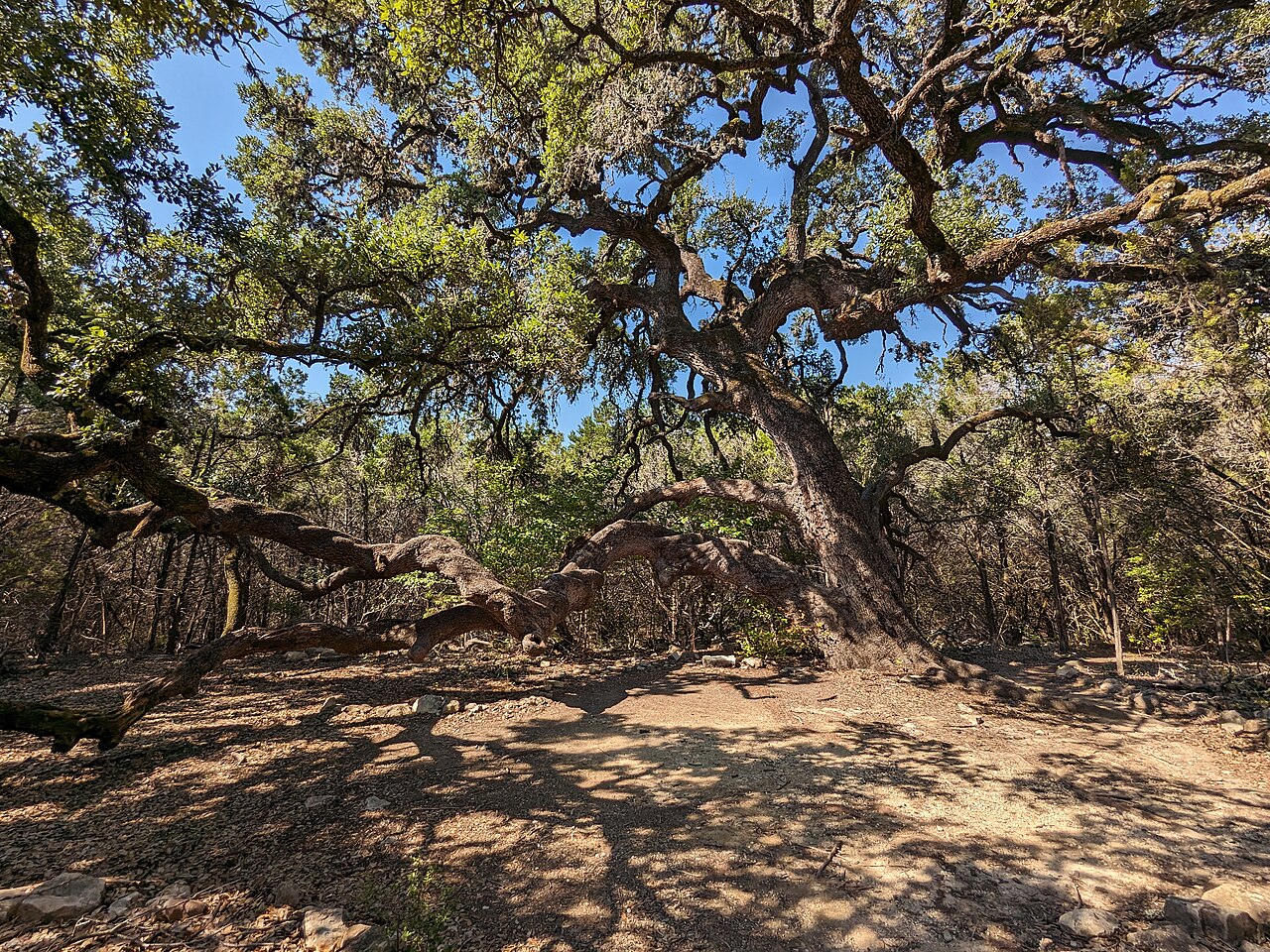
Quercus fusiformis, known as the Plateau Live Oak, Texas Live Oak, or Escarpment Live Oak, is the live oak of central Texas — the gnarled, wide-crowned evergreen that shades Hill Country ranches, river bottoms, and limestone canyons from the Edwards Plateau to the Wichita Mountains of southwestern Oklahoma. For decades it was treated as a variety of southern live oak (Quercus virginiana var. fusiformis), and the two still hybridize where their ranges meet, but Plateau Live Oak is now recognized as its own species, distinguished by smaller stature, a narrower trunk, more upright branching, and acorns with a more pointed tip.
Where southern live oak wants moist, humid bottomland, Plateau Live Oak is built for limestone and drought. It roots into thin, rocky, alkaline soils over caliche and does more with less rain than almost any other native Texas tree. Left alone, it suckers from its roots to form dense colonal stands called “mottes” — clusters of trunks that are, genetically, a single spreading individual. Solitary specimens in open pasture develop the low, horizontal, ground-sweeping limbs that make this species so recognizable and so beloved for shade.
It is also, unfortunately, ground zero for oak wilt, a lethal fungal disease that has killed tens of thousands of live oaks across the Texas Hill Country. Anyone planting or maintaining a Plateau Live Oak in its native range needs to understand that threat — it’s covered honestly below, not glossed over, because this tree’s biggest landscape risk and its biggest land-stewardship opportunity are the same thing.
Identification
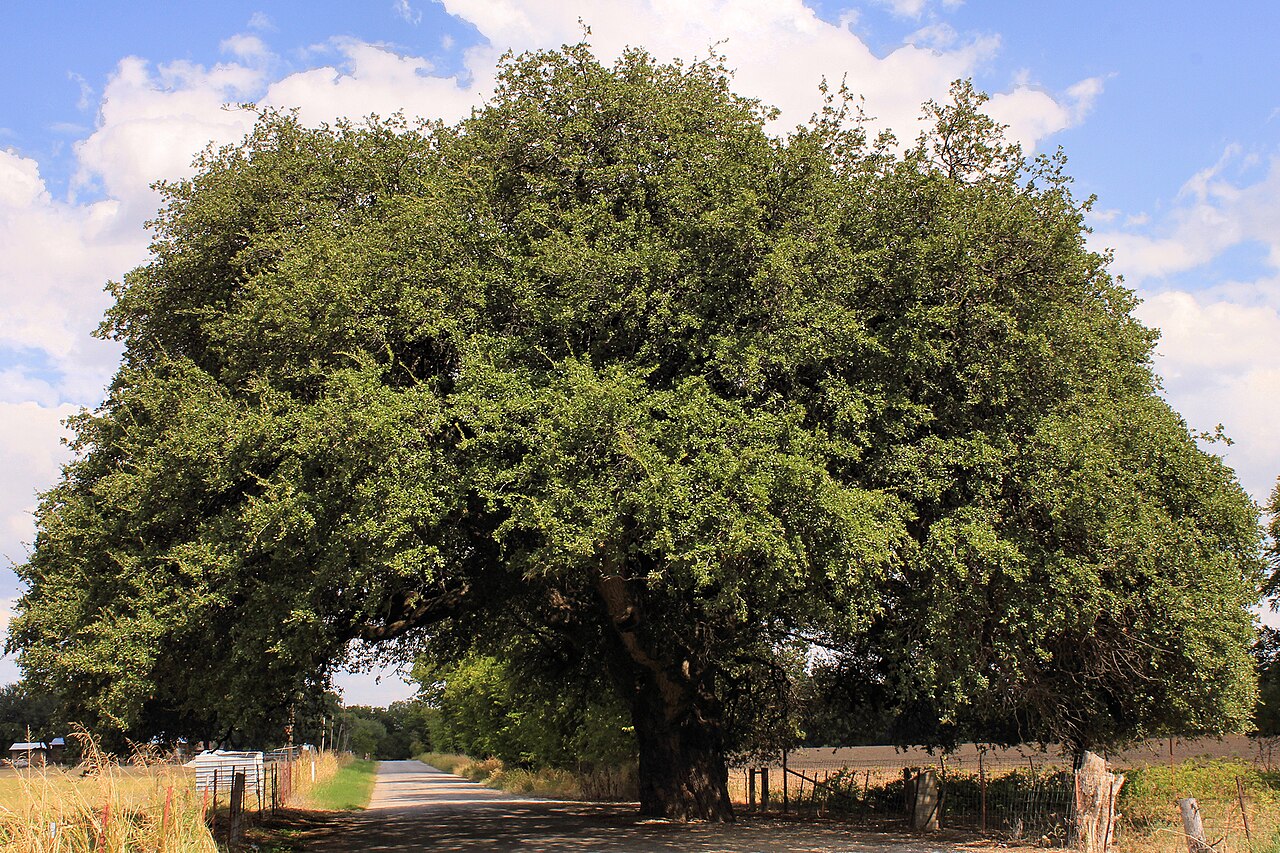
Plateau Live Oak is an evergreen to semi-evergreen tree, usually 30 to 50 feet tall with an equal or greater spread, though old pasture specimens can reach 60 feet with crowns far wider than they are tall. Trunk diameter rarely exceeds about 3 feet, noticeably less than the massive trunks southern live oak can produce in better-watered sites. Growth is slow to moderate. Many individuals grow as multi-trunked clumps or mottes rather than single-stemmed trees, the result of root suckering rather than separate seedlings.
Bark & Stems
Bark is dark gray to blackish-brown, thick, and broken into narrow, deeply furrowed ridges on mature trunks — rougher and darker than the smoother gray bark of many deciduous oaks. Young twigs are slender, gray-brown, and minutely hairy. Branching tends to be more erect and ascending than in southern live oak, giving younger trees a tighter, less sprawling silhouette until age and weight pull the limbs down.
Leaves
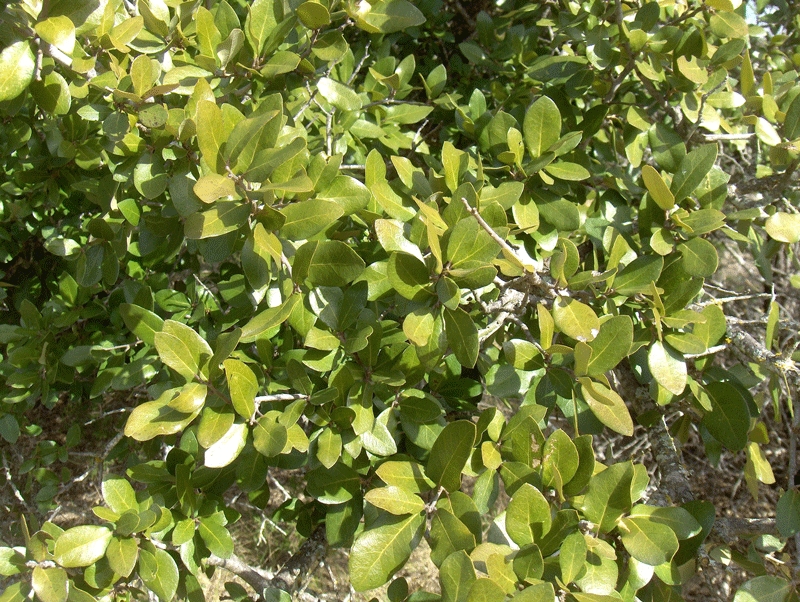
Leaves are evergreen, leathery, and simple, 1 to 3 inches long, elliptic to oblong, with smooth or slightly spine-toothed margins that curl under at the edges (revolute). The upper surface is glossy dark green; the underside is paler and finely hairy. Leaves drop and are replaced gradually each spring just before or during new growth, so the tree is never fully bare — a trait that confuses people expecting a true deciduous oak.
Flowers
Like all oaks, Plateau Live Oak is wind-pollinated and monoecious. Male flowers hang in slender yellowish-green catkins 2 to 3 inches long in March and April, appearing with the new leaves. Female flowers are tiny, reddish, and inconspicuous, borne singly or in small spikes in the leaf axils.
Fruit & Seeds
Acorns are narrow and somewhat spindle-shaped (hence fusiformis, “spindle-shaped”), ½ to 1 inch long, with a more tapered, pointed tip than the blunter acorns of southern live oak. They sit in a shallow, scaly cup covering roughly a quarter of the nut, ripen in one season, and drop in fall. Acorns are bitter with tannins and are an important wildlife food rather than a human one.
Quick Facts
| Scientific Name | Quercus fusiformis (syn. Quercus virginiana var. fusiformis) |
| Family | Fagaceae (Beech) |
| Plant Type | Evergreen to Semi-Evergreen Tree |
| Mature Height | 30–50 ft (occasionally to 60 ft) |
| Mature Spread | Equal to or wider than height |
| Growth Rate | Slow to moderate |
| Sun Exposure | Full Sun |
| Water Needs | Low once established |
| Soil Type | Rocky, limestone or caliche; well-drained |
| Soil pH | Neutral to alkaline |
| Bloom Time | March – April |
| Flower Color | Yellowish-green (catkins) |
| Fall Color | None; evergreen |
| Fruit | Narrow, spindle-shaped acorns |
| Deer Resistant | No (foliage and acorns browsed) |
| USDA Hardiness Zones | 6a – 9 |
Native Range
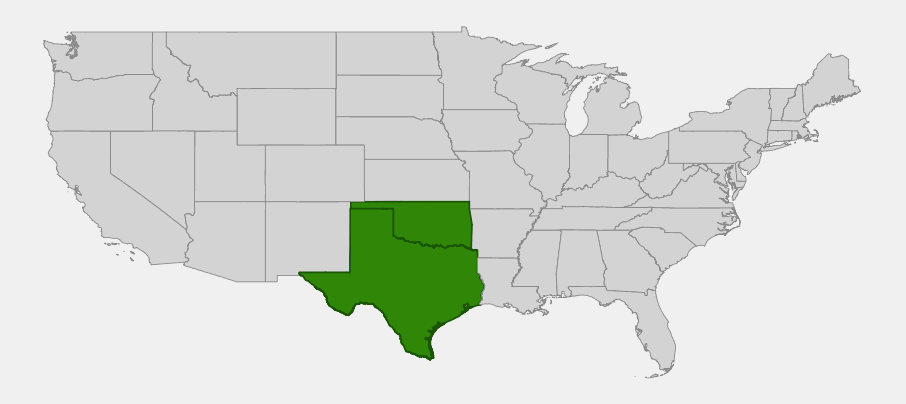
Plateau Live Oak is a Texas tree first and foremost. It dominates the woodlands of the Edwards Plateau and Hill Country, and spreads across most of the central and southern part of the state — from roughly the Brazos River west to the Pecos River and the southern edge of the Llano Estacado, and south into the Rio Grande Plains. A disjunct, unusually cold-hardy population also grows in the Wichita and Quartz Mountains of southwestern Oklahoma, the northernmost live oaks in North America. South of the border, the species continues into the Mexican states of Coahuila, Nuevo León, and Tamaulipas.
It favors dry uplands over bottomland: limestone hills, caliche flats, rocky canyon rims, and savanna grassland where its roots can reach cracks in the bedrock. This is a meaningful difference from southern live oak, which prefers the moister, sandier soils of the Gulf Coast and the Southeast. Where the two species’ ranges overlap in eastern and southern Texas, they hybridize freely, and many “live oaks” planted in Texas landscaping are actually a blend of the two.
Because Plateau Live Oak is so widely planted as a shade tree far outside this native footprint — it shows up in yards and medians across much of Texas and increasingly in xeriscape plantings in the broader Southwest — it is worth being clear that its true wild range is limited to central and south-central Texas and that one pocket of southwestern Oklahoma. Trees growing outside that range are planted, not naturally occurring.
📋 Regional plant lists featuring Plateau Live Oak: not currently covered by a regional list on this site (its Texas and Oklahoma range falls outside the areas our regional lists track).
Growing & Care Guide
Plateau Live Oak is about as low-maintenance as a Texas shade tree gets, provided it has well-drained soil and room to spread. The tradeoffs are a slower growth rate than fast-growing shade trees and, in its native range, a serious disease risk that changes how and when you should prune it.
Light
Give it full sun. It grows naturally in open savanna and rocky hillsides with little canopy competition, and performs best as an unshaded specimen or shade tree rather than an understory planting.
Soil & Water
This oak is built for thin, rocky, alkaline soils over limestone and tolerates caliche that would stunt most other trees. It needs regular watering for the first two to three years to establish a deep root system, after which it is genuinely drought tolerant and should not be watered heavily or on a regular landscape irrigation schedule — overwatering established trees can encourage root rot and other problems. Good drainage matters more than soil fertility.
Planting Tips
Plant small container-grown trees in fall or late winter so roots can establish before summer heat. Because the species suckers from the roots, give it plenty of open ground if you want a single clean trunk rather than a spreading motte — or embrace the motte habit and let it form a natural grove, which is how it behaves without management. Avoid planting over septic lines or near foundations, since root systems are wide and aggressive once mature.
Pruning & Maintenance
Prune only in winter, from roughly December through February, and never during the warm months. This is not a cosmetic preference — it’s disease prevention. Oak wilt, caused by the fungus Bretziella fagacearum, is one of the most destructive tree diseases in Texas and has killed enormous numbers of live oaks across the Hill Country. Sap-feeding beetles are attracted to fresh wounds on live oaks during the growing season and can carry fungal spores directly into the tree; because live oaks commonly share interconnected root systems within a motte, the fungus can then move from tree to tree underground and wipe out an entire grove. Seal any wound, including storm damage, immediately with pruning paint if it occurs outside the safe winter window, don’t move live oak firewood, and if you see rapid branch dieback and leaf veinal browning on a mature live oak in central Texas, have it checked for oak wilt before pruning anything on or near it.
Landscape Uses
Plateau Live Oak is a workhorse Texas shade and specimen tree:
- Drought-tolerant shade tree for large residential or ranch landscapes
- Xeriscaping in central and south Texas
- Wildlife plantings — acorns and cover support a wide range of animals
- Erosion control on rocky slopes and caliche banks
- Windbreaks and screens when allowed to grow as a motte
- Historic and heritage tree plantings — many Hill Country specimens are centuries old
Wildlife & Ecological Value
As a dominant evergreen tree across huge stretches of central Texas, Plateau Live Oak anchors the food web and structure of Hill Country woodlands and savannas.
For Birds
Acorns feed Wild Turkey, Scrub-Jays, woodpeckers, and a range of songbirds, while the dense evergreen canopy provides year-round nesting cover and roosting habitat that deciduous trees can’t match in winter. Cavities in old, gnarled trunks and limbs are used by cavity-nesting species including owls and woodpeckers.
For Mammals
White-tailed deer browse the foliage and eat fallen acorns heavily, especially in fall and winter. Javelina, fox squirrels, and rodents also rely on the acorn crop, and the tree’s dense low branches provide shelter and shade for livestock and wildlife alike across Hill Country ranchland.
For Pollinators
Like other oaks, Plateau Live Oak is wind-pollinated rather than insect-pollinated, but it serves as a larval host plant for numerous moth and butterfly species, including several hairstreaks, making it ecologically valuable well beyond its acorn crop.
Ecosystem Role
Plateau Live Oak is a foundation species of Edwards Plateau savanna and woodland, stabilizing thin limestone soils with its root systems, moderating summer heat under its canopy, and creating the motte structure that shelters understory plants and smaller wildlife from Texas sun and wind.
Cultural & Historical Uses
Indigenous peoples of central Texas, including Tonkawa and other Plains and Hill Country groups, historically gathered live oak acorns as a food source, leaching out the bitter tannins through repeated soaking or boiling before grinding them into meal. The hard, dense wood was used for tool handles, fence posts, and fuel, prized for burning slow and hot.
European and later Anglo-American settlers in the Hill Country valued live oaks for the deep shade they threw over homesteads and stock pens in a landscape with little other tree cover, and many of today’s named “heritage” live oaks mark historic ranch headquarters, townsites, and meeting places. The tree’s association with endurance and permanence runs deep in Texas culture — old live oaks are frequently the oldest living things on a piece of land and are often protected or built around rather than cleared.
Today the species remains central to how Texans identify their own landscape: it is one of the defining trees of the Hill Country and a default choice for drought-tolerant native shade planting across the southern half of the state.
Frequently Asked Questions
Is Plateau Live Oak the same tree as Texas live oak?
Yes — Texas Live Oak, Escarpment Live Oak, and Plateau Live Oak are all common names for Quercus fusiformis. It was long classified as a variety of southern live oak (Quercus virginiana var. fusiformis) and the two still hybridize, but it is now treated as its own species.
What’s the difference between Plateau Live Oak and southern live oak?
Plateau Live Oak is smaller, with a narrower trunk and more upright young branching, and it grows on dry limestone uplands rather than moist bottomland. Its acorns are more narrow and pointed. Southern live oak (Quercus virginiana) is a larger tree of the moister Gulf Coast and Southeast.
Is oak wilt a real threat to this tree?
Yes, and it’s a serious one in central Texas. Oak wilt spreads both through root grafts between neighboring live oaks and via sap beetles attracted to fresh wounds. Prune only in winter, seal any wounds made outside that window immediately, and don’t move live oak firewood between properties.
How much water does a Plateau Live Oak need?
Established trees are genuinely drought tolerant and need little to no supplemental water. Young trees need consistent watering for the first two to three years while roots establish; after that, regular irrigation can do more harm than good.
Can I grow Plateau Live Oak outside Texas and Oklahoma?
It is widely planted well outside its native range, especially elsewhere in the Southwest, where it tends to perform well in hot, dry, alkaline conditions. Just be aware it is not native there — check local oak wilt status before planting live oaks near other live oaks in a new area.
