Purple Leatherflower (Clematis pitcheri)
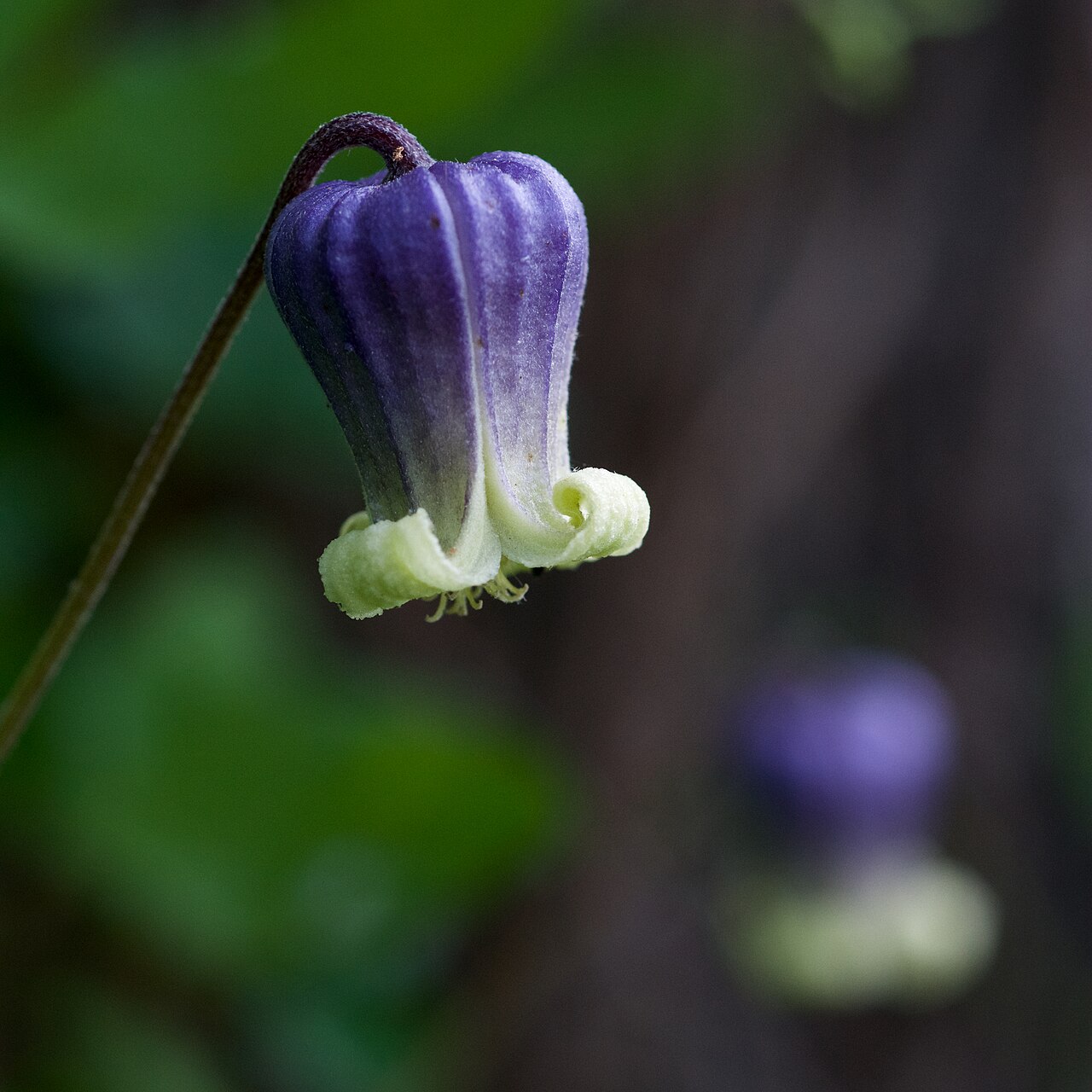
Clematis pitcheri, commonly called purple leatherflower or bluebill, is a woody-based, twining perennial vine native to the south-central United States, from Texas and Oklahoma east through Arkansas and Louisiana and north into Kansas and Missouri. Unlike the familiar open, star-shaped blooms of garden clematis, this native species produces small, thick, leathery, urn-shaped flowers in solid purple or blue that nod downward from the vine on long stalks, never fully opening the way most clematis do.
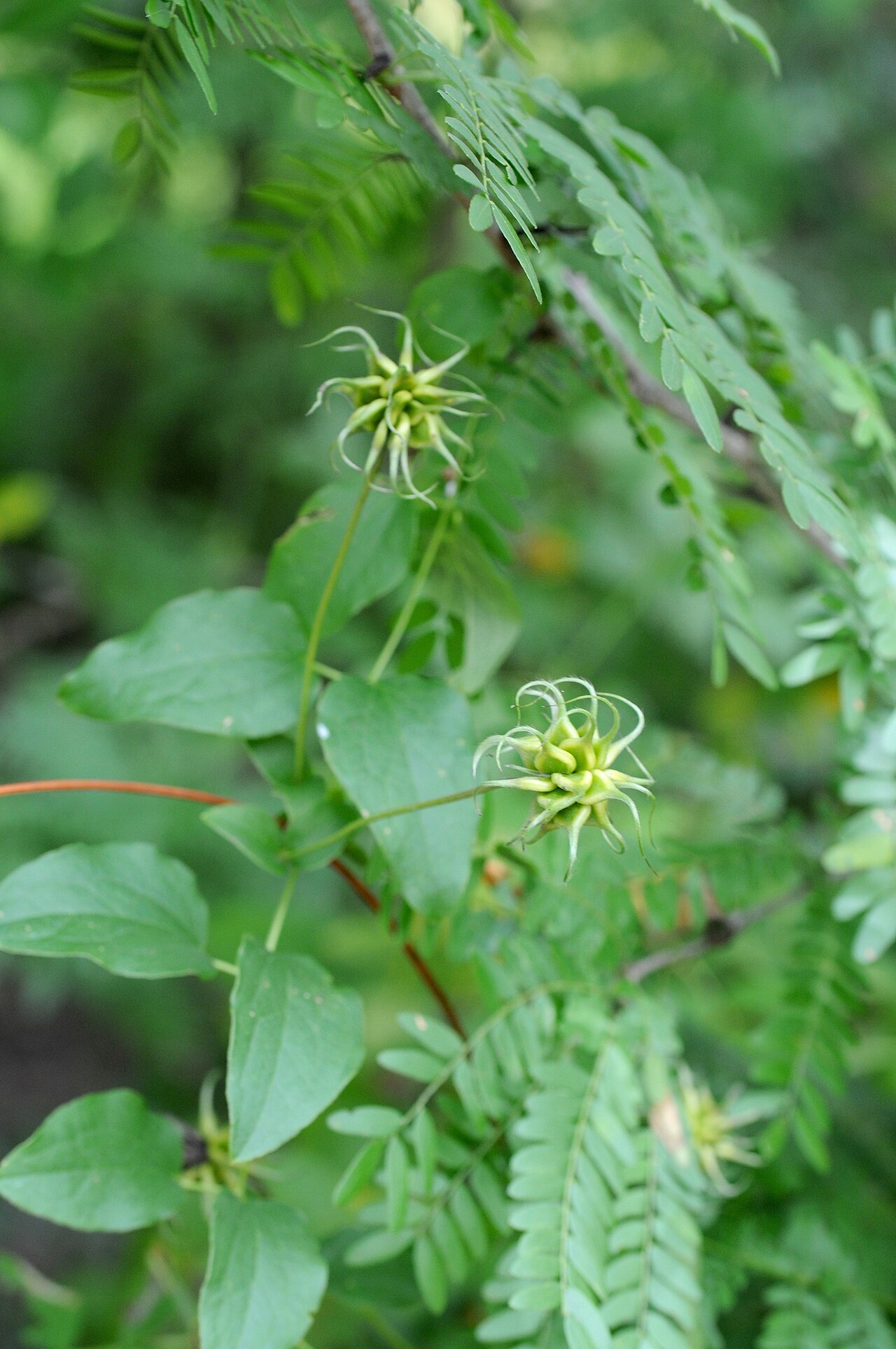
The common name “leatherflower” comes directly from the texture of the four fused sepals (clematis flowers have no true petals), which are noticeably thick, stiff and leather-like, with thin, crinkled margins that curl outward at the tip. After bloom, the flowers give way to striking, starburst-shaped seed heads made up of many long, feathery-tailed achenes, nearly as ornamental as the flowers themselves.
Purple leatherflower scrambles and twines over shrubs, fences and low trees in open woods, bluffs and streamside thickets across its native range. For gardeners within that range, it is an easy, well-behaved native vine, less aggressive than many introduced clematis, that adds unusual nodding purple blooms from late spring through summer and then a second season of interest when its wispy seed heads catch the light.
Identification
Purple leatherflower is a twining, woody-based perennial vine, with stems that can reach 3 to 13 feet long, climbing by wrapping its leaf stalks (petioles) around supports rather than using tendrils or suckers.
Stems & Leaves
Stems are slender and woody toward the base, with distinct collar-like nodes where the leaf stalks join the stem. Leaves are opposite and pinnately compound, usually with 4 to 8 leaflets, leathery in texture with a raised network of veins visible on the upper surface, green above and paler, often slightly hairy along the veins, beneath. Leaflets are typically undivided, though some are shallowly 3-lobed, with smooth (entire) margins.
Flowers
Flowers are solitary (occasionally in groups of three) on long stalks, nodding rather than upright, and urn- to bell-shaped rather than flat and open. The four sepals, 0.7 to 1.3 inches long, are purple to blue, thick and leathery, erect to slightly incurved with the tips reflexed outward, and edged with thin, crisped margins; the outer surface is hairy while the inside is smooth. There are no true petals; the numerous stamens and pistils are tucked inside the urn formed by the sepals. Bloom season runs from May through August.
Fruit & Seeds
After flowering, each bloom develops into a rounded cluster of flattened, beaked achenes, and as the beaks elongate and dry into long, curling, feathery tails, the whole seed head becomes a conspicuous silvery-green starburst, a signature late-season feature of the vine.
Quick Facts
| Scientific Name | Clematis pitcheri |
| Family | Ranunculaceae (Buttercup) |
| Plant Type | Woody-based twining perennial vine |
| Mature Height | 3–13 ft of climbing/trailing growth |
| Mature Spread | Variable; spreads over its support |
| Growth Rate | Moderate |
| Sun Exposure | Full Sun to Part Shade |
| Water Needs | Average; fairly drought tolerant once established |
| Soil Type | Well-drained soils of many textures, including rocky ground |
| Soil pH | Neutral to alkaline |
| Bloom Time | May – August |
| Flower Color | Purple to blue |
| Fall Color | None notable; feathery seed heads persist into fall |
| Fruit | Starburst clusters of long-beaked achenes |
| Deer Resistant | Yes |
| USDA Hardiness Zones | 5–9 |
Native Range
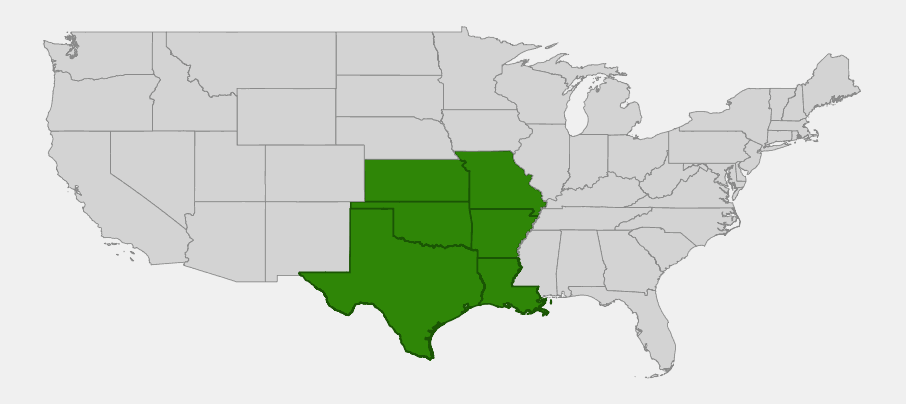
Purple leatherflower is native to the south-central United States, with its core range covering Texas, Oklahoma, Arkansas, Louisiana, Kansas and Missouri, and it reaches into northern Mexico along the southern edge of its range. It grows mostly east of the drier High Plains and west of the moister Southeast, favoring the transition zone between prairie and woodland that runs through much of its native states.
Typical habitat includes open woods, rocky bluffs, streambanks, fence rows and roadsides, usually on well-drained soils over limestone or other rock, in full sun to light shade. It climbs over shrubs, small trees, fences and other structures by wrapping its leaf stalks around them, rather than using tendrils, and is often found scrambling along woodland edges and disturbed ground where some open structure is available to climb.
Purple leatherflower is considered apparently secure (NatureServe rank G4) and remains a regular, if not especially common, component of its native plant communities across the south-central states, favoring the kind of semi-open, well-drained habitat that has not been too heavily altered by cultivation or dense tree cover.
📋 Regional plant lists featuring Purple Leatherflower: South and West Texas · Arkansas, Louisiana & Eastern Oklahoma/Texas · Illinois, Iowa & Missouri · Nebraska, Kansas & Eastern Colorado
Growing & Care Guide
Purple leatherflower is a well-mannered native vine for gardeners across its south-central range, needing a support to climb and modest ongoing care once it is established.
Light
Plant it in full sun to light shade. It flowers most heavily with good sun exposure, though in the hottest parts of its range it appreciates some afternoon shade, especially on the roots, a classic clematis preference often summed up as “head in the sun, feet in the shade.”
Soil & Water
Give it well-drained soil of almost any texture, including the rocky, limestone-influenced ground it favors in the wild; heavy, waterlogged soil is the main thing to avoid. It appreciates regular water during establishment and benefits from a layer of mulch to keep the root zone cool and evenly moist, but established plants tolerate dry spells well.
Planting Tips
Give purple leatherflower something to climb, a fence, trellis, shrub or small tree, since it supports itself by wrapping its leaf stalks around whatever is nearby rather than clinging directly to flat surfaces. Plant in spring or fall, setting the crown at or slightly below soil level, and mulch well to keep roots cool, following the same root-shading approach used for garden clematis.
Pruning & Maintenance
Prune after flowering if needed to control size or shape, since this species blooms on the current season’s growth; cutting it back hard in late winter before growth resumes is generally safe. It has few serious pests or diseases and needs no fertilizer, performing well with just an annual topdress of compost and renewed mulch.
Propagation
Purple leatherflower can be grown from seed, which benefits from a period of cold stratification over winter before spring germination, or propagated from softwood cuttings taken in early summer. Because the seed heads are so ornamental, many gardeners simply let some achenes mature and scatter naturally to produce a few volunteer seedlings near the parent vine.
Landscape Uses
- Fences and trellises for an easy-care native flowering vine
- Woodland edge and naturalistic plantings scrambling over shrubs
- Rock gardens and limestone outcrops where its wild habitat is echoed
- Wildlife and pollinator gardens for season-long interest, flower then seed head
- Low-maintenance screening over an unused fence or arbor
Wildlife & Ecological Value
Purple leatherflower’s unusual nodding flowers and striking seed heads give it a modest but real role in supporting wildlife across its woodland-edge and bluff habitat.
For Pollinators
The thick, urn-shaped flowers are visited mainly by bumblebees and other larger bees strong enough to push into the nearly closed bloom to reach the pollen and nectar inside, a pollination strategy shared by several native leatherflower species. The numerous stamens provide a substantial pollen reward once a bee gains entry.
For Birds
Small songbirds may use the tangled, twining growth as nesting cover and forage among the dried seed heads for the achenes, while the vine’s structure along woodland edges and fence rows adds useful vertical cover in otherwise open habitat.
For Mammals
Like other clematis, the foliage contains mildly irritating compounds that make it generally unpalatable and deer resistant, helping established vines persist even under browsing pressure from deer and rabbits.
Ecosystem Role
As a non-aggressive native vine that climbs rather than smothers, purple leatherflower adds structural diversity to open woodland edges, bluffs and fence rows without outcompeting the shrubs and small trees it climbs over, and its long bloom and seed season provides resources across a good stretch of the growing year.
Cultural & Historical Uses
Purple leatherflower has relatively little documented history of use by Indigenous peoples or early settlers compared with some of its showier native clematis relatives, likely reflecting both its modest, nodding flowers and the mild toxicity common throughout the genus, which made the plant unsuitable as food or medicine. Like other clematis, the fresh foliage and sap can be irritating to skin, and the plant has not been used as a food source.
Its main significance has always been horticultural and ecological rather than practical: a distinctive, well-mannered climbing vine whose unusual urn-shaped purple flowers and feathery seed heads have made it a quietly popular choice among native-plant gardeners in the south-central states looking for an alternative to non-native ornamental clematis.
Frequently Asked Questions
Why doesn’t purple leatherflower open like other clematis?
Its flowers are adapted as thick, leathery, urn-shaped blooms that stay mostly closed, nodding downward on long stalks rather than opening flat like many garden clematis varieties. Strong bees are able to push into the small opening to reach the pollen and nectar inside.
What does purple leatherflower climb on?
It climbs by wrapping its leaf stalks (petioles) around supports such as shrubs, small trees, fences and trellises, rather than using tendrils or suckers, so it needs something narrow enough for the petioles to grip.
Is purple leatherflower native to my state?
It is native to Texas, Oklahoma, Kansas, Missouri, Arkansas and Louisiana, plus adjacent northern Mexico. It is not documented as native outside this south-central range.
Is purple leatherflower toxic?
Like other clematis, the fresh sap and foliage can be mildly irritating to skin, and the plant is not used as food. It should be treated as ornamental only, with basic care in handling fresh cuttings.
When does purple leatherflower bloom?
From May through August, with the urn-shaped purple flowers followed later in the season by showy, feathery, starburst-shaped seed heads that extend its visual interest well past the bloom period.

Looking for a nursery that carries Purple Leatherflower?
Browse our native plant nursery directory: Texas · Oklahoma · Kansas · Missouri & Louisiana · Arkansas