Cusp Blazing Star (Liatris mucronata)
Liatris mucronata (treated by USDA PLANTS as Liatris punctata var. mucronata), commonly called Cusp Blazing Star, Texas Gayfeather or Texas Liatris, is a tough, drought-proof perennial wildflower of the rocky prairies, glades and limestone outcrops of the south-central United States. In late summer and early fall, when most of the Texas landscape has baked dry, its slender spikes send up dense wands of brilliant rose-purple flowers that seem to defy the heat entirely.
Unlike the taller, more flamboyant Liatris species of the eastern tallgrass prairie, cusp blazing star is a low, wiry plant built for thin, rocky, often calcareous soil. A deep, woody, bulb-like corm anchors it well below the surface, storing water and energy through long dry spells and sending the plant back year after year even on sites too harsh for most garden perennials.
For a Texas or Great Plains gardener with a hot, dry, sunny spot and lean soil, cusp blazing star is about as low-maintenance as native wildflowers get. It needs no supplemental water once established, shrugs off summer heat that wilts less adapted plants, and provides one of the most reliable late-season nectar sources for migrating monarchs and other butterflies working their way south.
Identification
Cusp blazing star grows as an erect, unbranched, wand-like perennial herb, typically 1 to 3 feet tall and 12 to 18 inches wide at the base, arising from a thickened, corm-like rootstock.
Stems
A single stiff, upright stem (or several stems from one crown) rises straight from the base without branching, giving the plant its characteristic wand or spike silhouette. The extensive, deep root system anchoring this slender top growth is what makes the plant so drought tolerant.
Leaves
Leaves are narrow, grass-like and numerous, crowded densely along the lower stem and becoming progressively shorter and sparser toward the top. Each leaf tapers to a small sharp point (the “cusp” or “mucro” that gives the plant its scientific epithet), a detail that helps separate it from the closely related dotted gayfeather (Liatris punctata var. punctata), whose leaves lack this pointed tip.
Flowers
From roughly late August into October, the upper third to half of the stem becomes a dense, narrow spike of small, stalkless, rose-purple to magenta flower heads, each made up entirely of disc florets (no ray “petals”). Like other Liatris, the spike opens from the top down, an unusual pattern among composite wildflowers. The tightly packed spike reads from a distance as a single glowing purple wand above the surrounding grass.
Fruit & Seeds
Each floret matures into a small, ribbed, one-seeded fruit (a cypsela, often loosely called an achene) topped with a tuft of feathery bristles that carry it on the wind, typical of the aster family.
Quick Facts
| Scientific Name | Liatris mucronata (Liatris punctata var. mucronata) |
| Family | Asteraceae (Aster/Sunflower) |
| Plant Type | Herbaceous perennial wildflower (corm-rooted) |
| Mature Height | 1–3 ft |
| Mature Spread | 12–18 in |
| Growth Rate | Slow to moderate |
| Sun Exposure | Full Sun |
| Water Needs | Low; very drought tolerant once established |
| Soil Type | Rocky, gravelly or sandy calcareous soils; limestone-based |
| Soil pH | Neutral to alkaline (about 7.0–8.5) |
| Bloom Time | Late August – October |
| Flower Color | Rose-purple to magenta |
| Fall Color | None; foliage senesces tan |
| Fruit | Small bristle-tipped cypselae, fall |
| Deer Resistant | Yes |
| USDA Hardiness Zones | 6–9 |
Native Range
Cusp blazing star is native to the south-central Great Plains and mid-South, with its range centered on Texas and extending north through Oklahoma and Kansas, east into Missouri, and southeast into Louisiana.
It is a plant of open, rocky or sandy ground with excellent drainage: limestone glades, caliche outcrops, rocky prairie hillsides, chalky bluffs and dry calcareous grassland. It is especially characteristic of the Edwards Plateau, Blackland Prairie and Cross Timbers regions of Texas, where thin, rocky soil over limestone keeps competition from taller grasses and shrubs in check.
Because its deep corm stores water and energy, cusp blazing star thrives on sites that would stress most other perennials, including exposed, sun-baked, poor-soil slopes. This makes it an unusually reliable choice for xeriscaping and rock-garden plantings well beyond the moister soils that many native wildflower guides assume.
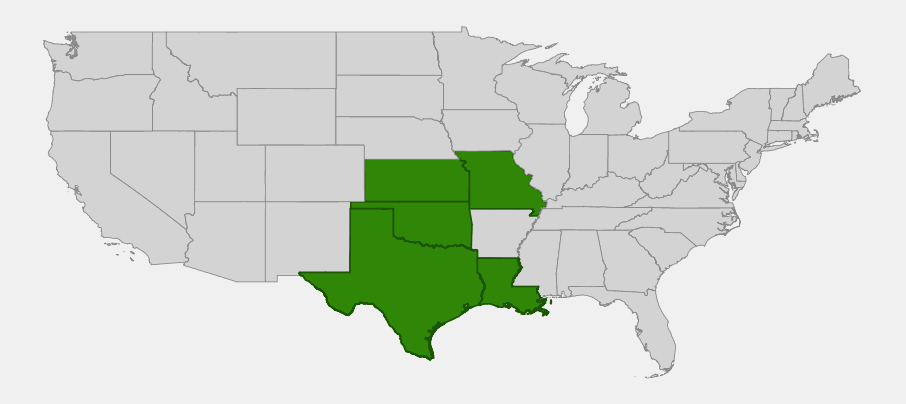
📋 Regional plant lists featuring Cusp Blazing Star: South & West Texas · Arkansas, Louisiana, Eastern Oklahoma & Eastern Texas · Nebraska, Kansas & Eastern Colorado · Illinois, Iowa & Missouri
Growing & Care Guide
Cusp blazing star rewards gardeners who can offer it exactly what it avoids in the wild: competition and wet feet. Give it lean, sharply drained soil and full sun, and it needs almost nothing else.
Light
Full sun is essential. This is a plant of open rock and thin prairie soil with no natural tolerance for shade; shaded plants grow weak, lean badly and rarely flower well.
Soil & Water
Sharp drainage matters more than fertility. Rocky, gravelly or sandy soils, especially those with a calcareous (limestone) component, come closest to its native habitat and suit it best. Water occasionally through the first season to help the corm establish; after that, cusp blazing star is one of the most drought-tolerant native perennials available and should not be watered on a regular schedule, since soggy soil — especially in winter — is far more likely to kill it than drought.
Planting Tips
Plant container-grown corms in spring, setting the crown at or just above soil level in a raised bed, rock garden or sharply drained slope if garden soil tends to hold moisture. Avoid heavy mulch piled against the crown, which can trap moisture and encourage rot. Established plants resent being moved, so choose the permanent spot carefully.
Pruning & Maintenance
Essentially none is needed. Leave the flower spikes standing through fall and winter for seed-eating birds and garden structure, then cut the old stem back in late winter before new growth emerges. The plant needs no fertilizer and no division; its slow spread keeps it tidy for years in one spot.
Propagation
Propagate from seed sown in fall or cold-stratified 30 to 60 days before spring sowing; germination and early growth are slow, and seedlings may take two or three years to flower as the corm builds up reserves. Named selections are occasionally available from native-plant nurseries as potted corms.
Landscape Uses
- Xeriscapes and rock gardens, where its deep corm shrugs off drought no other wildflower can match
- Limestone and caliche slopes too thin and dry for most perennials
- Late-season pollinator gardens alongside Indian blanket and native grasses
- Prairie and glade restoration on calcareous soils
- Vertical accents among shorter, mounding perennials, thanks to its wand-like form
Wildlife & Ecological Value
Cusp blazing star’s late bloom time makes it one of the most valuable native nectar plants in its range, filling a gap when few other wildflowers are still flowering.
For Pollinators
The flower spikes are a major late-season nectar source for migrating monarch butterflies moving south through Texas and Oklahoma in September and October, along with other butterflies, skippers, bumblebees and native solitary bees. Hummingbirds occasionally visit as well.
For Birds
Seed-eating songbirds, including goldfinches, feed on the ripe cypselae in fall and winter if the spikes are left standing rather than cut back.
For Mammals
Deer and rabbits generally leave the wiry, slightly bitter foliage alone, making it a dependable choice in landscapes with heavy browsing pressure. The deep corm is well protected from most grazing damage.
Ecosystem Role
On thin, rocky prairie and glade soils where few other forbs can compete, cusp blazing star adds structural and bloom diversity, and its extensive root system helps stabilize soil on exposed slopes and outcrops.
Cultural & Historical Uses
Like other Liatris species, cusp blazing star’s corm was historically used by some Indigenous peoples of the southern Plains, sometimes as a food source after cooking and sometimes in preparations applied for various ailments. These are matters of historical and ethnobotanical record rather than guidance for modern use, and the plant has no established food or medicinal role today.
More recently, cusp blazing star has become appreciated among Texas and southern Plains native-plant gardeners specifically for the trait that makes it rare in typical nursery stock: true drought resilience on thin, rocky soil where almost nothing else blooms reliably in fall.
Frequently Asked Questions
Is cusp blazing star the same as Liatris punctata?
They are closely related. USDA PLANTS currently treats cusp blazing star as a variety of dotted gayfeather, Liatris punctata var. mucronata, while many regional floras and nurseries still use the name Liatris mucronata for this more southern, pointed-leaved form.
Why won’t my cusp blazing star bloom?
Young plants grown from seed often take two to three years to build up enough reserves in their corm before flowering. Mature plants that fail to bloom are usually getting too much shade or too much water and fertilizer, both of which work against this lean-soil specialist.
Can cusp blazing star handle heavy clay soil?
Not well, especially if the clay holds winter moisture. It performs best in rocky, gravelly or sandy soil with sharp drainage; in clay, raised beds or added coarse gravel can improve its odds considerably.
Does cusp blazing star spread aggressively?
No. It stays as a single clump or slowly offsets from the corm, and does not spread by rhizomes or self-sow aggressively, making it a well-behaved choice for small gardens.
When does cusp blazing star bloom compared to other gayfeathers?
It is one of the latest-blooming Liatris species, typically flowering from late August into October, well after spring- and summer-blooming relatives like dense blazing star (Liatris spicata), which makes it especially valuable for fall monarch migration.

Looking for a nursery that carries Cusp Blazing Star?
Browse our native plant nursery directory: Texas · Oklahoma · Kansas · Missouri & Louisiana