Steve’s Pincushion (Chaenactis stevioides)
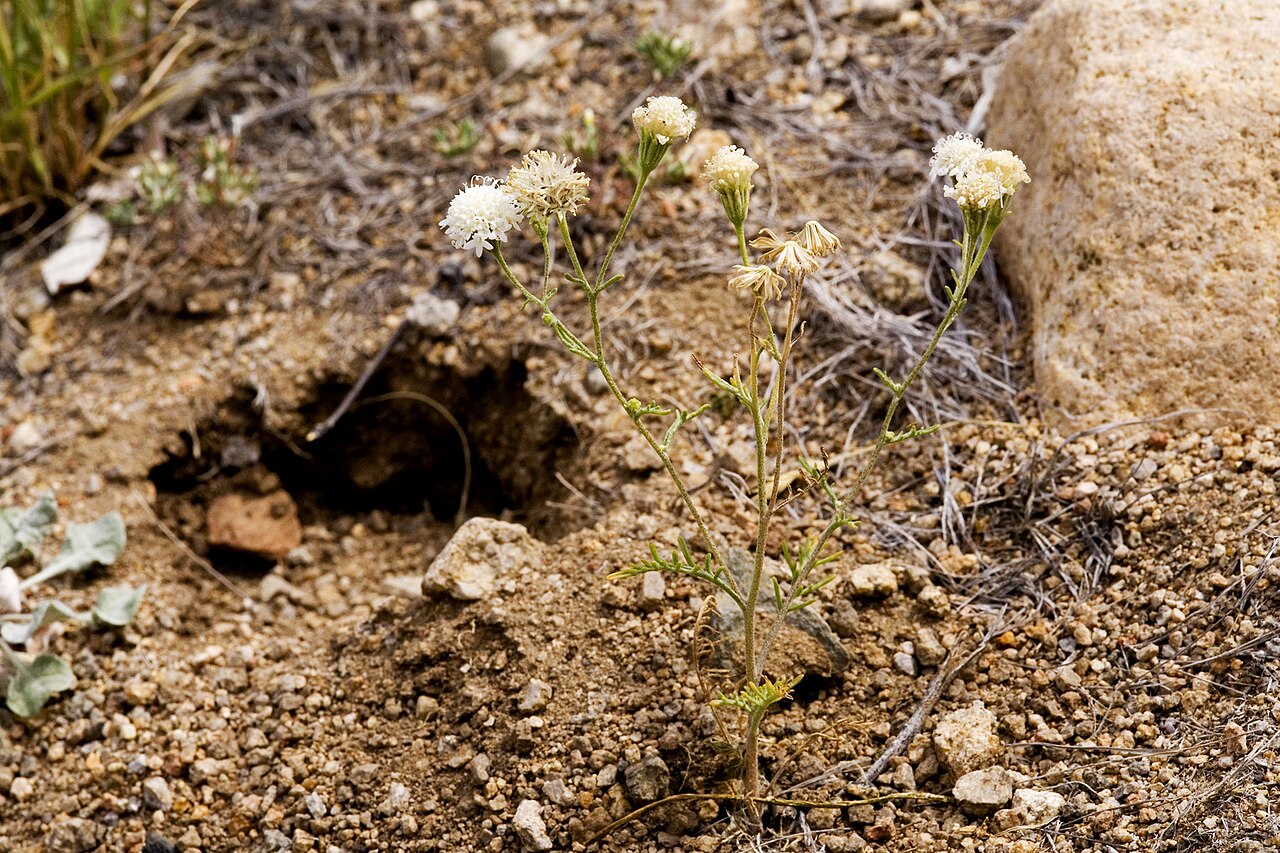
Chaenactis stevioides, commonly called Steve’s pincushion (also Esteve’s pincushion, desert pincushion, or Steve’s dustymaiden), is a small, unassuming annual wildflower of the warm and cold deserts of the American Southwest. Named for the Spanish botanist Pedro Jaime Esteve, it belongs to the sunflower family (Asteraceae) and the genus Chaenactis, whose members are known collectively as pincushions or dustymaidens for the dense, bristling look of their flower heads. It is one of the most widespread and reliable spring annuals across the Mojave, Sonoran, and Great Basin deserts.
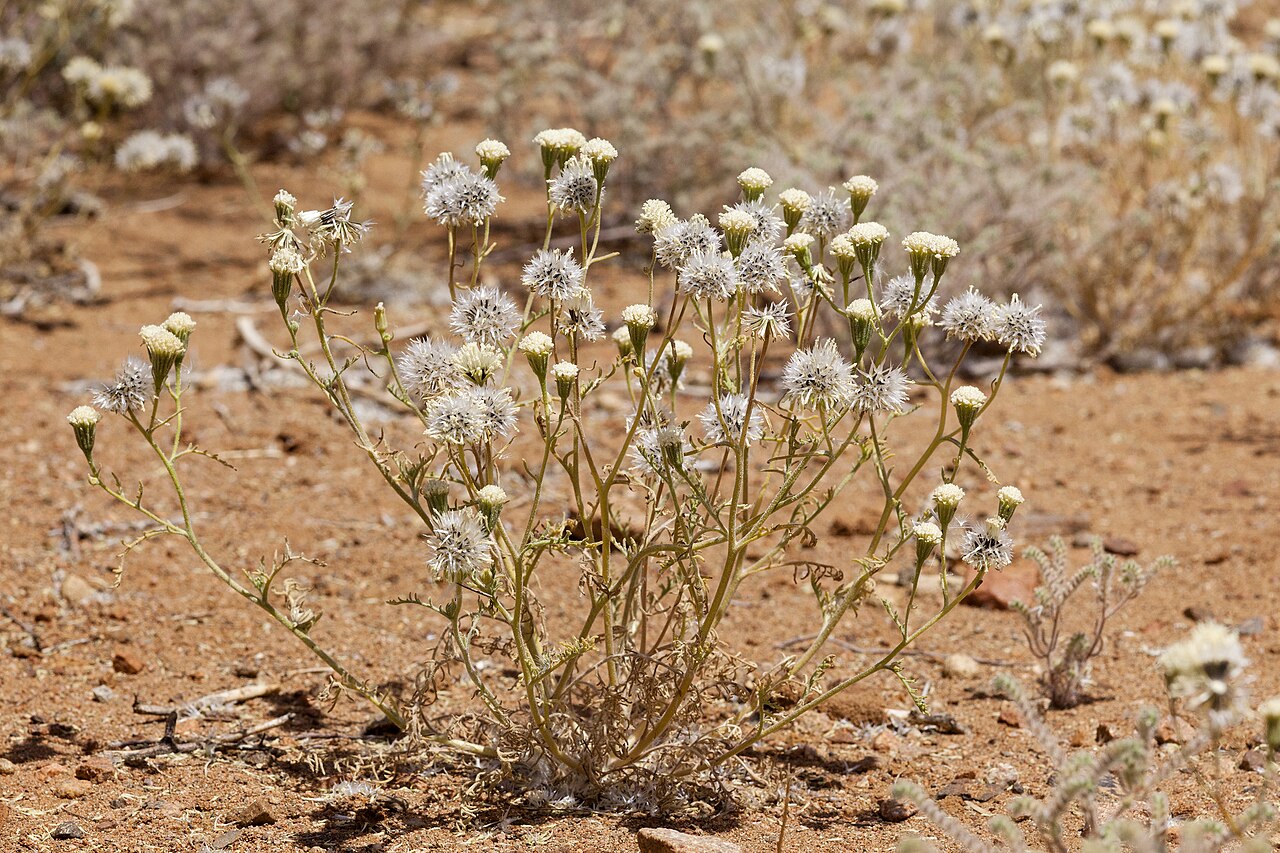
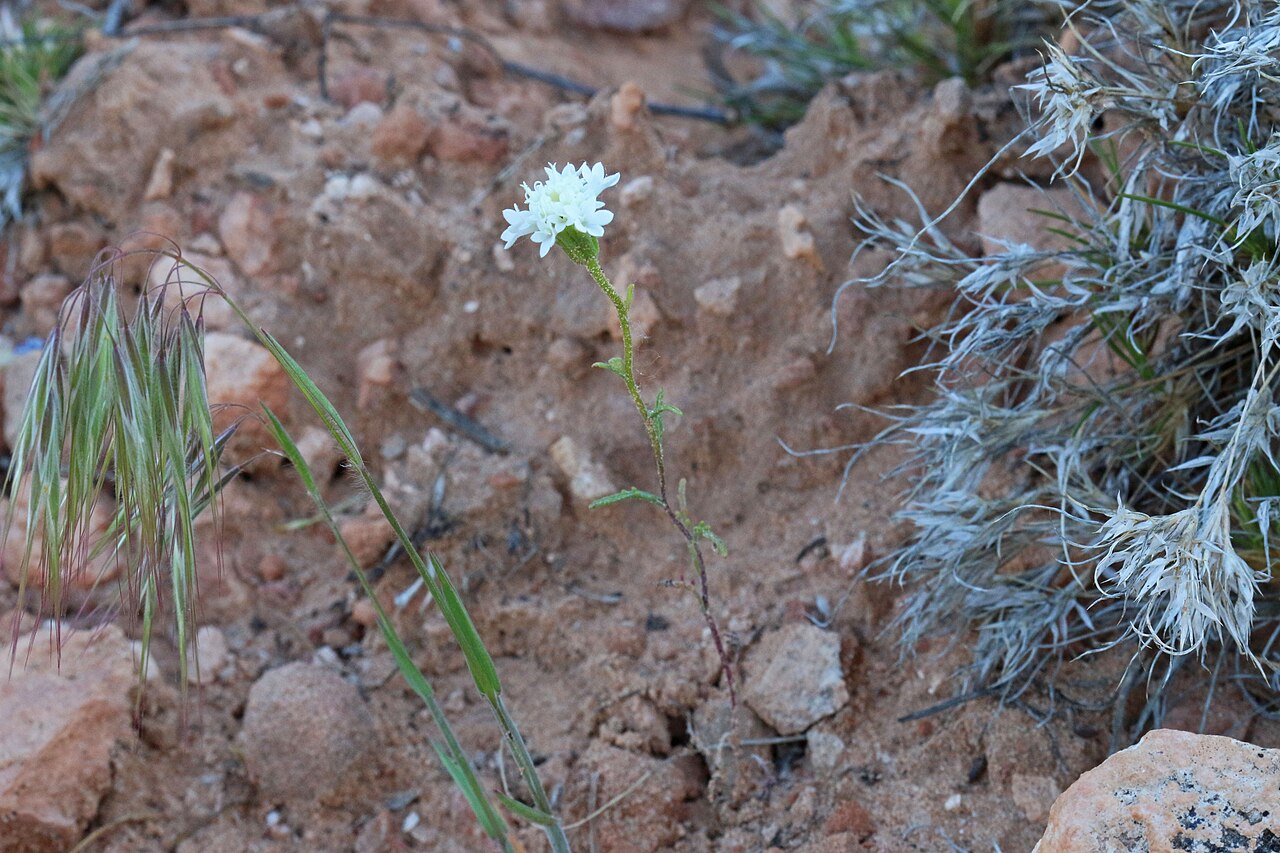
Growing just a few inches to about sixteen inches tall, Steve’s pincushion is easy to overlook until its clusters of pale, pom-pom-shaped flower heads open on wiry, blue-green stems. The plant has no showy ray florets — its “petals” are an illusion created by slightly enlarged outer disc flowers, giving each head a soft, cushiony look that is the source of its common name. After a wet winter, it can carpet open desert flats and washes alongside better-known annuals like desert marigold and popcorn flower.
Steve’s pincushion plays a quiet but important ecological role: it is one of the earliest nectar sources available to native bees and other small pollinators emerging in the desert spring, and its finely dissected, silvery foliage and fibrous roots make it a useful, low-water component of a naturalistic desert or xeriscape garden grown from seed.
Identification
Steve’s pincushion is an annual forb, meaning it completes its entire life cycle — germination, flowering, seed set, and death — within a single growing season, typically over just a few months in late winter and spring.
Stems & Leaves
Plants produce one to a dozen slender, erect to spreading stems from a basal rosette, reaching 2 to 16 inches (5–40 cm) tall. Young stems and leaves are covered in loose, cobwebby white hairs that give the whole plant a soft gray-green or blue-green cast; older plants often lose much of this pubescence and look more green or purplish. Leaves are alternate and concentrated near the base of the plant, with the basal leaves often withering by bloom time. Leaf blades are narrow and once- or twice-pinnately divided into 4 to 8 pairs of short, linear to elliptical lobes, giving the foliage a lacy, fern-like texture.
Flowers
Each plant produces several rounded flower heads, roughly ½ to ¾ inch (1–2 cm) across, carried on long, mostly leafless stalks above the foliage. The heads are discoid — composed entirely of tubular disc florets, with no ray “petals” — but the outer ring of florets is enlarged and often pale pink-tinged, creating a pincushion or powder-puff appearance. Florets range from white to cream to pale yellow, sometimes blushed with pink. Bloom occurs from February into June, starting earliest at low desert elevations and later at higher, cooler sites.
Fruit & Seeds
After flowering, each floret produces a small, dry, club-shaped fruit called a cypsela (often loosely called an achene), tipped with a crown of thin scales. The seeds are wind- and water-dispersed and persist in the soil seed bank, germinating heavily after fall and winter rains — which is why Steve’s pincushion is a dependable member of desert wildflower blooms in good rain years and nearly absent in drought years.
Quick Facts
| Scientific Name | Chaenactis stevioides |
| Family | Asteraceae (Sunflower) |
| Plant Type | Annual Wildflower (Forb) |
| Mature Height | 2–16 in (5–40 cm) |
| Mature Spread | 6–12 in (15–30 cm) |
| Growth Rate | Fast (single growing season) |
| Sun Exposure | Full Sun |
| Water Needs | Low (Arid once established) |
| Soil Type | Sandy, gravelly or rocky, well-drained |
| Soil pH | 7.0–8.5 (neutral to alkaline) |
| Bloom Time | February – June |
| Flower Color | White to cream, often pink-tinged |
| Fall Color | None (plant dies back after seed set) |
| Fruit | Small dry cypselae (achene-like) |
| Deer Resistant | Yes |
| USDA Hardiness Zones | 6–10 |
Native Range
Steve’s pincushion is native to the warm and cold deserts of the southwestern United States, with core populations in California, Nevada, Arizona, Utah, western Colorado, and New Mexico. It is especially abundant through the Mojave and Sonoran Deserts of California, Nevada, and Arizona, and extends north into the drier basins of the Great Basin in Nevada and Utah, and east onto the Colorado Plateau in western Colorado and New Mexico.
Across this range it grows from low desert floor to pinyon-juniper woodland, typically between 100 and about 6,500 feet (30–2,000 m) elevation. Typical habitat includes open, sandy or gravelly desert flats, washes, mesas, and disturbed openings in creosote bush scrub, saltbush scrub, and pinyon-juniper woodland. It is often one of the first annuals to germinate after fall and winter rains, flowering heavily in wet years and sparsely or not at all in drought years.
Some older references list Steve’s pincushion more broadly across Idaho, Oregon, and Wyoming, but county-level distribution data do not support reliably established native populations in those states, and a historical record from New York is considered a cultivated escapee rather than a wild occurrence. This page lists only the states with confirmed native, naturally occurring populations.
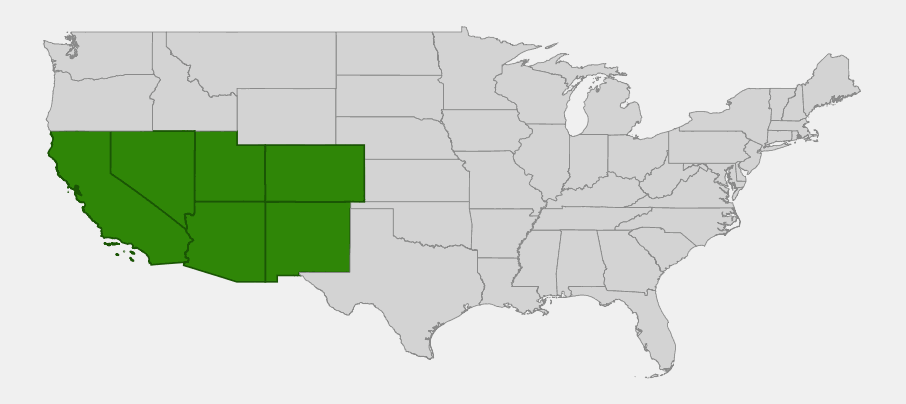
📋 Regional plant lists featuring Steve’s pincushion: California & Nevada · Arizona & New Mexico · Utah & Western Colorado
Growing & Care Guide
Steve’s pincushion is rarely cultivated commercially, but it is an easy, low-maintenance addition to a desert wildflower meadow or native seed mix, prized for its drought tolerance and early-season blooms when grown from seed collected or purchased in-range.
Light
Give it full sun. Like most desert annuals, it needs strong, direct light to germinate and flower well; it will not perform in shade.
Soil & Water
Plant in sandy, gravelly, or rocky soil with excellent drainage and a neutral to alkaline pH — rich or heavily amended garden soil tends to favor weeds and fungal problems over this desert native. Once germinated by fall or winter rain, established seedlings need little to no supplemental water; occasional deep watering during an unusually dry winter can extend bloom, but overwatering shortens the plant’s life and reduces flowering.
Planting Tips
Sow seed directly in fall, just before the rainy season, pressing seed lightly into bare, disturbed soil rather than burying it deeply — Steve’s pincushion germinates best with light and a period of cool, moist stratification. It does not transplant well as a seedling, so direct sowing in its permanent spot is best. Because germination and bloom are rain-dependent, expect variation from year to year, with the showiest displays following wet winters.
Pruning & Maintenance
None needed. As an annual, the plant completes its life cycle and dies back naturally after setting seed in late spring or early summer; simply leave spent plants in place to reseed, or clear them once seed has dropped if a tidier look is wanted.
Landscape Uses
Steve’s pincushion suits several low-water garden settings:
- Desert wildflower meadows and native seed mixes
- Xeriscape and rock gardens with sandy or gravelly soil
- Pollinator gardens as an early spring nectar source
- Restoration seeding on disturbed desert soils
- Interplanting among cacti, yuccas, and other desert perennials for seasonal color
Wildlife & Ecological Value
Despite its modest size, Steve’s pincushion punches above its weight as a desert pollinator resource, flowering at a time of year when few other nectar sources are available.
For Pollinators
The flower heads attract a range of small native bees, syrphid flies, and other short-tongued pollinators drawn to the shallow, accessible disc florets. Because it often blooms in late winter and early spring ahead of many larger desert wildflowers, it provides an important early-season nectar and pollen source in years following good winter rain.
For Birds & Small Mammals
The small, dry seeds are eaten by seed-foraging songbirds and small desert rodents once the plant sets fruit and dries in late spring, adding to the broader seed bank that supports desert granivores through the dry season.
Ecosystem Role
As a fast-germinating, short-lived annual, Steve’s pincushion is part of the desert’s “boom and bust” ephemeral flora — a group of plants that respond quickly to rainfall, cover and stabilize bare soil between longer-lived shrubs, and cycle nutrients rapidly through the ecosystem. Its dense winter-rain germination also contributes structure and ground cover that reduces erosion on open desert flats between larger perennial shrubs.
Cultural & Historical Uses
Steve’s pincushion is a minor but documented part of regional ethnobotany. Historical accounts describe some Native American groups in the Southwest preparing an infusion from the plant as a folk remedy intended to calm rapid heartbeats in feverish children. This use is recorded as a point of historical and cultural interest rather than a recommendation; the plant has no established modern medicinal or food use, and its safety for ingestion has not been studied.
Beyond this recorded folk use, Steve’s pincushion has little documented history of economic or ceremonial importance compared to larger, longer-lived desert plants such as agave or mesquite. Its primary significance, historically and today, is ecological: as a reliable, widespread early bloomer that signals a healthy desert wildflower season after a wet winter.
The genus name Chaenactis comes from Greek roots referring to the gaping, ray-like form of some species’ outer florets, while the species name stevioides honors the sixteenth-century Spanish botanist and physician Pedro Jaime Esteve — the source of the alternate common name “Esteve’s pincushion.”
Frequently Asked Questions
Is Steve’s pincushion the same as Esteve’s pincushion?
Yes. Both names refer to the same species, Chaenactis stevioides. “Esteve’s pincushion” is closer to the origin of the species name, honoring botanist Pedro Jaime Esteve, while “Steve’s pincushion” is a simplified, more common English rendering.
Is Steve’s pincushion edible or medicinal?
No established food or medicinal use is recommended today. Historical accounts describe a folk infusion used by some Native American groups for feverish children, but this is recorded as cultural history, not a current health recommendation, and the plant’s safety for ingestion has not been studied.
Why didn’t my Steve’s pincushion seeds come up this year?
Germination and bloom are strongly tied to fall and winter rainfall. In dry years, seeds can remain dormant in the soil seed bank and simply wait for a wetter season rather than germinating poorly or failing outright.
Does Steve’s pincushion spread aggressively?
No. As a native annual, it reseeds within its planted area but is not aggressive or weedy; its spread is naturally limited by available rainfall and open, bare soil for germination.
Can Steve’s pincushion grow outside its native desert range?
It is best suited to arid climates with mild, wet winters and dry summers, matching the Mojave, Sonoran, and Great Basin regions it comes from. It is unlikely to thrive or reseed reliably in humid or heavy-clay-soil climates outside this range.

Looking for a nursery that carries Steve’s pincushion?
Browse our native plant nursery directory: California · Arizona · Nevada & New Mexico · Utah · Colorado