Big Galleta (Pleuraphis rigida)
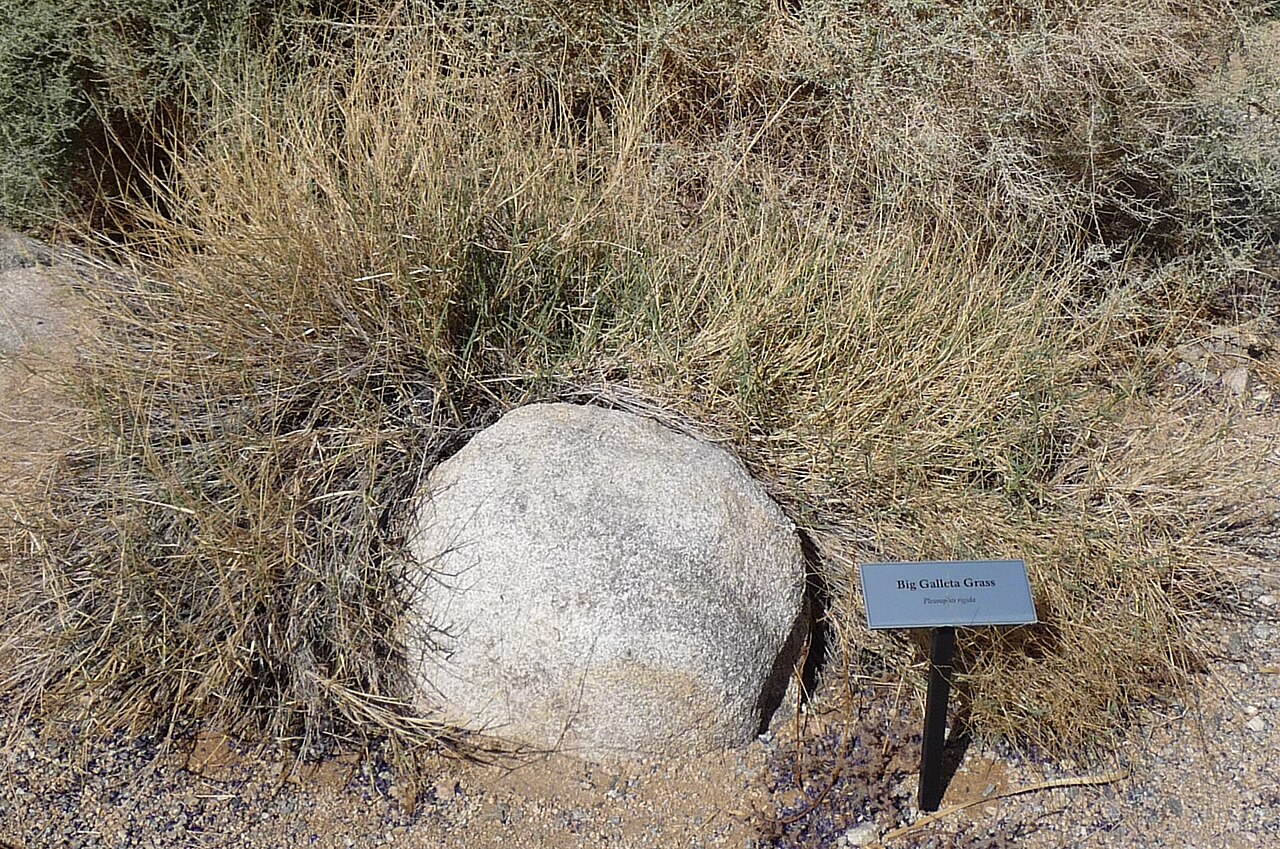
Pleuraphis rigida (syn. Hilaria rigida), commonly called Big Galleta or Big Galleta Grass, is a tough, long-lived perennial bunchgrass of the Mojave and Sonoran deserts. It belongs to the Poaceae (grass family) and is one of the most drought-hardy native grasses in the American Southwest, holding its ground on sun-blasted slopes, dunes, and desert pavement where few other grasses survive. Unlike most desert grasses that die back completely in dry years, Big Galleta keeps a woody, semi-persistent base and can green up quickly after even modest rain.
The plant grows in coarse, rounded clumps 1 to 3 feet tall, with stiff, wiry stems that are often partially woody at the base and covered in soft, woolly hairs at the nodes. Narrow, gray-green leaves curl and roll inward during drought to conserve moisture, giving established clumps a shaggy, silvery cast that is easy to pick out from a distance. Dense, bristly flower spikes appear atop the stems after warm-season rain, a brief but welcome sign of green in an otherwise bleached landscape.
Big Galleta is a foundational species of open desert scrub and dune communities, binding loose sand with its spreading rhizomes and providing forage and cover where little else grows. For a xeriscape or desert restoration planting in the Southwest, it offers texture, erosion control, and wildlife value with essentially no irrigation once established.
Identification
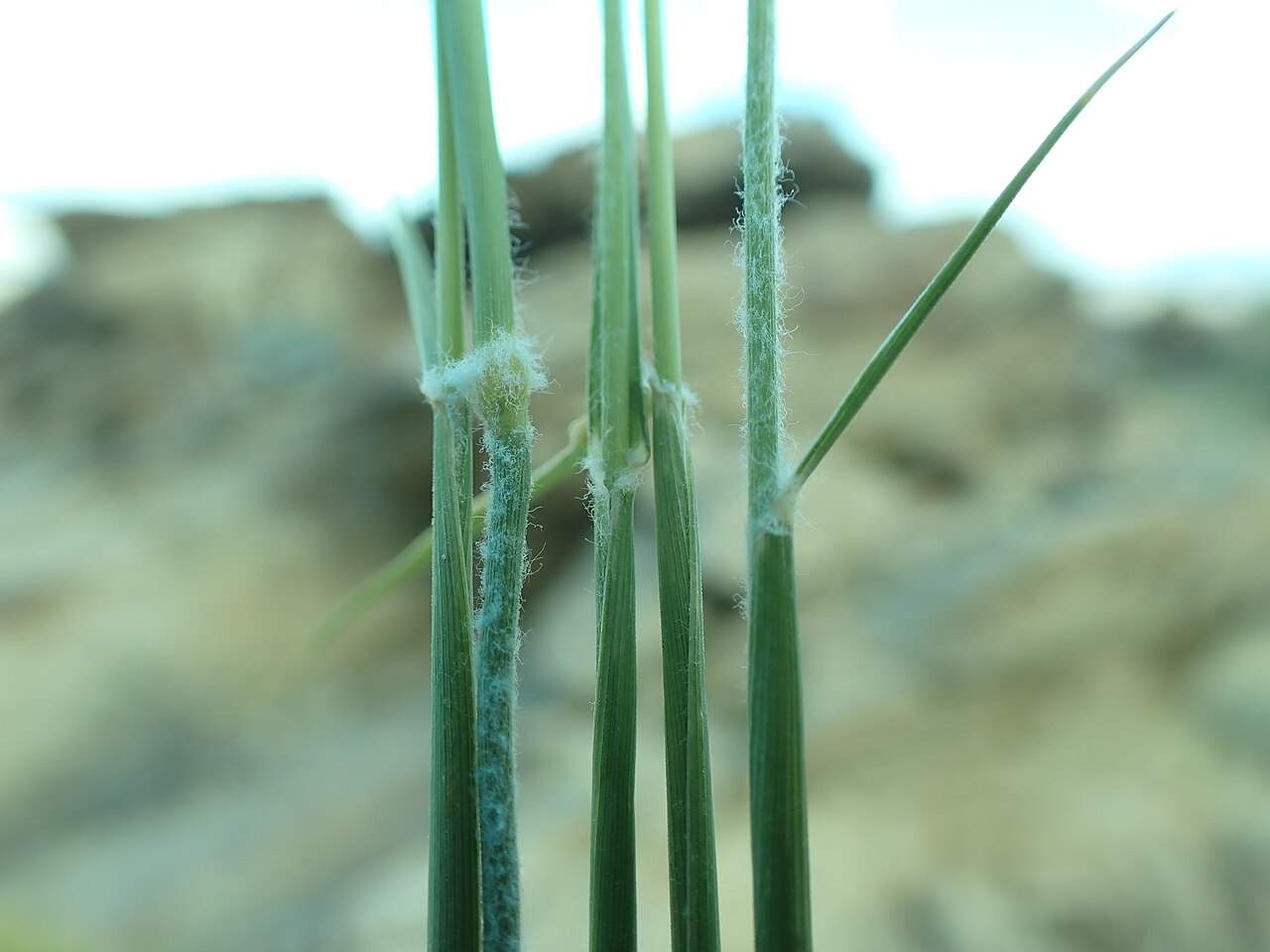
Big Galleta is most easily recognized by its tough, bunched growth habit and the dense wool of hairs at each stem node — a feature that distinguishes it from the related, smaller galleta grass (Pleuraphis jamesii), which lacks the conspicuously woolly nodes and tends to form sod rather than discrete bunches.
Stems & Growth Habit
Stems are erect to somewhat sprawling, 1 to 3 feet (30–90 cm) tall, often becoming woody and persistent at the base in older plants. New growth arises from short, scaly rhizomes, so a mature clump slowly expands outward into a rounded mound rather than spreading aggressively. The stem nodes are covered in dense, cottony, silvery-white hairs that are visible even at a glance and are a reliable field mark.
Leaves
Leaves are narrow, flat to inrolled, 2 to 6 inches (5–15 cm) long, gray-green and often with fine hairs near the base. In drought the blades curl tightly inward, reducing water loss and giving the clump a wiry, straw-colored appearance that can persist for months; the plant greens again quickly once rain arrives.
Flowers & Seedheads
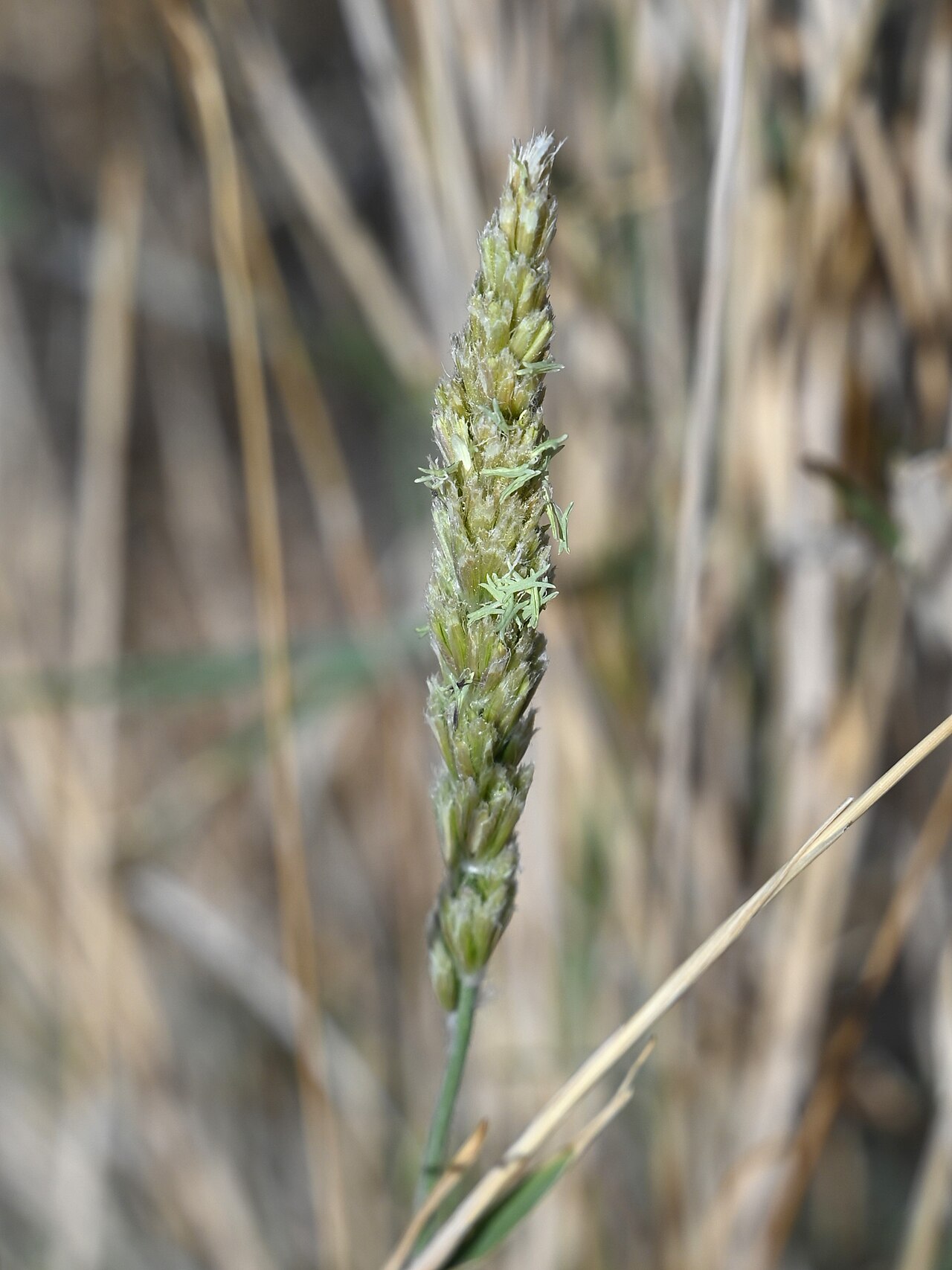
The flowering spike is a dense, cylindrical cluster 1 to 3 inches long, made up of tightly packed spikelets in groups of three, with the central spikelet usually staminate (male) and the two flanking spikelets perfect or pistillate. The spikes are bristly with awns and short hairs, giving them a fuzzy, bottle-brush look. Bloom follows warm-season rain, most often between March and October depending on moisture, and the spikes persist on the stems well after seed is shed.
Quick Facts
| Scientific Name | Pleuraphis rigida (syn. Hilaria rigida) |
| Family | Poaceae (Grass) |
| Plant Type | Perennial Bunchgrass |
| Mature Height | 1–3 ft (30–90 cm) |
| Mature Spread | 1–2 ft clump, slowly expanding by short rhizomes |
| Growth Rate | Slow |
| Sun Exposure | Full Sun |
| Water Needs | Very Low once established |
| Soil Type | Sandy, gravelly or rocky, well-drained |
| Soil pH | 7.0–8.5 (neutral to alkaline) |
| Bloom Time | March – October (after warm-season rain) |
| Flower Color | Greenish to straw-tan |
| Fall Color | Tan / straw (dormant) |
| Fruit | Small dry grain (caryopsis), not showy |
| Deer Resistant | Yes (grazed mainly by jackrabbits and desert bighorn) |
| USDA Hardiness Zones | 8–11 |
Native Range
Big Galleta is native to the hot deserts of the American Southwest, where it is one of the most widespread perennial grasses of the Mojave and Sonoran Desert floor. Its range runs through southeastern California, southern Nevada, western and southern Arizona, southern Utah, and New Mexico, generally below about 4,500 feet elevation.
It grows on sandy flats, stabilized dunes, desert pavement, alluvial fans, and rocky slopes, often alongside creosote bush (Larrea tridentata), white bursage (Ambrosia dumosa), and Mojave yucca (Yucca schidigera). In the eastern Mojave Desert it is often more abundant than its smaller relative, galleta grass (Pleuraphis jamesii), and it is notably scarce in the far-western Mojave where summer monsoon rainfall is negligible, since the species relies heavily on warm-season moisture.
Big Galleta is a key sand stabilizer in dune and desert-wash habitats, with its rhizomes helping to anchor loose, shifting substrate. It is not found in the cooler, higher-elevation grasslands of the Colorado Plateau or Great Basin, where galleta grass (P. jamesii) takes over the same ecological role.
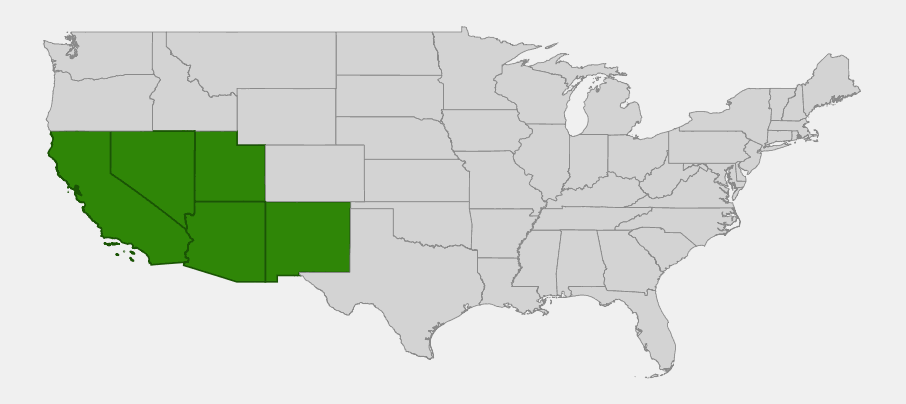
📋 Regional plant lists featuring Big Galleta: California & Nevada · Arizona & New Mexico · Utah & Western Colorado
Growing & Care Guide
Big Galleta is built for neglect in hot, dry climates and is an excellent choice for low-water desert landscaping where few other grasses will thrive. It is, however, slow to establish and not suited to gardens outside its desert comfort zone.
Light
Give it full sun. Big Galleta is adapted to open, unshaded desert ground and will grow thin and weak in significant shade.
Soil & Water
It thrives in sandy, gravelly, or rocky soils with sharp drainage and tolerates alkaline conditions without issue. Once established — which can take one to two full growing seasons — it needs no supplemental irrigation in its native range and relies on infrequent rainfall. Young plants benefit from occasional deep watering during their first summer; established clumps are best left alone, since excess moisture and heavy soils promote root rot.
Planting Tips
Plant from containers in fall or early spring so roots can establish before summer heat arrives. Space plants 18 to 24 inches apart to allow for their slow, mounding spread. Avoid amending the planting hole with rich organic matter, which can hold moisture against the roots; native desert soil, even if poor, is usually the better medium.
Pruning & Maintenance
Big Galleta needs little maintenance. Old, dry growth can be trimmed back in late winter to tidy the clump before new growth resumes, but this is cosmetic rather than necessary. Avoid cutting during active growth. The plant is not prone to pests or disease in cultivation.
Landscape Uses
Big Galleta’s texture and resilience make it useful in several desert-garden roles:
- Xeriscaping — a true no-irrigation grass once established
- Erosion control on sandy slopes, washes, and dunes
- Desert restoration plantings and reseeding projects
- Accent planting among rocks and boulders for form and texture
- Wildlife habitat gardens in low desert and Mojave-climate yards
Fire Ecology
Big Galleta is not strongly fire-adapted; it occurs naturally in desert scrub with very long, irregular fire-return intervals, and increased fire frequency from invasive annual grasses can damage or kill established clumps. It can resprout from surviving rhizomes after a light burn but is slow to recover after repeated or intense fire.
Wildlife & Ecological Value
Big Galleta is a cornerstone forage and cover species across the low desert floor, valuable precisely because it stays green and palatable longer into the dry season than most desert annuals.
For Mammals
Desert bighorn sheep, mule deer, and black-tailed jackrabbits browse the foliage, especially new growth after rain. Desert woodrats and other small rodents use dense clumps for cover and sometimes incorporate the stems into their middens. Historically it was an important forage grass for livestock on open desert range, though heavy grazing can damage stands that recover slowly.
For Birds & Reptiles
Ground-dwelling birds such as Gambel’s quail use the bunched growth for nesting cover and shade. Desert reptiles, including lizards and snakes, shelter at the base of mature clumps, which stay several degrees cooler than open sand on hot days.
Ecosystem Role
As one of the most widespread perennial grasses on the Mojave and Sonoran desert floor, Big Galleta plays an outsized role in stabilizing loose, sandy and gravelly soils against wind and water erosion. Its persistent root and rhizome system holds ground through drought years when most annual vegetation disappears entirely, making it an anchor species for dune and wash plant communities.
Cultural & Historical Uses
Indigenous peoples of the Mojave and Sonoran Desert regions, including Southern Paiute and other desert communities, recognized Big Galleta as a reliable forage plant for horses and livestock, valuing its ability to cure standing in the field and remain nutritious through dry periods, much like the related galleta grass used by Puebloan communities farther east.
Early Southwestern ranchers likewise prized Big Galleta rangeland for its drought tolerance, since the grass could sustain grazing animals through periods when more palatable forage had dried up. Overgrazing in parts of its range during the late 19th and early 20th centuries reduced some stands, and recovery in heavily grazed areas can be slow given the plant’s naturally gradual growth.
Today Big Galleta has no significant commercial or medicinal use, but it remains an important species in desert revegetation and erosion-control seed mixes used by land managers across the Mojave and Sonoran Deserts.
Frequently Asked Questions
Is Big Galleta the same plant as galleta grass?
No. Big Galleta (Pleuraphis rigida) is a larger, bunch-forming relative of galleta grass (Pleuraphis jamesii), which is shorter, forms sod rather than distinct clumps, and grows at higher, cooler elevations on the Colorado Plateau rather than the low desert floor.
How much water does Big Galleta need?
Very little once established. In its native range it survives entirely on natural rainfall, though young plants benefit from occasional deep watering during their first one to two summers while roots establish.
Will Big Galleta grow outside the desert Southwest?
It is adapted specifically to hot, dry, low-elevation desert conditions and alkaline, well-drained soils. It is not a good choice for humid climates, heavy clay soils, or regions with cold, wet winters.
Does Big Galleta spread aggressively?
No. It spreads slowly by short rhizomes, gradually enlarging its clump rather than running or self-seeding into a problem. It is not considered weedy or invasive anywhere in its native range.
Is Big Galleta good for erosion control?
Yes. Its rhizomatous root system is one of its most valuable traits, helping stabilize sandy slopes, desert washes, and dunes where wind and flash-flood erosion are common concerns.

Looking for a nursery that carries Big Galleta?
Browse our native plant nursery directory: California · Nevada & New Mexico · Arizona · Utah