Chairmaker’s Bulrush (Schoenoplectus americanus)
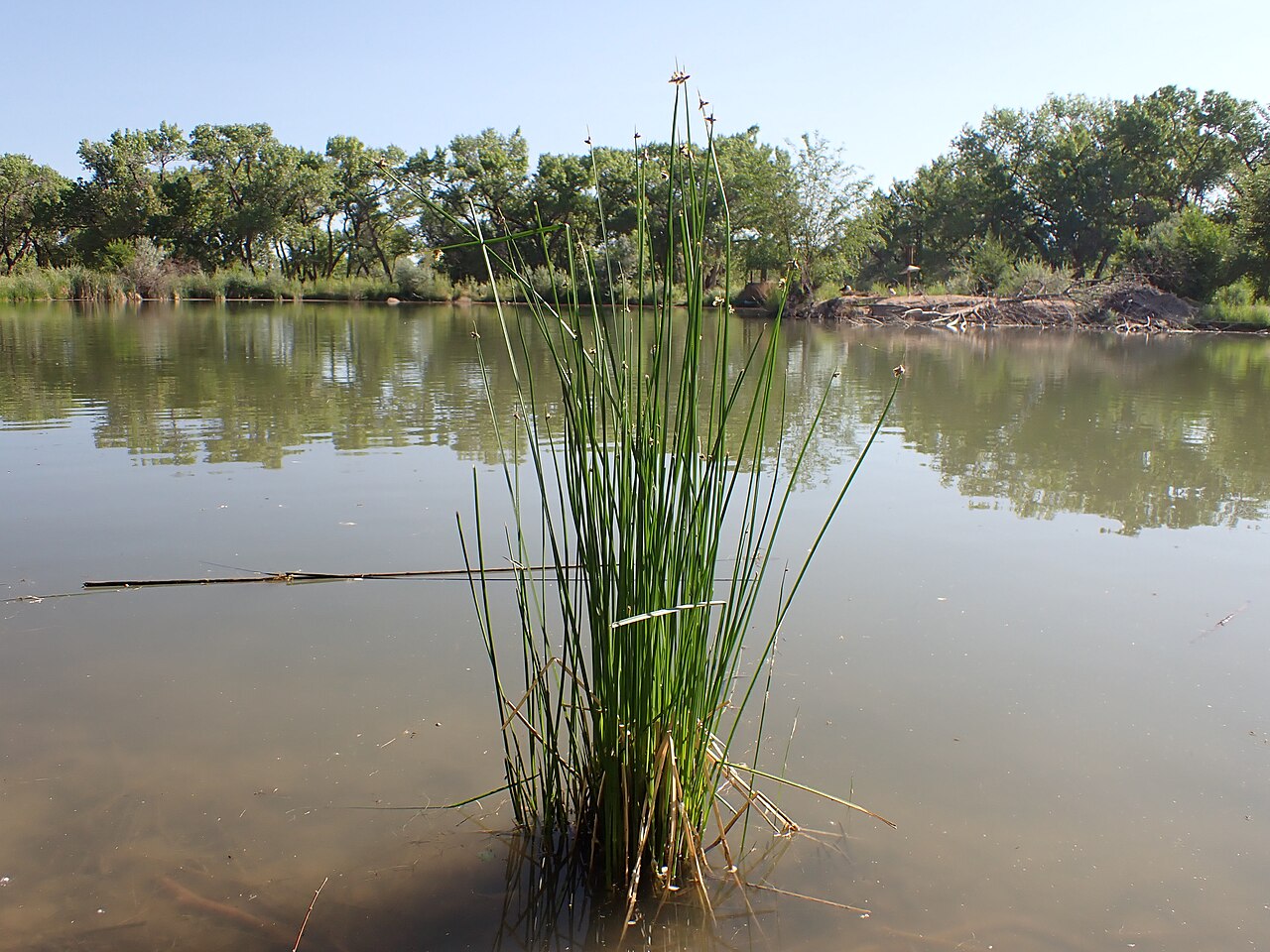
Schoenoplectus americanus (syn. Scirpus americanus, Scirpus olneyi), commonly called Chairmaker’s Bulrush, American Bulrush, or Olney’s Three-Square, is a tall, leafless wetland sedge found in marshes, pond margins, and tidal wetlands across most of the continental United States. A member of the Cyperaceae (sedge family), its tough, sharply three-angled stems were historically prized for weaving chair seats and baskets, a use preserved in its common name.
Growing from spreading rhizomes, Chairmaker’s Bulrush forms dense colonies of erect, leafless, dark green stems 1 to 4 feet tall, each distinctly triangular in cross-section — a feature you can feel by rolling a stem between your fingers. Small clusters of brownish spikelets emerge from one side of the stem near the tip, appearing almost as an afterthought on an otherwise bare, architectural stalk.
Found in both freshwater and brackish tidal wetlands, this bulrush is an important marsh-building and shoreline-stabilizing species, equally at home along a mountain pond in the arid West and a salt marsh on the Atlantic coast.
Identification
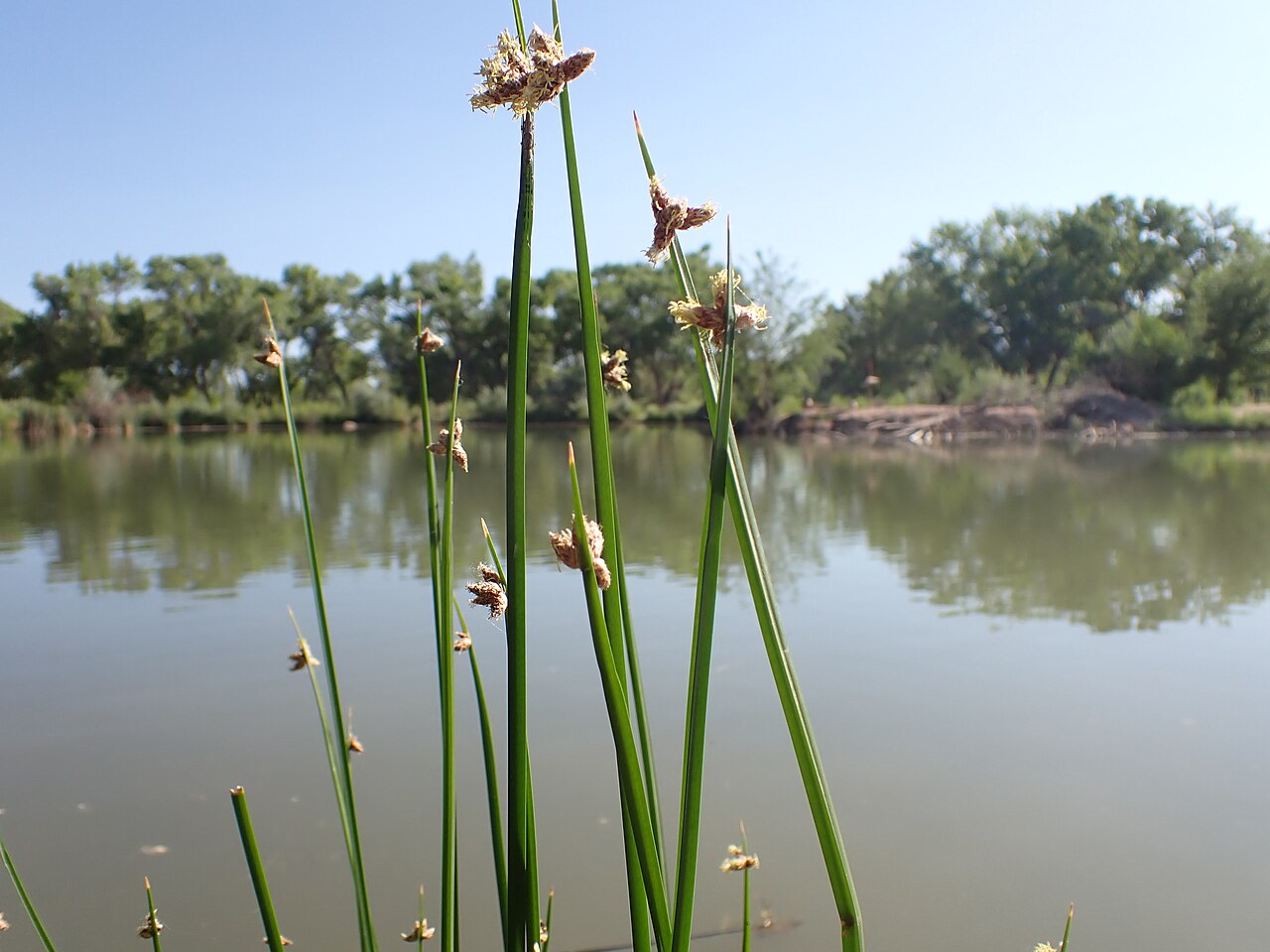
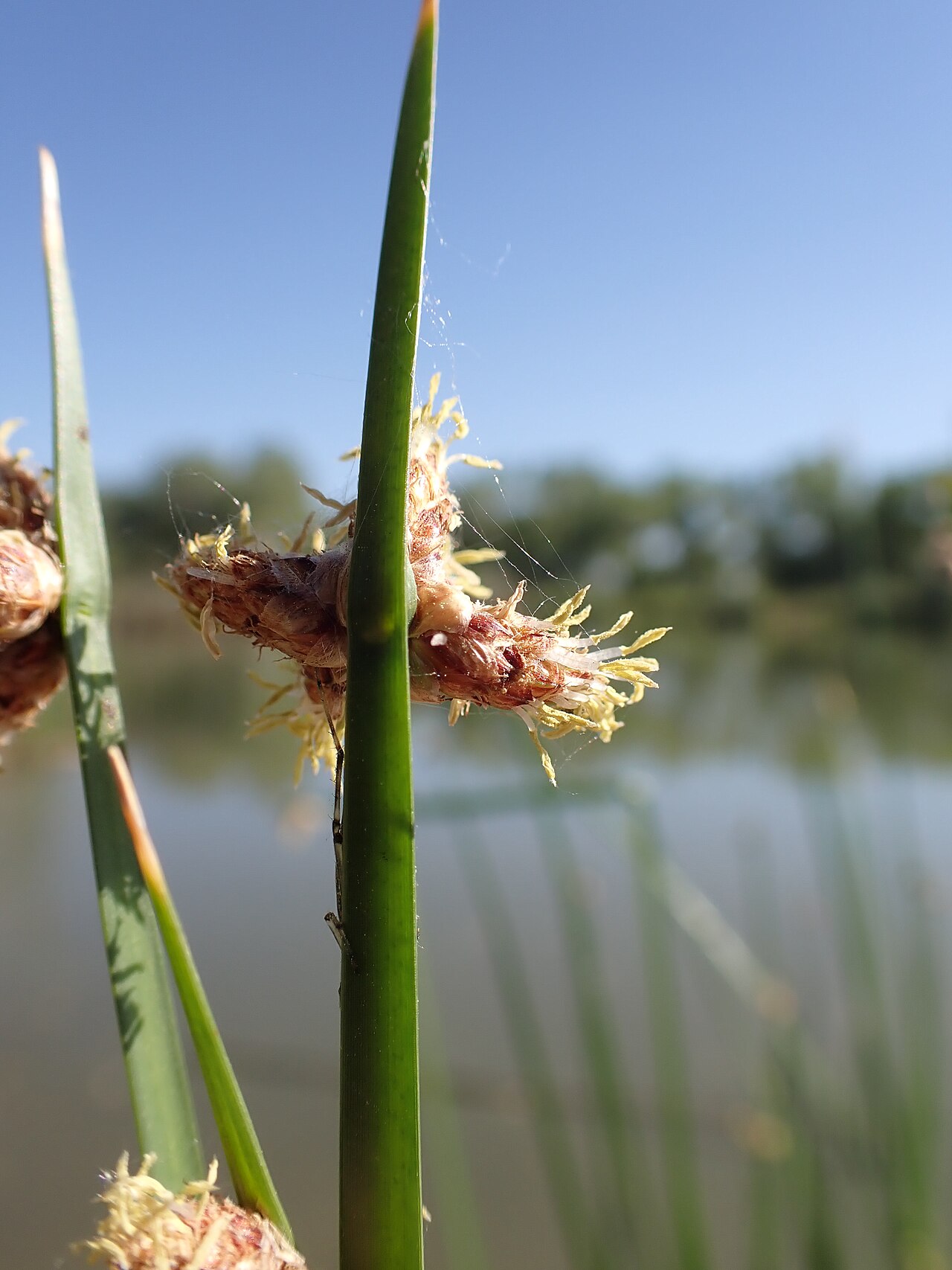
Chairmaker’s Bulrush is identified by its leafless, sharply triangular stems and the small cluster of spikelets that appears to emerge from partway up the side of the stem rather than at its tip.
Stems & Growth Habit
Stems are erect, unbranched, and leafless, 1 to 4 feet (30–120 cm) tall, rising singly from creeping rhizomes to form loose to dense colonies. In cross-section each stem is sharply three-angled (triangular), giving it a stiff, almost reed-like rigidity; this triangular form is the single best field mark distinguishing it from round-stemmed rushes.
Leaves
True leaves are reduced to a few short, inconspicuous basal sheaths; the plant is essentially leafless above the waterline, with the green, photosynthetic stem doing the work leaves normally perform.
Flowers & Fruit
The inflorescence consists of one to several clusters of small, brownish, egg-shaped spikelets that appear to emerge from one side of the stem, 1 to 4 inches below the pointed stem tip, because a single leaf-like bract continues the line of the stem above the flower cluster. Bloom occurs from mid to late summer, and the small, flattened, dark achenes that follow are an important food source for marsh wildlife.
Quick Facts
| Scientific Name | Schoenoplectus americanus (syn. Scirpus americanus, Scirpus olneyi) |
| Family | Cyperaceae (Sedge) |
| Plant Type | Perennial Sedge (Grass-like) |
| Mature Height | 1–4 ft (30–120 cm) |
| Mature Spread | Spreads by rhizomes into dense colonies |
| Growth Rate | Fast in saturated soil |
| Sun Exposure | Full Sun to Part Shade |
| Water Needs | High; tolerates standing water |
| Soil Type | Wet to saturated; mud, sand, or silt |
| Soil pH | 6.0–8.0 (tolerates brackish/alkaline conditions) |
| Bloom Time | June – September |
| Flower Color | Brownish |
| Fall Color | Tan, dying back after frost |
| Fruit | Small flattened achenes, not showy |
| Deer Resistant | Yes |
| USDA Hardiness Zones | 4–10 |
Native Range
Chairmaker’s Bulrush is one of the most widely distributed native sedges in the United States, found from the Pacific Coast across the arid West and Rocky Mountains, through the southern Great Plains and Southwest, and along the Gulf Coast and much of the Atlantic Seaboard.
In the arid West it grows at the margins of ponds, irrigation ditches, slow streams, and alkaline wetlands, often the only wetland vegetation present at a desert stock pond. Along the Gulf and Atlantic coasts it is a dominant species of brackish and tidal freshwater marshes, where it helps build marsh peat and stabilize shoreline sediment. It is generally absent from the colder interior of the northern Great Plains and upper Midwest, where other bulrush and sedge species take its ecological place.
Because it tolerates both freshwater and brackish conditions, Chairmaker’s Bulrush bridges a wide range of wetland types, from high desert ponds to coastal salt marsh, making its exact regional habitat quite different from one end of its range to the other.
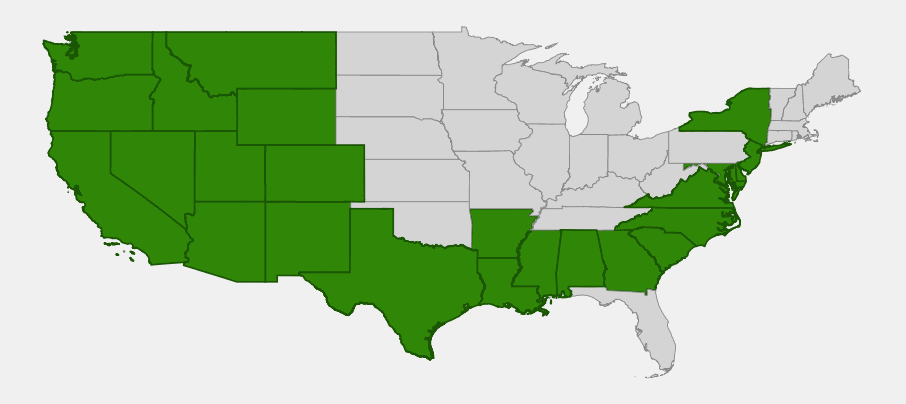
📋 Regional plant lists featuring Chairmaker’s Bulrush: California & Nevada · Western Oregon & Western Washington · Idaho, Eastern Oregon & Eastern Washington · Utah & Western Colorado · Arizona & New Mexico · Montana & Wyoming · South & West Texas · Arkansas, Louisiana & Eastern Texas · Georgia, Alabama & Mississippi · North Carolina & South Carolina · Maryland, Virginia & West Virginia · Delaware, Southern New Jersey & Long Island
Growing & Care Guide
Chairmaker’s Bulrush is an easy, vigorous choice for any garden spot that stays wet or shallowly flooded, and one of the most adaptable native sedges for both freshwater and brackish water gardens.
Light
Grows best in full sun, though it tolerates light shade. Full sun produces denser stands and more robust flowering.
Soil & Water
This sedge requires consistently wet to saturated soil and tolerates standing water up to several inches deep, as well as brackish or alkaline conditions that many other wetland plants cannot handle. It is not drought-tolerant and declines quickly if allowed to dry out. It adapts to mud, sand, or silty substrates as long as moisture is reliable.
Planting Tips
Plant from containers or divisions in spring, setting plants at or just below the waterline in a pond margin, rain garden basin, or constructed wetland. Space plants 12 to 24 inches apart; the rhizomatous habit fills gaps within a season or two in favorable conditions.
Propagation
The easiest method is dividing established rhizome clumps in spring, since the spreading root system separates readily into plantable sections. It can also be grown from seed, though division gives faster, more reliable establishment.
Landscape Uses
Its tolerance for both fresh and brackish standing water makes it valuable in several settings:
- Pond and wetland margins for shoreline stabilization and texture
- Constructed and treatment wetlands for water quality projects
- Rain gardens and bioswales with reliably wet conditions
- Coastal and brackish marsh restoration plantings
- Erosion control along slow-moving streams and irrigation channels
Pruning & Maintenance
Little maintenance is required. Cut back dead stems in late winter before new growth emerges. Established stands may need periodic thinning or division every several years if they become overly dense for the intended planting space.
Wildlife & Ecological Value
Chairmaker’s Bulrush is a foundational marsh-building species, providing food, shelter, and structure in wetlands that range from high desert stock ponds to coastal salt marsh.
For Birds
Waterfowl, including ducks and geese, eat the seeds and tubers, and the dense stem colonies provide nesting cover and concealment for marsh birds such as rails and bitterns. Shorebirds and wading birds forage at the base of the stems in shallow water.
For Mammals
Muskrats feed on the rhizomes and stems and often use stands of this bulrush in lodge construction, while the dense growth offers cover for other marsh-dwelling mammals.
Ecosystem Role
As a rhizomatous marsh-builder, Chairmaker’s Bulrush stabilizes shoreline and marsh sediment, slows water flow to encourage settling of suspended sediment, and contributes significantly to peat accumulation in tidal marshes along the Atlantic and Gulf coasts. Its tolerance for both fresh and brackish water makes it an important transitional species between freshwater and saltwater wetland communities.
Cultural & Historical Uses
As the common name suggests, Indigenous peoples and early settlers across much of the plant’s range used the tough, pliable triangular stems to weave chair seats, mats, and baskets, a practical craft tradition that persisted into the 20th century in some rural communities.
Indigenous communities throughout the arid West and along the coasts also used the rhizomes and young shoots as a minor food source in some regions, though this use was secondary to the plant’s importance as a basketry and weaving material.
Today, Chairmaker’s Bulrush is valued primarily for ecological restoration, particularly in coastal marsh rebuilding and constructed wetland projects, where its tolerance for variable salinity and standing water makes it a reliable, widely used species for stabilizing disturbed wetland sites.
Frequently Asked Questions
Why is it called Chairmaker’s Bulrush?
Its tough, flexible, triangular stems were traditionally woven into chair seats, mats, and baskets by Indigenous peoples and early settlers across much of its range.
Can Chairmaker’s Bulrush grow in salty or brackish water?
Yes. It is unusually tolerant of brackish conditions compared to most freshwater sedges, which is why it dominates so much of the Atlantic and Gulf Coast tidal marsh zone in addition to freshwater ponds inland.
How can I tell it apart from other rushes and sedges?
Look for the sharply three-angled (triangular) stem, easily felt by rolling it between your fingers, combined with the lack of true leaves and a spikelet cluster that appears to emerge from the side of the stem rather than its tip.
Does it need standing water to survive?
It grows best with consistently saturated soil or shallow standing water and is not drought-tolerant. It is a poor choice for any spot that dries out between waterings.
Will it spread too aggressively in a garden pond?
It spreads by rhizomes and can form dense colonies over time, so give it defined boundaries, such as a container or a bounded pond margin, in smaller garden settings.

Looking for a nursery that carries Chairmaker’s Bulrush?
Browse our native plant nursery directory: California · Oregon · Washington · Idaho · Utah, Texas, South Carolina & Virginia · Arizona, Arkansas & Alabama · Montana, Louisiana, Mississippi & Maryland · Wyoming · Colorado, Georgia & Delaware · Nevada, New Mexico, North Carolina, New Jersey & New York