Ashe Magnolia (Magnolia ashei)
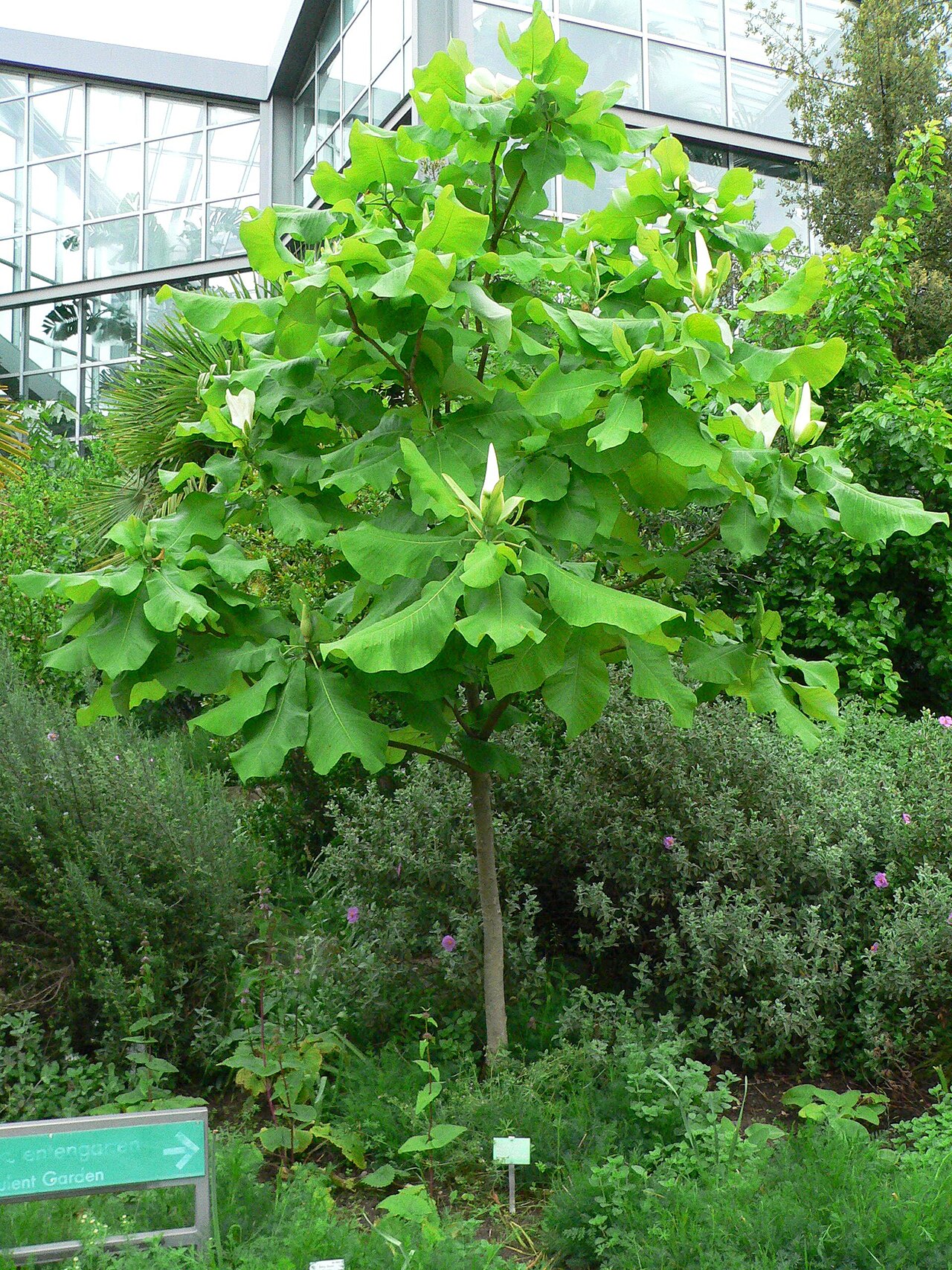
Magnolia ashei, commonly known as Ashe Magnolia or Ashe’s Magnolia, is a small deciduous tree or large shrub found in the wild nowhere on Earth except a handful of steep ravines and bluffs in the Florida Panhandle. It carries some of the largest leaves and flowers of any North American native tree — leaves up to nearly two feet long and flowers that can reach 10 inches or more across — packed onto a plant that rarely tops 20 feet, giving it a strikingly oversized, almost tropical presence for its modest stature. Ashe magnolia is closely related to the more widespread bigleaf magnolia (Magnolia macrophylla), and some botanists classify it as a subspecies of that tree (Magnolia macrophylla subsp. ashei) rather than a full species; this profile covers it on its own, as is common practice given its distinct, naturally dwarfed form and its status as a globally rare, range-restricted plant, while noting that alternative classification here.
In the wild, Ashe magnolia grows as an understory tree in steep, shaded ravines and bluffs along a short stretch of the Florida Panhandle, usually flowering at just a few years of age and a few feet tall — unusually precocious for a magnolia. Its enormous, pale-undersided leaves cluster at branch tips in a whorled, umbrella-like arrangement, and its creamy white, often purple-blotched flowers open in late spring with a strong, sweet fragrance.
For southeastern gardeners with a shaded spot to fill, Ashe magnolia is treasured as one of the most dramatic small native trees available, prized by native plant enthusiasts for its huge foliage and flowers on a scale that fits an ordinary yard. Because it is genuinely rare and legally protected in Florida, always buy nursery-propagated plants, never material collected from the wild. For general magnolia planting and care basics that also apply to this species, see our magnolia tree growing guide.
Identification
Ashe magnolia is a large shrub or small deciduous tree, typically 10 to 20 feet tall, occasionally reaching close to 30 feet in the best ravine sites, with a broad, open, often multi-stemmed form. It is considerably smaller in stature than its close relative bigleaf magnolia, which can reach 40 to 90 feet, even though the two share similarly enormous leaves and flowers.
Bark & Stems
Bark is thin, smooth, and light gray on young wood, becoming only slightly furrowed with age. Twigs are stout, with large, conspicuous, pointed terminal buds covered in a silky, silvery pubescence that is a useful winter identification feature.
Leaves
The leaves are the plant’s signature feature: simple, alternate, obovate, 10 to 20 inches long and 6 to 10 inches wide, with two small, ear-like basal lobes — a shape close to bigleaf magnolia’s but typically somewhat smaller and often with a more tapered base. The upper surface is light green; the underside is silvery to whitish with fine hairs, so a gust of wind flashes the pale underside dramatically. Leaves cluster near branch tips in a whorled, umbrella-like arrangement and turn an unremarkable brown before dropping in fall.
Flowers
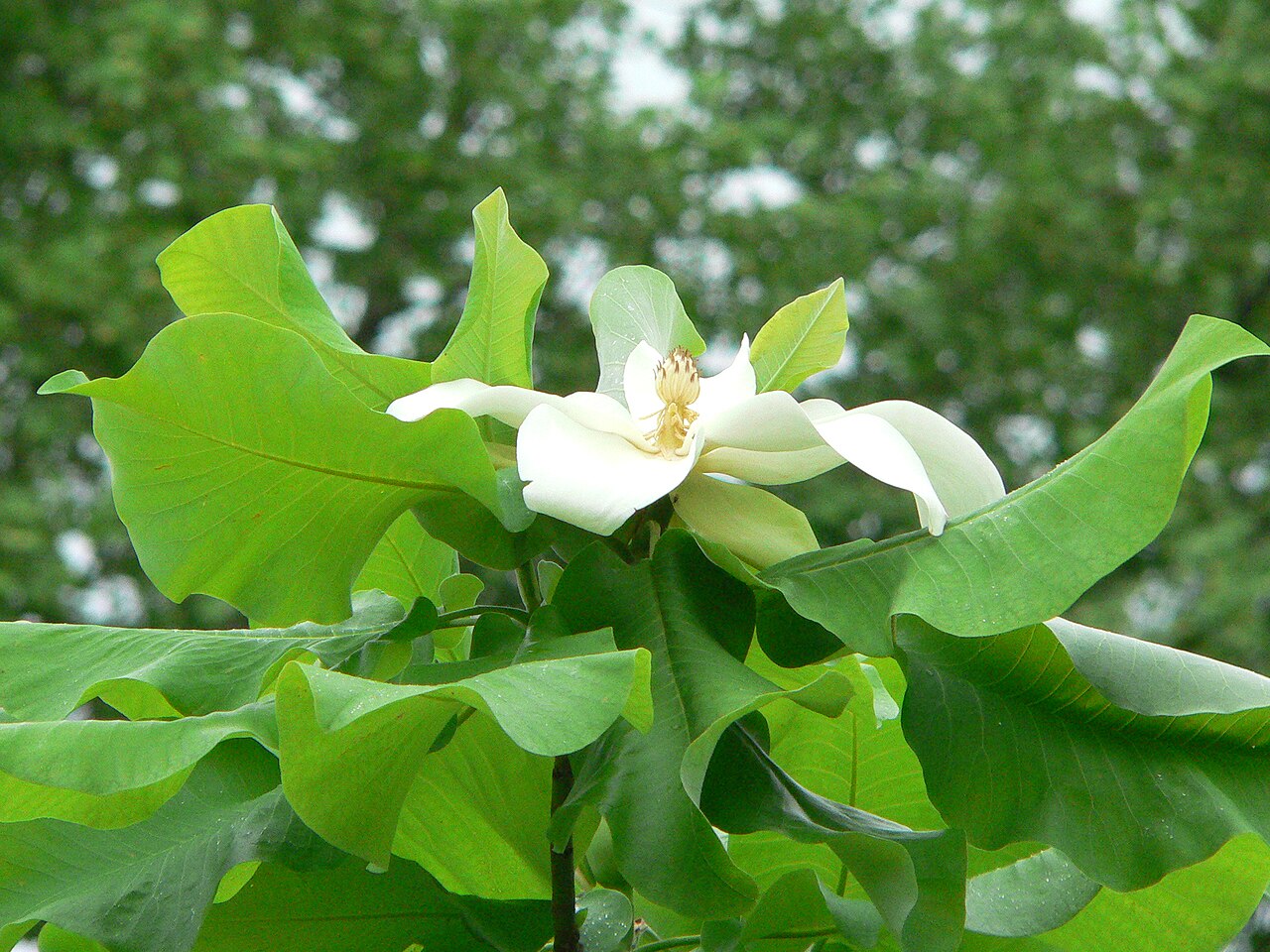
Flowers are enormous for a native tree — typically 8 to 10 inches across, occasionally more — with six to nine creamy white, strap-like tepals, the three inner ones usually marked with a distinctive purple or rose-colored blotch at the base. They open in April and May, held upright at branch tips above the new leaves, and carry a strong, sweet fragrance that draws pollinators from a distance. Ashe magnolia is notable for flowering at a very young age and small size compared to most magnolias.
Fruit & Seeds
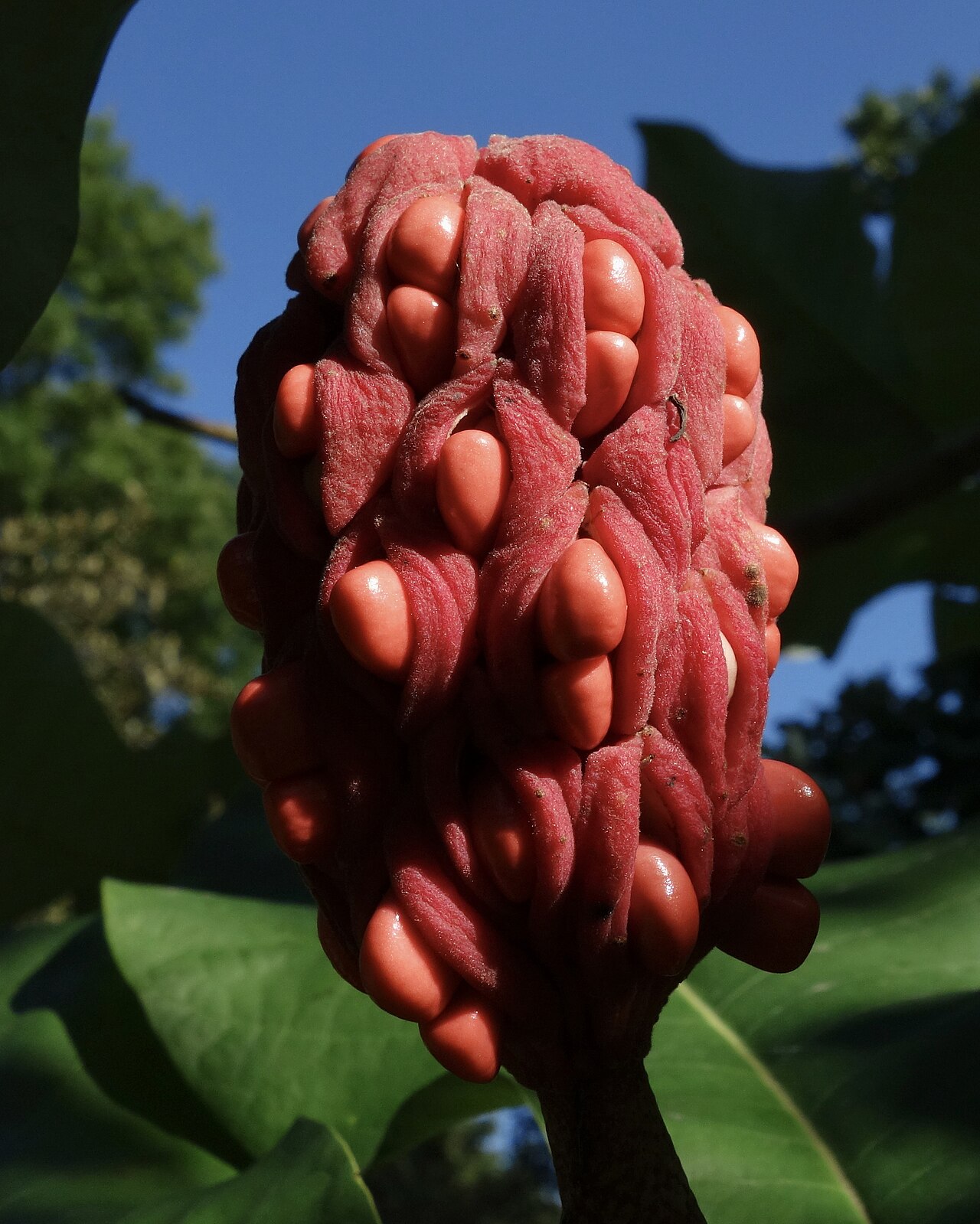
Fertilized flowers develop into an oval, cone-like aggregate fruit 2 to 4 inches long, rose-pink to red at maturity in late summer and early fall. As it ripens, the fruit splits open to expose individual bright orange-red seeds, which dangle briefly on thin silky threads before dropping or being taken by wildlife.
Quick Facts
| Scientific Name | Magnolia ashei (also treated as Magnolia macrophylla subsp. ashei) |
| Family | Magnoliaceae (Magnolia) |
| Plant Type | Deciduous Large Shrub / Small Tree |
| Mature Height | 10–20 ft (3–6 m) |
| Mature Spread | 8–15 ft (2.5–4.5 m) |
| Growth Rate | Moderate |
| Sun Exposure | Part Shade (best with morning sun, afternoon shade) |
| Water Needs | Moderate to High |
| Soil Type | Rich, moist, well-drained acidic soils; ravine and bluff soils |
| Soil pH | 5.0–6.5 (acidic) |
| Bloom Time | April – May |
| Flower Color | Creamy white with purple basal blotches |
| Fall Color | Dull brown, not showy |
| Fruit | Rose-pink to red cone-like aggregate with orange-red seeds |
| Deer Resistant | Somewhat (occasional browsing on young growth) |
| USDA Hardiness Zones | 7–9 |
Native Range
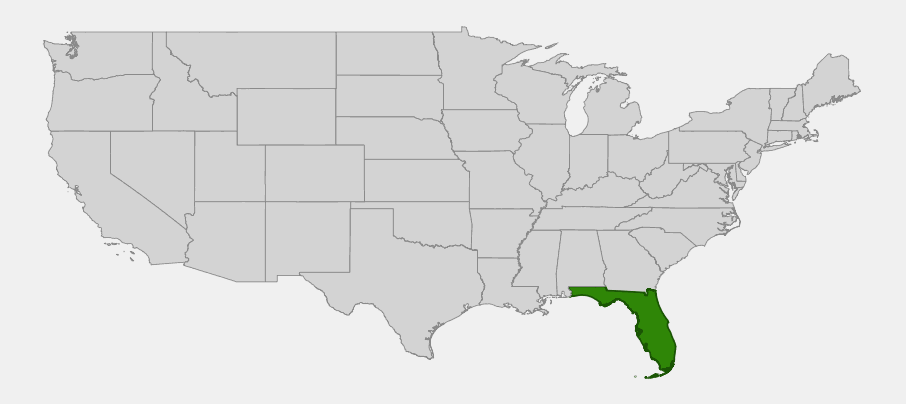
Ashe magnolia is endemic to a short stretch of the Florida Panhandle, found only in a cluster of counties roughly between the Apalachicola and Ochlockonee River drainages — Liberty, Gadsden, Leon, Wakulla, Jackson, Bay, Washington, Walton, Okaloosa and Santa Rosa counties are the generally recognized native area. It is not reliably documented as a naturally occurring wild population anywhere outside Florida; occasional reports from Georgia are not considered confirmed wild occurrences. This makes it one of the most geographically restricted native trees in the eastern United States.
Within that narrow range, Ashe magnolia grows almost exclusively in steep, shaded ravines, bluffs, and steephead slopes — the moist, cool, spring-fed topography characteristic of the Florida Panhandle’s unusual ravine ecosystems — usually as an understory plant beneath taller hardwoods and pines. It depends on consistently moist, well-drained soil and the buffered microclimate these ravines provide.
Because of its tiny native range, Ashe magnolia is considered globally rare and is tracked by conservation agencies; it is best grown from nursery-propagated stock, and wild populations should never be disturbed or collected from. For a broader look at other white-flowered native trees of the region, including other magnolias, see our guide to Florida trees with white flowers.
📋 Regional plant lists featuring Ashe Magnolia: No PlantNative.org regional native-plant list currently covers the Florida Panhandle, so Ashe Magnolia is not included on a regional list at this time.
Growing & Care Guide
Ashe magnolia is surprisingly garden-friendly for such a rare wild plant, flowering young and tolerating a range of soils as long as moisture and shade needs are met. Southeastern gardeners outside its native range but within a compatible climate (zones 7–9) grow it successfully well beyond the Florida Panhandle.
Light
Part shade is ideal, mimicking its native ravine understory — morning sun with afternoon shade, or dappled light all day, keeps the huge leaves from scorching in hot climates. It can tolerate more sun farther north or in consistently moist soil, but leaf burn becomes a risk in full, hot Deep South sun.
Soil & Water
Give it rich, moist, well-drained, acidic soil, amended with organic matter to mimic the leaf-litter-rich ravine soils where it grows wild. It is not drought-tolerant once established compared to many native trees, and consistent moisture, especially during the first several years, is key to healthy growth and good flowering. Avoid heavy, poorly drained clay.
Planting Tips
Plant only nursery-propagated stock, ideally in fall or early spring. Choose a sheltered spot out of strong wind, since the huge leaves can tear or shred in exposed, gusty sites. Because the plant’s enormous leaves and flowers are its main appeal, give it room to display them — at least 10 to 15 feet from walkways and structures — and site it where its dramatic early-summer bloom can be appreciated up close.
Pruning & Maintenance
Ashe magnolia needs very little pruning. Remove dead or damaged wood as needed, generally after flowering, and avoid shearing, which ruins its naturally open, multi-stemmed form. Mulch well to retain soil moisture and keep roots cool.
Landscape Uses
This small magnolia makes an outsized impact in several garden settings:
- Woodland and shade garden specimen — few native plants deliver such large, dramatic foliage
- Understory planting beneath taller shade trees, echoing its wild ravine habitat
- Native plant collections and conservation gardens highlighting a globally rare Florida endemic
- Fragrance gardens, thanks to its strongly scented late-spring flowers
- Small-space statement tree where a full-size bigleaf magnolia would be too large
Wildlife & Ecological Value
Ashe magnolia supports a range of wildlife typical of Deep South magnolias, scaled to its small, rare range.
For Birds
Songbirds, including thrushes and woodpeckers, eat the bright orange-red seeds as the fruit ripens and splits open in late summer and fall, helping disperse seed away from the parent plant.
For Mammals
Squirrels and other small mammals forage on fallen seed, and white-tailed deer occasionally browse young foliage, though the huge leaves and open growth form generally make it a minor part of their diet.
For Pollinators
The large, fragrant flowers attract beetles as primary pollinators, an ancient pollination strategy shared by magnolias generally, which evolved before bees existed. Beetles crawl into the flower to feed on pollen and tough floral tissue, picking up pollen as they move between blooms.
Ecosystem Role
As an understory tree restricted to a very specific, cool, moist ravine habitat, Ashe magnolia is part of a distinctive and ecologically significant Florida Panhandle plant community that also includes relict, disjunct species more typical of cooler regions farther north — a legacy of past climate shifts preserved in the shaded microclimate of these ravines.
Cultural & Historical Uses
Ashe magnolia was first formally described in 1933, named for American botanist William Willard Ashe, who studied the flora of the southeastern United States extensively. Because of its restricted range and relatively recent scientific recognition, it lacks the deep, centuries-old use history of more widespread native trees; it has never been an important timber, medicinal, or food-crop species.
Unlike the evergreen Southern Magnolia that dominates so much of southern horticulture, Ashe magnolia’s modern significance is almost entirely horticultural and conservation-focused. Since the mid-20th century, native plant enthusiasts and botanical gardens throughout the Southeast have propagated and planted Ashe magnolia for its spectacular foliage and flowers, helping relieve collecting pressure on the small wild population while introducing a striking, little-known native tree to a much wider gardening audience.
Today, Ashe magnolia is primarily valued as a conservation flagship for Florida Panhandle ravine habitats and as a prized specimen plant among gardeners who appreciate bold, oversized native foliage — a plant that, despite its tiny wild range, has found a much larger home in gardens across the Southeast.
Frequently Asked Questions
Is Ashe magnolia the same as bigleaf magnolia?
They are very closely related, and some botanists treat Ashe magnolia as a subspecies of bigleaf magnolia (Magnolia macrophylla subsp. ashei) rather than a distinct species. The clearest practical difference is size: Ashe magnolia stays a large shrub or small tree, typically under 20 feet, and often flowers within just a few years, while bigleaf magnolia grows into a substantial 40- to 90-foot tree. If you want a similarly huge-leaved native magnolia for a larger space, see our Bigleaf Magnolia profile.
Can I grow Ashe magnolia outside Florida?
Yes — it is reliably hardy and widely grown throughout USDA zones 7 to 9, well beyond its tiny native Florida Panhandle range, as long as it gets part shade and consistent moisture.
Why are the leaves so much bigger than other trees?
Ashe magnolia belongs to a group of magnolias that evolved unusually large leaves, likely as an adaptation to maximize light capture in shaded, humid understory conditions. Its leaves rank among the largest simple (undivided) leaves of any temperate tree in North America.
Is Ashe magnolia endangered?
It is considered globally rare because of its extremely small native range, and it is tracked and protected under Florida law as an endangered species within the state, though it is not currently listed under the federal Endangered Species Act. Always buy nursery-propagated plants rather than wild-collected material.
How long before a young Ashe magnolia flowers?
Often just a few years — Ashe magnolia is known for flowering remarkably young and small compared to most magnolias, sometimes blooming on plants only 3 to 4 feet tall, which is part of why it has become so popular with gardeners wanting magnolia flowers without decades of waiting.

Looking for a nursery that carries native magnolias?
Browse our native plant nursery directory: Florida