Cumberland Azalea (Rhododendron cumberlandense)
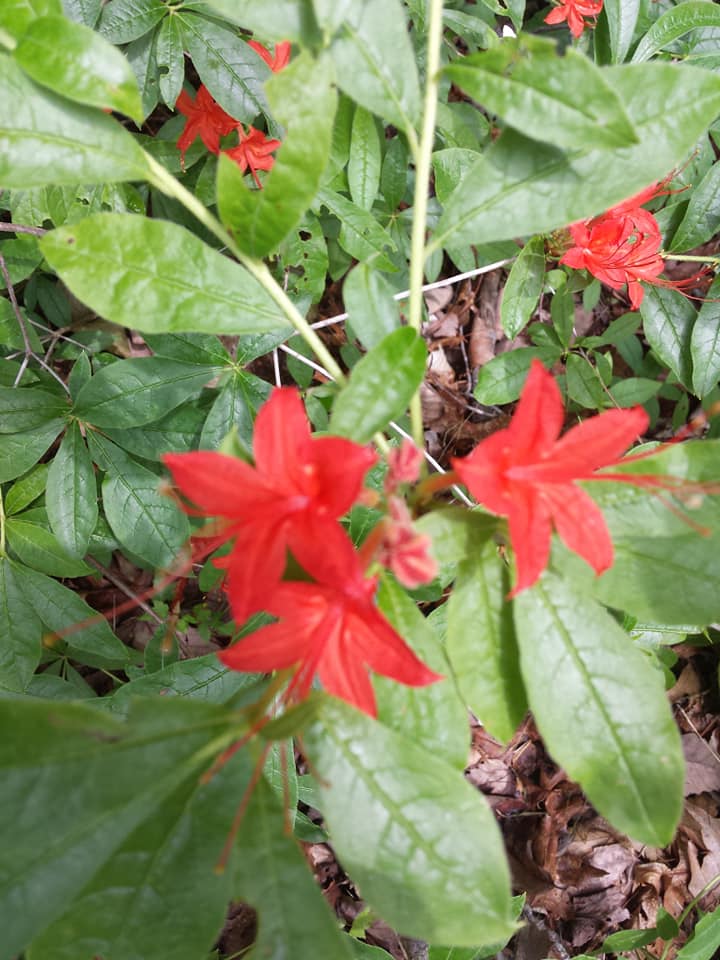
Rhododendron cumberlandense, the Cumberland Azalea (also called Cumberland Rhododendron, and historically known by the synonym R. bakeri), is a compact deciduous shrub centered on the Cumberland Plateau of Kentucky and Tennessee, with scattered populations reaching into the Blue Ridge Mountains of Virginia, North Carolina, South Carolina, Georgia, and Alabama. It is closely related to, and sometimes confused with, the showier Flame Azalea (R. calendulaceum), but blooms several weeks later, from June into early July, after most other native azaleas have finished.
Cumberland Azalea grows as a dense, rounded shrub typically 3 to 6 feet tall, smaller and more compact than many native azaleas, which makes it well suited to smaller gardens. It favors open, rocky woodlands and balds at mid to high elevations on the Cumberland Plateau and in the southern Appalachians, where its brilliant orange-red flowers stand out against summer greenery after spring’s azalea displays have passed.
Because it was only formally distinguished from Flame Azalea in the mid-twentieth century, some older references and nursery catalogs still list this species under its former names, R. bakeri or as a variety of R. calendulaceum; current USDA PLANTS and botanical treatments recognize it as its own accepted species.
Identification
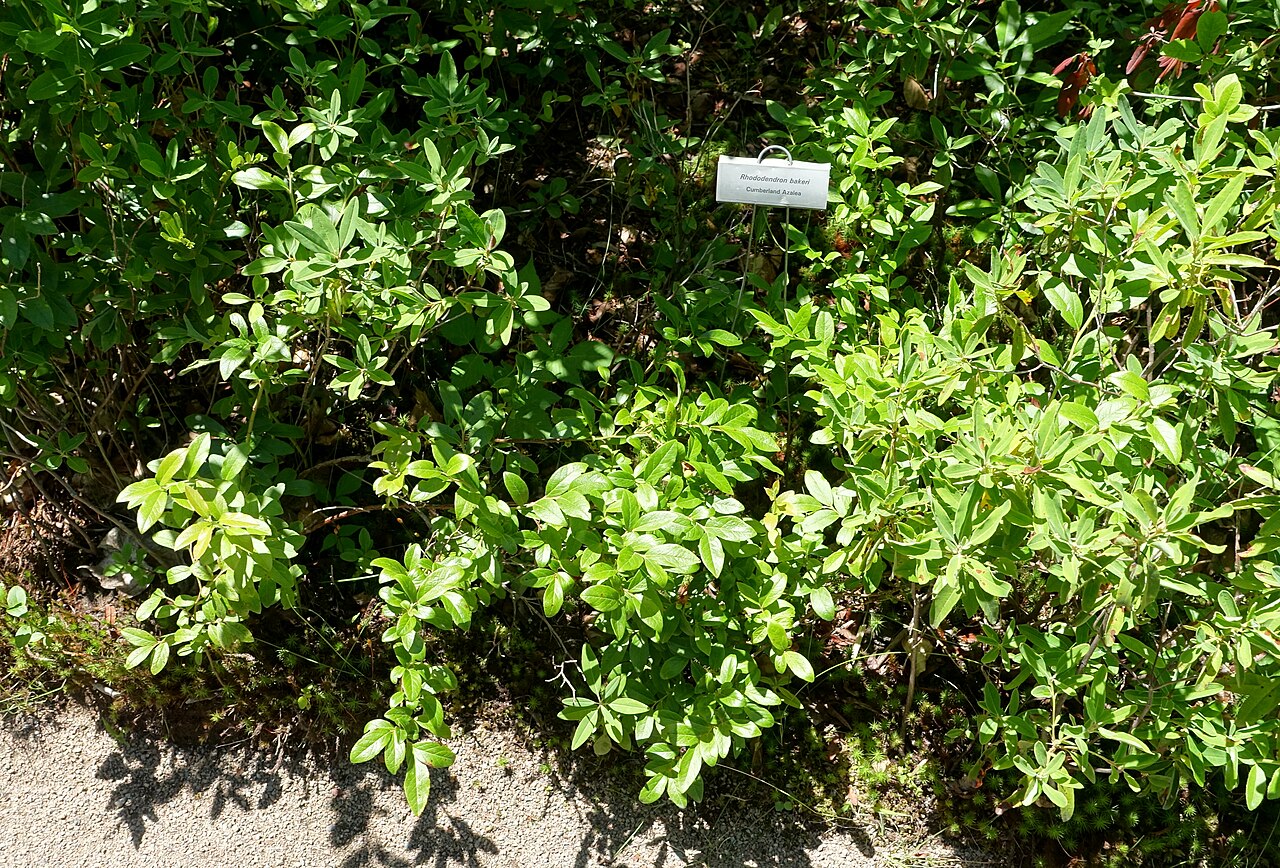
Cumberland Azalea is a compact, densely branched deciduous shrub, more low and rounded in form than the taller, more open-growing Flame Azalea it is often confused with.
Bark & Stems
Twigs are slender and finely hairy when young, becoming smooth gray-brown with age; the shrub’s dense branching gives it a tidier, more compact silhouette than many other native azaleas.
Leaves
Leaves are elliptic to obovate, 1.5 to 3 inches long, dark bluish-green and often somewhat glaucous (with a whitish bloom) on the underside — a helpful field mark that distinguishes it from the yellow-green leaves of Flame Azalea. Fall color is a modest yellow to orange.
Flowers
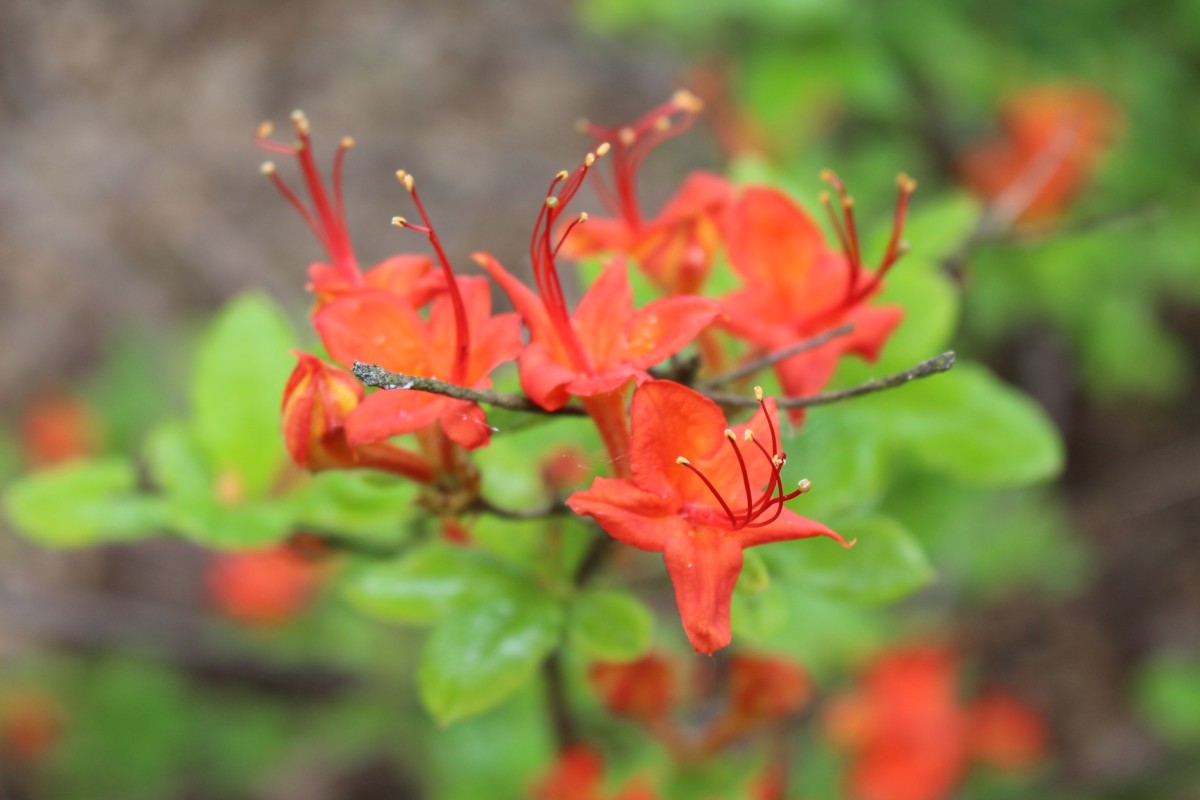
Flowers open from June into early July, later than Flame Azalea and most other native azaleas, in trusses of 5 to 7 blooms. Color ranges from bright orange to red-orange to true red, funnel-shaped, roughly 1.5 to 2 inches across, with little to no fragrance — a trait shared with its close relatives in the orange-to-red azalea group.
Fruit & Seeds
Small, dry, hairy seed capsules follow the flowers, ripening by early fall and splitting to release numerous tiny wind-dispersed seeds.
Quick Facts
| Scientific Name | Rhododendron cumberlandense (syn. R. bakeri) |
| Family | Ericaceae (Heath) |
| Plant Type | Deciduous Shrub |
| Mature Height | 3–6 ft |
| Mature Spread | 3–5 ft |
| Growth Rate | Slow to moderate |
| Sun Exposure | Full Sun to Part Shade |
| Water Needs | Moderate |
| Soil Type | Well-drained, rocky to loamy upland soils |
| Soil pH | 5.0–6.0 (acidic) |
| Bloom Time | June – early July |
| Flower Color | Orange to red-orange to red |
| Fall Color | Yellow to orange |
| Fruit | Small dry seed capsules (not showy) |
| Deer Resistant | Mostly yes (foliage contains grayanotoxins) |
| USDA Hardiness Zones | 5–8 |
Native Range
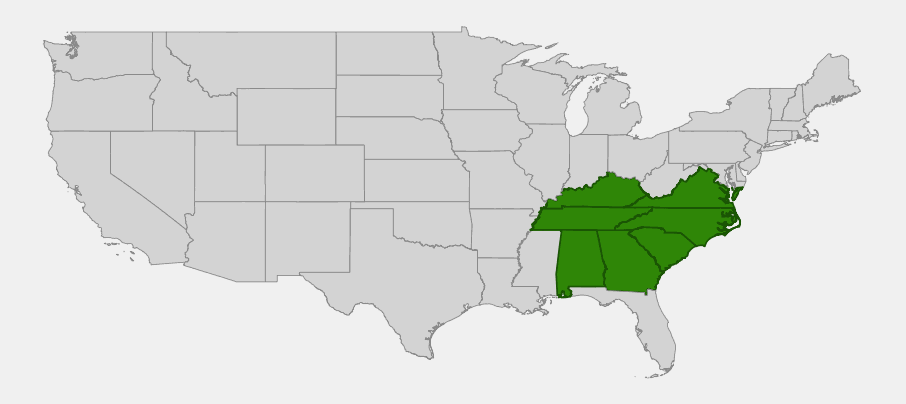
Cumberland Azalea is centered on the Cumberland Plateau and mountain areas of Kentucky, Tennessee, Virginia, and Alabama, with additional scattered populations in the Blue Ridge Mountains of Virginia, North Carolina, South Carolina, and Georgia. It is a plant of mid- to high-elevation ridgetops, balds, and open rocky woodlands rather than the lower, moister sites favored by some other azaleas.
Within this range it typically grows on dry to moderately moist, well-drained upland soils, often in open woodland, along ridgelines, or on rocky balds where competition from taller canopy trees is limited. Because its range overlaps with Flame Azalea in several areas, the two species can occur together, distinguished mainly by Cumberland Azalea’s later bloom time, smaller stature, and glaucous leaf undersides.
Gardeners outside its native Appalachian and Cumberland Plateau range should treat it as a non-native ornamental, since the species does not occur naturally beyond the areas described here.
📋 Regional plant lists featuring Cumberland Azalea: Kentucky & Tennessee · Maryland, Virginia & West Virginia · North Carolina & South Carolina · Georgia, Alabama & Mississippi
Growing & Care Guide
Cumberland Azalea’s compact size and tolerance for drier, rockier upland sites make it one of the easier native azaleas to fit into a typical garden bed rather than requiring a streamside or ravine setting.
Light
Full sun to part shade works well; more sun generally produces denser growth and heavier bloom, while light shade can help in hotter, drier gardens. See our guide on how much sun azaleas need for help choosing a site.
Soil & Water
Well-drained, acidic soil is essential; Cumberland Azalea is more tolerant of rocky or lean upland soils than many azaleas, but still benefits from organic matter and consistent (not constant) moisture, especially while establishing. A layer of organic mulch helps conserve moisture and moderate soil temperature; see our notes on mulches for native plant beds for acid-friendly options.
Planting Tips
Plant container stock in fall or early spring on a well-drained slope or raised bed if native soil holds too much water. Its compact mature size makes it a good choice for foundation plantings, small borders, or mixed shrub beds where a larger azalea would outgrow the space.
Pruning & Maintenance
Prune only to remove dead or damaged wood, ideally right after flowering. Watch for yellowing between leaf veins, usually a sign of iron deficiency in overly alkaline soil; our article on why rhododendron leaves turn yellow covers common causes and fixes. If growth seems weak, a light feeding with an acid-forming fertilizer can help; see our guide to fertilizing azaleas for timing.
Propagation
Propagate by semi-hardwood cuttings taken in summer, or from seed sown on the surface of an acidic growing medium; because the species has sometimes been confused with Flame Azalea in the nursery trade, buy from a supplier that can confirm correct identification.
Landscape Uses
- Compact native shrub borders where a smaller azalea is needed
- Rock gardens and dry upland plantings
- Extended-season color following spring-blooming azaleas
- Appalachian and Cumberland Plateau native-range restoration
- Pollinator gardens in the Southeast and Mid-South
Wildlife & Ecological Value
Cumberland Azalea’s mid-summer bloom fills a useful gap for pollinators once the main spring azalea bloom has finished.
For Pollinators
Swallowtail butterflies and large native bees are regular visitors to the bright, unscented flowers, which rely on visual attraction rather than fragrance to draw pollinators, similar to its close relative Flame Azalea.
For Birds
Hummingbirds visit the tubular flowers for nectar, particularly valuable in mid-summer on the Cumberland Plateau when many spring bloomers have already finished flowering.
For Mammals
Deer and other browsers typically avoid the toxic foliage, making Cumberland Azalea a dependable choice in areas with heavy deer pressure.
Ecosystem Role
As part of the fire-adapted oak and pine woodlands of the Cumberland Plateau and southern Blue Ridge, Cumberland Azalea contributes to the understory diversity of these increasingly fragmented upland forest and bald communities, several of which depend on periodic disturbance to maintain open, sunny conditions the species favors.
Cultural & Historical Uses
Cumberland Azalea was described as a distinct species by botanist Emma Lucy Braun in the mid-twentieth century, separating it from the closely related Flame Azalea with which it had long been confused; it was also known for a time under the name Rhododendron bakeri, honoring botanist C. F. Baker, a name still seen on older nursery tags and in some garden literature.
Because of its Appalachian and Cumberland Plateau home range, the species carries strong regional identity in Kentucky and Tennessee, where it is valued by native plant societies as a signature summer-blooming shrub of the region’s upland balds and ridgetop woodlands.
There is no significant historical record of medicinal or food use of Cumberland Azalea; as with other native azaleas, its documented value has always been ornamental and ecological rather than edible.
Frequently Asked Questions
How is Cumberland Azalea different from Flame Azalea?
Cumberland Azalea is generally more compact, blooms several weeks later (June into July versus April to May), and has leaves with a glaucous (whitish) underside, compared to the taller, earlier-blooming, yellow-green-leaved Flame Azalea.
Is Rhododendron bakeri the same plant as Cumberland Azalea?
Yes. Rhododendron bakeri is an older scientific synonym still used in some nursery and garden references for what is now accepted as Rhododendron cumberlandense.
Does Cumberland Azalea need the same wet conditions as other native azaleas?
No. It is more tolerant of drier, rockier upland soils than many azaleas, though it still needs acidic, well-drained ground and benefits from regular watering while establishing.
Where is the best place to see Cumberland Azalea blooming in the wild?
Open balds and ridgetop woodlands on the Cumberland Plateau in Kentucky and Tennessee, and scattered sites in the southern Blue Ridge Mountains, typically bloom from June into early July.
Is Cumberland Azalea toxic?
Yes, like other native azaleas, all parts contain grayanotoxins and should not be ingested; its value is strictly ornamental and ecological.

Looking for a nursery that carries Cumberland Azalea?
Browse our native plant nursery directory: Kentucky · Tennessee, Virginia & South Carolina · North Carolina · Georgia · Alabama