Plumleaf Azalea (Rhododendron prunifolium)
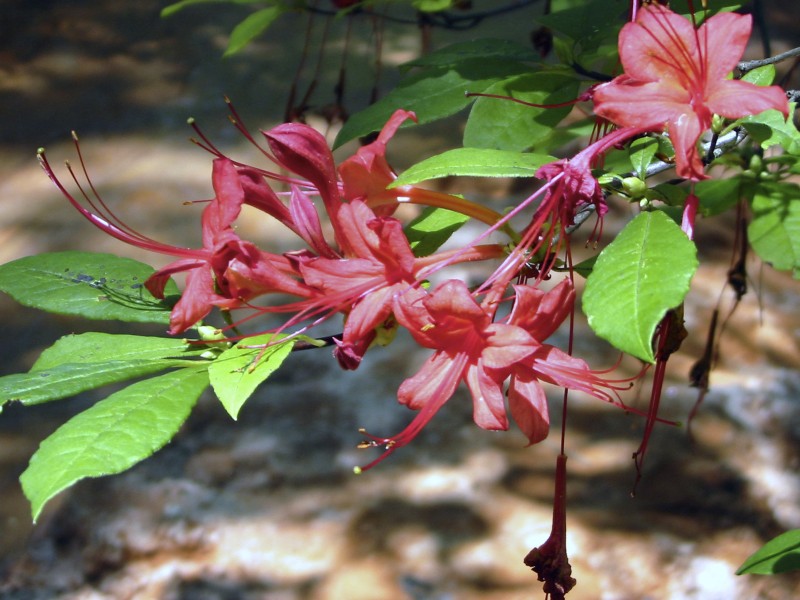
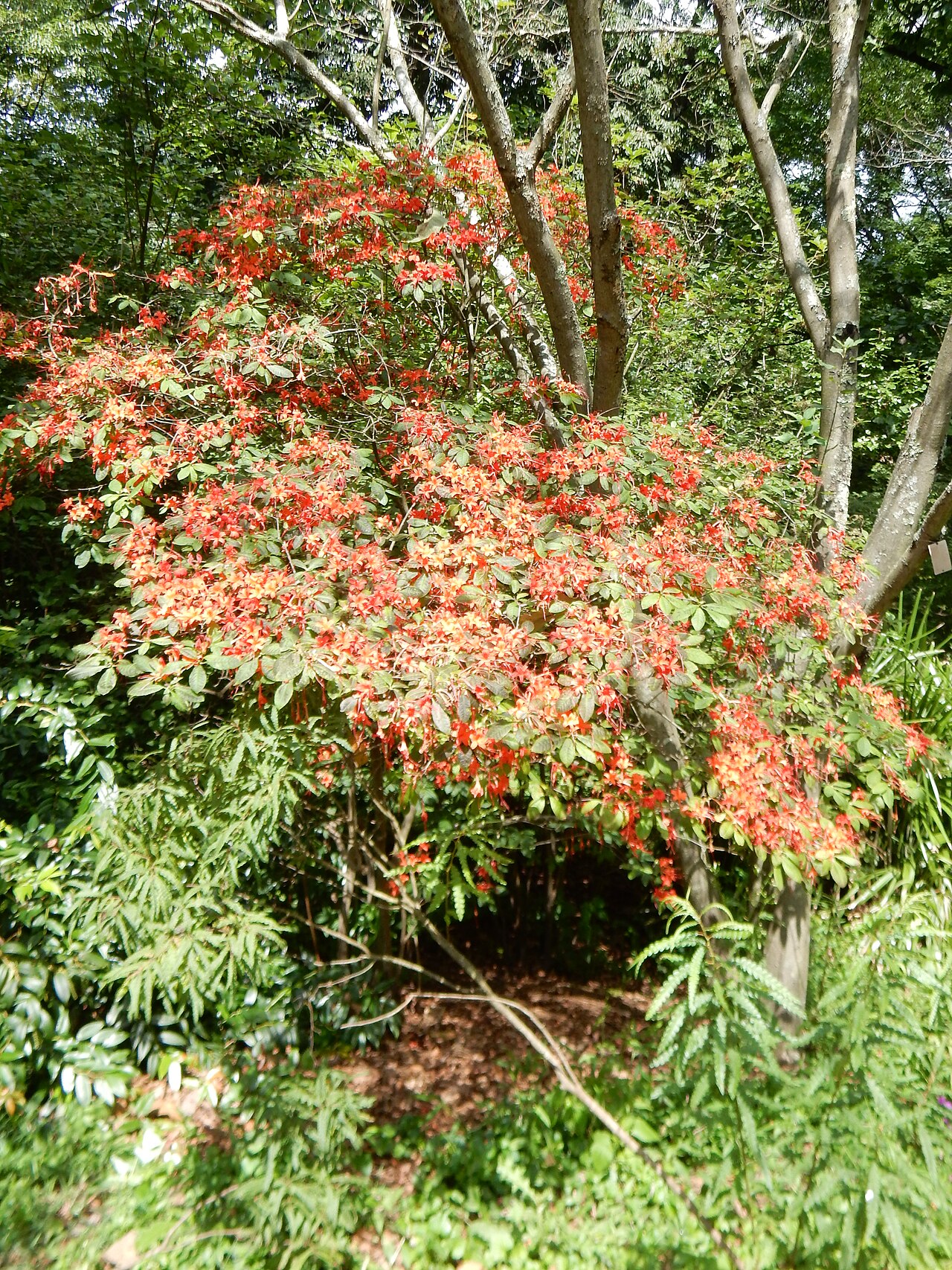
Rhododendron prunifolium, the Plumleaf Azalea, is one of the rarest native shrubs in the eastern United States, found naturally only in a handful of counties straddling the Chattahoochee River along the Georgia-Alabama border. Named for leaves that resemble those of a plum tree, it is best known for blooming later and in a deeper, more saturated orange-red than any other native azalea — often opening from late June into August, when most spring-flowering azaleas have long finished. The species is listed as Vulnerable by NatureServe because of its tiny natural range.
Plumleaf Azalea grows as a large, upright, deciduous shrub reaching 6 to 15 feet, typically found along the shaded, moist walls of steep ravines (“steepheads”) cut into the sandy hills of the lower Chattahoochee drainage. Its combination of late bloom, vivid color, and rarity has made it a favorite of native plant collectors and a conservation priority within its narrow home range, most famously protected at Providence Canyon State Park in Georgia.
In the garden, Plumleaf Azalea extends the native azalea bloom season well past where Flame Azalea and other spring-blooming species leave off, and its hummingbird-attracting flowers make it a standout for late-summer wildlife gardens in the Southeast.
Identification
Plumleaf Azalea is a multi-stemmed, upright deciduous shrub, more erect and taller-growing than many other native azaleas, often developing an open, small-tree-like form with age in shaded ravine settings.
Bark & Stems
Young twigs are slender and finely hairy, aging to smooth gray-brown bark on older stems. Growth habit is upright with relatively few low branches compared to more sprawling azalea species.
Leaves
Leaves are elliptic to obovate, 2 to 4 inches long, dark green and glossy above with a paler, sometimes hairy underside — the shape and sheen recall a plum or peach leaf, the source of the common and scientific names. Fall color is a modest yellow to bronze, less showy than the flowers.
Flowers
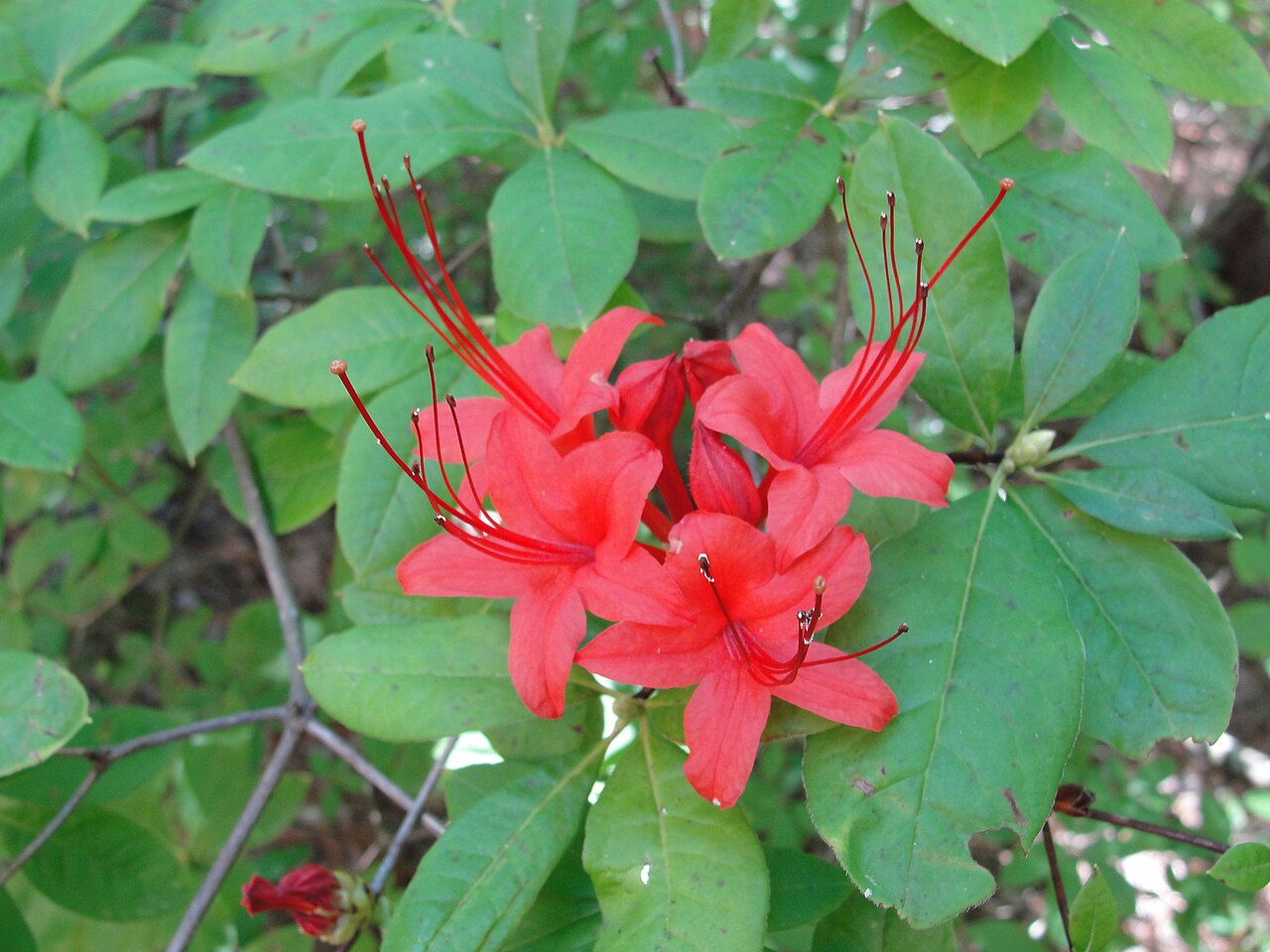
Flowers open in trusses of 5 to 8 blooms from late June into August, strikingly later than almost any other native azalea. Each flower is a narrow, flaring tube 1.5 to 2 inches long in a rich orange-red to deep red-orange, with long, prominently exserted stamens tipped in contrasting color. Unlike many azaleas, the flowers have little to no fragrance, trading scent for a hummingbird-pollination strategy built around color and timing.
Fruit & Seeds
Flowers are followed by small, dry, hairy seed capsules that ripen in autumn and split to release tiny wind-dispersed seeds.
Quick Facts
| Scientific Name | Rhododendron prunifolium |
| Family | Ericaceae (Heath) |
| Plant Type | Deciduous Shrub |
| Mature Height | 6–15 ft |
| Mature Spread | 5–10 ft |
| Growth Rate | Slow to moderate |
| Sun Exposure | Part Shade (filtered light) |
| Water Needs | Moderate; prefers consistently moist soil |
| Soil Type | Moist, humus-rich, well-drained sandy loam |
| Soil pH | 5.0–6.0 (acidic) |
| Bloom Time | Late June – August |
| Flower Color | Orange-red to deep red-orange |
| Fall Color | Yellow to bronze (modest) |
| Fruit | Small dry seed capsules (not showy) |
| Deer Resistant | Mostly yes (foliage contains grayanotoxins) |
| USDA Hardiness Zones | 6–9 |
Native Range
Plumleaf Azalea has one of the smallest native ranges of any North American azalea, restricted to a cluster of counties along the Chattahoochee River where it forms the border between southwestern Georgia and east-central Alabama. It is considered the rarest azalea species native to the eastern United States.
Within this narrow range it is a specialist of “steephead” ravines — steep-walled valleys cut into sandy hillsides by groundwater seepage — where cool, moist, shaded conditions persist even through hot Deep South summers. Providence Canyon State Park in Stewart County, Georgia, is the best-known site for seeing wild populations in bloom, typically from mid-July into August.
Because of its rarity and specialized habitat, Plumleaf Azalea is a conservation priority in both Georgia and Alabama; wild populations should never be collected from, and gardeners should source nursery-propagated plants only.
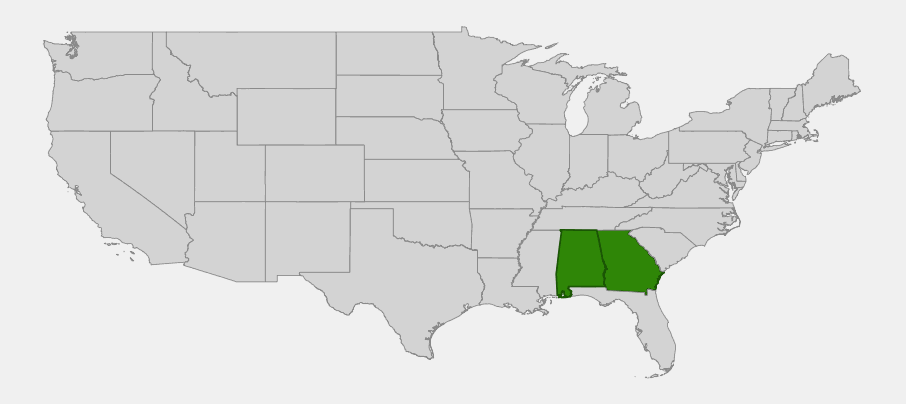
📋 Regional plant lists featuring Plumleaf Azalea: Georgia, Alabama & Mississippi
Growing & Care Guide
Plumleaf Azalea is more heat-tolerant than many deciduous azaleas since it is adapted to the Deep South, but it still needs the cool, moist, acidic conditions of its native ravine habitat to perform well.
Light
Part shade with filtered or dappled light is ideal, mimicking the ravine-wall understory where it grows wild. Full sun in the hot Southeast will stress the plant and increase water needs; deep, continuous shade reduces flowering. See our guide on how much sun azaleas need for help finding the right balance.
Soil & Water
Plant in humus-rich, acidic, well-drained but moisture-retentive soil. In its native steephead ravines, groundwater seepage keeps roots cool and moist even in summer heat, so gardeners should aim to replicate that consistency with regular deep watering and a generous mulch layer rather than letting the soil dry out between waterings. Review our guide to mulches for native plant beds for options that help hold moisture around acid-loving shrubs.
Planting Tips
Plant container-grown stock in fall or early spring on an east- or north-facing slope, or anywhere afternoon shade is available. Amend heavy or sandy soils generously with compost. Because the species blooms so late, site it where the color will be appreciated in mid- to late summer, such as near a patio or shaded path rather than tucked into a spring-focused border.
Pruning & Maintenance
Minimal pruning is needed; remove dead or weak wood after flowering. Watch for interveinal yellowing on new leaves, a sign of iron chlorosis from soil that is too alkaline; see our article on why rhododendron leaves turn yellow for diagnosis and fixes. Fertilize lightly, if at all, with an acid-forming azalea fertilizer; our guide to fertilizing azaleas covers timing and rates.
Propagation
Propagate from semi-hardwood cuttings taken in summer and rooted under mist, or from seed sown on the surface of an acidic medium; named selections are typically propagated by cuttings to preserve flower color.
Landscape Uses
- Late-summer color when most other flowering shrubs have finished
- Shaded slopes and ravine-style plantings in Southeastern gardens
- Hummingbird gardens timed to migration season
- Woodland garden focal point under high, open canopy
- Conservation and native-range plantings in Georgia and Alabama
Wildlife & Ecological Value
Plumleaf Azalea’s unusually late, vivid flowers make it an important late-season nectar source in a part of the growing season when fewer native shrubs are in bloom.
For Pollinators
Swallowtail butterflies, including the Eastern Tiger Swallowtail and Spicebush Swallowtail, are frequent visitors, along with large bees able to reach the nectar deep in the floral tube. The lack of strong fragrance and the vivid red-orange color point to a pollination strategy built around sight-feeding visitors rather than scent-tracking moths.
For Birds
Ruby-throated Hummingbirds are the signature pollinator of Plumleaf Azalea, and the plant’s late-summer bloom lines up closely with hummingbird activity in the Southeast before fall migration, making it one of the best native shrubs for supporting hummingbirds late in the season.
For Mammals
As with other azaleas, deer and rabbits generally avoid browsing the toxic foliage, making Plumleaf Azalea a reliable choice in areas with browsing pressure.
Ecosystem Role
Within its narrow steephead ravine habitat, Plumleaf Azalea is part of a distinctive, relict plant community that depends on stable groundwater seepage; protecting these ravines protects the plant and the unusual microclimate community that surrounds it.
Cultural & Historical Uses
Plumleaf Azalea was not widely known to botanists until the late nineteenth century, when botanist John Kunkel Small documented it along the Chattahoochee River; it was later named and described formally in the early twentieth century. Its rarity and remote ravine habitat meant it remained a little-known species for decades even after discovery.
The shrub gained a wider following in the mid-twentieth century as native plant enthusiasts and conservationists in Georgia worked to protect its last wild populations, culminating in the creation of azalea-focused conservation areas within Providence Canyon State Park. Today it is a point of regional pride in southwest Georgia, celebrated for its late, fiery bloom in a season when most other spring-flowering azaleas have long faded.
There is no significant historical record of medicinal or culinary use of Plumleaf Azalea; like other native azaleas its tissues are toxic, and its importance has always been ornamental, ecological, and — more recently — as a conservation symbol.
Frequently Asked Questions
Why does Plumleaf Azalea bloom so much later than other azaleas?
Its late bloom window, typically late June through August, appears to be an adaptation tied to hummingbird pollination rather than the bee- and moth-pollination strategies of spring-blooming azaleas, and it allows the plant to avoid competing with earlier-blooming species for pollinators.
Can I grow Plumleaf Azalea outside Georgia and Alabama?
Yes, in similar USDA zones with acidic soil and part shade, though gardeners outside its native Southeastern range should treat it as a non-native ornamental rather than describing it as locally native, and should always buy nursery-propagated stock.
Is Plumleaf Azalea endangered?
It is ranked Vulnerable by NatureServe because of its extremely limited native range. It is not federally listed as threatened or endangered, but conservation of its ravine habitat in Georgia and Alabama is actively supported by state and private efforts.
Does Plumleaf Azalea have fragrance like other native azaleas?
No, or very little. Unlike many sweetly fragrant native azaleas, Plumleaf Azalea relies on vivid color rather than scent to attract its primary pollinator, the Ruby-throated Hummingbird.
What makes a good companion planting for Plumleaf Azalea?
Other shade- and acid-loving Southeastern natives such as Flame Azalea, Piedmont Azalea, ferns, and native understory trees like dogwood make good companions, echoing its natural ravine-forest setting.