American Lotus (Nelumbo lutea)
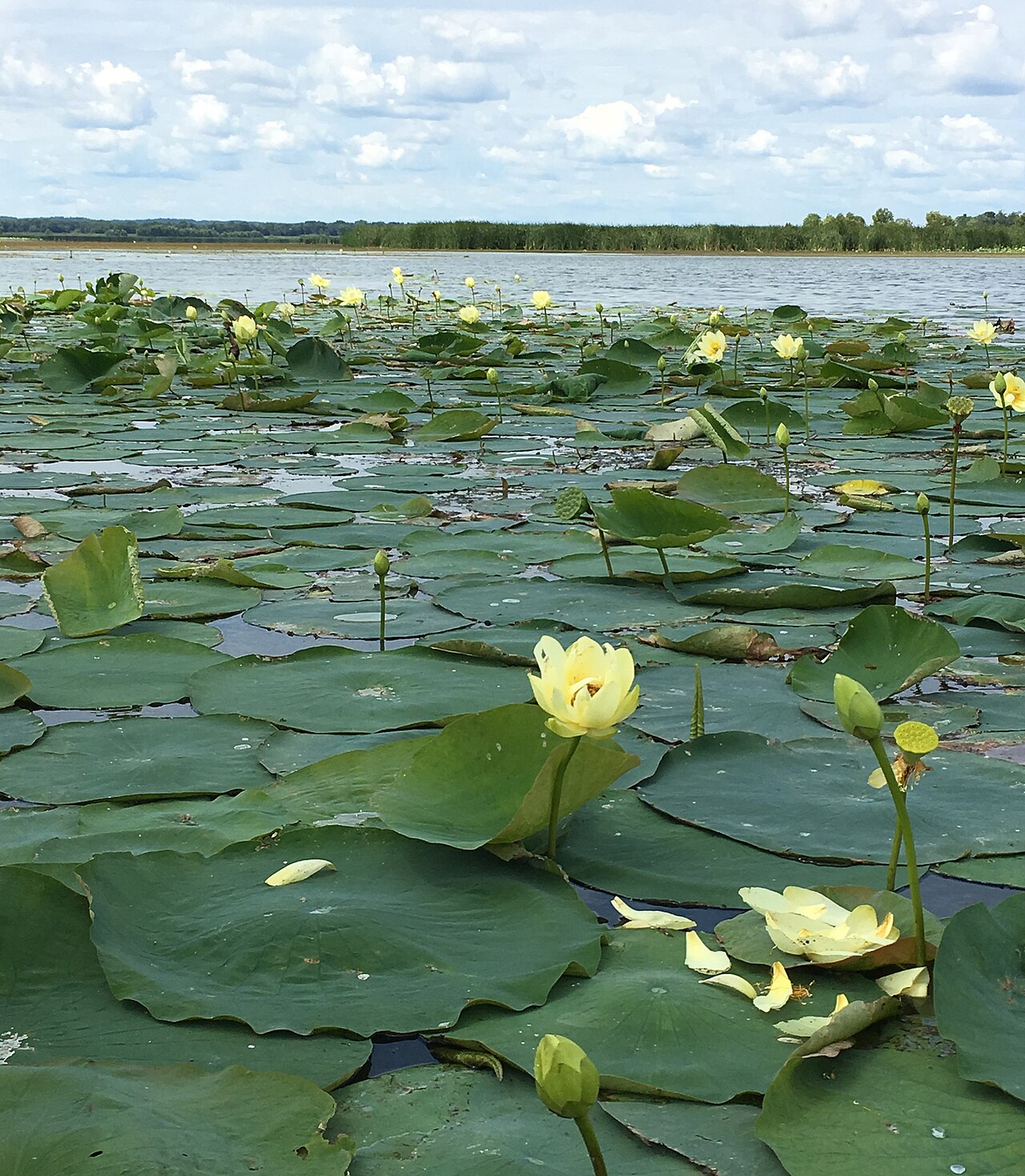
Nelumbo lutea, commonly called American Lotus, Yellow Lotus, or Water-chinquapin, is one of the most dramatic native aquatic plants in North America. It belongs to its own small family, Nelumbonaceae, and is only distantly related to the true water lilies (Nymphaea and Nuphar) that often share its ponds. Where a water lily’s leaf floats flat on the surface with a notch cut to its center, American Lotus holds its enormous, perfectly round, bluish-green leaves up on stiff stalks a foot or more above the water — a trait that makes a lotus colony instantly recognizable from a distance.
The plant spends summer producing pale lemon-yellow flowers up to 10 inches across, each one opening for just two or three mornings before dropping its petals and leaving behind the unmistakable flat-topped seed pod that gives this plant its popular nickname, “shower head.” Beneath the water, a thick network of rhizomes anchors the colony in soft mud and allows it to expand steadily, season after season, until a single planting can cover acres of a shallow lake or backwater.
American Lotus is a plant for people with real water — a farm pond, a lake edge, or a large constructed water garden — rather than a small backyard fountain. Given the right site, it rewards the gardener with weeks of striking bloom, dependable winter hardiness, and some of the best waterfowl and pollinator value of any native aquatic plant. It is also deeply woven into Indigenous foodways across its range, where its starchy tubers and nutritious seeds were gathered for food long before European contact.
Identification
American Lotus is a rhizomatous aquatic perennial that dies back to its rootstock each winter and re-emerges from the mud in spring. Everything about the plant — leaves, flowers, and seed pods — is held well clear of the water surface on round, hollow stalks, distinguishing it immediately from the floating-leaved water lilies and pond-lilies it often grows alongside.
Leaves
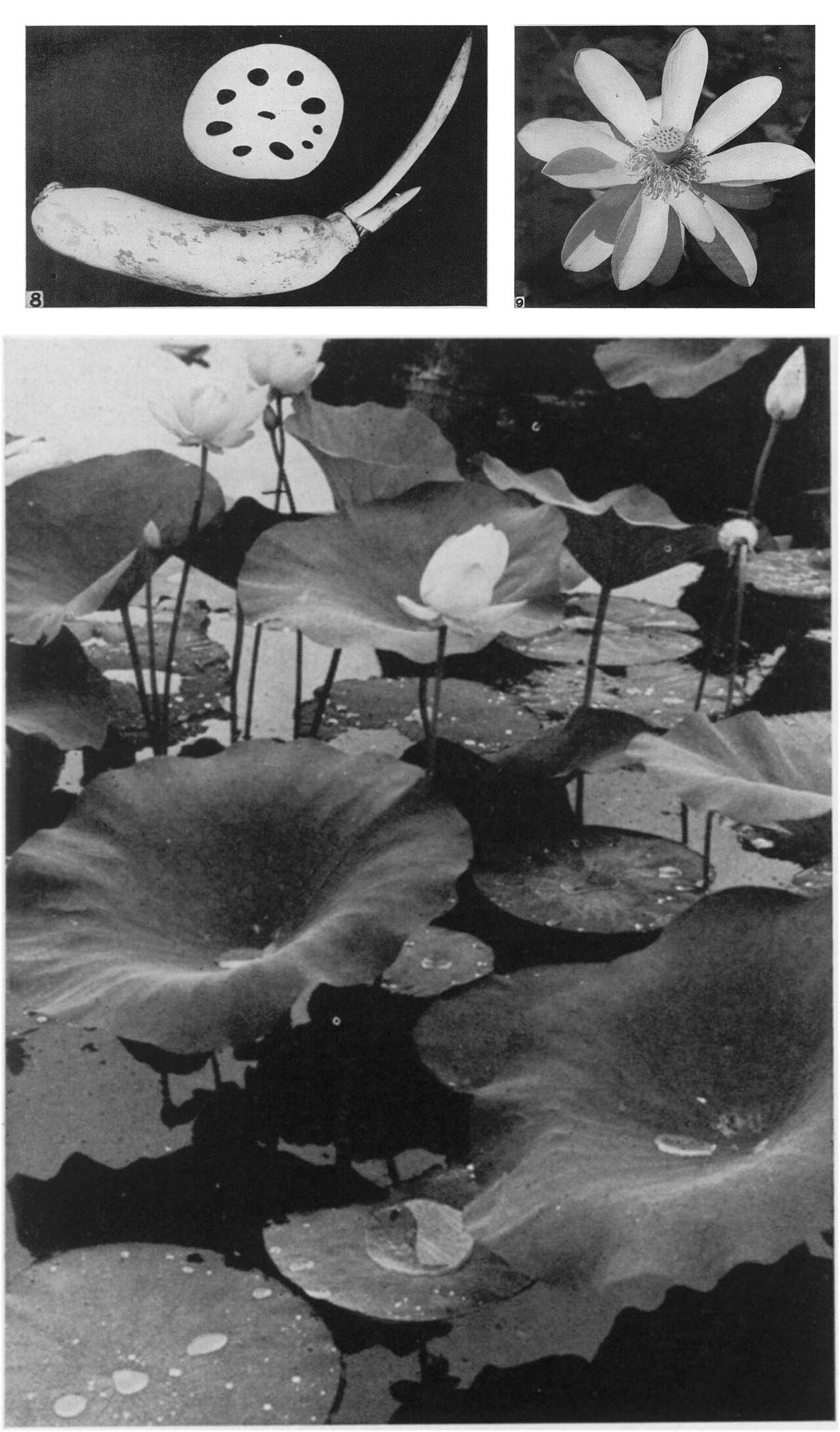
The leaves are the plant’s signature feature: nearly circular, 12 to 28 inches across, with the leafstalk attaching at dead center (peltate) rather than at the edge. Young leaves may float briefly on the surface, but mature leaves are raised 1 to 6 feet into the air on stout, prickly petioles, giving the colony a billowing, blue-green canopy. The upper surface has a waxy, water-repellent coating — the famous “lotus effect” — that causes raindrops and dew to bead up and roll off, carrying dust and debris with them.
Flowers
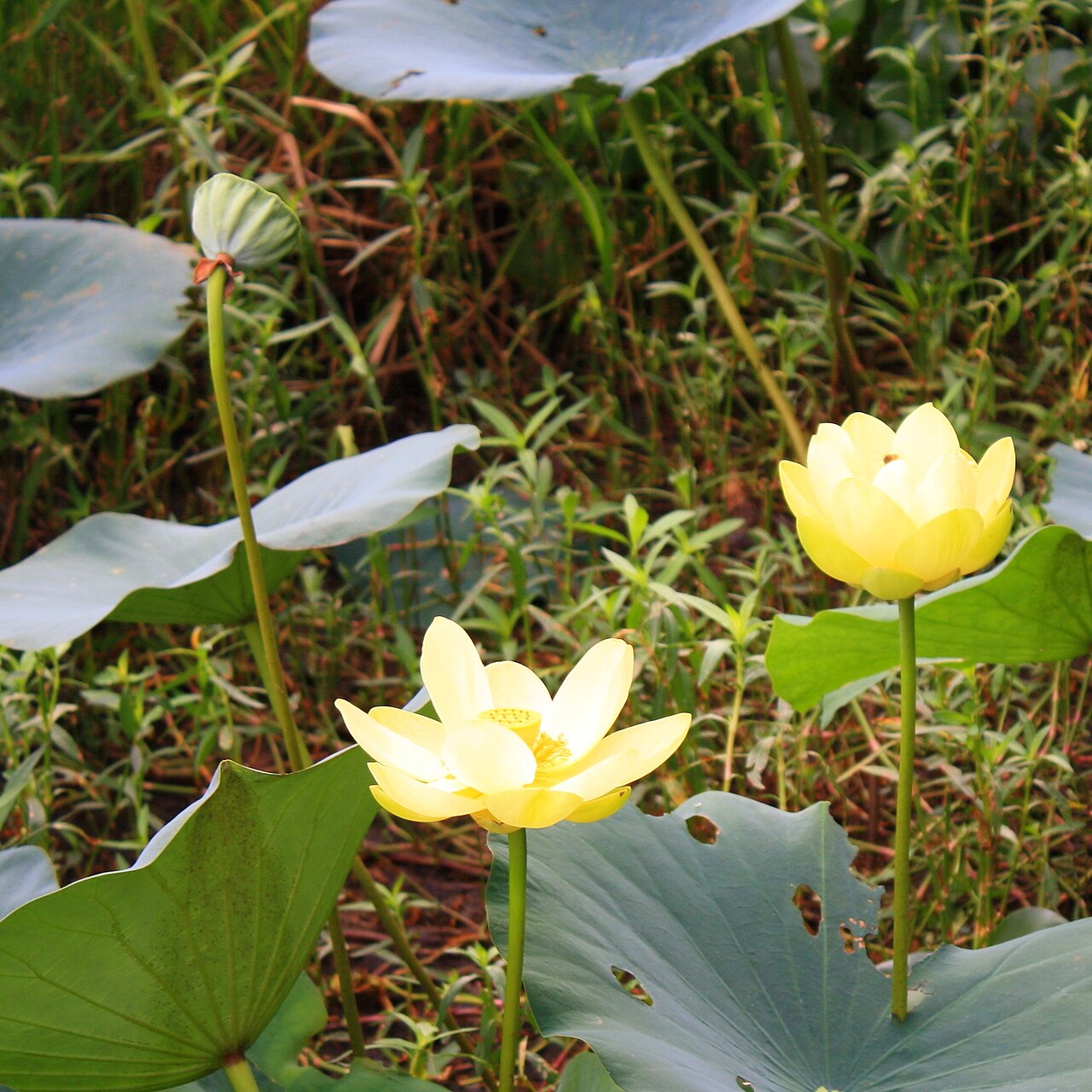
Flowers are large, fragrant, and pale creamy-yellow, 4 to 10 inches across, with numerous spoon-shaped petals surrounding a flat-topped, cone-like receptacle studded with the pistils. Each flower opens for only two to three days in succession, typically in the cool of early morning, closing again by afternoon, before the petals drop entirely. Bloom runs from June into September, with individual colonies producing a long succession of flowers rather than a single flush.
Fruit & Seeds
After the petals fall, the flat-topped receptacle enlarges into the distinctive woody seed pod, 3 to 4 inches across, pocked with 10 to 25 round holes, each containing a single hard, acorn-like nutlet. The pods stand upright on their stalks as they mature and dry, turning from green to brown, and eventually nod over to spill their seeds into the water or get carried off by waterfowl. These dried pods are widely collected for flower arranging.
Quick Facts
| Scientific Name | Nelumbo lutea Willd. |
| Family | Nelumbonaceae (Lotus) |
| Plant Type | Aquatic Perennial (emergent) |
| Mature Height | Leaves & flowers rise 1–6 ft above the water |
| Spread | Unconfined — spreads by rhizome to form large colonies |
| Growth Rate | Fast, aggressive once established |
| Sun Exposure | Full Sun |
| Water Needs | Aquatic — standing water 1–6 ft deep |
| Soil Type | Soft mud or silt pond/lake bottom |
| Soil pH | 6.0–8.0 |
| Bloom Time | June – September |
| Flower Color | Pale creamy yellow |
| Fruit | Flat-topped woody seed pod (“shower head”) with hard nutlets |
| Deer Resistant | Yes — grows out of browsing reach in open water |
| USDA Hardiness Zones | 4–10 |
Native Range
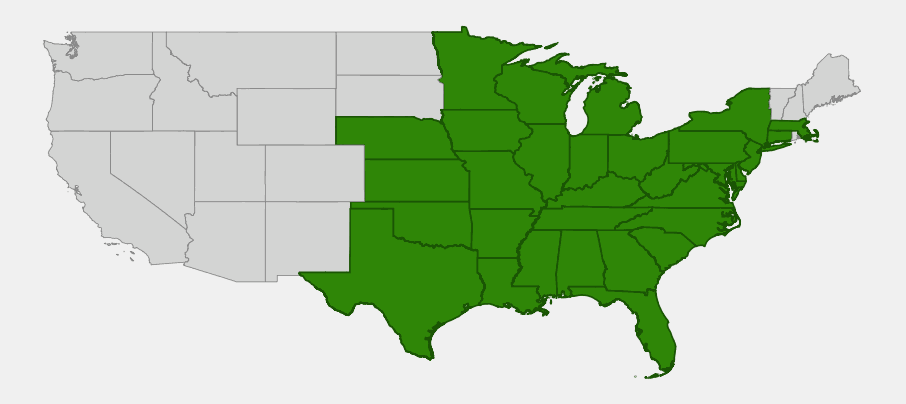
American Lotus is native across the central and eastern United States, from the lower Great Lakes and the Mississippi and Missouri River drainages south to the Gulf Coast and east to the Atlantic seaboard. It is most abundant in the Mississippi Valley and the prairie pothole and backwater lakes of the Midwest, where large colonies carpet shallow, slow-moving water. Isolated native and long-naturalized populations also occur along parts of the East Coast and in scattered wetlands further north into the upper Midwest.
In the wild, American Lotus roots in soft, nutrient-rich mud in water 1 to 6 feet deep: oxbow lakes, old river backwaters, farm ponds, marshes, and the quiet coves of larger lakes. It needs still or very slow-moving water — river current and heavy wave action will tear up its leaves and prevent colonies from establishing. Once rooted, it tolerates considerable water-level fluctuation and can persist through droughts by drawing on its deep, starchy rhizomes.
Gardeners on the West Coast will sometimes see American Lotus offered for ornamental ponds in California and Washington; populations there are garden escapes rather than part of the plant’s native range, and the species should be treated as a regional native only within the central and eastern states listed below.
📋 Regional plant lists featuring American Lotus: Iowa, Illinois & Missouri · Arkansas, Louisiana & Eastern Texas/Oklahoma · New York, Pennsylvania & New Jersey · North & South Carolina · Maryland, Virginia & West Virginia · Kentucky & Tennessee · Texas
Growing & Care Guide
American Lotus is easy to grow once it has the two things it truly needs: full sun and a large body of still, shallow water. It is not a plant for a patio half-barrel or a small preformed pond — give it room and it will reward you; confine it and it will either sulk or try to escape its container.
Light
Lotus needs full sun — at least six hours a day — to flower well. In partial shade the plant will usually survive and spread its leaves, but flowering drops off sharply, and in deep shade it will not bloom at all.
Water & Planting Depth
Plant tubers so the growing tip sits just below the mud surface, in water that will reach 1 to 3 feet deep over the root zone as the season progresses (established colonies tolerate up to 6 feet). Still or slow-flowing water is essential; avoid sites with strong current, heavy boat wakes, or constant wave action, which shred the leaves and prevent rhizomes from anchoring. In a lined pond, a large container (at least 15–20 gallons) filled with heavy clay-loam garden soil — never potting mix, which floats — gives the rhizome room to run for a season or two before it needs dividing.
Planting Tips
Start with a dormant tuber or a potted division in late spring once the water has warmed, handling the brittle growing tip carefully since a snapped tip can kill the tuber. Lay the tuber horizontally and anchor it lightly with a stone or mesh until roots take hold. In a farm pond or lake setting meant for naturalizing, simply push tubers into soft mud in shallow water near shore.
Maintenance & Controlling Spread
In open ponds and lakes, American Lotus spreads steadily by rhizome and can fill a shallow water body within a few years — plan for this before planting, and only introduce it where expansion is welcome or where depth and open water naturally limit it. In a contained water garden, keep it in a large submerged tub to control spread, and divide and thin the rhizome mass every two to three years as it becomes congested. Cut back dead foliage and stalks after hard frost blackens them; the rootstock survives winter cold well below the frost line underwater.
Landscape Uses
- Farm ponds & small lakes — a dramatic, long-blooming native for large open water
- Waterfowl habitat plantings — seeds and tubers are a major duck and goose food
- Large constructed water gardens with room for the leaves to spread
- Wetland and shoreline restoration in slow backwaters and oxbows
- Cut-flower and dried-pod gardens — the seed pods are prized in arrangements
Wildlife & Ecological Value
Few native aquatic plants match American Lotus for the sheer volume of wildlife it supports once a colony is established.
For Waterfowl
The hard seeds are a favored food for ducks, geese, and other waterfowl, especially in fall and winter when the dried pods shed their contents into the water. Muskrats dig up and eat the starchy rhizomes, and the dense leaf canopy provides shade and cover that waterfowl and other wetland animals use to rest and hide from predators.
For Pollinators
Flowers are visited and pollinated chiefly by beetles and native bees drawn to the pollen-rich center of the bloom; honeybees and other generalist pollinators also work the flowers during their brief open period.
Ecosystem Role
A lotus colony slows water movement, traps sediment, and improves water clarity in the shallow coves and backwaters where it grows. The dense stands of leaves and stems provide critical cover and nursery habitat for fish, frogs, and aquatic invertebrates, while the rhizome mat stabilizes soft mud bottoms against erosion.
Cultural & Historical Uses
American Lotus held major importance as a food plant for Indigenous peoples across its range for thousands of years before European contact. The starchy tubers were dug, roasted, or boiled much like a potato, and the hard seeds — sometimes called “water chinquapins” for their resemblance to chinquapin nuts — were gathered, dried, and ground into meal or eaten roasted. Archaeological sites throughout the Mississippi and Ohio River valleys have yielded lotus seeds and tuber remains, evidence of how widely the plant was harvested as a reliable wetland food source.
European settlers and naturalists documented lotus beds as notable landscape features of Midwestern rivers and lakes, and the plant’s dried seed pods have long been gathered for decorative use in dried flower arrangements. Unlike its Asian relative, the sacred lotus (Nelumbo nucifera), American Lotus does not carry the same depth of religious symbolism in North American tradition, but it remains one of the most visually striking native wetland plants, and large wild colonies — such as those found in backwaters of the Mississippi, Ohio, and Illinois Rivers — continue to draw visitors each summer during peak bloom.
Today, American Lotus tubers and seeds are still occasionally gathered by foragers familiar with safe identification and local regulations, though most modern gardeners grow the plant purely for its ornamental and wildlife value rather than as a food crop.
Frequently Asked Questions
Is American Lotus the same as the Asian sacred lotus?
No. American Lotus (Nelumbo lutea) is a separate species native to North America, with pale yellow flowers, distinct from the pink-flowered sacred lotus (Nelumbo nucifera) native to Asia. The two are closely related and sometimes hybridize in cultivation, but N. lutea is the only lotus native to the United States.
Can I grow American Lotus in a small backyard pond?
Only if you confine it to a large, heavy container (15–20 gallons or more) set in the pond, since an unconfined lotus will quickly outgrow a small water feature. For ponds under a few hundred square feet, a compact water lily is usually a better fit.
How is American Lotus different from a water lily?
Lotus leaves and flowers rise well above the water surface on stiff stalks and the leaf blade is perfectly round with the stalk attached at the center; water lily leaves float flat on the surface and have a distinct notch cut to the center where the stalk attaches.
Will American Lotus take over my pond?
In open ponds and lakes with soft mud bottoms, yes — it spreads aggressively by rhizome and can cover large areas over a few growing seasons. This vigor is a benefit in a farm pond or wildlife planting, but plan ahead or use a container if you want to keep it contained.
Do American Lotus seeds really stay viable for centuries?
Lotus seeds are famous for their unusually tough, water-resistant seed coat, and sealed, undamaged seeds can remain viable for an extremely long time in sediment, far longer than most native plant seeds — part of why old lotus beds can reappear after decades of apparent absence once water levels and conditions allow.
For more ideas on working with wetland-edge and water-loving natives, see our guide to starting a rain garden, and pair American Lotus with other moisture-loving natives discussed in our piece on the benefits of planting native Joe-Pye Weed.