Pine Lily (Lilium catesbaei)
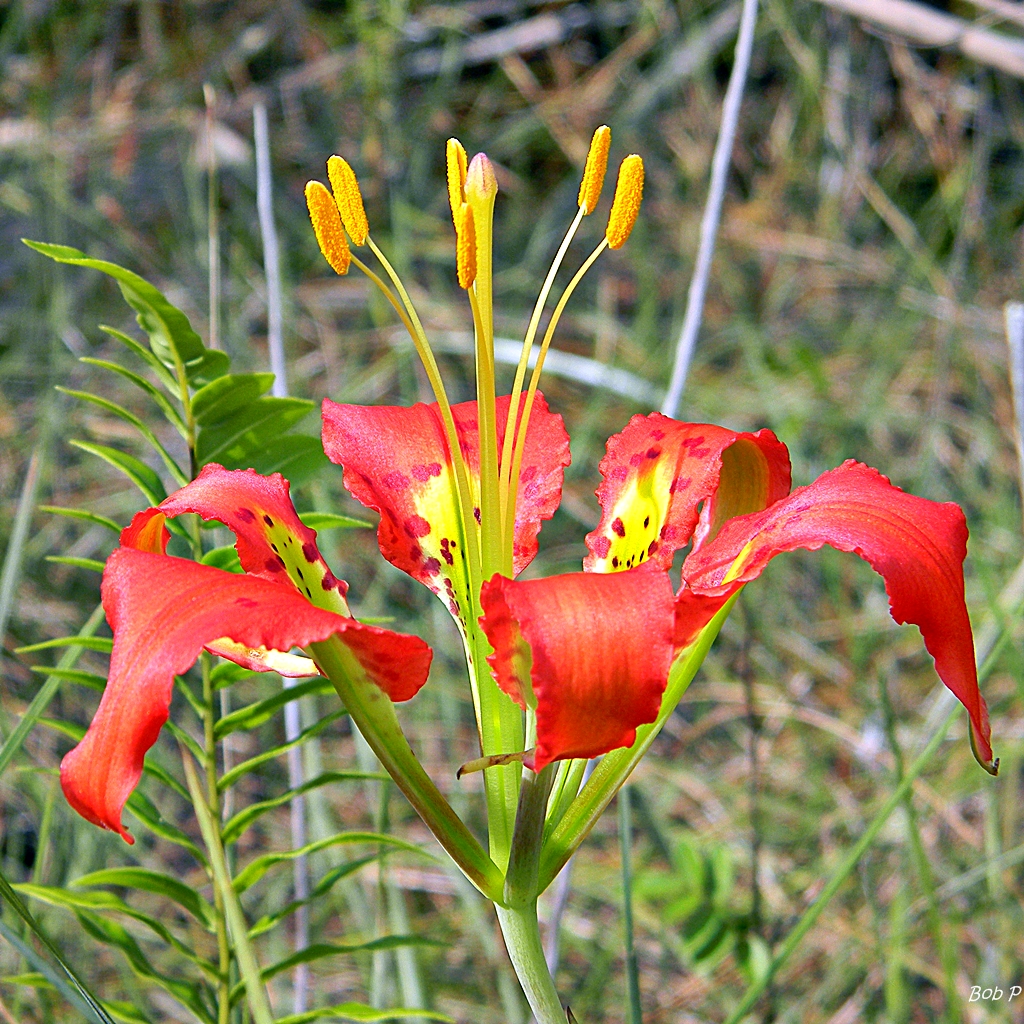
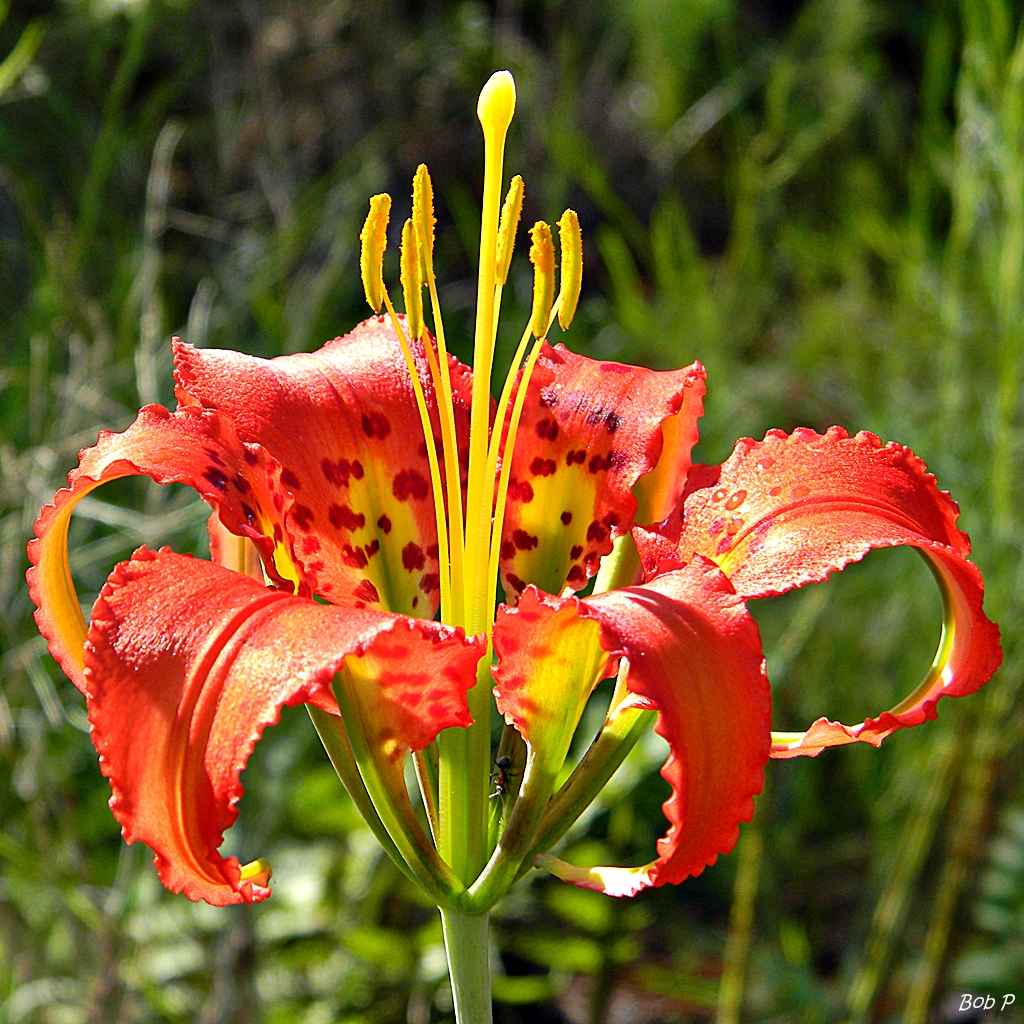
Lilium catesbaei, known as Pine Lily, Catesby’s Lily, or Southern-red Lily, is the showstopper of the wet pine savannas and flatwoods of the Southeastern Coastal Plain. Unlike most of its lily relatives, which carry several nodding flowers per stem, pine lily produces a single, upright, outward-facing bloom at the top of a slender stalk — and that one flower is enormous, with crimson-orange, strongly reflexed petals marked by a bold yellow-and-maroon throat. It carries the largest flower of any lily native to North America, and in a small plant the sheer weight of the bloom can tip the slender stem sideways.
Named for the English naturalist Mark Catesby, who collected plants across the colonial Southeast in the early 1700s, pine lily is a true fire-adapted wildflower. It thrives in the open, sun-drenched ground layer of longleaf pine savannas that burn every few years, and it tends to flower most conspicuously in the growing seasons immediately following a fire — a trait that has made wildfire suppression one of the biggest long-term threats to its populations across much of its range.
Pine lily is a long-lived perennial that grows from a small bulb, standing about 1 to 3 feet tall with narrow, scattered leaves along an unbranched stem. It blooms from roughly late June through October across most of its range, with Florida populations sometimes flowering sporadically in spring and fall as well. For a Southeastern wildflower or bog garden with hot, wet, acidic soil — conditions most other garden plants can’t tolerate — pine lily is a genuinely spectacular and under-planted choice.
Identification
Pine lily stands apart from other native lilies by its single large, upright, outward-facing flower atop a slender, mostly unbranched stem — a form quite different from the multi-flowered, downward-nodding clusters typical of many other Lilium species.
Stems & Leaves
The stem is slender, upright, and unbranched, typically 1 to 3 feet tall, rising from a small ovoid bulb about an inch long. Leaves are narrow and lance-shaped (linear-lanceolate), arranged alternately along the stem rather than in whorls, and scattered rather than densely clustered.
Flowers
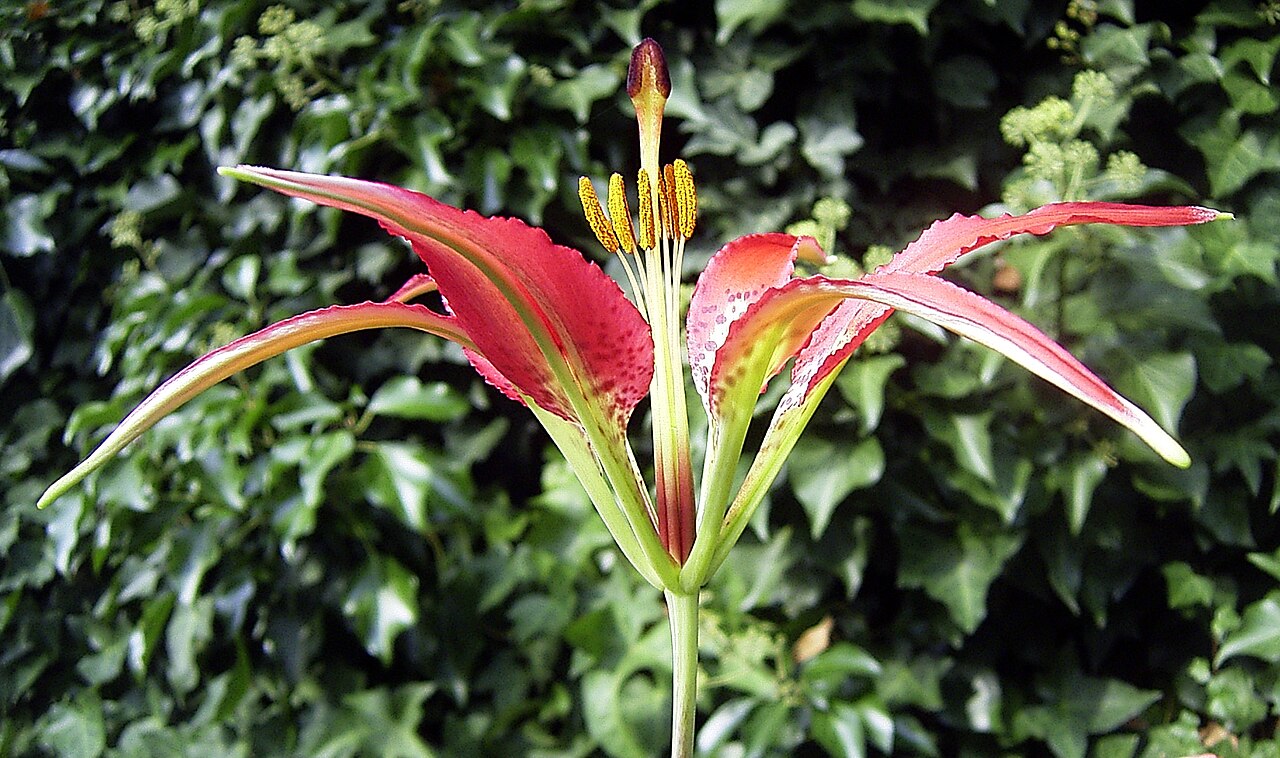
Each plant produces a single terminal flower, held upright and facing outward rather than nodding — an unusual posture among lilies. The six tepals are strongly reflexed (curled backward), crimson-orange toward the tips with a yellow throat heavily marked in maroon or magenta spots that serve as nectar guides. The flower measures roughly 3 to 4.4 inches long, the largest of any lily native to North America, and sits atop a long flower stalk (pedicel) that allows the heavy bloom to sway in the wind. Bloom typically runs from late June into October, peaking after growing-season fires.
Fruit & Seeds
The fruit is an upright, often ridged capsule, 1 to 2 inches long, that splits open to release numerous flat seeds with a very high germination rate — often 90 to 95 percent. Under ideal cultivated conditions, seed-grown plants can flower within a single year, though in the wild this process usually takes two to three years.
Quick Facts
| Scientific Name | Lilium catesbaei |
| Family | Liliaceae (Lily) |
| Plant Type | Bulbous Perennial |
| Mature Height | 1–3 ft |
| Mature Spread | Under 1 ft (single stem per bulb) |
| Growth Rate | Slow from seed; 2–3 years to first bloom in the wild |
| Sun Exposure | Full Sun |
| Water Needs | High; consistently wet soil |
| Soil Type | Wet, acidic sand or peat |
| Soil pH | 4.5–6.0 (strongly acidic) |
| Bloom Time | Late June – October |
| Flower Color | Crimson-orange with a yellow, maroon-spotted throat |
| Fruit | Upright, ridged seed capsule |
| Deer Resistant | No |
| USDA Hardiness Zones | 7–9 |
Native Range
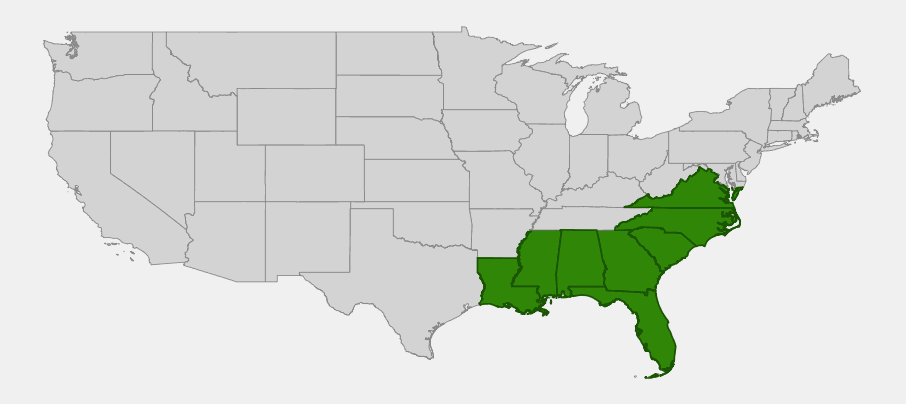
Pine lily is native to the Coastal Plain of the American Southeast, from southeastern Virginia south through the Carolinas, Georgia, and Florida, and west through Alabama, Mississippi, and into Louisiana. It is most abundant and secure in Florida, where it remains a familiar sight in wet flatwoods each summer, but it has become critically imperiled in the northern and western parts of its range — ranked critically imperiled in both Louisiana and Virginia, and vulnerable in the Carolinas, largely due to habitat loss and decades of fire suppression.
Within its range, pine lily grows almost exclusively in open, sunny, fire-maintained wetlands: wet pine flatwoods, longleaf pine savannas, and the margins of seasonal ponds and prairies, nearly always in hot, wet, strongly acidic soil inhospitable to most other lilies. It is specifically adapted to periodic growing-season fire, which clears competing woody vegetation and appears to trigger heavier flowering in the following one to two years — a relationship well documented at long-unburned versus recently burned sites across its Florida range.
Because fire suppression has allowed shrubs and trees to crowd out the open, sunny ground layer pine lily depends on across much of its range, the species has declined significantly outside Florida even where it was once common, making prescribed-fire management one of the single most important tools for conserving remaining populations.
📋 Regional plant lists featuring Pine Lily: Maryland, Virginia & West Virginia · North & South Carolina · Georgia, Alabama & Mississippi · Arkansas, Louisiana, Eastern Oklahoma & Eastern Texas
Growing & Care Guide
Pine lily is a rewarding but exacting garden subject: it demands the same hot, wet, acidic conditions it finds in a pine savanna, and it rarely thrives in an ordinary flower bed. Gardeners who can recreate a bog-like setting are rewarded with one of the most dramatic native wildflowers in the Southeast.
Light
Give it full sun — this species does not persist in shade and needs open, unobstructed light to flower well, mirroring the open canopy of a fire-maintained pine savanna.
Soil & Water
Pine lily requires consistently wet, strongly acidic, sandy or peaty soil, the kind found in flatwoods and bog margins. It will not tolerate alkaline soil, standard well-drained garden beds, or extended dry periods. A rain garden, bog bed, or the consistently damp edge of a water feature, amended to stay acidic, offers the closest match to its native habitat.
Planting Tips
Source bulbs or seed only from reputable native-plant nurseries, never collected from the wild, given the species’ declining status outside Florida. Plant bulbs in fall, about 3 to 4 inches deep, in prepared acidic, consistently moist soil. Because seed germinates readily and seedlings can reach flowering size in as little as one year under good conditions, growing pine lily from seed is a practical option for patient gardeners.
Pruning & Maintenance
Little maintenance is needed beyond keeping the soil consistently wet and acidic. If grown in a naturalistic planting, periodic late-winter cutting back of surrounding competing vegetation can mimic the effect of the fire this species depends on in the wild, encouraging heavier bloom the following summer.
Landscape Uses
Pine lily is best suited to:
- Bog gardens and rain gardens with acidic, consistently wet soil
- Longleaf pine and pine savanna restoration plantings
- Pitcher plant bog companion plantings
- Butterfly gardens in a sunny, damp setting
- Specimen plantings where its single dramatic flower can be appreciated up close
Wildlife & Ecological Value
Pine lily’s single enormous flower is a prime nectar source for the Southeast’s largest native butterflies, and its presence is a strong indicator of a healthy, fire-maintained pine savanna ecosystem.
For Pollinators
The Palamedes swallowtail (Papilio palamedes) is pine lily’s primary pollinator, its long proboscis and large size well matched to the flower’s deep nectar reserves and wide reach. Spicebush swallowtails also visit, though their smaller size likely makes them somewhat less effective pollinators than the Palamedes swallowtail.
For Birds
While not a major direct food source for birds, the open pine savanna habitat pine lily depends on supports a rich community of grassland and savanna birds, including species closely tied to fire-maintained longleaf pine ecosystems.
Ecosystem Role
As a fire-adapted wildflower of the longleaf pine ecosystem — among the most biodiverse plant communities in North America — pine lily is both a beneficiary and an indicator of good land management. Its tendency to bloom more heavily after fire reflects an evolutionary relationship with periodic burning stretching back thousands of years, and its decline in areas where fire has been suppressed is one of many signals of broader ecological change in Southeastern pine savannas.
Cultural & Historical Uses
Pine lily’s scientific name honors Mark Catesby, the English naturalist and artist whose early eighteenth-century expeditions through the colonial Southeast produced some of the first detailed illustrations of North American plants and animals for a European audience. His collections, including this striking lily, helped introduce Europe to the remarkable diversity of the Southeastern Coastal Plain.
Pine lily has long been prized by wildflower enthusiasts for the sheer drama of its bloom — the largest flower of any native North American lily — and it remains a favorite subject for nature photographers visiting Florida’s wet flatwoods and preserves each summer, including well-known sites such as Deer Prairie Creek Preserve.
Today the species is mainly significant for conservation and native-plant horticulture rather than any traditional practical use; its greatest modern value lies in its role as a flagship species for longleaf pine savanna restoration and prescribed-fire management across the Southeast.
Frequently Asked Questions
Why does Pine Lily bloom better after a fire?
Periodic fire clears away competing shrubs and trees that would otherwise shade out this sun-loving species, and research in Florida pine savannas has documented noticeably heavier flowering in the one to two growing seasons following a burn.
Is Pine Lily endangered?
Its status varies sharply by state. It remains fairly secure in Florida, but is ranked critically imperiled in Louisiana and Virginia and vulnerable in North and South Carolina, mainly due to habitat loss and long-term fire suppression. It was briefly listed as threatened in Florida in 2010, though that state listing has since been removed.
Can I grow Pine Lily in a normal garden bed?
Only if you can recreate its native conditions: full sun and consistently wet, strongly acidic soil. In typical well-drained garden soil, pine lily will struggle and is unlikely to persist for long.
How is Pine Lily different from Leopard Lily?
Pine lily produces a single large, upright, outward-facing flower per stem and is native to Southeastern wet pine savannas, while leopard lily (Lilium pardalinum) produces multiple nodding, strongly recurved flowers per stem and is native to streambanks and wet meadows of California and Oregon.
What pollinates Pine Lily?
The Palamedes swallowtail butterfly is its primary pollinator, with spicebush swallowtails visiting as a secondary, somewhat less effective pollinator.
Is Pine Lily safe to plant around pets?
No. Like all true lilies in the genus Lilium, every part of the plant is highly toxic to cats and can cause fatal kidney failure even in small amounts. Keep it away from cats, and contact a veterinarian immediately if a cat ingests any part of the plant.

Looking for a nursery that carries Pine Lily?
Browse our native plant nursery directories: Virginia & South Carolina · North Carolina · Georgia & Florida · Alabama · Mississippi & Louisiana