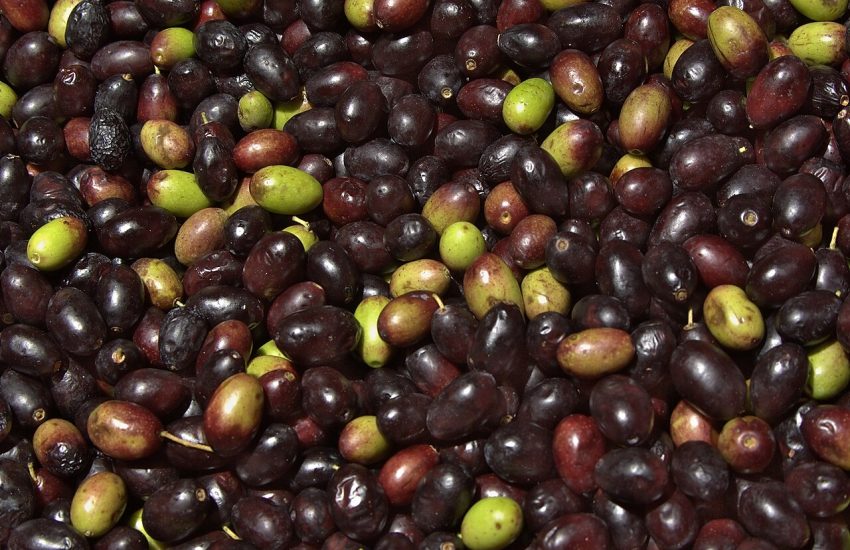
Texas Walnut (Juglans microcarpa)
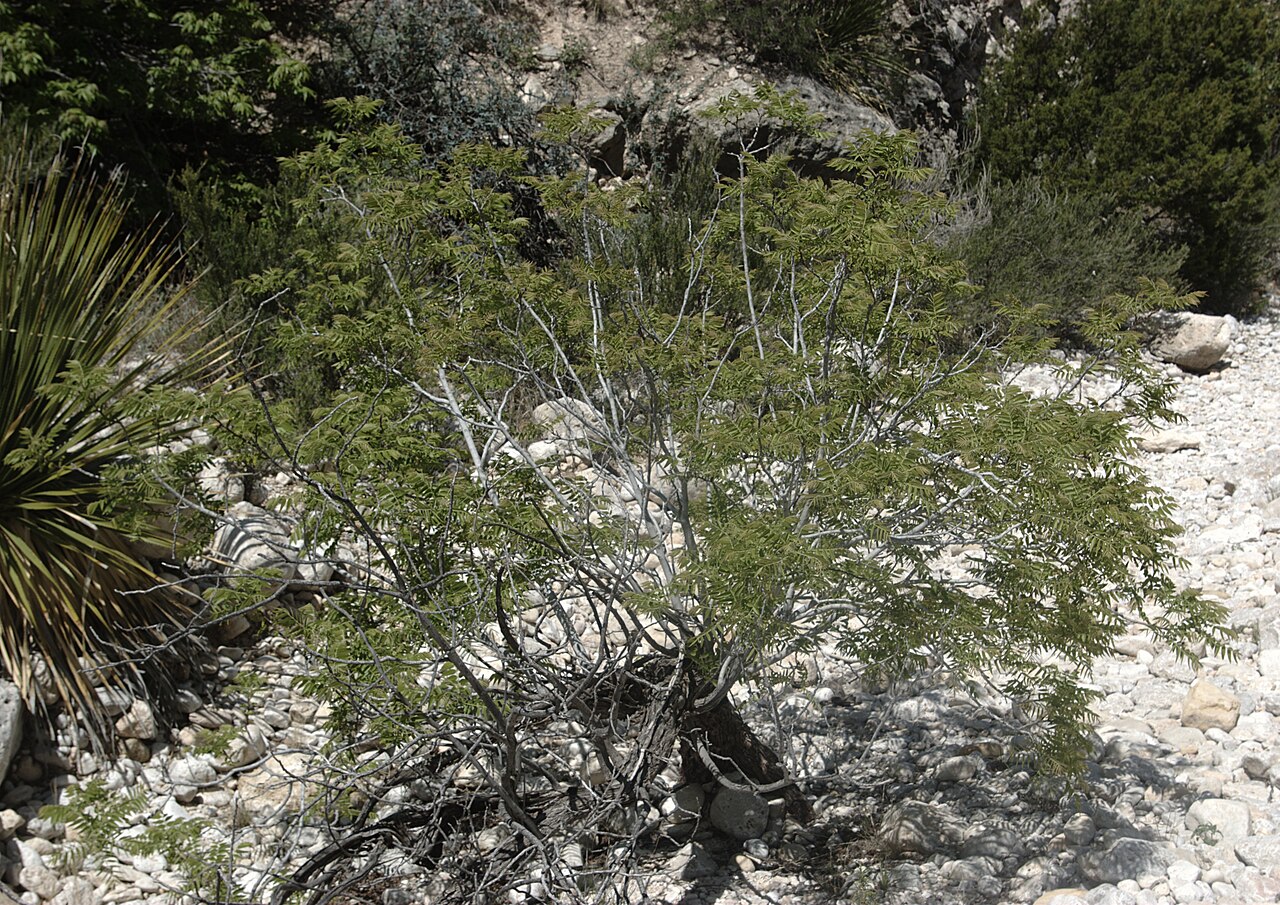
Juglans microcarpa, commonly called Texas Walnut or Little Walnut, is a tough, deeply rooted native tree or large shrub of the arid canyons, dry washes and stream banks of the southern Great Plains and the Trans-Pecos. The species name microcarpa means “small-fruited,” and that is exactly what sets it apart from its relatives: its round, thumbnail-sized nuts are the smallest of any walnut species, mostly hard shell with little meat inside, but still an important food source for squirrels and other wildlife.
Where Black Walnut needs deep, rich bottomland soil, Texas Walnut thrives in conditions that would kill most other walnuts: rocky, shallow, alkaline soils and the hot, dry, wind-scoured climate of west-central Texas, eastern New Mexico, the Oklahoma Panhandle region and southwestern Kansas. Depending on growing conditions, it ranges from a many-stemmed shrubby thicket along a dry arroyo to a small, single-trunked tree 20 to 30 feet tall along a reliable stream.
For gardeners in the southern High Plains and Trans-Pecos who want a genuinely tough native tree with fine, feathery foliage and real wildlife value, Texas Walnut is one of the few walnuts truly built for the job. It asks for almost nothing once established and rewards patience with graceful, drought-hardy shade.
Identification
Texas Walnut is variable in form, growing as a large, multi-stemmed shrub in dry, exposed sites and as a small single-trunked tree, usually 15 to 30 feet tall, where moisture is more reliable. The crown is open and rounded, and the overall silhouette is finer and more delicate than other native walnuts, thanks to its narrow leaflets.
Bark & Stems
Bark on young stems is smooth and gray, becoming lightly furrowed and darker gray-brown with age, without the deep, blocky ridges of mature Black Walnut bark. Twigs are moderately stout, and older multi-stemmed plants often have a tangled, wind-pruned look from growing in exposed rocky terrain.
Leaves
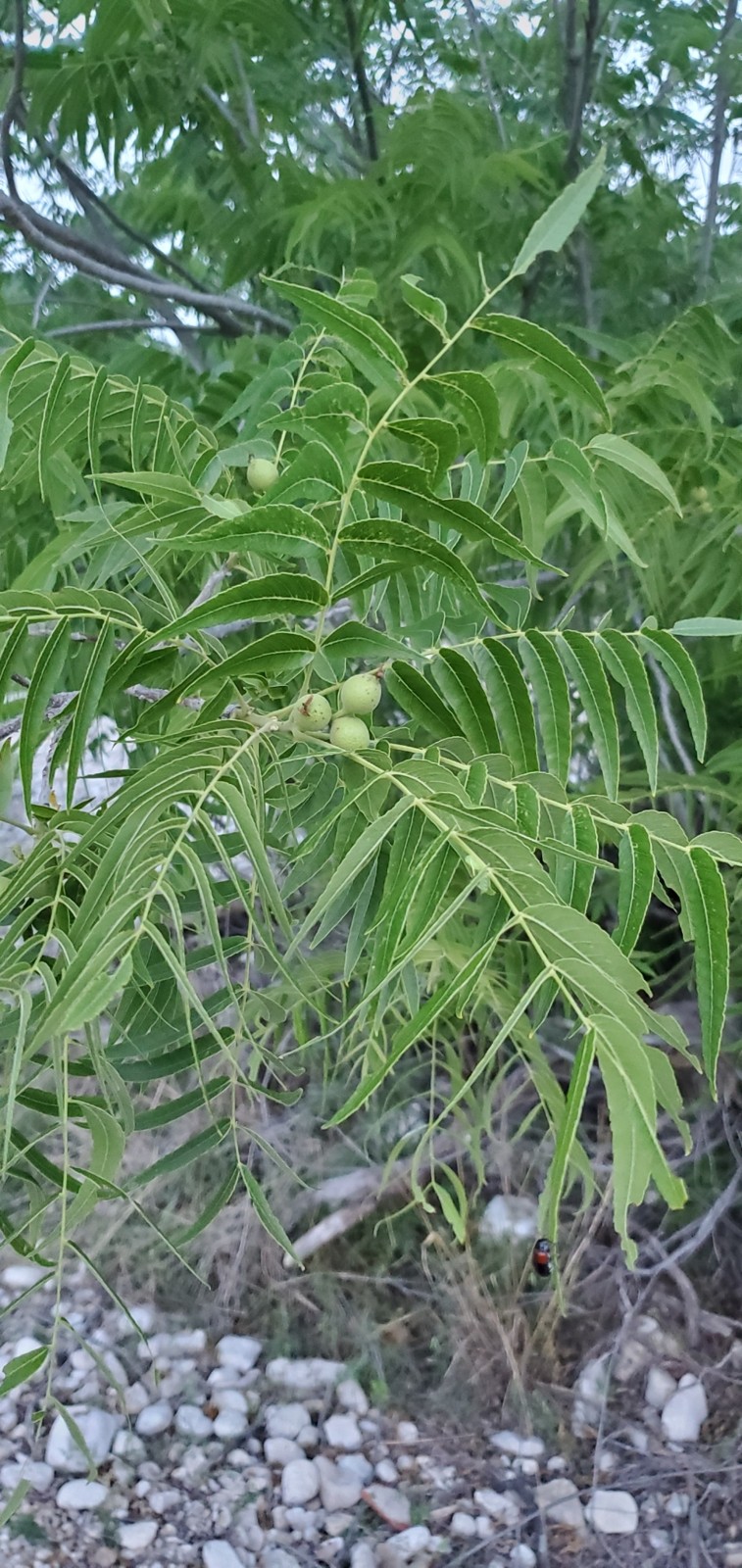
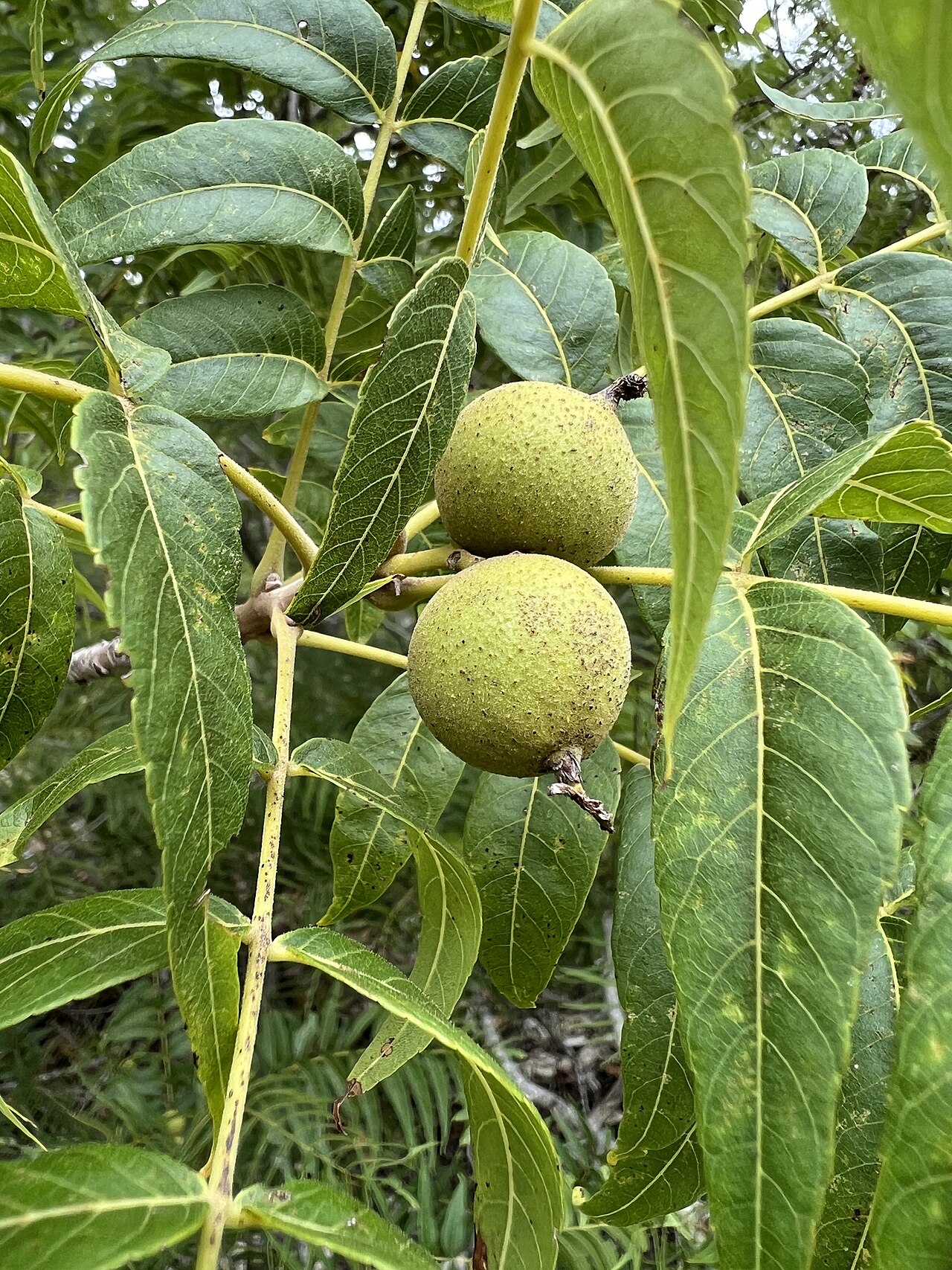
Leaves are pinnately compound, 8 to 14 inches long, with 11 to 25 narrow, finely toothed leaflets that are yellow-green and give the foliage a feathery, almost fern-like texture quite different from the broader leaflets of Black Walnut. Crushed leaves release the characteristic spicy, resinous walnut scent common to the genus.
Flowers & Fruit
Like other walnuts, Texas Walnut is monoecious, with male and female flowers on the same tree. Male flowers hang in slender, drooping yellow-green catkins from the previous year’s wood, while inconspicuous female flowers form at the tips of new growth and develop into the fruit. The nuts are round, only about half an inch to an inch across, encased in a thin, finely textured green husk that darkens and splits at maturity in fall; this is the smallest fruit of any walnut species, mostly hard shell with a small, oily, hard-to-extract kernel.
Quick Facts
| Scientific Name | Juglans microcarpa |
| Family | Juglandaceae (Walnut) |
| Plant Type | Deciduous large shrub or small tree |
| Mature Height | 15–30 ft (shrubbier and shorter on dry sites) |
| Mature Spread | 15–25 ft |
| Growth Rate | Slow to moderate |
| Sun Exposure | Full Sun to Part Shade |
| Water Needs | Low once established |
| Soil Type | Rocky, limestone-based, sandy loam to clay loam |
| Soil pH | Neutral to alkaline; low tolerance for very acidic soil |
| Bloom Time | March – June |
| Flower Color | Yellow-green catkins; inconspicuous female flowers |
| Fall Color | Yellow |
| Fruit | Small round nuts, under 1 in, mostly shell; fall |
| Deer Resistant | Moderate |
| USDA Hardiness Zones | 6–9 |
Native Range
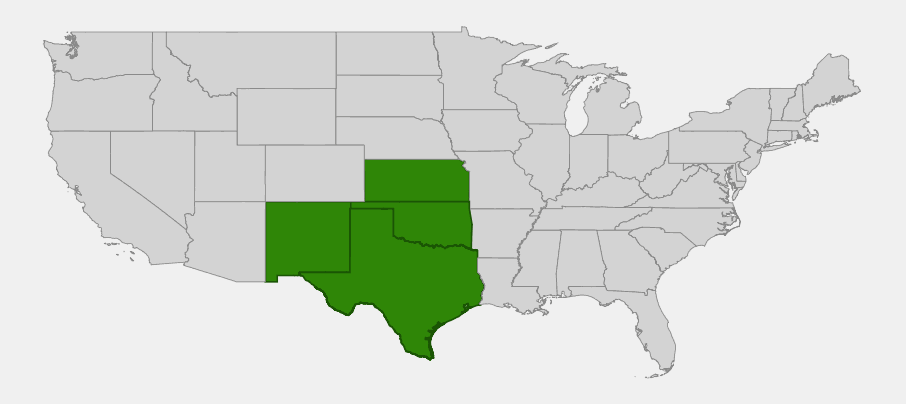
Texas Walnut is native to the southern Great Plains and Trans-Pecos region: west-central and southwestern Texas, southeastern New Mexico and central New Mexico, western Oklahoma, and southwestern Kansas, extending south into Coahuila and Nuevo León in northern Mexico. It is especially characteristic of the Edwards Plateau, the Trans-Pecos canyonlands and the dry breaks of the southern High Plains.
Typical habitat is dry, rocky ravines, canyon washes, hillsides and intermittent stream banks, often on limestone-derived soils. Unlike Black Walnut, which needs consistently moist bottomland, Texas Walnut is adapted to go for long stretches without surface water, relying on a deep root system to reach moisture well below the parched surface of its native canyons and arroyos.
Because its range sits at the arid western edge of the walnut genus in North America, Texas Walnut sometimes hybridizes with the related Arizona Walnut where their ranges meet in the Trans-Pecos and southern New Mexico, and the two species can be difficult to tell apart without close comparison of leaflet number and nut size.
📋 Regional plant lists featuring Texas Walnut: South and West Texas · Arizona and New Mexico · Nebraska, Kansas & Eastern Colorado
Growing & Care Guide
Texas Walnut is built for tough love. It is one of the most drought-resilient native trees available for the alkaline, rocky soils of the southern Great Plains, and it needs very little coddling once its roots are established.
Light
Plant Texas Walnut in full sun to part shade. In its native canyons it often grows in full exposure, and full sun generally produces the fullest, most balanced crown; light shade is tolerated, especially for young plants establishing beneath nurse shrubs.
Soil & Water
Texas Walnut is at home in rocky, shallow, alkaline soils, including limestone-based ground where many trees struggle, and it tolerates sandy loam, clay loam and genuinely rocky sites. It has low tolerance for highly acidic soils. Water new transplants regularly through their first one to two years to help the deep taproot establish; after that, Texas Walnut needs supplemental water only in extended drought, reflecting its adaptation to the arid washes and canyons where it grows wild.
Planting Tips
Plant young, container-grown or direct-seeded Texas Walnut in fall or early spring. Because it develops a long taproot early, it transplants best while young; larger, older nursery stock establishes more slowly. Choose a well-drained site, since the species is adapted to intermittently dry washes rather than soils that stay soggy. Give multi-stemmed plants room to spread if you want the natural thicket form, or select and prune to a central leader for a more tree-like shape.
Pruning & Maintenance
Little pruning is needed beyond removing dead, damaged or crossing wood in late winter. If a single-trunk tree form is desired, remove competing stems while the plant is young. Texas Walnut has few serious pest or disease problems in its native dry habitat, though walnuts in general can develop issues in unusually wet or humid conditions outside their normal range. It needs no regular fertilization in reasonable soil.
Propagation
Texas Walnut is grown from seed. Collect nuts in fall or winter once the husks begin to turn black and split; husks should be removed, but the hard shell itself does not need to be cracked before sowing. Sow immediately in fall, or store nuts in moist sand over winter and stratify for 60 to 120 days at 34 to 41°F before spring planting. Seeds lose viability quickly if allowed to dry out completely, so keep them moist from collection to sowing.
Landscape Uses
- Drought-tolerant shade for rocky, alkaline sites in West Texas, the Trans-Pecos and the southern High Plains
- Dry streambank and arroyo restoration alongside Arizona walnut and plateau live oak
- Wildlife gardens, where the small nuts feed squirrels and other rodents
- Naturalistic thickets and screening when allowed to grow as a multi-stemmed shrub
- Xeriscaping and other low-water native landscape designs
Wildlife & Ecological Value
In the dry canyons and washes it calls home, Texas Walnut is a disproportionately valuable wildlife tree, offering food and structure in landscapes where woody cover can be scarce.
For Pollinators
Texas Walnut is primarily wind-pollinated, like other walnuts, so its catkins are not a major nectar source, but the tree still supports insect life as a larval host for the banded hairstreak butterfly, whose caterpillars feed on walnut foliage.
For Birds
Birds use Texas Walnut for nesting sites and cover, and some species feed on the small nuts or on insects drawn to the foliage. In the more open, rocky terrain of its native range, any woody tree or large shrub provides disproportionately valuable structure for nesting and shelter.
For Mammals
Squirrels and other rodents are the primary consumers of the small, hard-shelled nuts, gnawing through the thin husk and shell to reach the oily kernel inside. Though the nuts are mostly shell with little meat, they remain an important fall and winter food source in canyon and wash habitats where other mast-producing trees are limited.
Ecosystem Role
Texas Walnut’s deep root system helps stabilize the banks of intermittent washes and canyon bottoms prone to flash flooding, and its canopy, however modest, provides rare shade and cover in the sparsely wooded canyonlands and plains breaks of its range. As one of relatively few trees adapted to such dry, rocky terrain, it plays an outsized structural role in these arid plant communities.
Cultural & Historical Uses
Texas Walnut has long been known by its Spanish names, nogalito and nogalillo (“little walnut”), reflecting its long familiarity to Spanish-speaking communities across its range in Texas and northern Mexico. The small, hard-shelled nuts have been gathered and eaten locally, though the thick shell and minimal kernel make them far more labor-intensive to process than cultivated walnuts or even Black Walnut.
Like other walnuts, the wood has seen some local use for tool handles and small projects where its strength was useful, though the typically small, often multi-stemmed habit of Texas Walnut has limited its use as a timber species compared to larger-growing relatives. Its greater historical value has been ecological and practical: as a dependable, deep-rooted source of shade and erosion control along the washes and canyons of a demanding, arid landscape.
Today Texas Walnut is valued mainly as a resilient native landscape tree for the driest, rockiest parts of its range, where few other true trees can establish without irrigation, and as rootstock material in some walnut breeding and grafting programs because of its drought and alkaline-soil tolerance.
Frequently Asked Questions
Can you eat Texas Walnut nuts?
Yes, the kernels are edible, but the nuts are small and thick-shelled with very little meat inside compared to the effort of cracking them, so they are eaten locally and by wildlife rather than grown commercially.
What is the difference between Texas Walnut and Arizona Walnut?
The two species are closely related and can be difficult to distinguish, especially where their ranges overlap in the Trans-Pecos and southern New Mexico. Texas Walnut generally has more, narrower leaflets and smaller nuts than Arizona Walnut, and the two sometimes hybridize.
Is Texas Walnut a tree or a shrub?
Both, depending on conditions. On the driest, rockiest sites it grows as a sprawling, multi-stemmed shrub; where moisture is more reliable, such as along a steady stream, it develops into a small single-trunked tree up to about 30 feet tall.
How drought tolerant is Texas Walnut?
Very. It is one of the most drought-hardy native trees for the southern Great Plains and Trans-Pecos, relying on a deep taproot to survive long dry spells in rocky canyon and wash habitats that would stress most other walnuts or shade trees.
Does Texas Walnut cause problems for other plants, like Black Walnut does?
Texas Walnut, like other walnuts, produces juglone, a compound that can inhibit the growth of certain sensitive plants nearby, though its effects are generally considered milder and less documented than those of Black Walnut. Avoid planting juglone-sensitive species, such as tomatoes, directly beneath its canopy.

Looking for a nursery that carries Texas Walnut?
Browse our native plant nursery directory: Texas · New Mexico & Oklahoma · Kansas. See also our guides to shade trees for El Paso and shade trees for Lubbock.