
Paurotis Palm (Acoelorraphe wrightii)
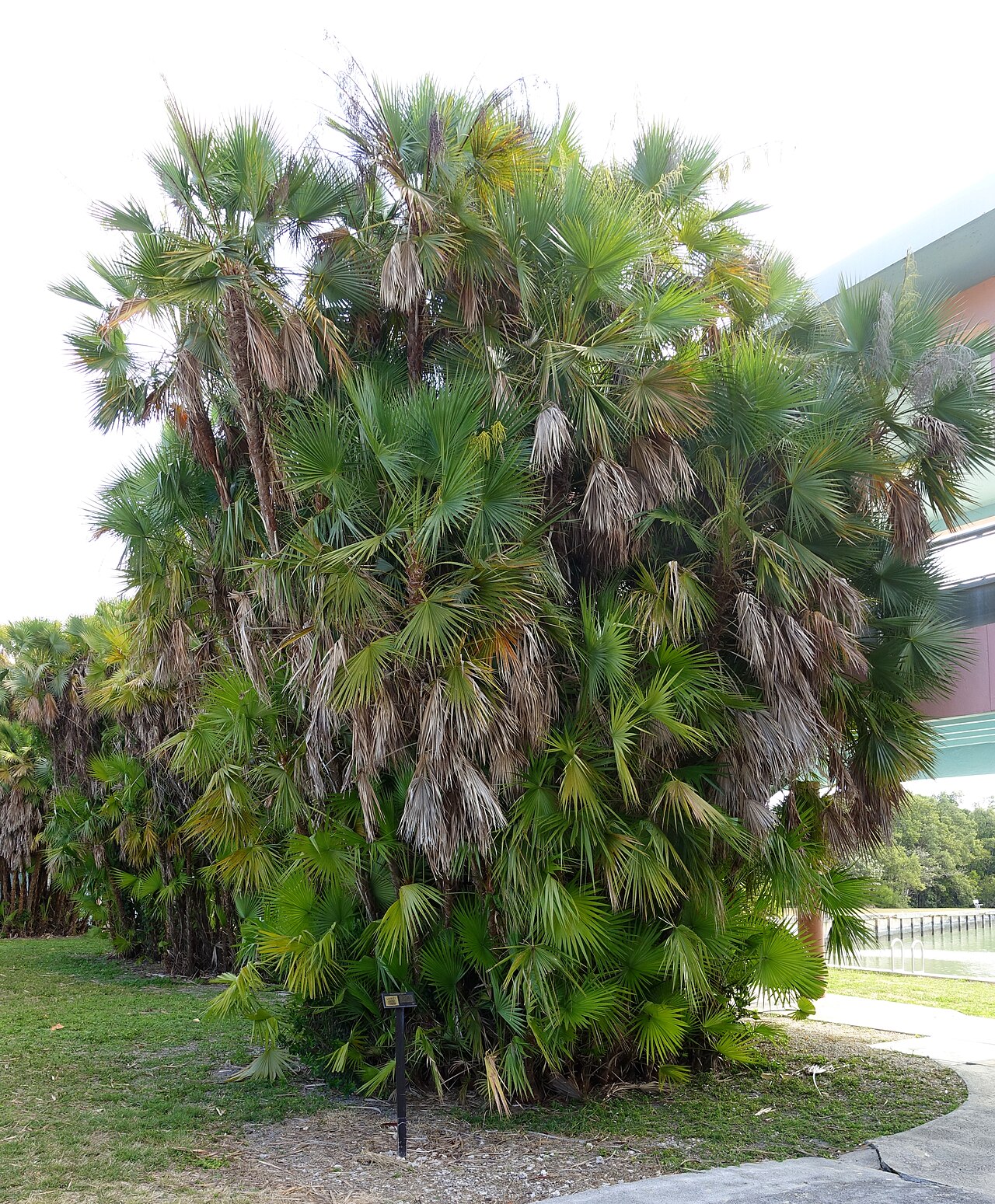
Acoelorraphe wrightii (also written Acoelorrhaphe wrightii), commonly called Paurotis Palm or Everglades Palm, is the only clustering, multi-trunked fan palm native to the United States. It is a defining plant of the Florida Everglades, where dense stands of this slender, many-stemmed palm rise straight out of seasonally flooded sawgrass marshes and the brackish edges of coastal wetlands, giving its name to the famous Paurotis Pond overlook in Everglades National Park.
Unlike most palms, which grow as a single trunk from a single root system, Paurotis Palm continually produces new shoots (suckers) at its base, so a single plant develops into a wide, dense clump of 20 or more trunks of varying heights and ages over time, topped with bright green to yellow-green fan-shaped fronds. Mature clumps reach 20 to 35 feet tall and can spread 15 to 25 feet wide, forming a strikingly architectural, almost thicket-like mass that reads as a grove even though it is genetically one plant.
For South Florida gardeners, Paurotis Palm is both a true native wetland specialist and a widely admired landscape palm, prized for its graceful multi-trunk form, tolerance of wet or seasonally flooded soil, and reasonable salt tolerance near the coast. It is slow-growing and cold-sensitive, which limits it to the warmest parts of the state, but where it thrives, few native palms make as dramatic a statement.
Identification
Paurotis Palm is unmistakable once its clustering habit is recognized: a single plant sends up many slender trunks, typically 4 to 6 inches in diameter, from a shared base, so that what looks like a grove of palms is usually one individual. Trunks within a clump vary in height, from short new suckers at the edges to the oldest, tallest stems reaching 20 to 35 feet in the center.
Trunk & Stems
Trunks are slender and often leaning or slightly curved, covered in a dense mat of old, persistent leaf bases and fibers, especially on younger stems; older trunks below the canopy may shed this covering and show a smoother gray surface. New sucker shoots continually emerge from the base of the clump, which is how the plant steadily widens over the years.
Leaves
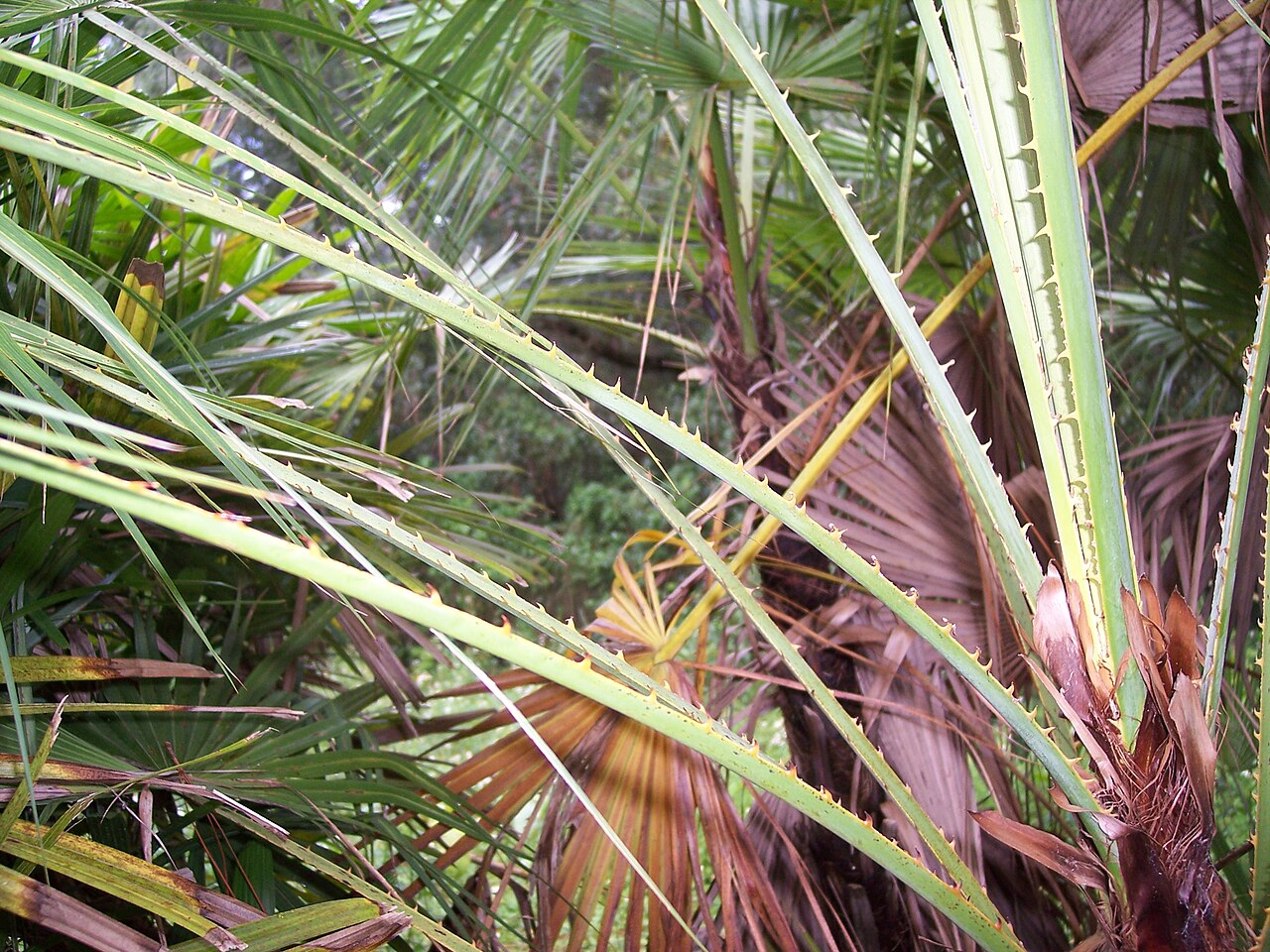
Leaves are costapalmate (fan-shaped with a slight midrib-like costa), 2 to 3 feet across, divided into many stiff, pointed segments, and colored bright to yellow-green, sometimes with a silvery cast on the underside. The leaf stalks (petioles) are armed along their edges with small, sharp, curved teeth or spines, a key identification feature that distinguishes Paurotis Palm from the unarmed petioles of cabbage palm and most other native fan palms.
Flowers & Fruit
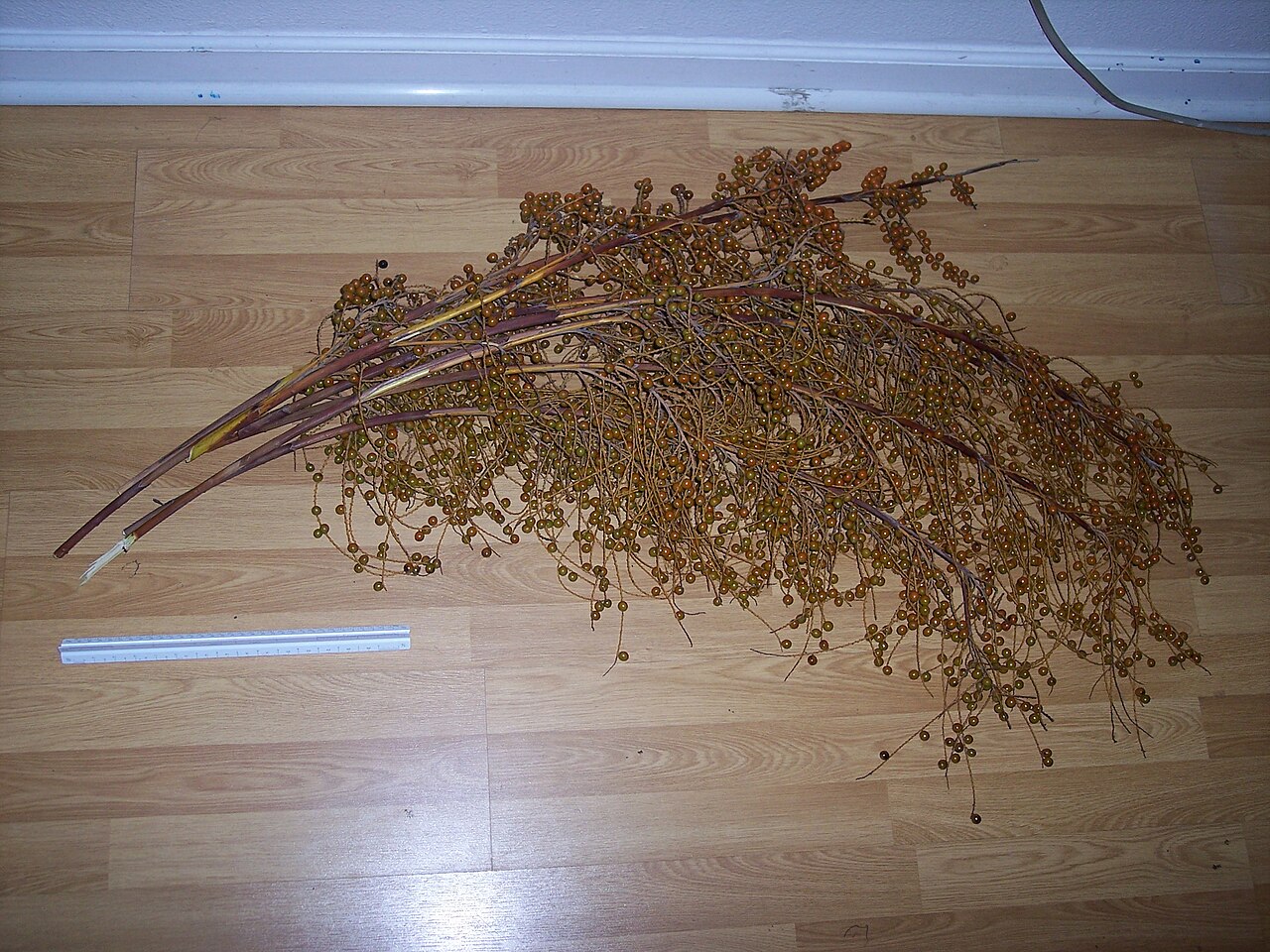
Small, fragrant, creamy white to yellow flowers form on branched flower stalks that emerge from among the leaves, blooming primarily in summer. The flowers give way to round, pea-sized fruits that ripen from green to orange and finally a deep blackish purple, hanging in large, showy, cascading clusters that can persist on the plant for weeks, adding significant ornamental interest even after bloom.
Quick Facts
| Scientific Name | Acoelorraphe wrightii (syn. Acoelorrhaphe wrightii) |
| Family | Arecaceae (Palm) |
| Plant Type | Evergreen, multi-trunked clustering palm |
| Mature Height | 20–35 ft |
| Mature Spread | 15–25 ft (clumps widen slowly over decades) |
| Growth Rate | Slow |
| Sun Exposure | Full Sun to Part Shade |
| Water Needs | High; tolerates seasonal flooding and standing water |
| Soil Type | Wet, marshy, sandy, limestone-based; tolerates poor drainage |
| Soil pH | Neutral to alkaline |
| Bloom Time | Summer, with some variation by location |
| Flower Color | Creamy white to yellow |
| Fall Color | None (evergreen) |
| Fruit | Pea-sized drupes, green ripening to blackish purple |
| Deer Resistant | Yes |
| USDA Hardiness Zones | 9b–11 (cold-sensitive; foliage damage below the high 20s°F) |
Native Range
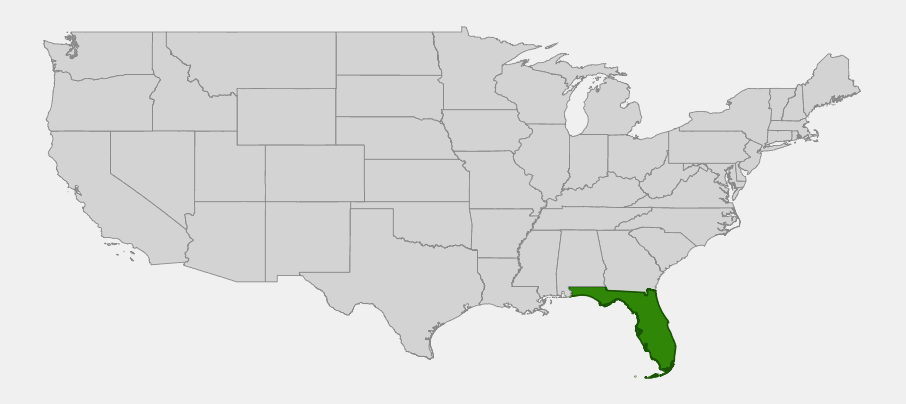
In the United States, Paurotis Palm is native only to the southern tip of Florida, where it is a defining plant of the Everglades and nearby wetlands in Miami-Dade, Monroe and Collier counties. It also occurs naturally in Cuba, the Bahamas, Mexico’s Yucatán Peninsula and parts of Central America, but within the continental U.S. its native range is limited to this small corner of subtropical South Florida.
Typical native habitat is seasonally flooded marl prairie and sawgrass marsh, the edges of cypress domes and sloughs, and the brackish, slightly saline margins of coastal wetlands, where Paurotis Palm tolerates both standing fresh water for much of the year and occasional exposure to salt spray or brackish water near the coast. Dense stands, sometimes called “paurotis palm heads” or “palm islands,” are a recognizable feature of the Everglades landscape, often rising as a slightly elevated hammock within the open marsh.
Because its true native range is so narrow and tied to intact South Florida wetlands, Paurotis Palm is best suited as a landscape plant in Miami-Dade, Broward, Monroe and similarly warm coastal counties; farther north in the state, cold snaps become a real limiting factor, and plants are more likely to suffer frond damage or dieback in a hard freeze.
📋 Regional plant lists featuring Paurotis Palm: this site does not currently publish a dedicated South Florida regional list; see the Florida nursery directory below.
Growing & Care Guide
Paurotis Palm rewards South Florida gardeners who can give it what the Everglades gives it naturally: plenty of water, warmth and sun. It is slow to establish but, once settled, becomes a long-lived, relatively low-maintenance landscape feature.
Light
Plant Paurotis Palm in full sun to light shade. Full sun produces the fullest, most compact clump with the best fruiting display; young plants establishing in part shade will stretch somewhat toward available light but still perform reasonably well.
Soil & Water
This is one of the most water-loving palms available for Florida landscapes, naturally adapted to standing water for extended periods. It grows well in wet, poorly drained or seasonally flooded soils, including sandy and limestone-based substrates, and tolerates some brackish influence near the coast. It also adapts reasonably well to typical garden irrigation once established, though it will not thrive in a consistently dry site. Mulching helps retain moisture in better-drained landscape soils.
Planting Tips
Plant container-grown Paurotis Palm in warm weather, spring through summer, to give roots time to establish before any cool-season stress. Choose a site with reliable moisture, such as a pond edge, low spot or irrigated bed, and allow for the clump’s eventual 15- to 25-foot spread as new suckers fill in over the years. Because it is cold-sensitive, avoid low frost pockets and plant it only within its true USDA zone 9b to 11 comfort range.
Pruning & Maintenance
Remove dead or badly damaged fronds as needed, cutting them close to the trunk; because the plant produces many trunks, maintenance is more involved than for a single-trunk palm, but each stem is otherwise easy to manage individually. Some gardeners selectively remove excess suckers to control the ultimate size and density of the clump, while others let it fill in naturally for the fullest effect. The petiole spines make pruning worth doing with heavy gloves and long sleeves.
Propagation
Paurotis Palm is grown from seed, which should be cleaned of fruit pulp and sown fresh, since viability drops as seed dries out; germination can be slow and uneven. Because the species naturally suckers, established clumps can occasionally be propagated by carefully separating rooted offshoots from the parent, though this is more difficult than simple seed propagation and risks damaging the clump.
Landscape Uses
- Pond and water-feature edges, where its flood tolerance is a genuine asset
- Wetland and rain garden plantings in South Florida landscapes
- Specimen clump for a dramatic multi-trunk silhouette
- Coastal and near-coastal landscaping, thanks to reasonable salt tolerance
- Native wildlife gardens alongside cabbage palm and saw palmetto
Wildlife & Ecological Value
As one of the few true trees able to establish in the open, seasonally flooded prairies of the Everglades, Paurotis Palm plays an outsized role in a landscape otherwise dominated by sawgrass and low marsh vegetation.
For Pollinators
The small, fragrant summer flowers attract bees and other insects, offering a nectar source in a habitat where woody flowering plants are relatively scarce.
For Birds
The dense, multi-trunked clumps provide valuable nesting and roosting cover in open marsh habitat where tall vegetation is otherwise limited, and wading birds and songbirds alike use “palm heads” as elevated perches and shelter above the flooded prairie. The abundant small fruits are eaten by a range of birds.
For Mammals
Raccoons and other mammals feed on the ripe fruit, and the dense clumps offer cover for small wildlife moving through the open marsh. In the Everglades, these palm stands function as miniature habitat islands within the surrounding wetland.
Ecosystem Role
Paurotis Palm stands, known locally as palm heads, create slightly elevated microhabitats within the marl prairie and sawgrass marsh, adding structural diversity to an otherwise low, open landscape. Their root systems help stabilize the thin soils of these seasonally flooded prairies, and the shade and shelter they provide support species that would otherwise have little woody cover in the open Everglades.
Cultural & Historical Uses
Paurotis Palm takes its common name from the historic Paurotis Pond area of Everglades National Park, itself named for an earlier scientific name applied to the species before it was reclassified into the genus Acoelorraphe. The Everglades palm or Madeira palm names reflect its two defining associations: the wetland habitat where it is most famous, and an old common reference sometimes used in the nursery trade.
Throughout its broader Caribbean and Central American range, local communities have used the fibrous leaf bases and fronds for thatch and basic weaving, much as other native fan palms have been used regionally, though Paurotis Palm has never been a major commercial fiber or food source compared with more widely cultivated palms.
Today its primary human value is horticultural. Paurotis Palm has become one of the most sought-after native landscape palms in South Florida, prized for its distinctive clumping silhouette, tolerance of wet sites that defeat many other ornamentals, and status as a genuinely native alternative to non-native clustering palms in the regional nursery trade.
Frequently Asked Questions
Is Paurotis Palm the same as Everglades Palm?
Yes, Everglades Palm and Madeira Palm are both common names for the same species, Acoelorraphe wrightii, named for its signature habitat in the Florida Everglades.
How cold-hardy is Paurotis Palm?
It is reliably hardy in USDA zones 9b through 11 but is sensitive to hard freezes, with foliage damage possible as temperatures drop into the high 20s°F. It is best suited to the warmest parts of South Florida rather than the northern half of the state.
Why does Paurotis Palm have so many trunks?
Unlike most palms, Paurotis Palm continually produces new sucker shoots at its base, so a single plant develops into a dense clump of many trunks of different ages and heights over the years, rather than growing as one single stem.
Does Paurotis Palm tolerate wet soil?
Very well. It is naturally adapted to the seasonally flooded marshes of the Everglades and tolerates standing water for extended periods, making it one of the best native palm choices for pond edges and consistently wet landscape sites.
How fast does Paurotis Palm grow?
It is a slow-growing palm. New clumps take years to develop their full, dense, multi-trunked form, so patience is required, but the resulting mature specimen is long-lived and visually striking.

Looking for a nursery that carries Paurotis Palm?
Browse our native plant nursery directory: Florida. See also our guides to palm trees for Florida and palm trees for Tampa.

