
Southern Shagbark Hickory (Carya carolinae-septentrionalis)
Carya carolinae-septentrionalis, the Southern Shagbark Hickory (also called Carolina Hickory), is a Deep South relative of the familiar Shagbark Hickory that most field guides and gardeners rarely treat as a thing apart. Most current taxonomic sources, including Plants of the World Online, fold it into Carya ovata as a variety, C. ovata var. australis, distinguished mainly by smaller leaflets and a smaller nut. USDA PLANTS, however, keeps it on the books as its own accepted species with its own symbol, a position that reflects older but still-used regional floras of the Southeast. We follow the USDA treatment here and build it as its own page, while noting throughout that you may also see this tree sold, described, or mapped simply as Shagbark Hickory.
Whichever name you use, the tree itself is unmistakably a hickory: tall, slow-growing, deeply rooted, and extremely long-lived, with the shaggy, curling bark that gives the group its common name once trees reach maturity. Southern Shagbark Hickory occupies a more restricted range than typical Shagbark Hickory, centered on the Piedmont and lower mountains of the Southeast, where it grows on dry ridges, rocky slopes, and the edges of upland oak-hickory woods rather than rich bottomland. For gardeners in the Carolinas, Georgia, Alabama, Tennessee, and Virginia who want a genuinely regional native shade and nut tree with a strong wildlife résumé, it is worth seeking out — understanding that you are planting what most nurseries and some botanists would simply call a Southern-form Shagbark Hickory.
Like all true hickories, this tree develops a long taproot early and does not transplant well once established, so container-grown stock from a native plant nursery or direct seeding are the practical ways to start one. The payoff for that early patience is a tree that can live well over a century, producing sweet, edible nuts and dense wood prized for its strength and the clean smoke it gives off when burned.
Identification
Southern Shagbark Hickory is a medium to large deciduous tree, generally smaller in stature than typical northern Shagbark Hickory, reaching 50 to 80 feet in height with a narrower, more open crown. The trunk is usually straight, and like other shagbark-type hickories, the bark is the tree’s signature feature once it matures.
Bark
Young trees have smooth, gray bark. With age, the bark separates into long, thick plates that curl outward at the ends and often hang loosely from the trunk, giving the tree a distinctively shaggy, unkempt silhouette that is one of the easiest ways to identify any shagbark-type hickory at a glance, even from a moving car.
Leaves
Leaves are pinnately compound, typically 8 to 14 inches long, usually with 5 leaflets (occasionally 7). The terminal three leaflets are noticeably larger than the basal pair. Compared with typical Shagbark Hickory, Southern Shagbark Hickory’s leaflets run smaller overall, generally under 8 inches for the largest leaflet, which is one of the characters used to separate the two forms where ranges meet. Margins are finely toothed, and the foliage turns a rich golden yellow in fall.
Flowers & Fruit
The tree is monoecious, with drooping yellow-green male catkins and small female flower spikes appearing with the new leaves in spring. The fruit is a round to slightly oval nut enclosed in a thick husk that splits into four sections at maturity. Southern Shagbark Hickory’s nuts run smaller than those of typical Shagbark Hickory, generally under an inch across, but the kernel is sweet and well regarded among wild hickory nuts.
Quick Facts
| Scientific Name | Carya carolinae-septentrionalis |
| Also Known As | Carya ovata var. australis; Carolina Hickory |
| Family | Juglandaceae (Walnut) |
| Plant Type | Deciduous Tree |
| Mature Height | 50–80 ft |
| Mature Spread | 30–45 ft |
| Growth Rate | Slow |
| Sun Exposure | Full Sun to Partial Shade |
| Water Needs | Low to Moderate |
| Soil Type | Well-drained; rocky, sandy or loamy upland soils |
| Soil pH | Acidic to slightly acidic |
| Bloom Time | April – May |
| Fall Color | Golden yellow |
| Fruit | Small, sweet-kerneled nut in a four-valved husk |
| Wildlife Value | High — nuts feed squirrels, chipmunks and many birds |
| USDA Hardiness Zones | 7–9 |
Native Range
Southern Shagbark Hickory occurs in the Piedmont and lower mountains of the Southeast, from Virginia and North Carolina south through South Carolina, Georgia, and Alabama, with scattered populations recorded eastward into Tennessee. It favors dry, rocky or sandy ridges and upland slopes, overlapping with typical Shagbark Hickory in parts of its range but generally replacing it on the drier, more southerly sites within the Piedmont and foothill country. BONAP county-level records concentrate most heavily in Georgia, Alabama, and South Carolina, with lighter, more scattered native county records across North Carolina, Tennessee, and southern Virginia; plant it with that more concentrated core range in mind if you are near the edges of the listed states.
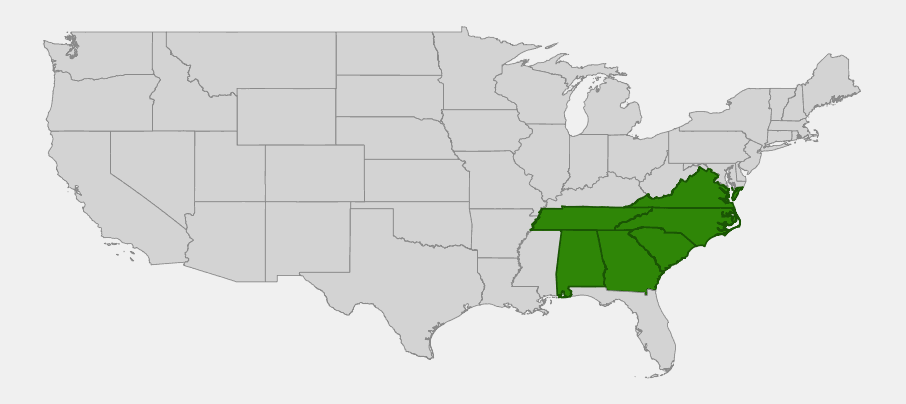
📋 Regional plant lists featuring Southern Shagbark Hickory: Georgia, Alabama & Mississippi · North Carolina & South Carolina · Kentucky & Tennessee · Maryland, Virginia & West Virginia
Growing & Care Guide
Southern Shagbark Hickory is undemanding once established, but its deep taproot means establishment itself takes patience and a bit of planning.
Light
Plant in full sun for the strongest growth and best nut production. Young trees tolerate partial shade as forest understory saplings, persisting for years while they wait for a gap in the canopy, but they grow and fruit best once they reach full sun.
Soil & Site
This tree wants well-drained, even rocky or sandy soil on a slope or ridge rather than a low, wet spot — it is a dry-site specialist among hickories. Avoid heavy clay that stays wet, and choose the permanent planting site carefully, since the long taproot makes relocation essentially impossible after the first year or two.
Water
Water regularly through the first two growing seasons to help the taproot establish, then taper off. Mature trees are drought-tolerant and rarely need supplemental watering once their root system is in place.
Planting
Start with small container stock (1 to 3 gallon) rather than larger balled-and-burlapped trees, since smaller hickories transplant far more reliably. Direct-seeding fresh nuts in fall, protected from squirrels with a wire cage, is also a reliable and inexpensive way to establish this tree where you want it to grow permanently.
Pruning & Maintenance
Little pruning is needed beyond removing dead, damaged, or crossing branches in the dormant season. Give the tree plenty of room to reach its mature spread — it is not a tree for small urban lots.
Landscape Uses
- Regional shade tree for larger Piedmont and Southeastern properties
- Woodland restoration on dry, rocky, or sandy upland sites within its native range
- Wildlife plantings alongside Shagbark Hickory and other upland oak-hickory species
- Nut production for foragers and wildlife managers wanting a regionally appropriate hickory
- Legacy planting for anyone establishing a long-term native woodland — hickories commonly outlive the people who plant them
Wildlife & Ecological Value
Hickories are among the most valuable wildlife trees of the eastern forest, and Southern Shagbark Hickory contributes the same benefits within its more limited Piedmont and foothill range.
For Mammals
Gray squirrels and fox squirrels are the primary consumers and planters of hickory nuts, burying far more than they eat and inadvertently seeding new trees. Chipmunks, white-footed mice, and white-tailed deer also use the nuts and foliage, with deer browse sometimes limiting seedling survival in heavily populated areas.
For Birds
Wild turkeys forage for fallen nuts, and woodpeckers work the bark and deadwood of mature trees for insects. A large, open-grown specimen also provides valuable nesting cover in its dense crown.
For Pollinators & Insects
Like other hickories, this tree hosts the larvae of a number of native moths, including the hickory horned devil, the caterpillar stage of the regal moth — one of the largest and most striking moths in North America.
Ecosystem Role
As a long-lived component of dry Piedmont and foothill oak-hickory forest, Southern Shagbark Hickory helps anchor erodible slopes with its deep root system and contributes structural diversity to a forest type that has lost ground to development across much of the Southeast.
Cultural & Historical Uses
Hickory wood, including that of Southern Shagbark Hickory, is dense, strong, and shock-resistant, historically used for tool handles, wagon parts, and other applications requiring toughness under stress. It remains a favorite wood for smoking meat, prized for its mild, sweet smoke. Indigenous peoples across the Southeast relied on hickory nuts as a significant food source, pounding and boiling the kernels to make an oily liquid used in cooking, sometimes called hickory milk. This is a matter of historical record, not a suggestion to forage and prepare wild nuts without proper identification and preparation knowledge.
Frequently Asked Questions
Is Southern Shagbark Hickory a different species from Shagbark Hickory?
It depends on which authority you follow. USDA PLANTS lists it as its own species, Carya carolinae-septentrionalis, while many current botanical references, including Plants of the World Online, treat it as Carya ovata var. australis, a southern variety of the same species. Either way, you are looking at the same tree: a shagbark-type hickory native to the Piedmont and foothills of the Southeast.
How do I tell it apart from typical Shagbark Hickory?
The most consistent differences are size: Southern Shagbark Hickory tends to have smaller leaflets (generally under 8 inches on the largest leaflet) and a smaller nut than typical Shagbark Hickory, along with a more southerly, Piedmont-centered range. The shaggy, curling bark looks essentially the same on both.
Can you eat the nuts?
Yes, the kernels are sweet and edible, though smaller than those of typical Shagbark Hickory. Confirm identification before eating any wild nut, and expect squirrels to claim much of the crop first.
Why is it hard to find at nurseries?
Its deep taproot makes it difficult to grow in containers past a certain size and resistant to transplanting, so general nurseries rarely stock it. Look to native plant specialty nurseries in its home range, or grow it from seed.
How fast does it grow?
Slowly. Like other hickories, it invests heavily in root development before putting on much height, and it is not considered a fast-growing shade tree at any life stage.

Looking for a nursery that carries Southern Shagbark Hickory?
Browse our native plant nursery directory: Alabama & Arkansas · Delaware, Florida & Georgia · New Hampshire, New Jersey, New York, North Carolina, Ohio & Oklahoma · Pennsylvania, South Carolina, Tennessee, Texas & Virginia
Related reading: Is Hickory Good for Firewood? · Planting Native Trees for Wildlife · Woodland Garden Design with Natives

