
Shortleaf Wild Coffee (Psychotria tenuifolia)
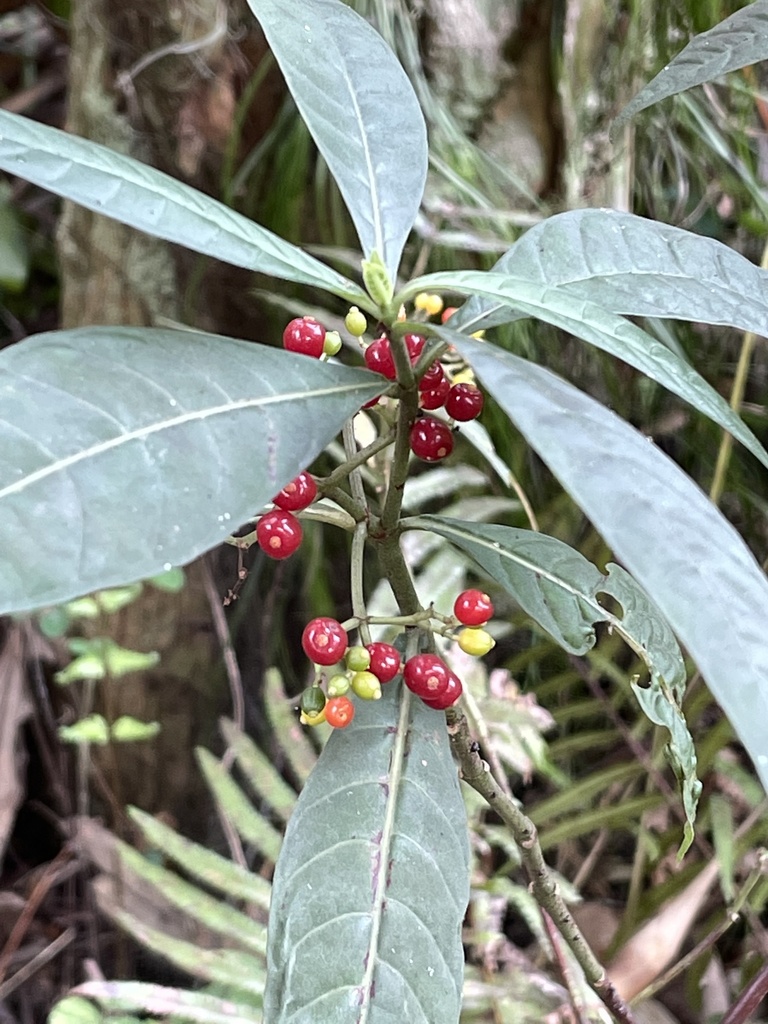
Psychotria tenuifolia, known as Shortleaf Wild Coffee and often sold in Florida as velvetleaf wild coffee or Sulzner’s wild coffee, is an evergreen shrub of shady hammocks in central and southern Florida. It belongs to the madder or coffee family (Rubiaceae), the same family as the coffee plant, and like true coffee it has opposite leaves, small white flowers and paired seeds inside bright fruits. Most Florida references and native nurseries still list it under its older name, Psychotria sulzneri.
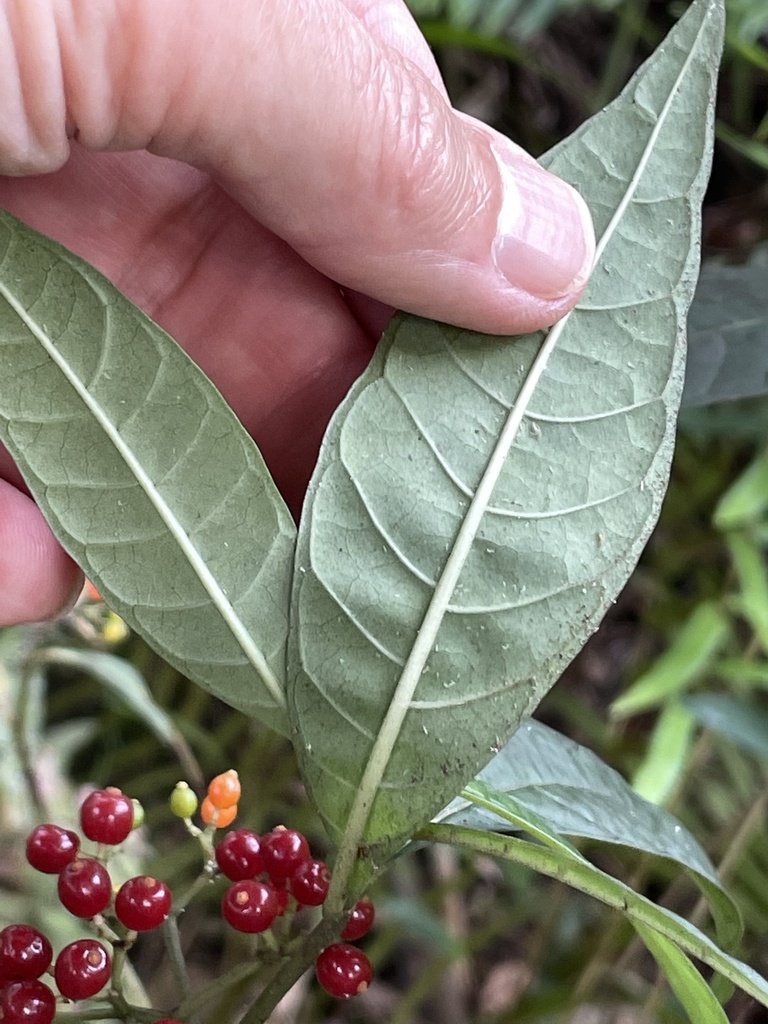
Gardeners who know common wild coffee (Psychotria nervosa) will notice the difference at once. Shortleaf wild coffee has thinner, matte, gray-green to bluish-green leaves with a soft, slightly velvety look, and its veins lie flat instead of forming the deep, glossy quilting of its cousin. In spring and summer it carries small clusters of white flowers at the branch tips, and from fall into winter those ripen into orange to red fruits that birds strip quickly.
It is one of the most useful native shrubs for dry or moist shade in frost-light parts of Florida, where it fills the understory beneath oaks and cabbage palms and feeds birds through the cool season. This guide covers how to tell it from other wild coffees, where it grows naturally, how to grow it, and its value to wildlife.
Identification
Three wild coffees are native to Florida: shortleaf wild coffee, common wild coffee (P. nervosa) and Bahama wild coffee (P. ligustrifolia) of the Keys and far south Florida. Leaf texture is the quickest way to separate them, and shortleaf wild coffee is the only one with dull, soft, grayish leaves.
Growth Habit
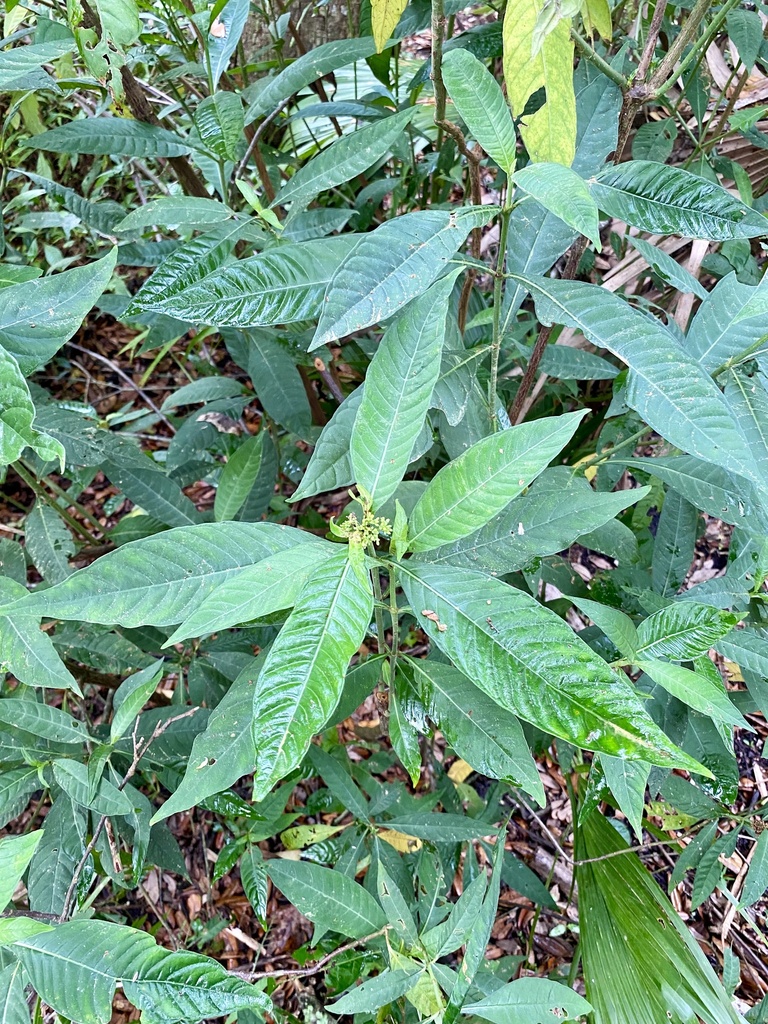
Shortleaf wild coffee is a loosely branched, multi-stemmed evergreen shrub, usually 2 to 4 feet tall in the wild and up to about 6 feet in good shade and moisture. Young stems are green and slightly hairy, and older stems turn gray-brown. In deep shade it grows open and airy, and in brighter spots it becomes denser.
Leaves
The leaves are opposite, simple and untoothed, elliptic to lance-shaped, generally 3 to 6 inches long, and taper to a point at both ends. They are thin and matte, dull green to gray-green or bluish-green above and noticeably paler beneath, with a fine, soft surface. The side veins are straight and not sunken. Common wild coffee, by contrast, has thick, very glossy, bright green leaves with deeply impressed veins.
Flowers
Small white to greenish-white flowers open in compact, branched clusters (cymes) at the tips of the shoots. Each flower is tubular, about ¼ inch long, with five short spreading lobes. Plants can bloom from spring into late summer, with the heaviest flowering in spring and early summer.
Fruit
The fruits are small, oval drupes about ¼ inch long. They ripen in fall and winter from green through yellow and orange to glossy red, so a single cluster often shows several colors at once. Each contains two ribbed seeds pressed together like a tiny coffee bean. The fruits are not toxic to people as far as is known, but they are bland and are best left for birds.
Quick Facts
| Scientific Name | Psychotria tenuifolia (syn. P. sulzneri) |
| Family | Rubiaceae (madder or coffee family) |
| Plant Type | Evergreen shrub |
| Mature Height | 2–4 ft (up to about 6 ft) |
| Mature Spread | 2–4 ft |
| Growth Rate | Moderate |
| Sun Exposure | Part shade to full shade |
| Water Needs | Low to moderate; tolerates dry shade once established |
| Soil Type | Sandy or loamy soils, including limestone and shell-rich soils |
| Soil pH | About 5.5–8.0 |
| Bloom Time | Spring through summer |
| Flower Color | White to greenish white |
| Fall Color | None; evergreen |
| Fruit | Orange to red drupes, fall–winter |
| Deer Resistant | No; deer sometimes browse wild coffees |
| USDA Hardiness Zones | 9–11 |
Native Range
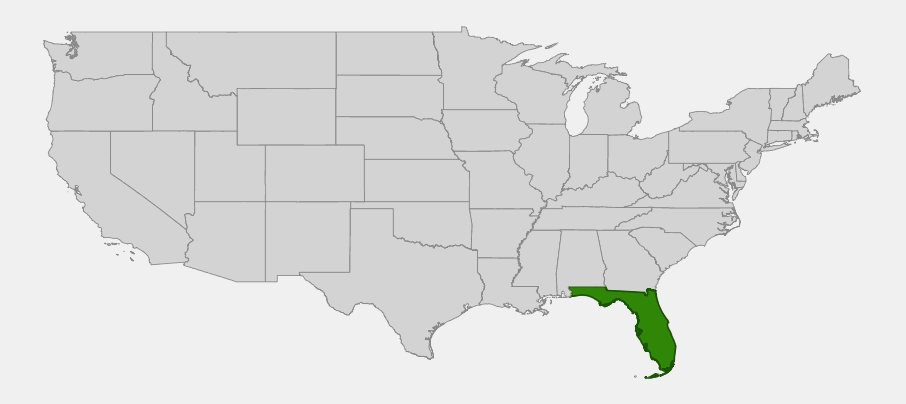
In the United States, shortleaf wild coffee grows only in Florida. USDA PLANTS lists it as native to the lower 48 states (Florida), Puerto Rico and the U.S. Virgin Islands, and the Atlas of Florida Plants records it as a native species. In Florida it occurs mainly in the central and southern peninsula, in hammocks and shady woods on both coasts and inland.
Beyond Florida, Psychotria tenuifolia is a Caribbean species. It was first described by Olof Swartz from Hispaniola in 1788, and in the broad sense now used by USDA and the Atlas it also grows in Puerto Rico, the Virgin Islands and other islands of the West Indies. Florida plants were long treated as a separate species, P. sulzneri, which some botanists and many nurseries still use.
Within its Florida range it is a plant of tropical and subtropical hardwood hammocks, shell mounds and moist, shady forest edges, often under live oak and cabbage palm. It tolerates drier, sandier sites than common wild coffee and is usually found in deeper shade, but it is sensitive to hard freezes, which limits it to the warmer parts of the state.
📋 Regional plant lists featuring Shortleaf Wild Coffee: North & South Florida
Growing & Care Guide
Shortleaf wild coffee is an easy, low-maintenance shrub for shade gardens in central and south Florida. It is less common in the trade than common wild coffee, but native plant nurseries in Florida usually offer it as Psychotria sulzneri. Buy nursery-grown plants rather than digging them from hammocks.
Light
Plant it in partial to full shade. It does best under a high canopy of oaks, palms or pines, where it gets filtered light. In full sun the leaves tend to yellow and scorch, especially in sandy soil.
Soil & Water
It grows in a wide range of well-drained soils, from sand to limestone-based and shell-rich soils, and tolerates both acidic and alkaline conditions. Water regularly for the first few months after planting. Once established it handles dry spells in shade well and needs watering only during long droughts. It does not tolerate standing water or salt spray.
Planting Tips
Space plants about 2 to 3 feet apart for a loose understory or a low informal hedge in shade. Mix in leaf litter or compost to imitate a hammock floor, and mulch with leaves. It combines well with ferns, coontie, marlberry and other shade-tolerant natives.
Pruning & Maintenance
Little pruning is needed. Pinch or cut back leggy stems in late winter, after birds have taken most of the fruit, to keep plants bushier. Avoid heavy shearing, which removes the flower clusters at the branch tips. After a freeze, wait until new growth appears in spring before cutting out damaged wood. Plants that are frozen back usually resprout from the base.
Propagation
Grow it from fresh seed: clean the pulp from ripe fruits and sow the seeds at once in a moist, shaded pot. Germination can take one to several months. Semi-hardwood cuttings taken in the warm season also root under mist or in a covered pot.
Landscape Uses
- Shade gardens: fills the understory beneath oaks and palms where few flowering shrubs thrive
- Wildlife gardens: fall and winter fruit for birds, and spring–summer flowers for small pollinators
- Informal hedges and screens: a soft, gray-green hedge in shady side yards
- Hammock restoration: replanting the shrub layer in coastal and inland hammocks within its range
- Woodland edges: transition planting between lawn and shady woods
Wildlife & Ecological Value
Like other wild coffees, shortleaf wild coffee is valued in Florida wildlife gardens because it flowers over a long season and holds colorful fruit through the cooler months, when food for birds is scarcer.
For Pollinators
The small white flowers produce nectar and are visited by small bees, wasps, flies and small butterflies. Because flowering is spread over many months, it provides a steady nectar source in shady parts of the garden.
For Birds
Fruit-eating birds take the orange and red fruits, including northern mockingbirds, gray catbirds, northern cardinals, thrushes and wintering warblers. Birds swallow the fruits whole and spread the seeds, which is why wild coffees often appear under perches.
For Mammals
Small mammals may eat fallen fruit, and deer sometimes browse the leaves and shoots. The dense shrub layer it forms also gives cover to small animals.
Ecosystem Role
Shortleaf wild coffee is part of the shrub layer of Florida’s hardwood hammocks, which are among the most species-rich plant communities in the state. As a bird-dispersed, shade-tolerant shrub it helps fill gaps in the understory and feeds the birds that carry the seeds of many other hammock plants.
Cultural & Historical Uses
The name wild coffee comes from the plant’s family resemblance to coffee: both have glossy-fruited, opposite-leaved shrubs with two seeds per fruit. The seeds of Florida’s wild coffees are sometimes said to have been roasted as a coffee substitute, but they lack the caffeine of true coffee, and there is no reason to try it.
Psychotria is one of the largest genera of flowering plants, with well over a thousand species across the tropics. The Florida plants were described by the botanist John Kunkel Small as Psychotria sulzneri. In 1989 the botanist C. W. Hamilton concluded that they belong to the widespread Caribbean species P. tenuifolia, first described by Olof Swartz in 1788, and USDA PLANTS and the Atlas of Florida Plants now follow that treatment.
Because many Florida nurseries, books and plant lists still use the name Psychotria sulzneri, it helps to search under both names when buying the plant or looking for local information. The common names shortleaf wild coffee, velvetleaf wild coffee and Sulzner’s wild coffee all refer to the same shrub.
Frequently Asked Questions
Is shortleaf wild coffee the same as Psychotria sulzneri?
Yes. Psychotria sulzneri is the older name for Florida plants. USDA PLANTS and the Atlas of Florida Plants now treat them as Psychotria tenuifolia, but most nurseries still sell the plant as P. sulzneri or velvetleaf wild coffee.
How is it different from common wild coffee?
Common wild coffee (Psychotria nervosa) has thick, very glossy, bright green leaves with deeply sunken veins. Shortleaf wild coffee has thinner, dull, gray-green leaves with flat veins and a soft, slightly velvety look, and it tolerates drier shade.
Can you make coffee from it?
No. Although it is in the coffee family and its fruits contain paired, bean-like seeds, it has no caffeine and is not used as a beverage today. Leave the fruit for the birds.
Will shortleaf wild coffee survive a freeze?
Light frost may damage the leaves, and a hard freeze can kill plants to the ground. Established plants usually resprout from the base. It is best suited to central and south Florida, roughly USDA zones 9 to 11.
Does it grow in full sun?
It prefers partial to full shade. In full sun, especially in dry, sandy soil, the leaves tend to yellow and burn. Plant it under trees or on the shady side of a building.

Looking for a nursery that carries Shortleaf Wild Coffee?
Browse our native plant nursery directory: Florida