
Helmet Skullcap (Scutellaria integrifolia)
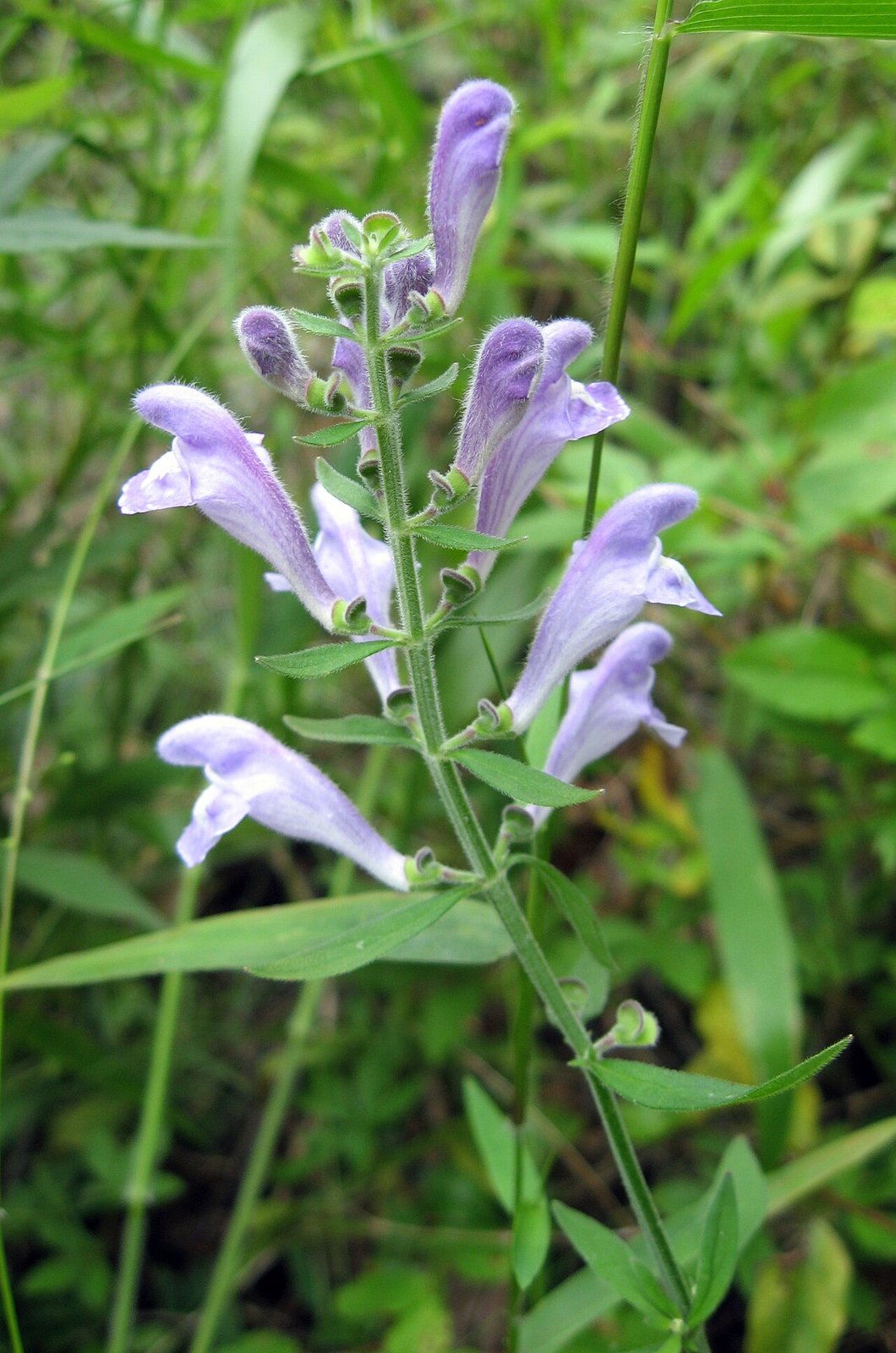
Scutellaria integrifolia, known as Helmet Skullcap, helmet flower or hyssop skullcap, is a native perennial in the mint family (Lamiaceae) and one of the showiest skullcaps of the eastern United States. In late spring it sends up slender, hairy stems 1 to 2 feet tall topped with loose spikes of blue-violet, two-lipped flowers nearly an inch long. Each flower has a hooded upper lip, the “helmet,” and a broad lower lip marked with a white patch. It grows in pine flatwoods and savannas, open oak and oak-hickory woods, sandy clearings, wet prairies and roadsides.
Skullcaps get their name from a tiny raised ridge, the scutellum, on the top of the flower’s calyx. After the corolla drops, the calyx closes over the developing seeds and looks like a little cap or helmet. Helmet skullcap differs from most of its relatives in its narrow, mostly untoothed upper leaves (the species name integrifolia means “entire-leaved”) and its comparatively large flowers, which make it easy to notice along a sunny woodland edge.
In Florida helmet skullcap is a fairly common spring wildflower from the Panhandle into the central peninsula, and the Florida Native Plant Society includes it among native plants suited to sunny, sandy to moist sites. It is not a nursery staple, but it is easy to grow from seed and fits well into a meadow, pineland or butterfly garden. This guide covers how to identify it, where it grows, how to grow it, and what it does for bees and other wildlife.
Identification
Helmet skullcap is a modest plant out of flower, but in bloom it is one of the easier skullcaps to name. Look for the combination of large flowers, a densely hairy stem, and narrow upper leaves without teeth.
Stems & Habit
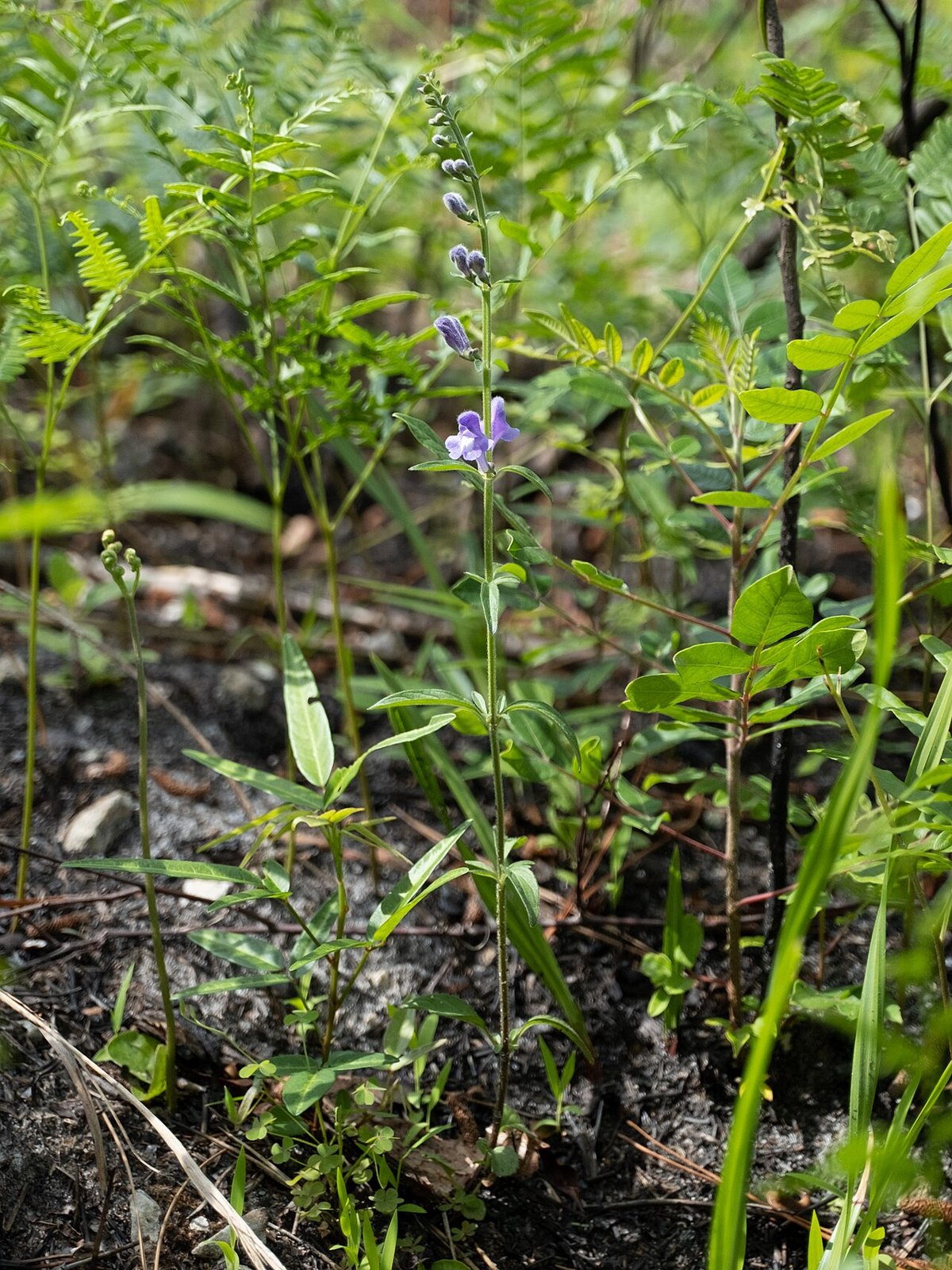
Plants grow from a short, somewhat woody base and produce one to several erect, square stems 6 inches to about 2½ feet tall, usually 1 to 2 feet. The stems are covered with fine, short hairs, and many plants branch near the base. There is no creeping rhizome, so helmet skullcap stays as a compact clump rather than spreading through the garden.
Leaves
Leaves are opposite, as in all mints, but helmet skullcap does not smell strongly minty. The lower leaves are small, ovate and often coarsely toothed, about ⅓ to 1¼ inches long, and many have withered by flowering time. The upper leaves are distinctly different: narrow, lance-shaped to linear, up to about 2 inches long, and usually with smooth (entire) margins. This change in leaf shape up the stem is one of the best field marks.
Flowers
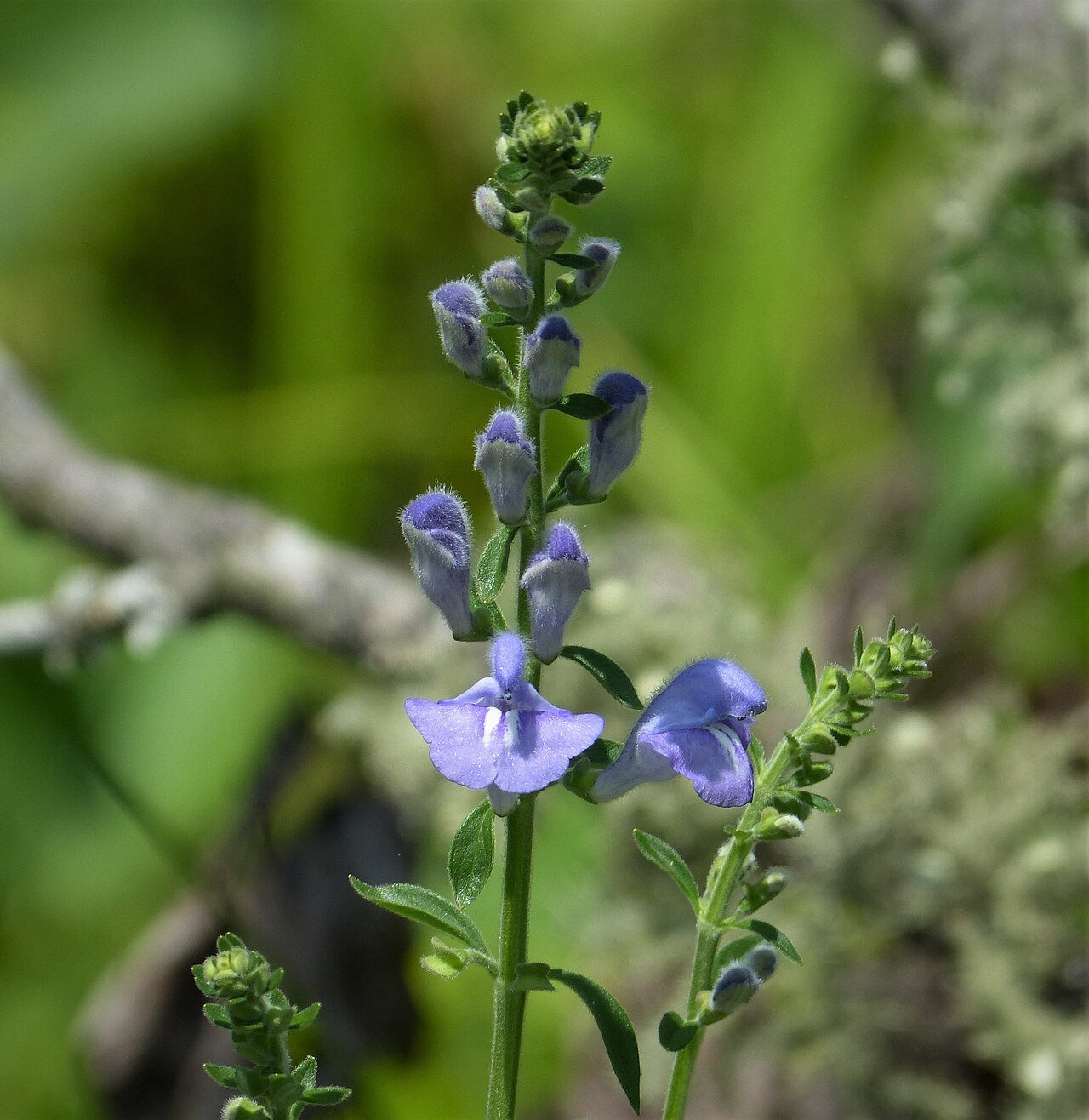
The flowers are borne in a loose, elongated raceme at the top of each stem, each one on a short stalk in the axil of a small bract-like leaf. The corolla is about ½ to 1 inch long, blue-violet to lavender (occasionally pinkish or white), finely hairy on the outside, with a long tube that curves upward. The upper lip forms a hood over the four stamens, and the wider lower lip is spread and marked with white in the center. Flowering starts in April in Florida and runs from May into July farther north.
Fruit & Seeds
After the flower falls, the two-lipped calyx closes over four small nutlets, and the raised cap on its back (the scutellum) becomes obvious. When ripe and dry, the upper half of the calyx falls away or the calyx splits open, and the dark, warty nutlets drop to the ground close to the parent plant. Seed ripens in early to mid summer.
Quick Facts
| Scientific Name | Scutellaria integrifolia L. |
| Family | Lamiaceae (mint family) |
| Plant Type | Herbaceous perennial wildflower |
| Mature Height | 1–2 ft (6 in to about 2½ ft) |
| Mature Spread | 6–12 in |
| Growth Rate | Moderate |
| Sun Exposure | Full sun to partial shade |
| Water Needs | Moderate; moist to seasonally wet soil, tolerates dry spells once established |
| Soil Type | Sandy, loamy or peaty acidic soils |
| Soil pH | About 4.5–6.5 (acidic) |
| Bloom Time | April–June in Florida; May–July farther north |
| Flower Color | Blue-violet to lavender with a white-marked lower lip; rarely pink or white |
| Fall Color | None of note |
| Fruit | Four small nutlets enclosed in a capped calyx |
| Deer Resistant | Generally not browsed heavily; bitter mint-family foliage |
| USDA Hardiness Zones | 5–9 |
Native Range
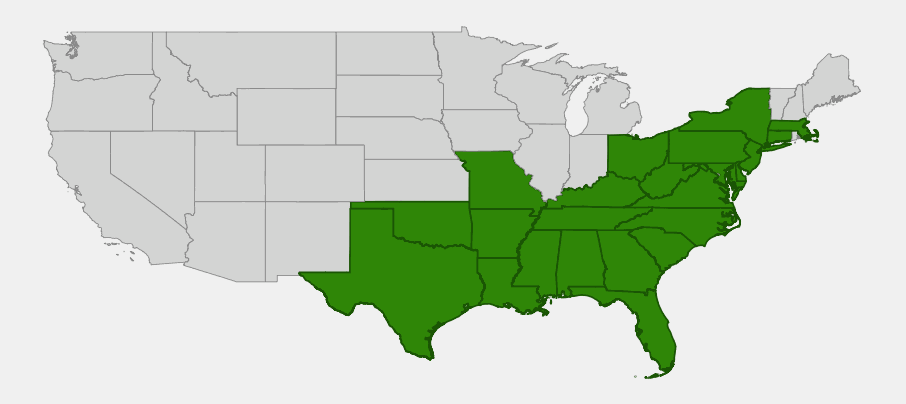
Helmet skullcap is native to the eastern United States. USDA PLANTS and the Lady Bird Johnson Wildflower Center record it from 23 states and the District of Columbia: from Massachusetts, Connecticut and New York south along the Atlantic seaboard to Florida, west across the Gulf states to eastern Texas and Oklahoma, and north in the interior to Arkansas, Missouri, Tennessee, Kentucky, Ohio and West Virginia.
It is most common on the Atlantic and Gulf Coastal Plain and the Piedmont, where it grows in longleaf pine flatwoods and savannas, open oak and oak-hickory woods, creek banks and sandy clearings. The Atlas of Florida Plants lists it as native, and in Florida it is found mainly from the Panhandle into the central peninsula. It becomes scarce at the northern edge of its range. The New England Plant Conservation Program has treated it as a rare plant in that region, where its fire-maintained openings have largely grown up into forest.
The plant grows in a wide range of soils, including sandy loam, loam, clay loam and peaty soils, but nearly always in open, sunny or lightly shaded places. Herbarium records from the Coastal Plain often note it at sites that had recently been burned, and it is most abundant where fire, mowing or other disturbance keeps shrubs from closing in.
📋 Regional plant lists featuring Helmet Skullcap: North & South Florida · Alabama, Georgia & Mississippi · North & South Carolina · Maryland, Virginia & West Virginia · Kentucky & Tennessee · Arkansas, Louisiana, Eastern Oklahoma & Eastern Texas · Illinois, Iowa & Missouri · Ohio & Indiana · New York, Pennsylvania & Northern New Jersey · Delaware, Southern New Jersey & Long Island · Connecticut, Massachusetts & Rhode Island
Growing & Care Guide
Helmet skullcap is an easy, undemanding wildflower once it has an open, sunny spot. It is seldom sold in garden centers, but native plant nurseries in the Southeast sometimes carry it, and it grows readily from seed. Like other wildflowers, collect seed only in small amounts and with permission rather than digging plants.
Light
Full sun gives the most compact plants and the heaviest bloom. Helmet skullcap also flowers in light or partial shade, such as the edge of an oak woodland or under high pine canopy. In deep shade it becomes lanky and flowers poorly.
Soil & Water
It grows best in acidic, sandy or loamy soil that is moist in spring and early summer. It handles seasonally wet flatwoods soils and also the drier, well-drained sand of upland pinelands once established. Rich garden soil and fertilizer are unnecessary and can make it floppy. Water new plants regularly for the first few weeks. After that, rainfall is usually enough in its native range.
Planting Tips
Set plants out in fall or early spring, 8 to 12 inches apart, in small groups of three to seven so the flowers make a visible show. Helmet skullcap is small and easily lost among larger perennials, so place it at the front of a border, along a path, or in a sunny meadow planting with low grasses such as wiregrass. It combines well with spring-blooming natives like golden aster, phlox and coreopsis.
Pruning & Maintenance
Little care is needed. Leave the stems standing after flowering until the seed has dropped, then cut them back if they look untidy. In larger meadow and pineland plantings, a burn or a mow in winter or very early spring keeps shrubs and tall grasses from shading it out, which is how the plant is maintained in the wild. Plants are generally free of serious pests and diseases.
Propagation
Grow it from seed. Collect the nutlets when the calyces turn brown in early summer, and sow them in fall outdoors or in a seed tray left outside over winter, lightly covered. A period of cool, moist conditions improves germination. Seedlings often flower in their second year. Established clumps can also be divided carefully in early spring, but plants with a single woody base do not divide easily.
Landscape Uses
- Pollinator gardens: its long-tubed flowers are worked mainly by bees, including bumblebees and leafcutter bees
- Pineland and flatwoods restoration: a typical groundcover wildflower of fire-maintained longleaf pine communities
- Meadow and prairie plantings: adds spring blue-violet color among low grasses and later-blooming asters
- Woodland edges: tolerates the light shade of open oak and pine woods
- Front of borders and rock gardens: a compact clump that fits small sunny spaces
Wildlife & Ecological Value
Helmet skullcap does not cover a lot of ground, but in spring it is one of the more reliable sources of nectar in open pinelands and meadows, and it is a good indicator that a site is still open and sunny.
For Pollinators
The flowers are built for bees. A bee lands on the broad lower lip, pushes into the curved tube for nectar, and picks up pollen on its back from the stamens hidden under the hood. Bumblebees and other medium to large bees are the main visitors, and the leafcutter bee Megachile georgica has been recorded visiting it in northern Florida. Butterflies and skippers occasionally probe the flowers as well.
For Birds
The small nutlets fall near the plant and are probably eaten by ground-feeding birds along with other small seeds, but helmet skullcap is not an important bird food. Its value to birds is mainly indirect, as part of the diverse groundcover that supports insects in pine savannas and woodland openings.
For Mammals
Like many mints, helmet skullcap contains bitter compounds, and it is not a preferred food of deer or rabbits. It is otherwise of little importance to mammals.
Ecosystem Role
Helmet skullcap is part of the species-rich herb layer of the longleaf pine ecosystem and other fire-maintained openings. It resprouts from its base after fire and often flowers well in the season after a burn. Where fire is excluded and shrubs close the canopy, it declines. Its scarcity at the northern edge of its range is linked to the loss of these open habitats.
Cultural & Historical Uses
Carl Linnaeus described Scutellaria integrifolia in 1753 in Species Plantarum. The genus name comes from the Latin scutella, a small dish or shield, after the raised cap on the calyx. The same feature gives skullcaps their English name: early botanists thought the fruiting calyx looked like a small helmet or skullcap.
Skullcaps as a group have a long history in herbal medicine, but most of that tradition refers to mad-dog skullcap, Scutellaria lateriflora, rather than this species. Helmet skullcap has occasionally been gathered as a substitute, and commercial “skullcap” products have at times been adulterated with other plants. This page does not recommend any medicinal use. Anyone interested in herbal use should rely on qualified medical advice.
For naturalists, helmet skullcap is above all a wildflower of the spring pinelands. It blooms around the same time as many of the early flatwoods and sandhill flowers, and its blue-violet spikes are a familiar sight along Southeastern roadsides and firebreaks from late April into June.
Frequently Asked Questions
Is helmet skullcap easy to grow?
Yes, in a sunny or lightly shaded spot with acidic, sandy or loamy soil. It needs no fertilizer and little care, and it is easy to start from seed collected in early summer.
How do I tell helmet skullcap from other skullcaps?
Look at the upper leaves. In helmet skullcap they are narrow and mostly untoothed, while most other eastern skullcaps have broader, toothed leaves all the way up the stem. Its flowers, up to about an inch long, are also larger than those of most relatives, and the stem is densely covered in short hairs.
Does helmet skullcap spread?
Not aggressively. It forms a small clump without creeping roots and seeds itself only lightly around the parent plant.
When does helmet skullcap bloom?
In Florida it blooms mainly from April into June. Farther north it flowers from May into July. Individual stems open their flowers from the bottom up over a few weeks.
Is helmet skullcap the medicinal skullcap?
No. The skullcap used in Western herbalism is mainly Scutellaria lateriflora, mad-dog skullcap, which has much smaller flowers arranged along one side of the stem. Do not use any skullcap medicinally without professional advice.

Looking for a nursery that carries Helmet Skullcap?
Browse our native plant nursery directory: Alabama & Arkansas · Connecticut, Delaware, Florida & Georgia · Kentucky, Louisiana, Maryland, Massachusetts, Mississippi & Missouri · New Jersey, New York, North Carolina, Ohio & Oklahoma · Pennsylvania, South Carolina, Tennessee, Texas & Virginia · West Virginia