
Southeastern Sunflower (Helianthus agrestis)
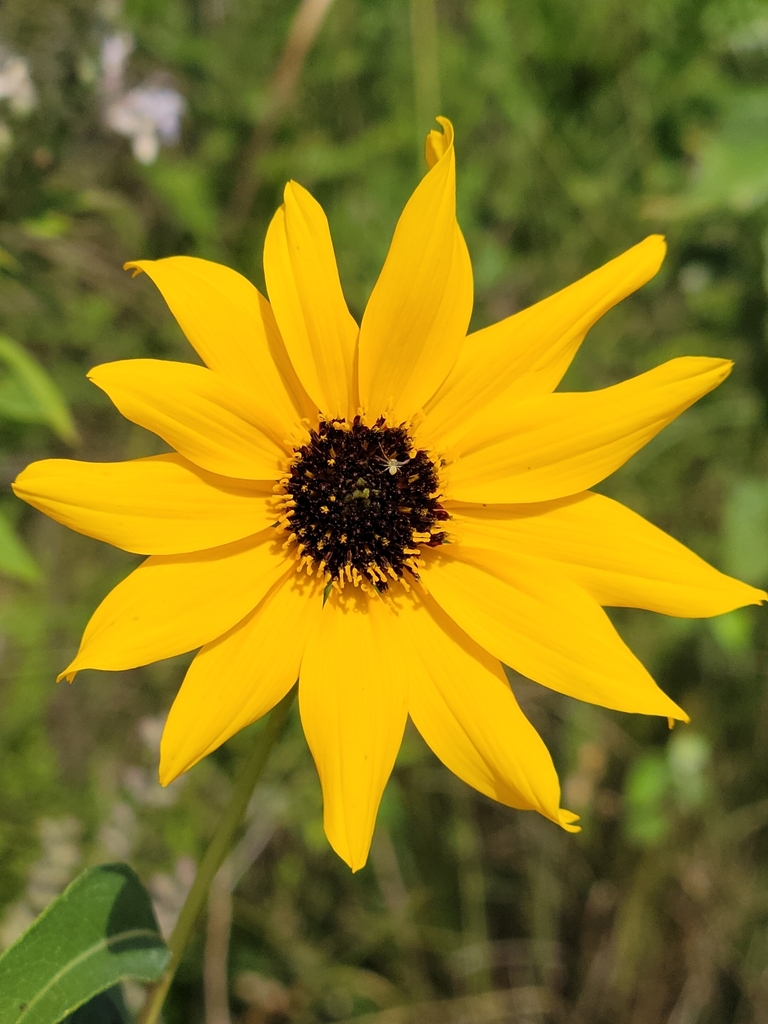
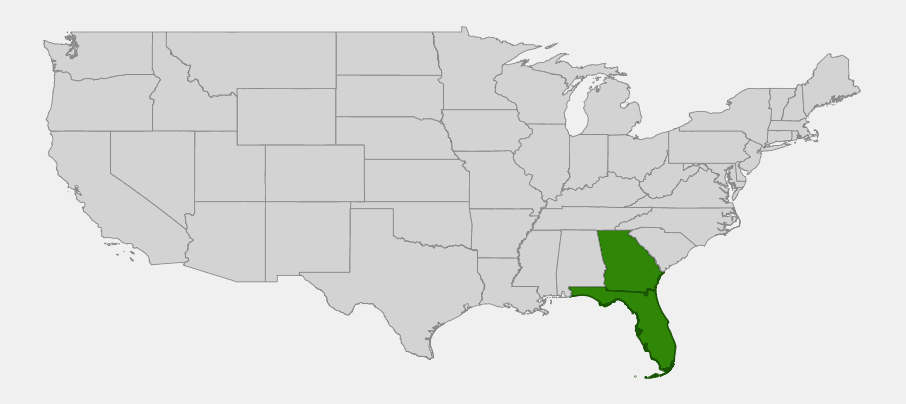
Helianthus agrestis, the Southeastern Sunflower, is a native annual sunflower with one of the smallest ranges in its genus. USDA PLANTS records it only from Florida and Georgia, and nearly all of its populations are on the Florida peninsula. It grows in wet, sunny places: marshes and marsh edges, wet prairies, wet pine flatwoods, ditches and the damp, disturbed ground of old pastures and roadsides. It is a member of the aster family (Asteraceae).
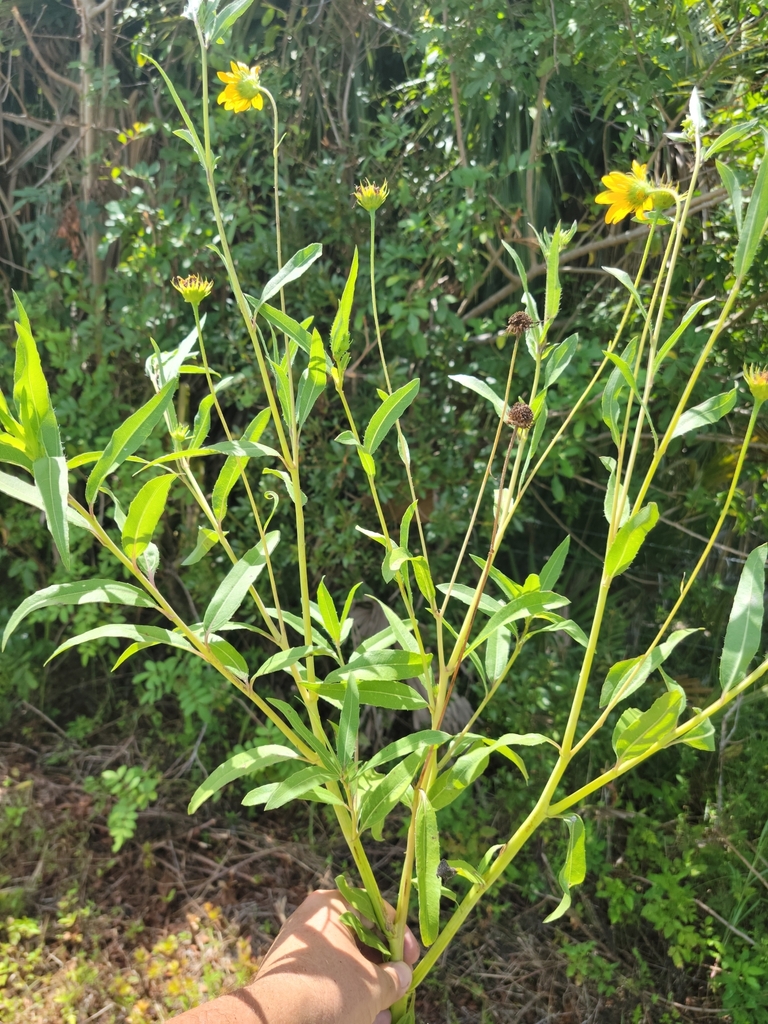
In late summer and fall the plant becomes a loose, branching column, usually 2 to 6 feet tall, carrying many flower heads about 2 inches across. Each head has 10 to 20 bright yellow rays around a small disc that is dark reddish purple. Most of the familiar wild sunflowers in the Southeast, such as the swamp sunflower, are long-lived perennials. Southeastern sunflower lives for one season, sprouting from seed, flowering, setting seed and dying back by early winter.
Because it is an annual with a limited range, this species is rarely sold, and few gardeners have met it. It is still a good plant for wet, sunny native gardens and wetland restorations in Florida, where it feeds late-season bees and seed-eating birds. This guide covers how to recognize it, where it grows, and how to keep a self-sowing stand going from year to year.
Identification
Southeastern sunflower can be confused with several other yellow-rayed sunflowers that bloom in Florida in the fall. The combination to look for is an annual plant with a single taproot, rough-hairy stems, mostly alternate lance-shaped leaves, and small heads with a reddish-purple disc, growing in wet ground.
Stems & Roots
The plant grows from a single taproot, with no rhizomes or tubers, which is the clearest sign that it is an annual. The main stem is upright, green to reddish, and roughened with stiff, spreading hairs. Toward the top it branches freely, so a well-grown plant in full sun becomes a narrow, open candelabra of flowering branches. Plants in crowded grassy sites may be single-stemmed and only a couple of feet tall.
Leaves
The leaves are narrowly lance-shaped, roughly 2 to 6 inches long and well under an inch wide, with short stalks or none. Lower leaves may be opposite, but most are alternate along the stem. Both surfaces are rough to the touch, and the margins are entire or have a few small teeth. The leaves are flat, not rolled under, which helps separate them from the very narrow, rolled leaves of swamp sunflower.
Flowers
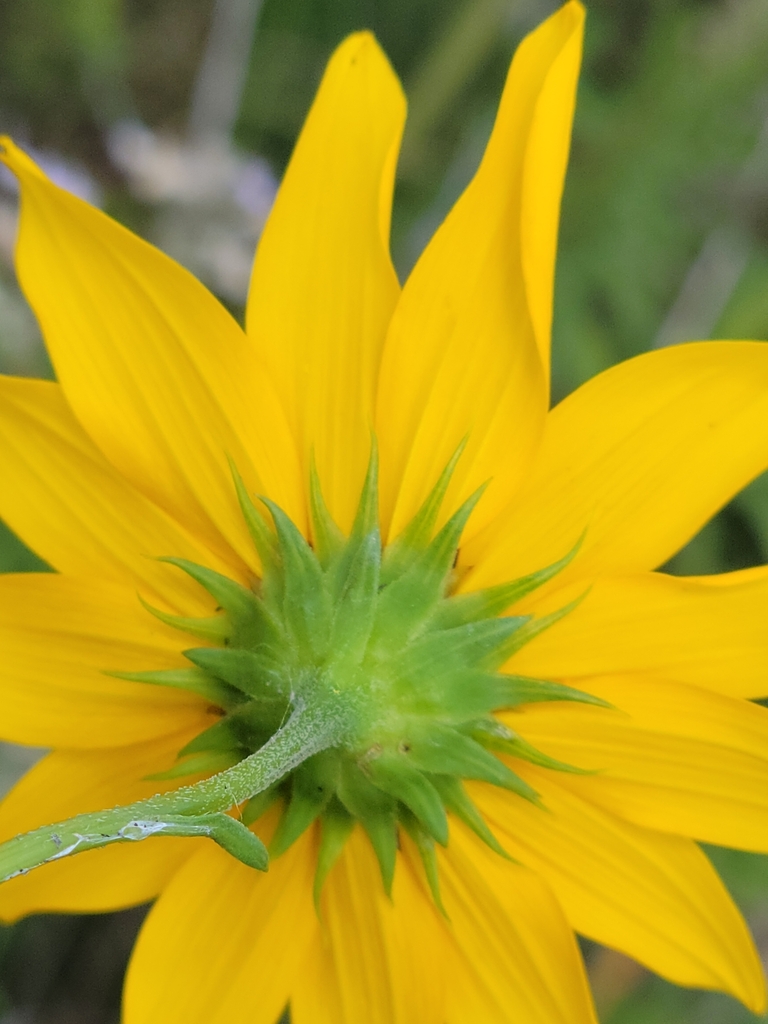
The flower heads are borne singly at the ends of long branches. Each head is about 1½ to 2½ inches across, with 10 to 20 golden-yellow ray florets around a disc roughly half an inch wide. The disc florets have reddish to purple lobes, so the center looks dark maroon. Beneath the head is a cup of green, narrow, long-pointed phyllaries that are often hairy along the edges. Flowering runs from about August into November, with the peak in September and October.
Fruit & Seeds
After flowering, each disc floret ripens into a small, dark, flattened seed (technically a cypsela) a few millimeters long, topped by a pair of thin scales that fall off easily. The seeds drop near the parent plant or are carried off by birds and water, and they germinate the following spring and summer.
Quick Facts
| Scientific Name | Helianthus agrestis Pollard |
| Family | Asteraceae (aster family) |
| Plant Type | Annual wildflower |
| Mature Height | 2–6 ft |
| Mature Spread | 1–3 ft |
| Growth Rate | Fast (completes its life cycle in one season) |
| Sun Exposure | Full sun |
| Water Needs | Moderate to high; moist to wet soil |
| Soil Type | Wet sand, sandy loam or mucky soil |
| Soil pH | About 5.0–7.0 (acidic to near neutral) |
| Bloom Time | August–November |
| Flower Color | Yellow rays with a dark reddish-purple disc |
| Fall Color | None; plants die after setting seed |
| Fruit | Small dark cypselae (seeds) eaten by birds |
| Deer Resistant | Moderately; deer browse young sunflowers |
| USDA Hardiness Zones | 8–10 (annual; returns from seed) |
Native Range
Southeastern sunflower has a small range. USDA PLANTS and the Lady Bird Johnson Wildflower Center list it as native in only two states, Florida and Georgia. Its center is the Florida peninsula, where it is recorded from the St. Johns River marshes of central Florida, the Kissimmee and Lake Okeechobee basins and the Caloosahatchee and Corkscrew areas of southwest Florida. Outside Florida it is known from southern Georgia, near Thomasville.
Within that range it is a plant of low, wet, open ground below about 150 feet elevation. Typical sites are freshwater marsh margins, wet prairies, seasonally flooded pine flatwoods, and wet pastures, ditches and roadsides where the soil stays damp through summer. The U.S. Army Corps of Engineers wetland plant list rates it Facultative Wetland (FACW), meaning it usually grows in wetlands but also occurs in moist uplands.
As an annual, it depends on open ground where its seeds can germinate each year. Fire, grazing, mowing and flooding all help by keeping taller perennials and shrubs from closing in. Populations can be large in one year and sparse the next, depending on rainfall and disturbance.
📋 Regional plant lists featuring Southeastern Sunflower: North & South Florida · Alabama, Georgia & Mississippi
Growing & Care Guide
Southeastern sunflower is easy to grow if you treat it as what it is: a self-sowing annual for a sunny, damp spot. You will not find it at most garden centers. Look for seed from Florida native seed producers or native plant nurseries, or collect a small amount of seed with permission from a large population near you.
Light
Plant it in full sun. In shade it grows thin, leans and flowers poorly. In the wild it disappears from marsh edges once shrubs such as wax myrtle and willow close in.
Soil & Water
Choose moist to wet ground: a rain garden, the edge of a pond or retention basin, a low spot in a lawn conversion, or a wet ditch. Sandy or mucky soils are both fine, and it needs no fertilizer. It tolerates short periods of standing water in summer and dry spells in spring, but seedlings and young plants grow best where the soil stays damp.
Planting Tips
Sow seed on bare, lightly raked soil in late winter or early spring and press it in, or simply scatter it in fall where you want plants and let it overwinter. Thin seedlings to about 1 to 2 feet apart. Because it is an annual, plant it in a group of at least a few dozen plants so that enough seed is produced to carry the stand into the next year.
Pruning & Maintenance
No pruning is needed. Pinching the tips of young plants in early summer gives bushier, shorter plants in small gardens. Leave the dead stems standing after flowering so the seed can ripen and fall, and so birds can feed on it. In late winter, cut or mow the old stems and rake lightly to open the soil for the next generation of seedlings.
Propagation
Propagate by seed only. Collect seed heads when they turn brown and dry in October to December, let them dry, and rub out the seeds. Store them cool and dry. Most seed germinates the following spring as the soil warms. A few months of cold, moist conditions (outdoor sowing over winter, or a few weeks in the refrigerator in damp sand) can improve germination, as with many wild sunflowers.
Landscape Uses
- Rain gardens and swales: a fast, tall fall bloomer for sunny, damp low spots
- Pond and retention basin edges: fills the wet margin between open water and drier upland plantings
- Wet prairie and marsh restoration: an early, self-sowing native annual for disturbed wet ground in Florida
- Pollinator gardens: adds late-season nectar and pollen when many summer flowers are finished
- Bird gardens: leave the seed heads standing for finches, sparrows and other seed eaters
Wildlife & Ecological Value
Like other wild sunflowers, southeastern sunflower is a generous wildlife plant. A single branched plant can carry dozens of flower heads in fall, and every head becomes a small cluster of oily seeds.
For Pollinators
The flower heads are visited by many kinds of bees, including bumblebees, sweat bees and long-horned bees, as well as butterflies, wasps and flies. Bees are the main pollinators. Its late bloom season makes it valuable for pollinators in Florida, where fall is a busy time for migrating monarchs and other butterflies.
For Birds
The seeds are eaten by birds such as American goldfinches, sparrows, cardinals and quail, and by other ground-feeding birds that forage where the seeds have dropped. Standing stems also give cover in open wet fields.
For Mammals
Small mammals such as mice and rats eat the fallen seeds. Deer and rabbits browse young sunflower plants.
Ecosystem Role
Southeastern sunflower is a pioneer of open, disturbed wet ground. It moves in after fire, flooding or soil disturbance and holds the site with fast annual growth until perennial grasses and wildflowers return. Wild sunflowers as a group host the caterpillars of many moths, and their stems, leaves and seed heads support beetles, true bugs and other insects that in turn feed birds.
Cultural & Historical Uses
The species was described by the American botanist Charles Louis Pollard in the late 1890s. Its name agrestis is Latin for “of the fields,” fitting a plant that often turns up in pastures and old fields as well as marshes. Its common name, southeastern sunflower, reflects its restriction to the far southeastern United States.
Botanists have long been interested in it because it is one of only a few annual sunflowers native to the eastern United States. Most annual Helianthus, including the common sunflower (H. annuus) that was domesticated as a crop, are native to the West and the Great Plains. That makes it a useful plant for comparing how annual and perennial sunflowers grow, flower and reproduce.
It has no recorded use as a food or crop plant, and it has never been an ornamental in the trade. In recent years Florida native plant gardeners and restoration ecologists have started using it as a quick, cheerful annual for wet, sunny sites, alongside better-known native sunflowers.
Frequently Asked Questions
Is southeastern sunflower a perennial?
No. It is an annual. Each plant grows from seed in spring, flowers in late summer and fall, sets seed and dies. Stands persist by reseeding, so leave the seed heads in place and keep some bare, open ground for seedlings.
How is it different from swamp sunflower?
Both bloom in fall in wet ground and have dark centers. Swamp sunflower (Helianthus angustifolius) is a clump-forming perennial with very narrow leaves whose edges roll under. Southeastern sunflower is an annual with a single taproot and somewhat wider, flat, lance-shaped leaves.
Where does southeastern sunflower grow?
It is native only to Florida, where most populations are on the peninsula, and to southern Georgia. It grows in marshes, wet prairies, wet flatwoods, ditches and damp pastures.
Can I grow it in a dry yard?
It is not a good choice for dry sandy yards. For dry, sunny sites in Florida, beach sunflower (Helianthus debilis) is a better native choice. Southeastern sunflower needs ground that stays moist through the growing season.
When does it bloom?
Mostly from August into November, with the heaviest flowering in September and October.

Looking for a nursery that carries Southeastern Sunflower?
Browse our native plant nursery directory: Florida & Georgia