Simpson’s Stopper (Myrcianthes fragrans)
Myrcianthes fragrans, commonly called Simpson’s Stopper or Twinberry, is a dense, aromatic evergreen shrub or small tree native to the coastal hammocks and pinelands of peninsular Florida. A member of the Myrtaceae (myrtle family) — the same family as guava and eucalyptus — it carries glossy, leathery leaves that release a warm, nutmeg-like scent when crushed, clusters of small white flowers that draw a steady stream of pollinators, and bright red-orange berries that ripen nearly black and feed songbirds through much of the year.
In the wild, Simpson’s stopper grows along the edges of hammocks, in coastal strand and scrub, and on the shell middens and limestone outcrops of South and Central Florida, often as an understory or edge species beneath taller hardwoods. Its tolerance for salt spray, limestone soils, and both drought and periodic flooding makes it one of the most adaptable native shrubs for Florida landscapes, from the immediate coast inland to drier upland sites.
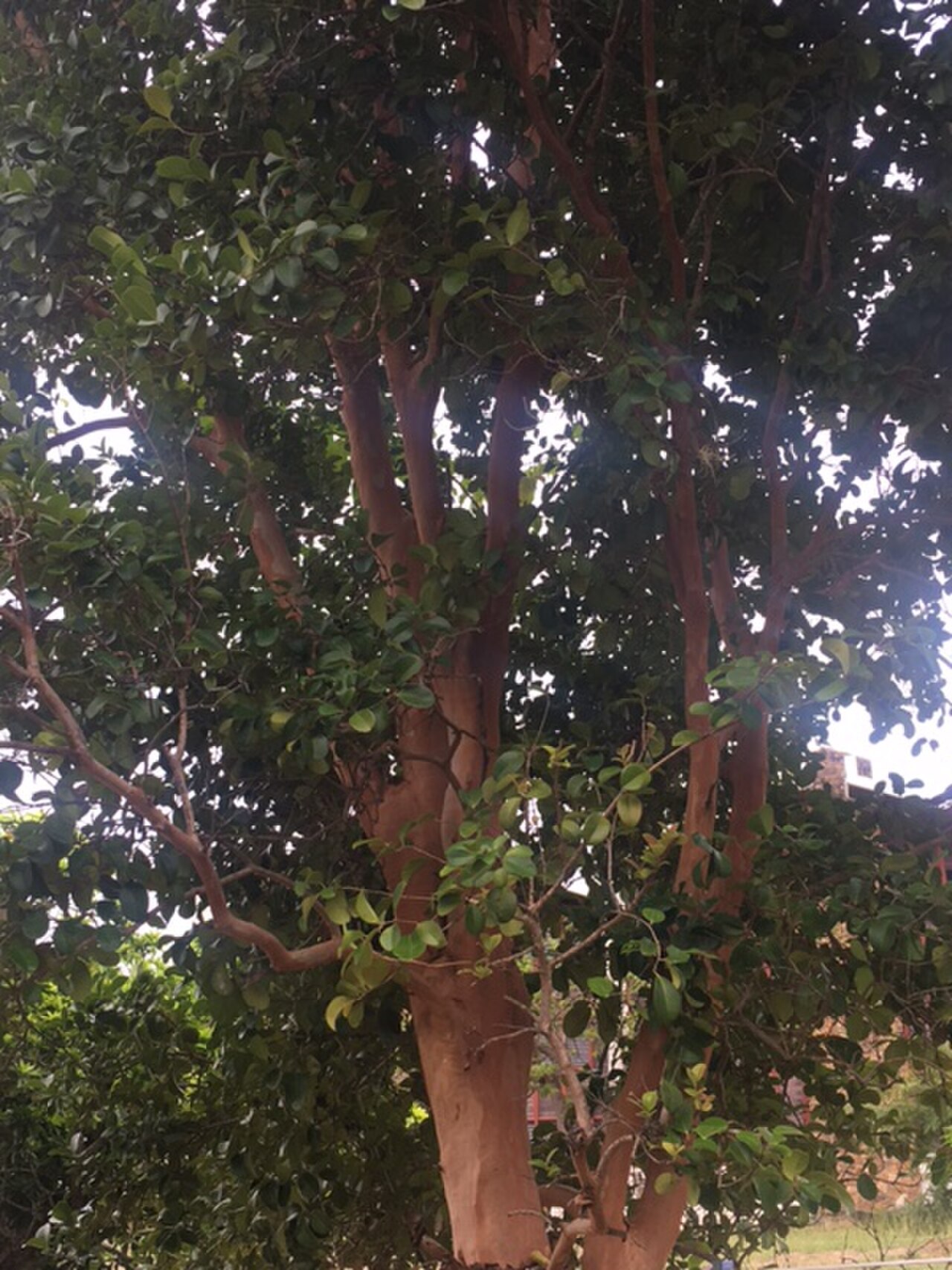
Because it takes well to pruning and naturally grows into a dense, twiggy form, Simpson’s stopper has become a go-to choice for hedges, screens, and foundation plantings throughout its native range, while left unpruned it develops into a handsome small multi-trunked tree with attractive peeling bark. Its combination of fragrance, wildlife value, and low maintenance has made it one of the most widely planted native shrubs in Florida gardens.
Identification
Simpson’s stopper is a densely branched evergreen that can be kept as a 6- to 10-foot hedge or allowed to grow into a small tree 15 to 20 feet tall, occasionally taller with age. Its form is naturally twiggy and full from the ground up unless limbed up, with new growth often showing a reddish or bronze flush before hardening to deep green.
Bark & Stems
On older specimens allowed to grow as small trees, the bark is smooth, thin, and attractively mottled in shades of tan, gray, and reddish-brown, peeling in thin flakes to reveal lighter patches beneath — a feature that becomes one of the plant’s most ornamental traits as it matures. Young stems are slender and reddish, becoming gray and woody with age.
Leaves
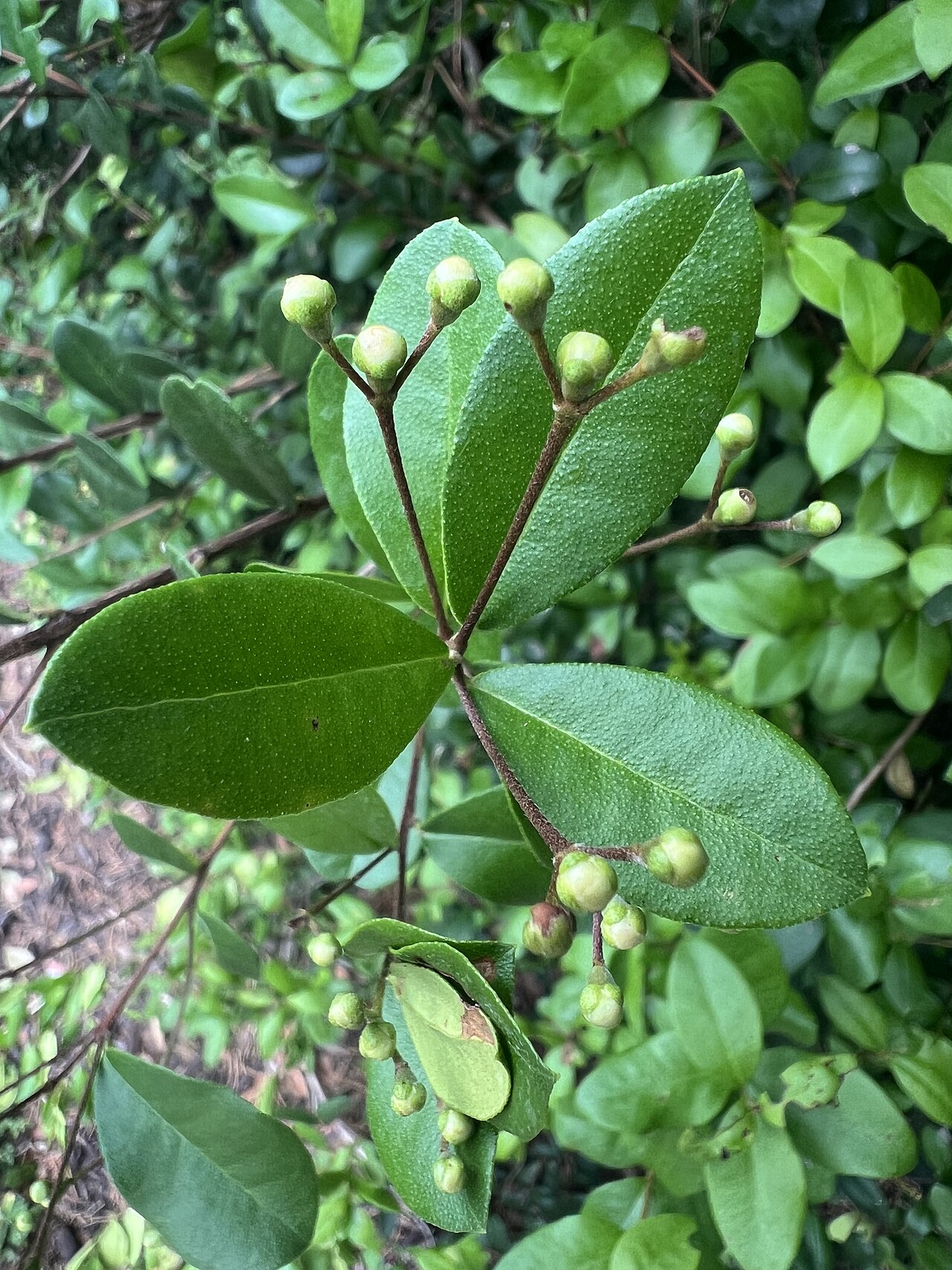
The leaves are opposite, elliptic to oval, 1 to 3 inches long, with a glossy dark green upper surface and numerous translucent glandular dots visible when held up to light — a hallmark of the myrtle family. Crushed leaves release a distinctive spicy, nutmeg-like fragrance, which is where the scientific epithet fragrans comes from.
Flowers & Fruit
Small, four-petaled white flowers with a prominent tuft of white stamens are borne in clusters (cymes) along the stems, mainly in spring but sporadically through much of the year in South Florida’s mild climate. They have a light, sweet fragrance and are visited heavily by bees, butterflies, and other pollinators. The fruit is a rounded berry roughly ⅓ to ½ inch across that ripens from green to orange-red and finally near-black; each berry typically contains one or two seeds. The fruit is readily eaten by birds and other wildlife, though it is not grown as a food crop and should not be treated as a foraging edible.
Quick Facts
| Scientific Name | Myrcianthes fragrans |
| Family | Myrtaceae (Myrtle) |
| Plant Type | Evergreen Shrub / Small Tree |
| Mature Height | 10–20 ft (hedged forms 6–10 ft) |
| Mature Spread | 8–15 ft |
| Growth Rate | Slow to Moderate |
| Sun Exposure | Full Sun to Partial Shade |
| Water Needs | Low to Moderate once established |
| Soil Type | Sandy or calcareous (limestone); well-drained |
| Soil pH | 6.0–8.0 (tolerates alkaline) |
| Bloom Time | Mainly spring, sporadic year-round in South FL |
| Flower Color | White |
| Fall Color | None (evergreen) |
| Fruit | Orange-red to near-black berries, bird-eaten |
| Deer Resistant | Moderate |
| USDA Hardiness Zones | 9b–11 |
Native Range
Simpson’s stopper is native to Florida, where it occurs from the central peninsula south through the Keys, with its heaviest concentration in coastal and near-coastal counties. Outside the continental U.S. it is also native to the Bahamas, the Greater and Lesser Antilles, and parts of Central America and northern South America, where it is a common component of moist tropical and subtropical forests. It is not native anywhere else in the continental United States and should not be planted outside Florida as a “native” selection, even though it is sometimes offered for sale in warmer parts of neighboring Gulf Coast states.
Within Florida, it grows naturally in coastal hammocks, pine rockland edges, shell middens, and scrub, often on shallow, well-drained, limestone-derived soils. It tolerates salt spray and occasional brackish exposure near the immediate coast, as well as the periodic flooding and drought typical of Florida’s hammock and pineland mosaic.
The species is not listed as endangered or rare, and it remains common within its Florida range, though as with many hammock species, habitat loss from coastal development has reduced naturally occurring stands in some areas even as the plant has become widely cultivated.
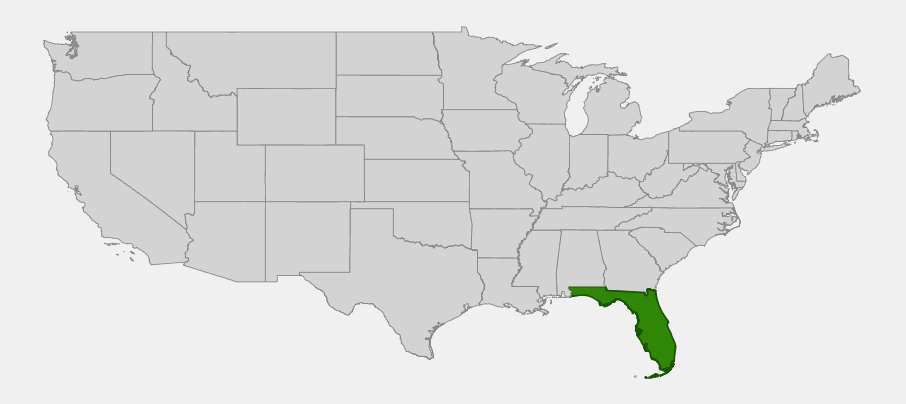
📋 Regional plant lists featuring Simpson’s Stopper: none yet — Simpson’s stopper is native only to Florida, which is not currently covered by one of Plant Native’s regional plant lists.
Growing & Care Guide
Simpson’s stopper is a forgiving, low-maintenance shrub that rewards minimal fuss with fragrant flowers, colorful fruit, and dense evergreen structure nearly year-round in its Florida range.
Light
It flowers and fruits most heavily in full sun but adapts well to partial shade, where it grows a bit looser and more open. In deep shade, flowering and fruiting drop off noticeably even though the plant will survive.
Soil & Water
This is an adaptable plant across Florida’s range of soils, from deep sand to shallow, rocky, limestone-derived ground, and it tolerates both brief drought and periodic wet spells once established. Regular watering speeds up establishment and early growth, but mature plants need little supplemental irrigation outside of extended drought. Light salt tolerance makes it useful in landscapes exposed to coastal spray, though it is not recommended for direct beachfront dune planting.
Planting Tips
Plant from containers in the cooler months (fall through early spring in Florida) to reduce transplant stress, and water consistently for the first several months while roots establish. Space plants 4 to 6 feet apart for a hedge, or allow 10 to 15 feet for specimens meant to grow into small trees. It tolerates a wide pH range, so soil amendment is rarely necessary.
Pruning & Maintenance
Simpson’s stopper takes pruning extremely well and is one of the most popular native hedge plants in Florida for exactly that reason. Shear it regularly to maintain a formal hedge, or prune selectively to remove lower branches and reveal the attractive peeling bark if you prefer a small multi-trunked tree form. It has few serious pest or disease problems and needs no routine spraying.
Landscape Uses
Simpson’s stopper fits into many roles in Florida landscapes:
- Clipped or informal hedges and screens thanks to its dense, twiggy growth
- Small specimen tree when limbed up to show off the bark
- Foundation plantings around homes and buildings
- Wildlife gardens for its flowers, fruit, and cover
- Coastal and salt-tolerant landscaping near (but not directly on) the shoreline
- Butterfly gardens, where the fragrant blooms draw steady pollinator traffic
Wildlife & Ecological Value
Few Florida native shrubs pack as much wildlife value into a tidy, garden-friendly package as Simpson’s stopper.
For Pollinators
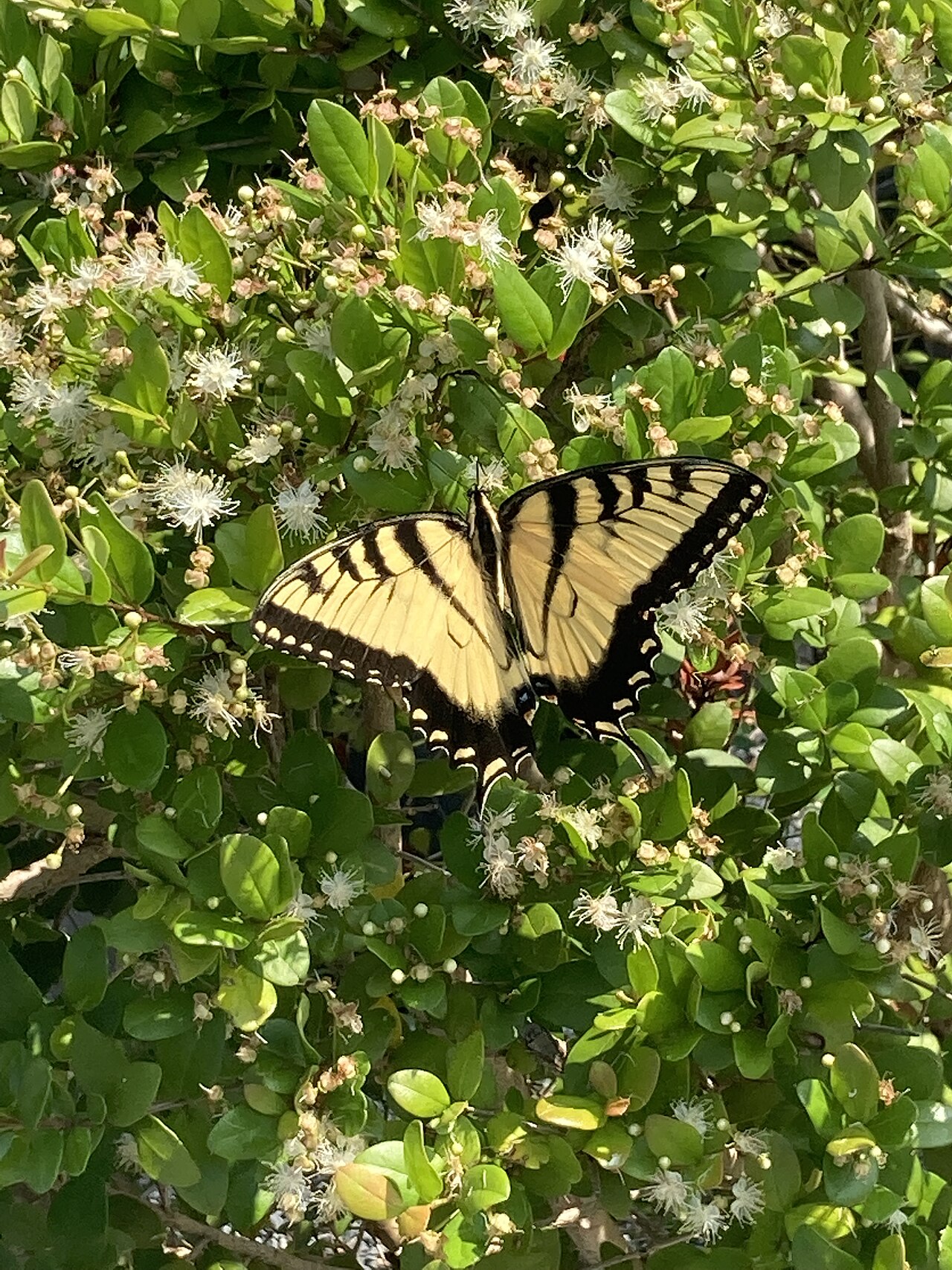
The small, fragrant white flowers attract a wide range of bees, butterflies (including swallowtails), and other pollinating insects, often blooming sporadically through much of the year in South Florida’s mild climate and providing a near-continuous nectar source.
For Birds
The orange-red to near-black berries are a favored food source for songbirds, which help disperse the seed. The dense, twiggy growth habit also provides excellent nesting cover and protection from predators.
For Mammals
Small mammals opportunistically feed on the fallen fruit, and the thick, shrubby structure offers shelter for a variety of small wildlife navigating hammock and scrub edges.
Ecosystem Role
As a common component of Florida’s coastal hammocks and pineland edges, Simpson’s stopper contributes to the layered shrub structure that supports hammock biodiversity, and its tolerance for disturbed, rocky, or salt-influenced ground makes it a useful early colonizer in restoration plantings along Florida’s coastal margins.
Cultural & Historical Uses
The common name “stopper” reflects a historical use shared by several related Myrtaceae species in Florida and the Caribbean: various parts of the plant were traditionally used by regional communities as a folk remedy to help “stop” diarrhea and other gastrointestinal complaints. This history is reflected in the plant’s folk name but is not a basis for modern medicinal use, and the berries should not be treated as a food source.
Beyond its folk-medicine history, Simpson’s stopper has long been appreciated simply for its fragrance — both in the crushed, nutmeg-scented leaves and the sweet-smelling flowers — which made it a favored dooryard and hedge plant in Florida long before it became a staple of modern native landscaping.
Today, the species is named for Charles Torrey Simpson, an early 20th-century Florida naturalist who extensively documented the state’s native flora, and it continues to be closely associated with South Florida’s hammock ecosystems in both horticultural and conservation contexts.
Frequently Asked Questions
Can Simpson’s stopper be grown outside Florida?
It is only cold-hardy to USDA zone 9b, so it is best suited to Florida and the mildest parts of the Gulf Coast. It is not native outside Florida and should be treated as a non-native ornamental anywhere else it is planted.
Are the berries edible?
The berries are readily eaten by birds, but they are not grown or sold as a human food crop, and eating them is not recommended.
How fast does Simpson’s stopper grow?
It is a slow to moderate grower, typically adding under a foot per year, which is part of why it holds a tidy hedge shape so well without constant shearing.
Does Simpson’s stopper tolerate salt and coastal conditions?
Yes, it tolerates salt spray and brief brackish exposure reasonably well, making it popular in coastal Florida landscapes, though it is not meant for planting directly on open beach dunes.
Can I grow Simpson’s stopper as a small tree instead of a hedge?
Yes. Left unpruned or selectively limbed up, it naturally develops into an attractive small multi-trunked tree 15 to 20 feet tall with ornamental peeling bark, rather than staying a dense shrub.

Looking for a nursery that carries Simpson’s Stopper?
Browse our native plant nursery directory: Florida