
Darlingplum (Reynosia septentrionalis)
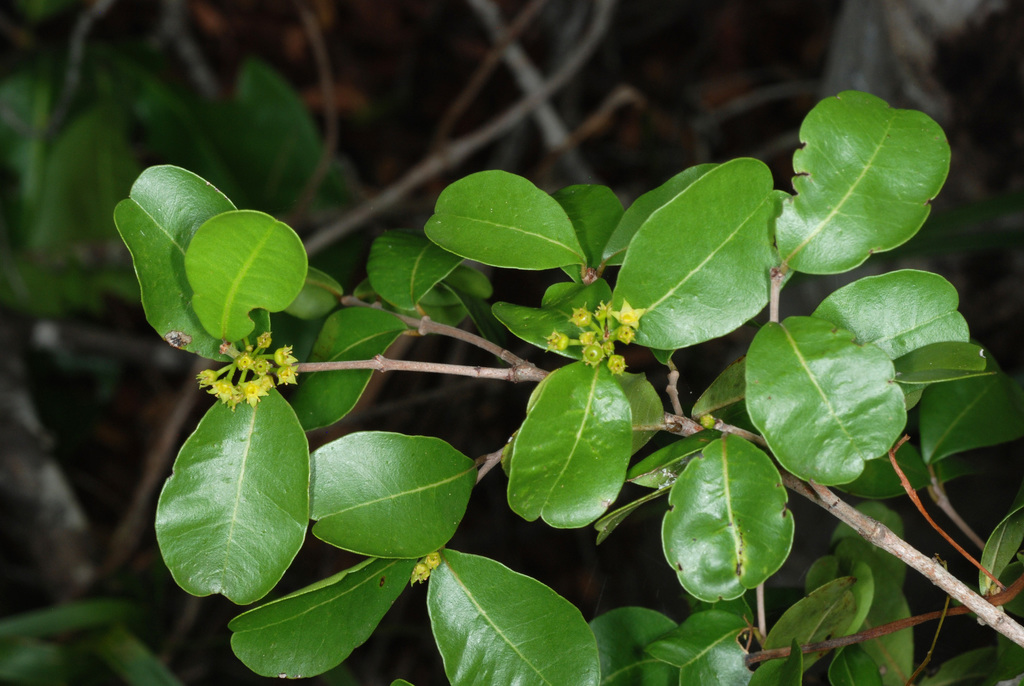
Reynosia septentrionalis, known as Darlingplum or red ironwood, is a slow-growing evergreen shrub or small tree of the tropical hammocks of extreme south Florida and the Florida Keys. It belongs to the buckthorn family (Rhamnaceae). Its stiff branches carry small, thick, rounded leaves in opposite pairs, tiny yellow-green flowers, and plum-like fruits that ripen dark purple to black. The heartwood is exceptionally hard and reddish, which explains the name red ironwood.
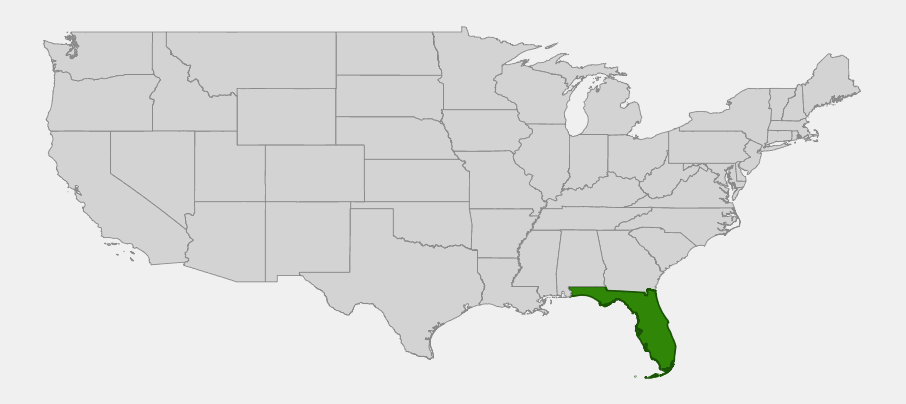
In the United States darlingplum grows only in Florida, where the Atlas of Florida Plants records it as native. It is listed as Threatened by the State of Florida (FDACS Regulated Plant Index). Much of its coastal hammock habitat in the Keys and southern Miami-Dade County has been lost to development. Gardeners who want to grow it should buy nursery-propagated plants and never dig plants or collect cuttings from the wild.
Darlingplum is a fine, salt-tolerant small tree for frost-free coastal gardens. It fits well in hammock-style plantings with other West Indian natives and provides fruit for birds. This guide covers identification, range, growing conditions, and its place in Florida’s tropical hammocks.
Identification
Darlingplum is a dense, slow-growing shrub or small tree. Look for small, leathery, round-tipped leaves in opposite pairs, clusters of tiny greenish flowers, and dark, olive-shaped fruits.
Trunk & Branches
Plants range from multi-stemmed shrubs to single-trunked trees, usually under 20 feet tall. The Lady Bird Johnson Wildflower Center gives a height of up to about 20 feet. Branches are stiff and often grow at wide angles, and the bark is gray to reddish-brown and smooth to slightly scaly. The heartwood is dense, heavy and dark reddish-brown.
Leaves
The leaves are evergreen, thick and leathery, mostly opposite or nearly so, and about 1 to 1½ inches long. They are elliptic to oblong or slightly wider toward the tip, with a rounded or shallowly notched tip that may end in a tiny point. The upper surface is glossy dark green and the lower surface paler, and the edges are smooth and often slightly rolled under. Leaf stalks are very short.
Flowers
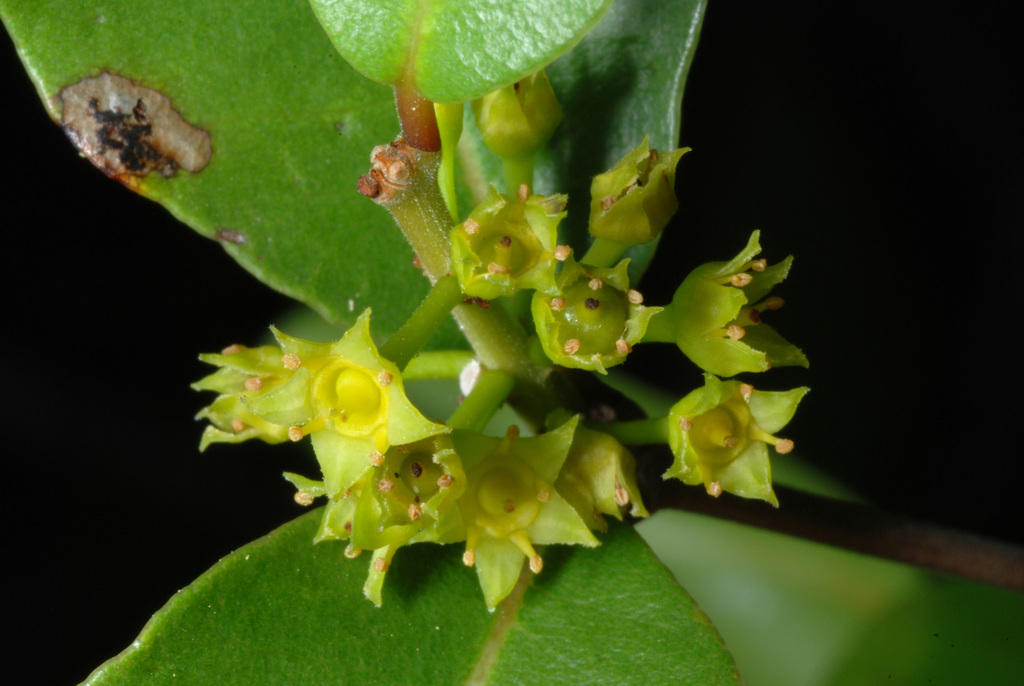
The flowers are tiny, only a few millimeters across, yellow-green, and carried in small clusters in the leaf axils. They have five pointed sepals and no showy petals. The Lady Bird Johnson Wildflower Center records blooming in any month of the year, with most flowering in spring and early summer.
Fruit & Seeds
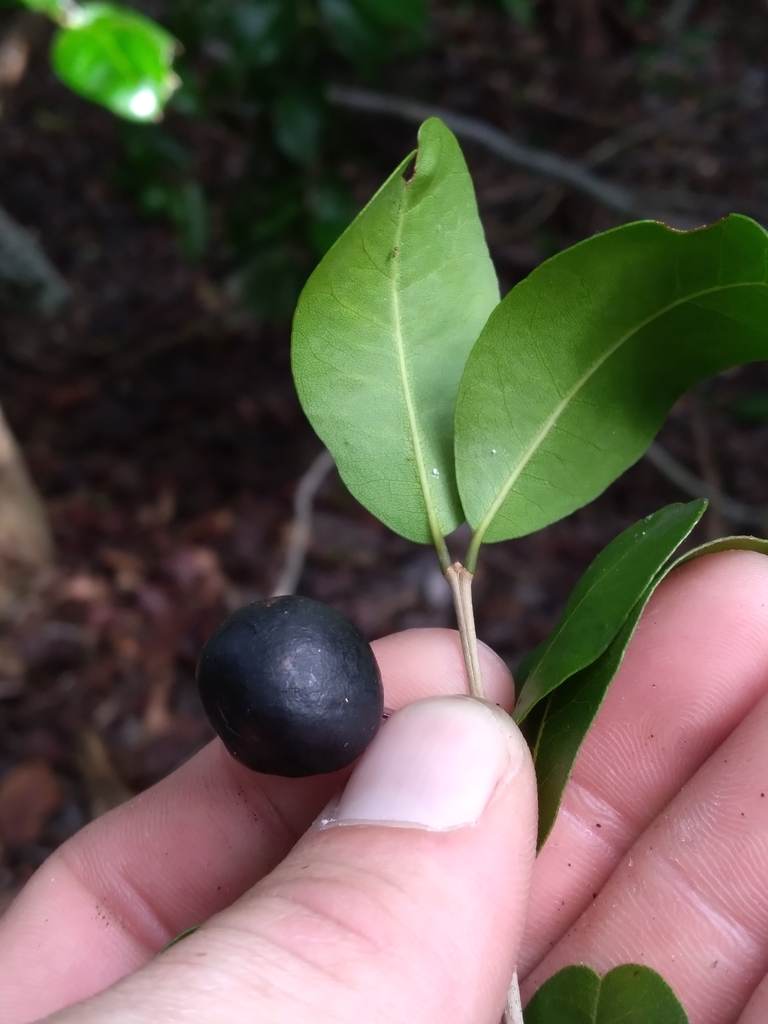
The fruit is an egg- to olive-shaped drupe roughly 1/2 inch long, ripening from green to dark purple or black. Each contains one or two hard seeds surrounded by a thin layer of sweet pulp. The fruits are reported to be edible, which may be the source of the name darlingplum. Ripe fruits appear mostly in summer and fall.
Similar Species
Black Ironwood (Krugiodendron ferreum), another hammock tree in the buckthorn family, has shiny, wavy-edged leaves with notched tips, and its small fruits are black and about 1/4 inch long. Stoppers such as White Stopper also have opposite leaves but are dotted with aromatic oil glands, and their fruits are round berries. Mastic and other bustics have alternate leaves and milky sap.
Quick Facts
| Scientific Name | Reynosia septentrionalis Urb. |
| Family | Rhamnaceae (buckthorn family) |
| Plant Type | Evergreen shrub or small tree |
| Mature Height | 10–20 ft (often smaller and shrubby) |
| Mature Spread | 6–12 ft |
| Growth Rate | Slow |
| Sun Exposure | Full sun to part shade |
| Water Needs | Low; drought tolerant once established |
| Soil Type | Limestone, shell or sand; well drained |
| Soil pH | About 7.0–8.5; tolerates alkaline limestone soils |
| Bloom Time | Possible year-round; mainly spring and early summer |
| Flower Color | Yellow-green |
| Fall Color | None; evergreen |
| Fruit | Dark purple to black drupe, about 1/2 in |
| Deer Resistant | Moderately; protect young plants where Key deer browse |
| USDA Hardiness Zones | 10b–11 |
Native Range
Darlingplum is a West Indian species at the northern edge of its range in Florida. Beyond the United States it grows in the Bahamas and elsewhere in the northern Caribbean, including the Turks and Caicos Islands. USDA PLANTS lists it as native to the lower 48 states, and the Lady Bird Johnson Wildflower Center records it only from Florida.
In Florida it is limited to the frost-free southern tip of the state. Most populations are in the Florida Keys, with others in the coastal and rockland hammocks of southern Miami-Dade County. It grows in rockland and coastal hammocks, on the edges of mangroves and salt marshes, in coastal thickets and on stabilized dunes. These are the same narrow, frost-free coastal habitats that have been most heavily developed.
It is listed as Threatened by the State of Florida (FDACS Regulated Plant Index). Habitat loss in the Keys and around Miami is the main reason. Protected populations remain in state parks, national wildlife refuges and other conservation lands in the Keys. Planting nursery-grown darlingplum in Keys and south Florida landscapes helps keep the species in the local landscape, but plants and seeds should never be taken from the wild.
📋 Regional plant lists featuring Darlingplum: North & South Florida
Growing & Care Guide
Darlingplum is an excellent small tree for frost-free coastal gardens in south Florida and the Keys, tolerating salt spray, limestone and drought. Because it is listed as Threatened by the State of Florida, buy only nursery-propagated plants from reputable native nurseries, and never dig plants, take cuttings or collect seed from the wild. It is offered occasionally by south Florida native plant nurseries.
Light
Full sun to part shade. In full sun it stays dense and fruits well. In the shade of a hammock canopy it grows more open and slowly.
Soil & Water
It is adapted to thin, alkaline soils over limestone and to sandy, shelly coastal soils. Good drainage is essential; it does not tolerate standing water. Water young plants regularly until established, then only during long droughts. It is highly tolerant of salt spray and moderately tolerant of salty soil. Fertilizer is rarely needed.
Planting Tips
Plant in warm months when roots grow fastest, in a site protected from frost. Set it 6 to 10 feet from other trees for a single specimen, or closer in a hammock-style mixed planting or informal screen. Mulch lightly with leaf litter, keeping mulch away from the trunk.
Pruning & Maintenance
It needs very little pruning. Remove crossing or damaged branches in spring. It can be trained as a small single-trunked tree by removing lower shoots, or left as a dense multi-stemmed shrub. Because it grows slowly, avoid heavy pruning.
Propagation
Nurseries grow it from cleaned seed of cultivated plants, sown fresh in a well-drained mix. Germination can be slow and irregular. Cuttings root with difficulty. Home gardeners should start with nursery-propagated plants.
Landscape Uses
- Coastal landscapes: salt-tolerant evergreen for exposed sites in the Keys and south Florida
- Hammock-style plantings: mixed with gumbo limbo, stoppers, pigeon plum and other West Indian natives
- Small specimen tree: a slow-growing, dense tree for small frost-free yards
- Wildlife gardens: fruits feed birds; dense foliage gives cover
- Conservation plantings: nursery-grown plants help keep a state-listed species in the local landscape
Wildlife & Ecological Value
Darlingplum is one of many West Indian trees that together make up Florida’s tropical hardwood hammocks, and its fruit and foliage serve a variety of wildlife.
For Pollinators
The tiny greenish flowers produce nectar and are visited by small bees, wasps and flies. Their long bloom season makes them a steady, if modest, resource in hammock edges.
For Birds
Ripe fruits are eaten by birds of the Keys hammocks, including resident species such as mockingbirds and migrating songbirds such as thrushes and catbirds, as well as white-crowned pigeons, which feed heavily on hammock fruits. Birds spread the seeds through the hammock.
For Mammals
Fallen fruits are eaten by raccoons and other small mammals. In the lower Keys, Key deer may browse young plants.
Ecosystem Role
Darlingplum is a slow-growing, long-lived member of the hammock understory and subcanopy. Its dense wood and evergreen foliage help hammocks resist hurricane winds and salt spray, and its fruits link it to the birds that spread hammock plants from island to island.
Cultural & Historical Uses
The German botanist Ignatz Urban described Reynosia septentrionalis. The genus was named in honor of Alvaro Reynoso, a nineteenth-century Cuban chemist and agronomist. The species name septentrionalis means “northern”, fitting for a species whose range reaches north into Florida.
Its common name red ironwood refers to the exceptionally hard, heavy, reddish heartwood, a trait it shares with black ironwood, another member of the buckthorn family in Florida hammocks. The trees are too small and slow-growing for lumber, but the wood has been used locally for small articles.
Today darlingplum is valued mostly by native plant gardeners and restoration ecologists in the Keys and south Florida. Its status as a state-Threatened species makes nursery-grown plantings in parks, yards and restoration sites a practical way to support it.
Frequently Asked Questions
Is darlingplum a protected plant?
Yes. It is listed as Threatened by the State of Florida (FDACS Regulated Plant Index). Buy only nursery-propagated plants, and never dig plants, take cuttings or collect seed from the wild.
Can I eat darlingplum fruit?
The ripe fruits are reported to be edible, with a thin layer of sweet pulp around the seed. They are small and best left for birds, especially since the plant is state-listed.
Where does darlingplum grow?
In the United States it grows only in extreme south Florida, mainly in the Florida Keys and southern Miami-Dade County. It also grows in the Bahamas and parts of the northern Caribbean.
Will darlingplum survive frost?
It is a tropical species suited to USDA zones 10b and 11. A light frost may damage leaves, and hard freezes can kill it.
How fast does darlingplum grow?
Slowly. It may take many years to reach small tree size, but it is long-lived and needs little maintenance once established.

Looking for a nursery that carries Darlingplum?
Browse our native plant nursery directory: Florida