
Manaca Palm (Calyptronoma rivalis)
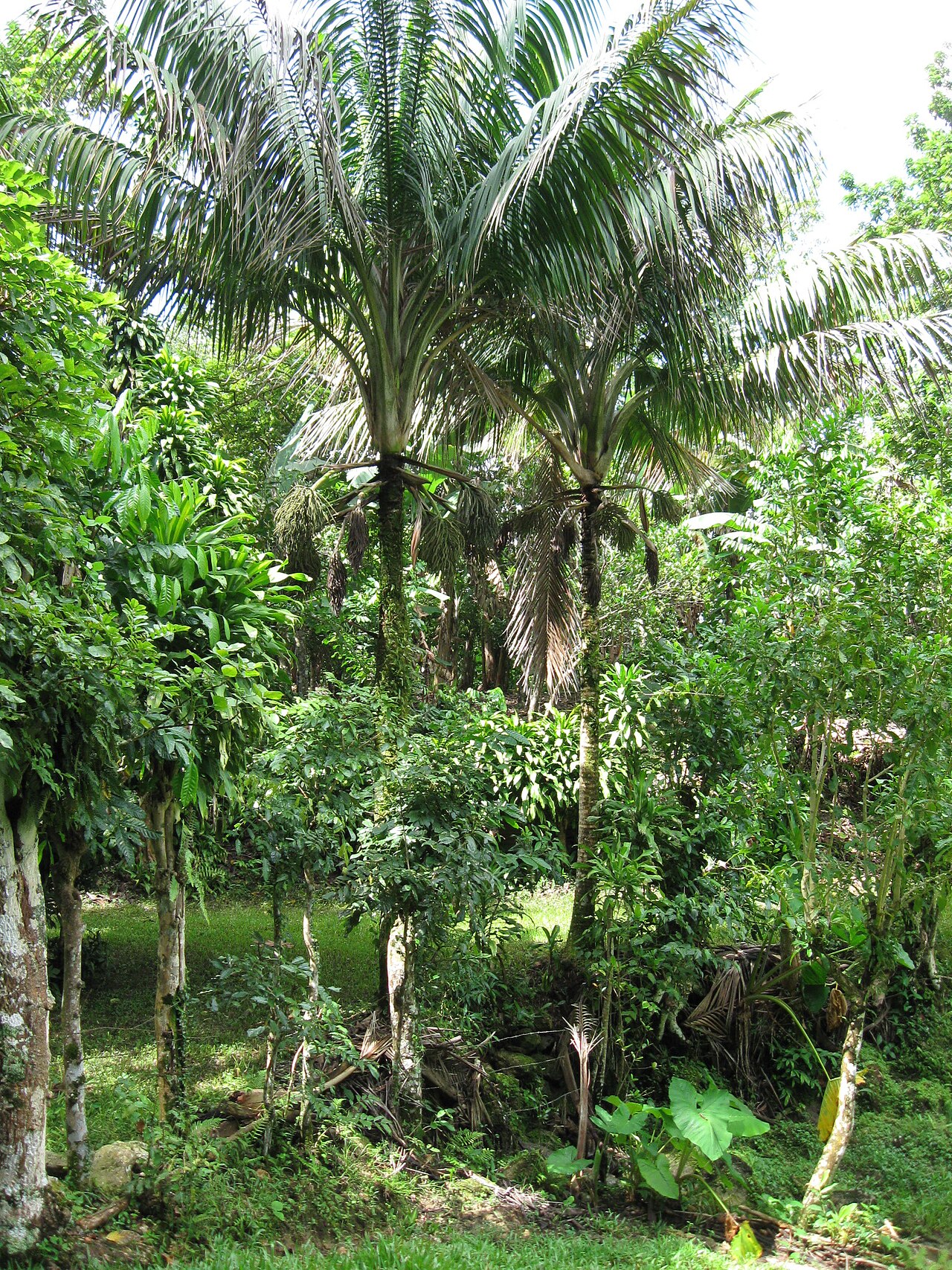
Calyptronoma rivalis, known in Puerto Rico as Palma de Manaca and listed by USDA PLANTS as Puerto Rico manac, is a tall, single-trunked feather palm of stream banks in the island’s northwestern limestone country. It can reach about 49 feet (15 m), with a rough grayish-brown trunk, a crown of arching pinnate leaves 9 to 16 feet long, and long, rope-like flower clusters that hang beneath the leaves like tassels. It belongs to the palm family (Arecaceae). The species name rivalis means “of streams,” which describes its habitat exactly.
Manaca palm is a federally threatened species. The U.S. Fish and Wildlife Service listed it as Threatened under the Endangered Species Act on February 6, 1990. At the time it was believed to grow only in Puerto Rico, in three populations with an estimated 220 individuals. Later work showed that the same palm, once called Calyptronoma quisqueyana, is widespread on Hispaniola, but in Puerto Rico it remains a rare plant of a few ravines and river banks, mostly on private land.
This guide covers how to recognize manaca palm, where it grows in Puerto Rico and the Caribbean, how it is being conserved, and how it can be grown in frost-free gardens. Anyone who wants to grow it should buy nursery-propagated plants only and never collect seed, seedlings or palms from wild populations. The palm is also known under the older names Calyptrogyne rivalis and Cocops rivalis.
Identification
Manaca palm is a large, elegant feather palm that is easy to recognize once you know where to look. In Puerto Rico it is the native feather palm of shady stream banks in the northwestern karst, where its hanging, tassel-like flower clusters set it apart from the island’s more familiar royal palm (Roystonea borinquena) and sierra palm (Prestoea acuminata var. montana).
Trunk
The trunk is solitary (never clustering), grayish brown and rough, about 7 to 10 inches (18 to 25 cm) thick according to the U.S. Fish and Wildlife Service. Mature palms usually stand 13 to 49 feet (4 to 15 m) tall. Unlike the royal palm, it has no smooth green crownshaft; the old leaf bases and fibers give the top of the trunk a rougher, more ragged look.
Leaves
The crown holds a dozen or more pinnate (feather-type) leaves, each 9 to 16 feet (3 to 5 m) long. Many slender, pointed leaflets are arranged neatly in two rows along the midrib, so the leaves look flat and orderly rather than plumed. Young plants in the forest understory have shorter leaves and can look almost fern-like.
Flowers
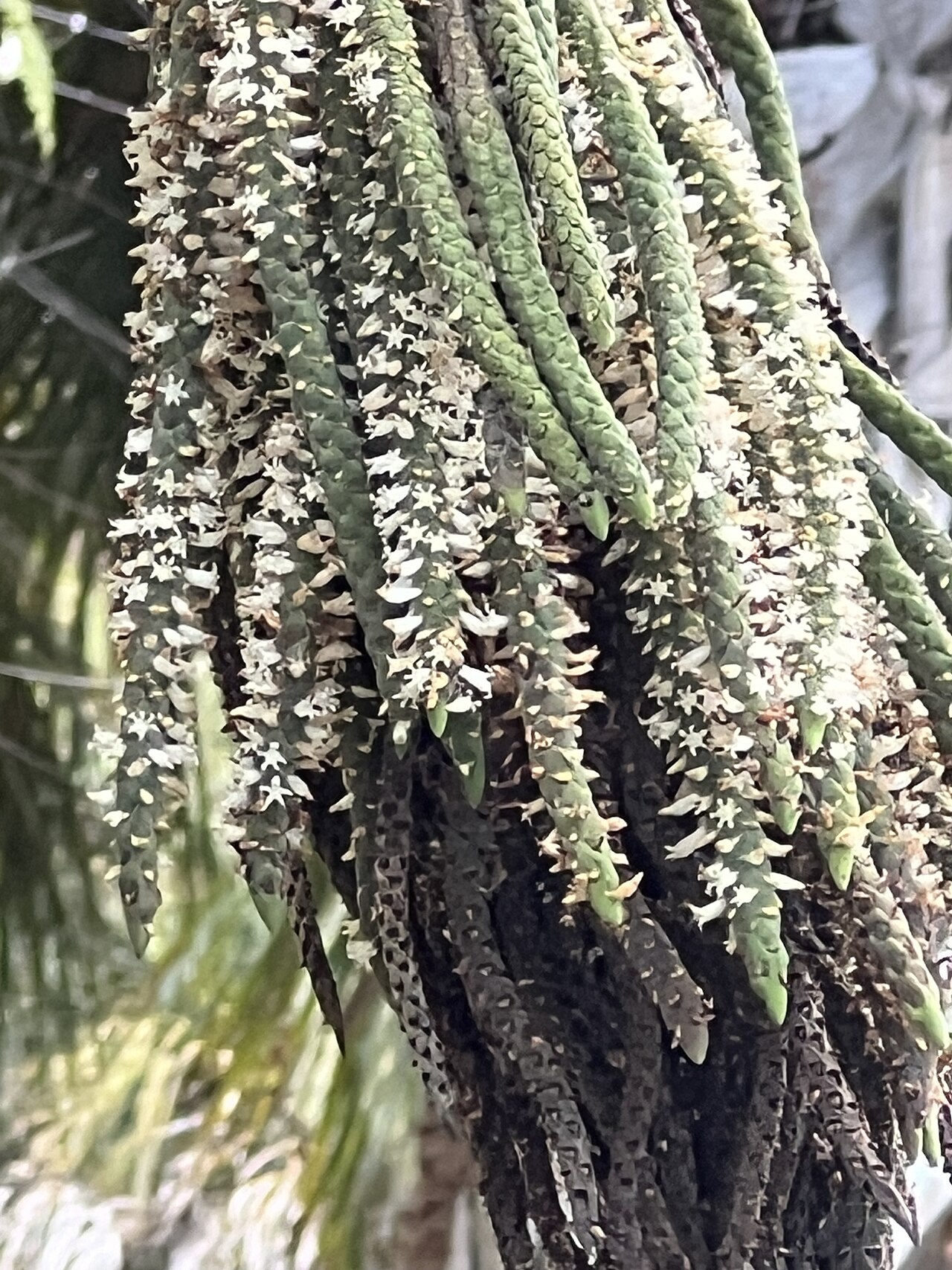
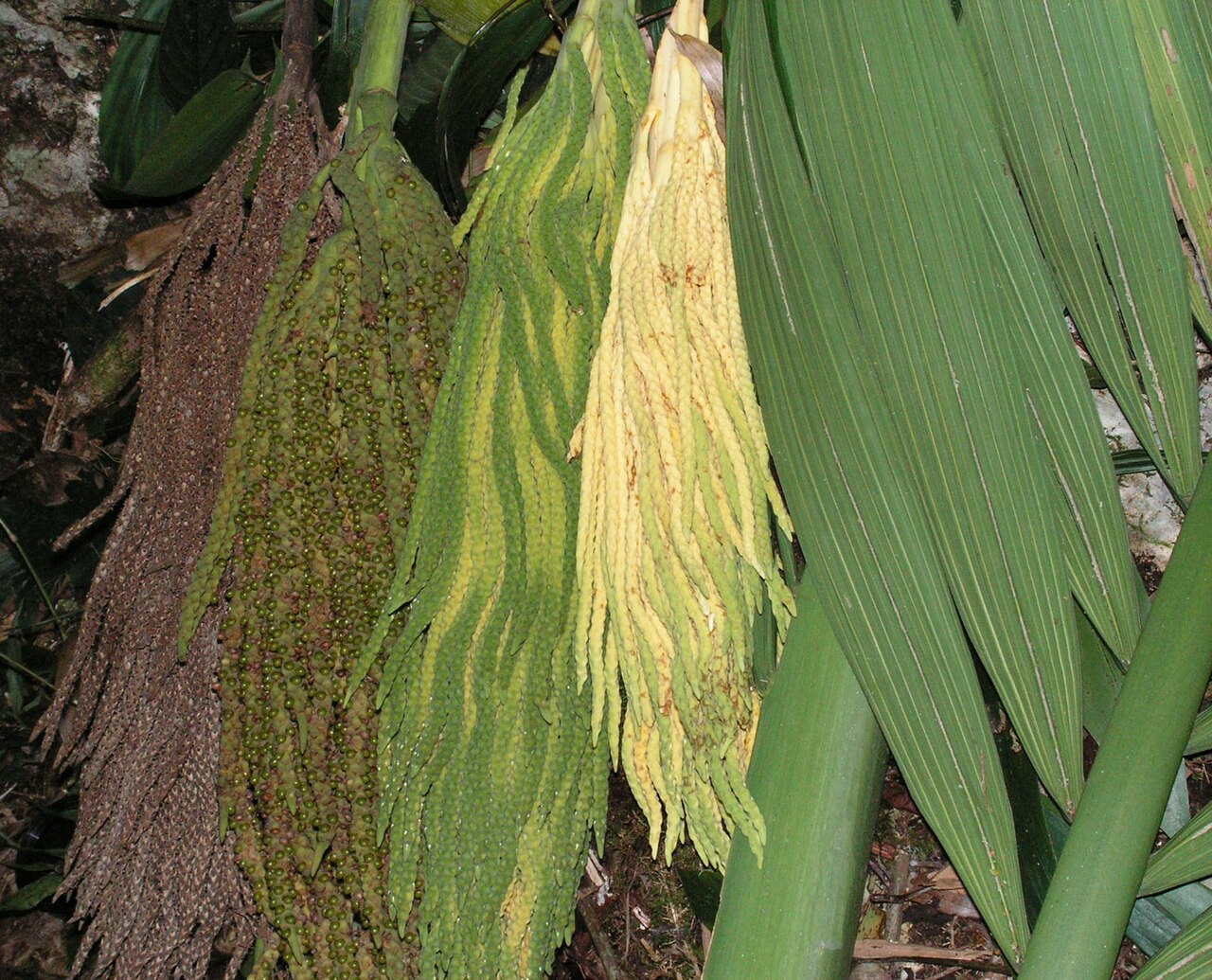
Flower clusters arise among the lower leaves and hang downward, reaching about 4 feet (1.2 m) long. Each cluster divides into many long, cord-like branches covered with small cream to whitish flowers set in shallow pits along the branches, which gives the spikes a pitted, snake-skin texture after the flowers drop. Male and female flowers are produced on the same palm. In Puerto Rico, the Fish and Wildlife Service reports that it flowers mainly from November to April and can flower twice a year.
Fruit & Seeds
The fruits are small, only about a quarter of an inch long. They ripen reddish brown, turning blackish before they fall, mostly in summer (May to August in Puerto Rico). Each fruit holds a single seed. A heavy crop turns the hanging spikes into dense, dark ropes of fruit.
Quick Facts
| Scientific Name | Calyptronoma rivalis (USDA common name: Puerto Rico manac; Spanish: palma de manaca; syn. Calyptrogyne rivalis, Cocops rivalis, Calyptronoma quisqueyana) |
| Family | Arecaceae (palm family) |
| Plant Type | Solitary feather palm (tree-sized); federally Threatened (ESA, 1990) |
| Mature Height | 13–49 ft (4–15 m) |
| Mature Spread | 15–25 ft crown |
| Growth Rate | Moderate with steady moisture |
| Sun Exposure | Partial shade to full sun when mature; seedlings need shade |
| Water Needs | High; moist to wet soil, never droughty |
| Soil Type | Moist, humus-rich soils over limestone; stream banks and ravine bottoms |
| Soil pH | About neutral to slightly alkaline (limestone-derived soils) |
| Bloom Time | Mainly November–April in Puerto Rico |
| Flower Color | Cream to whitish, on long hanging spikes |
| Fall Color | None; evergreen |
| Fruit | Small reddish-brown to blackish one-seeded fruits, May–August |
| Deer Resistant | Not a concern in its native range |
| USDA Hardiness Zones | 10b–12 (frost-free only) |
Native Range
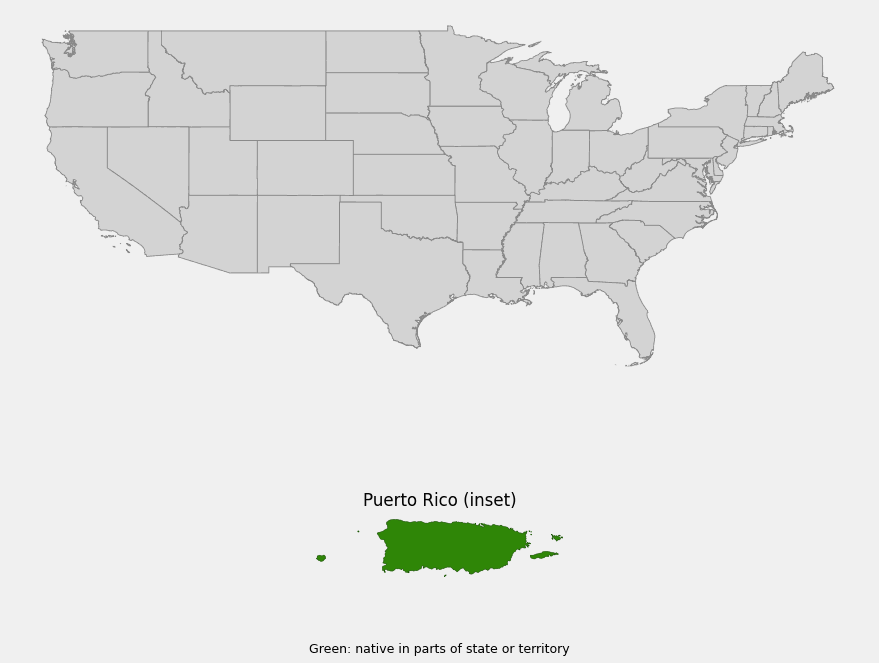
Manaca palm is native to the Greater Antilles: Puerto Rico and Hispaniola. In Puerto Rico, the U.S. Fish and Wildlife Service reports natural populations along Quebrada Collazo in San Sebastián, along the Río Camuy between Hatillo and Camuy, and along the Río Guajataca between Quebradillas and Isabela, with a newer natural population found in Camuy. The palm has also been planted into several Commonwealth forests and onto private lands under conservation agreements to create new populations.
All of the Puerto Rican sites lie in the northern and northwestern karst region, the haystack-hill limestone country between Arecibo and Aguadilla. There the palm grows along stream banks and in forest near ravines and creeks, in moist evergreen and semi-deciduous limestone forest and in wet evergreen forest at higher elevations. Its dependence on permanently moist ground along streams is why it occurs in so few places, and why clearing, development and poor management of those streamside strips threaten it.
On Hispaniola the palm is common and widespread, documented from Haiti to the eastern Dominican Republic, where it grows in waterlogged ground near streams below about 1,500 ft (450 m). Above that elevation it is replaced by a related species, Calyptronoma plumeriana. In 2022 the IUCN Red List assessed the species as Least Concern because of the large Hispaniolan population, but the U.S. listing for Puerto Rico remains in place because the island’s small populations are on unprotected private land and some are not reproducing well.
📋 Regional plant lists featuring Manaca Palm: Puerto Rico
Growing & Care Guide
Manaca palm is a strictly tropical palm. Outdoors in the United States it can only be grown in Puerto Rico, the U.S. Virgin Islands, Hawaii and the warmest parts of South Florida (roughly USDA zones 10b to 11), and even there it needs steady moisture. A specimen grows at Mounts Botanical Garden in West Palm Beach. Elsewhere it is a palm for large heated conservatories. Because it is federally threatened, buy only nursery-propagated plants from a reputable grower, and never collect seed or seedlings from wild palms; in Puerto Rico, conservation agencies and partners propagate it for reintroduction.
Light
In the wild, seedlings and young palms grow in the shade of the forest along streams, and the Fish and Wildlife Service notes that early stages need more moisture and shade than mature palms. Give young plants bright shade or filtered light. Older palms can take more sun as long as the roots stay moist.
Soil & Water
Plant in deep, humus-rich soil that stays consistently moist. In nature it grows over limestone, so neutral to slightly alkaline soils suit it. The roots tolerate periodically waterlogged ground, which makes it a good choice for low spots, stream edges or the margin of a pond. Never let it dry out, and mulch heavily with leaf litter in drier gardens.
Planting Tips
Plant at the same depth it grew in the container, in a sheltered, humid spot protected from strong wind, which shreds the long leaves. Allow plenty of room: the leaves can reach 16 feet, so place it at least 10 to 12 feet from buildings and paths. Water deeply and regularly for the first year.
Pruning & Maintenance
Remove only fully brown, dead leaves; green or yellowing leaves still supply the palm with nutrients. Like other palms it has a single growing point at the top of the trunk, so never cut the top. A palm fertilizer with magnesium and micronutrients helps on poor or sandy soils. Frost will damage or kill it.
Propagation
Manaca palm is grown from fresh seed. Clean the pulp from ripe, dark fruits and sow them promptly in a moist, well-drained mix kept warm and shaded. Like many palm seeds, they lose viability if they dry out. It produces a single trunk and does not sucker, so it cannot be divided. Gardeners should obtain seed or plants only from cultivated sources, not from wild populations.
Landscape Uses
- Stream and pond margins: a native feather palm for permanently moist ground and shaded banks
- Conservation plantings: reintroduction and riparian restoration in Puerto Rico’s karst region with propagated stock
- Botanical gardens and palm collections: a rare Caribbean endemic palm for tropical and conservatory collections
- Shade gardens in the tropics: young plants make a lush understory accent in moist, shady gardens
- Educational plantings: a living example of a federally listed Puerto Rican plant and the threats facing karst streams
Wildlife & Ecological Value
Manaca palm is part of the streamside forest that protects the rivers and creeks of Puerto Rico’s karst. Its large crown shades the water, and its roots help hold soft, wet stream banks in place.
For Pollinators
The flowers are small but produced in large numbers on long hanging spikes. The U.S. Fish and Wildlife Service reports that honeybees have been seen visiting the flowers and may be pollinators, but the palm’s native pollinators have not been well studied.
For Birds
The small, dark, single-seeded fruits are the kind that many Caribbean forest birds feed on, and fruit-eating birds likely help spread the seeds along streams. Specific studies of the birds that eat manaca fruit are scarce.
For Mammals
Puerto Rico has few native land mammals other than bats. Fruit bats feed on many native palm fruits, and they may visit manaca palm, though this has not been well documented.
Ecosystem Role
As a riparian palm, manaca helps stabilize stream banks, shades the water and drops leaves and fruit that feed the streamside food web. Its small number of Puerto Rican populations makes it a good indicator of how intact the island’s karst streams and their forests remain.
Cultural & Historical Uses
The palm was first described by the American botanist Orator F. Cook as Cocops rivalis. Liberty Hyde Bailey later moved it to Calyptronoma, and Brother León (Hermano León), a botanist of the Cuban flora, placed it in Calyptrogyne, a name that still appears in some older references. In 1995, palm specialists treated the Hispaniolan Calyptronoma quisqueyana as the same species, which greatly widened its known range.
In Puerto Rico the palm is known as palma de manaca. Its status as one of the island’s rarest native palms has made it a focus of conservation work: the U.S. Fish and Wildlife Service and its partners have propagated it and planted it into protected forests and private lands with conservation agreements, raising the number of palms on the island well above the roughly 220 counted at the time of listing.
Despite those gains, the Fish and Wildlife Service has kept the palm listed as Threatened because the natural Puerto Rican populations are on private land without formal protection, face pressure from development and poor land management, and in some cases are not reproducing successfully. Protecting the forested strips along the Guajataca, Camuy and other karst streams is the most important thing that can be done for it.
Frequently Asked Questions
Is manaca palm endangered?
In the United States it is listed as Threatened under the Endangered Species Act (since 1990), because only a few small natural populations survive in Puerto Rico. It is more common on Hispaniola, and the IUCN Red List rates the species as a whole as Least Concern.
Where does manaca palm grow in Puerto Rico?
Along streams and ravines in the northwestern karst region, including the Río Guajataca (Quebradillas–Isabela), the Río Camuy (Hatillo–Camuy) and Quebrada Collazo in San Sebastián. It has also been planted in several Commonwealth forests.
Can I grow manaca palm in Florida?
Only in the warmest, essentially frost-free parts of South Florida, in moist soil and partial shade. Elsewhere on the mainland it needs a large heated greenhouse. Buy nursery-propagated plants only and never collect from wild palms.
How do I tell manaca palm from a royal palm?
Royal palms have a smooth, pale gray trunk and a glossy green crownshaft below the leaves. Manaca palm has a rough brownish trunk, no smooth crownshaft, and long hanging rope-like flower and fruit clusters among the lower leaves. It also grows mainly along shady stream banks.
What does the name rivalis mean?
It comes from the Latin for “of streams,” a reference to the palm’s habitat along creeks and rivers. The older genus name Calyptrogyne and the original name Cocops rivalis are synonyms.

Looking for a nursery that carries Manaca Palm?
Our nursery directory does not yet include Puerto Rico. Browse the native plant nursery directory by state: Alabama–Arkansas · California · Colorado–Hawaii · Idaho–Kansas · Kentucky–Montana · Nebraska–Oklahoma · Oregon · Pennsylvania–Virginia · Washington · West Virginia–Wyoming