
Wild Birdnest Fern (Asplenium serratum)
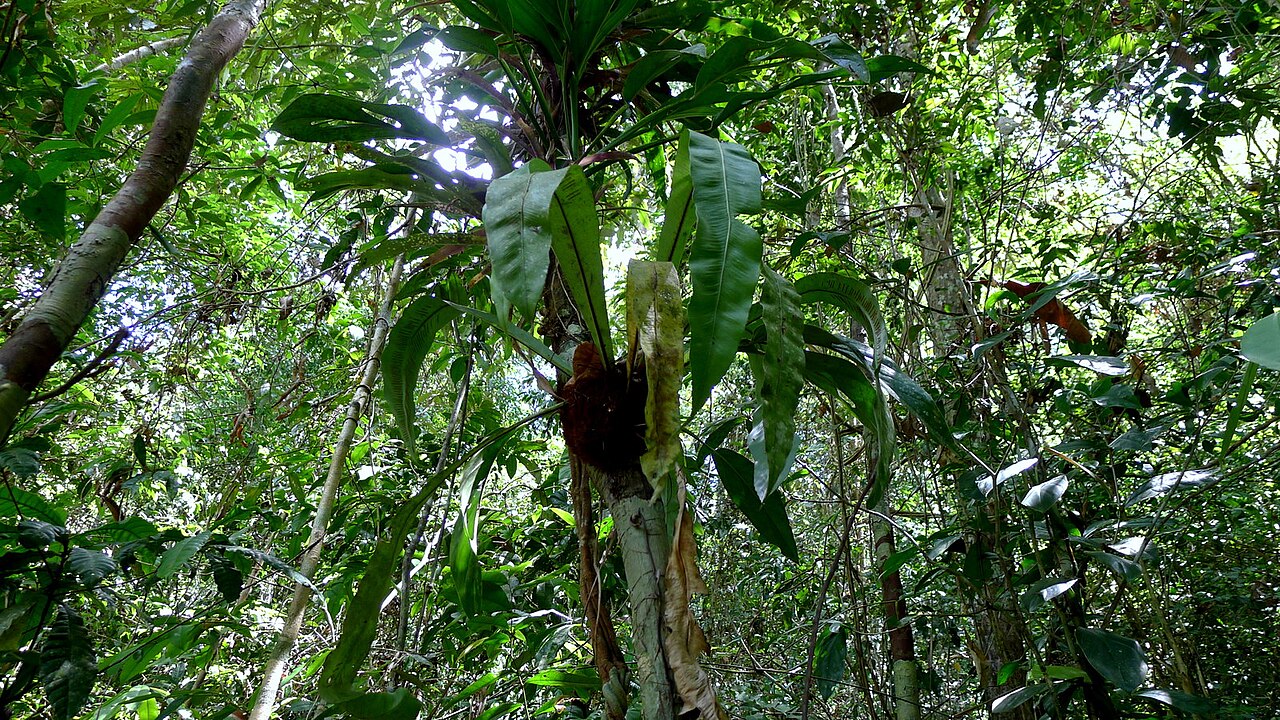
Asplenium serratum, the Wild Birdnest Fern, also called New World birdnest fern or bird’s-nest spleenwort, is the native American cousin of the bird’s-nest fern sold as a houseplant. In Puerto Rico it is one of the ferns known as culantrillo. It forms a vase-shaped rosette of glossy, undivided, strap-like fronds, each up to about 3 feet long, and it usually grows perched on tree trunks, rotting logs or mossy limestone in humid forest. It belongs to the spleenwort family (Aspleniaceae).
In Puerto Rico the wild birdnest fern grows from the northern coastal lowlands near Loíza into the Luquillo Mountains of El Yunque and along the Sierra de Cayey and the Cordillera Central, from near sea level to roughly 2,500 feet. It is a fern of shady, wet forest, where the funnel of fronds collects falling leaves and rainwater and slowly builds its own pad of humus, a small “nest” that gives the plant its name.
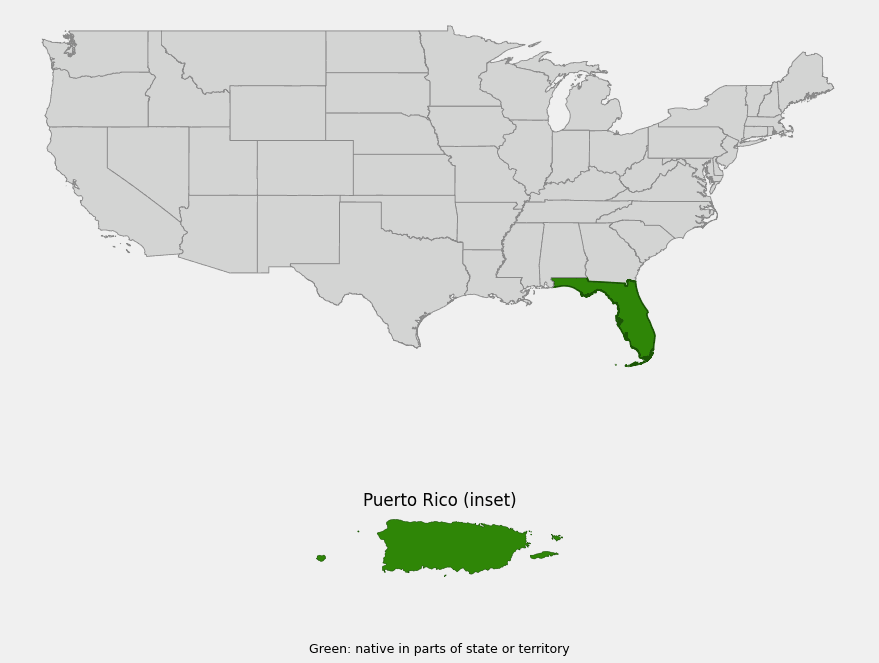
The species ranges widely across tropical America, from southern Mexico and the Antilles to Brazil and northeastern Argentina, but in the continental United States it reaches only the southern tip of Florida, where it is very rare and listed as state Endangered. This guide explains how to tell it from the Old World bird’s-nest fern, where it grows, how to grow it in a shaded tropical garden, and why it matters in the forest canopy.
Identification
Few native ferns look like the wild birdnest fern. Its fronds are not divided into leaflets at all, so at first glance the plant can be mistaken for a bromeliad or a young aroid. The fertile undersides, striped with long sori, identify it as a fern at once.
Growth Form
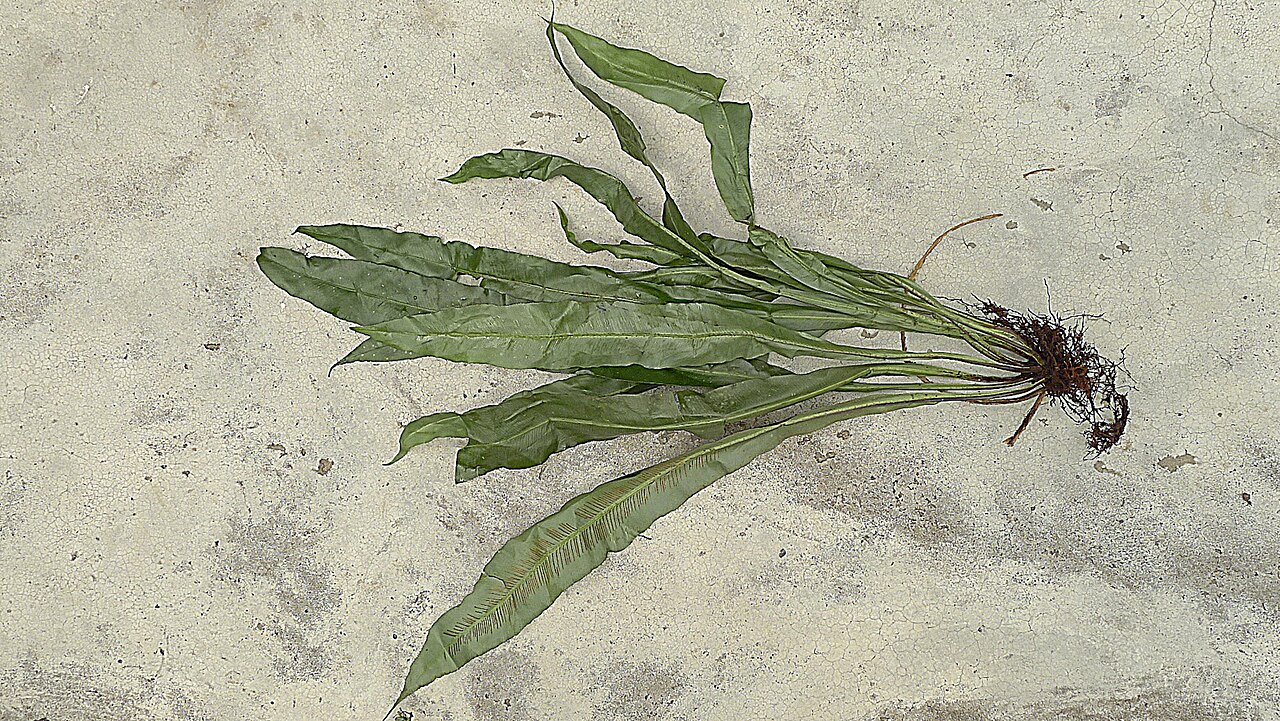
The plant forms an upright to spreading rosette from a short, stout rhizome covered with dark, narrow scales. Older plants hold a dozen or more fronds that arch outward like a shallow vase. A tangle of wiry, fuzzy roots anchors the plant to bark or rock and spreads through the humus that accumulates in the center. It is usually an epiphyte (growing on trees without taking nourishment from them), but it also grows on limestone boulders, stumps and fallen logs, and occasionally on the ground in deep leaf litter.
Fronds
Each frond is a single, simple blade, typically 1 to 3 feet long and 1½ to 4 inches wide, broadest above the middle and tapering gradually to a very short, winged stalk. The tip is pointed, and the margins are wavy to finely toothed, especially toward the tip, which is the meaning of the species name serratum. The blade is bright to dark green, smooth and somewhat leathery, with a prominent midrib and numerous fine, closely parallel side veins that run outward at an angle.
Spores
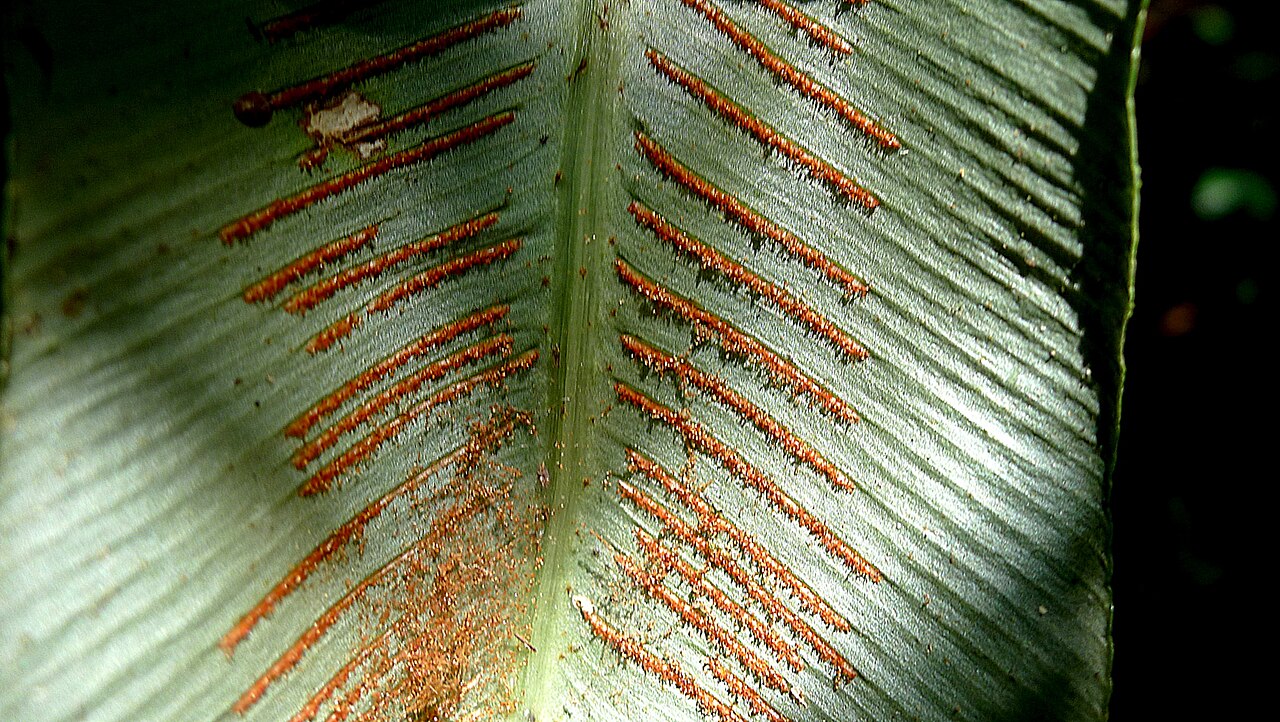
Like all ferns, it has no flowers or seeds. Spores are produced in long, narrow sori, often 1 to 2 inches long, that run along the side veins on the underside of the upper half of the frond. Each sorus has a thin flap of tissue (the indusium) along one side. When ripe the sori turn orange-brown and release clouds of fine spores. In Puerto Rico plants have been found with spores in every month of the year.
Similar Species
The bird’s-nest fern of the houseplant trade, Asplenium nidus and its relatives, comes from the Old World tropics. Its fronds are usually broader, with smooth margins and a dark midrib. Wild birdnest fern fronds are narrower, taper more gradually toward the base, and usually have toothed margins near the tip. Several unrelated ferns and bromeliads also form “nest” rosettes, but none has the simple, vein-striped fronds and long linear sori of a spleenwort.
Quick Facts
| Scientific Name | Asplenium serratum L. |
| Family | Aspleniaceae (spleenwort family) |
| Plant Type | Epiphytic or rock-dwelling fern; evergreen perennial |
| Mature Height | 1–3 ft (fronds to about 3 ft long) |
| Mature Spread | 2–4 ft rosette |
| Growth Rate | Slow |
| Sun Exposure | Partial to full shade |
| Water Needs | Medium to high; constant humidity, never waterlogged |
| Soil Type | Epiphytic: bark, moss and humus; coarse, fast-draining organic mix in cultivation |
| Soil pH | Slightly acidic to neutral humus; also on limestone |
| Bloom Time | None (spores year-round in Puerto Rico) |
| Flower Color | None; non-flowering fern |
| Fall Color | None; evergreen |
| Fruit | None; spores in long linear sori under the fronds |
| Deer Resistant | Not applicable in most of its range; rarely browsed |
| USDA Hardiness Zones | 10b–11 (frost-tender) |
Native Range
USDA PLANTS lists the wild birdnest fern as native to Puerto Rico, the U.S. Virgin Islands and the lower 48 states, where it is known only from Florida. Beyond the United States it ranges from southern Mexico through Central America and the Antilles to Trinidad and Tobago and across tropical South America to Brazil, Paraguay and northeastern Argentina.
In Puerto Rico, Axelrod’s Systematic Vademecum to the Vascular Plants of Puerto Rico records it from the northern coastal lowlands (Loíza), the Sierra de Luquillo, the eastern coast at Cuchilla de Panduras, the Sierra de Cayey and Las Tetas de Cayey, and the eastern and western Cordillera Central, from near sea level to about 750 m (roughly 2,500 ft). It favors moist to wet forest: lowland forest along the north coast, the tabonuco forest of El Yunque, and humid ravines in the central mountains, where it perches on trunks and branches or on mossy rocks.
Florida is the northern edge of its range. The Atlas of Florida Plants lists it from just five counties (Broward, Collier, Lee, Miami-Dade and Volusia), and most living populations are in the deep cypress and hardwood swamps of southwest Florida, such as the Fakahatchee Strand. It is listed as Endangered by the state of Florida. Freezes, drainage and collecting for the plant trade have all reduced Florida populations.
📋 Regional plant lists featuring Wild Birdnest Fern: Puerto Rico · North & South Florida
Growing & Care Guide
Wild birdnest fern is a handsome, low-maintenance plant for shady tropical gardens, shade houses and large containers in Puerto Rico and frost-free south Florida, and it grows well indoors in bright, indirect light. Buy only nursery-propagated plants. Wild plants are slow to replace, and in Florida the species is state-listed and must not be collected.
Light
Give it bright shade or filtered light, such as the dappled light under a tree canopy or on the north side of a building. Direct midday sun bleaches and scorches the fronds. In deep shade it survives but grows slowly and makes fewer fronds.
Soil & Water
As an epiphyte it needs air around its roots. Mount it on a rough-barked tree, a log or a slab of limestone with a pad of moss, or grow it in a basket or pot filled with a coarse mix of bark, coir or sphagnum and a little coarse compost. Keep the roots evenly moist but never waterlogged, and keep humidity high. In dry weather water the rosette and roots regularly. Avoid letting water stand in the crown in cool weather, and do not use heavy, compacted potting soil.
Planting Tips
To mount a plant, set the root ball against the trunk or rock in a shaded, sheltered spot, pad it with moss and tie it in place with soft twine or fishing line until new roots grip the surface, usually within a few months. Trees with rough bark and some shade, such as oaks, figs and gumbo limbo, make good hosts. In containers use a shallow pot just large enough for the root mass.
Pruning & Maintenance
Remove old, yellow or damaged fronds at the base. Let fallen leaves collect in the center, since they rot into the humus the plant feeds on, but clear out any heavy debris that could cause rot. A light feeding with diluted fertilizer during the warm, wet months is plenty. Protect it from temperatures below about 40°F (4°C); frost kills the fronds and can kill the plant.
Propagation
The species does not form offsets readily, so it is propagated from spores. Sow fresh spores on sterile, moist peat or fine compost in a covered container in bright shade. Tiny heart-shaped gametophytes appear in a few weeks, and young fronds follow after several months. Seedlings grow slowly and take a few years to reach a good size, which is one reason this fern is uncommon in nurseries.
Landscape Uses
- Tree mounts: attach to rough-barked trees in shady tropical gardens for a natural epiphyte display
- Shade gardens: a bold, glossy accent among native shrubs and groundcovers in frost-free areas
- Containers and baskets: for shaded patios, porches and shade houses
- Indoor plant: a native alternative to the Old World bird’s-nest fern in bright, indirect light
- Fern and epiphyte collections: alongside native bromeliads, orchids and other tropical ferns
Wildlife & Ecological Value
A wild birdnest fern is a small habitat of its own. The funnel of fronds catches leaves, water and dust from the canopy and turns them into a pocket of moist humus high above the forest floor.
For Pollinators
As a fern it produces no flowers, nectar or pollen and does not depend on pollinators. It is part of the humid, epiphyte-rich forest that supports many native bees, butterflies and other pollinators.
For Birds
It has no fruit or seeds for birds, but insect-eating birds forage among epiphytes like it for the insects and spiders they shelter. In Puerto Rico it shares the canopy with bromeliads and orchids that provide water and foraging sites for forest birds.
For Mammals
It has little food value for mammals. In Puerto Rico, where the only native land mammals are bats, its main role for animals is as shelter in the canopy.
Ecosystem Role
Litter-trapping epiphytes such as birdnest ferns build up “suspended soils” in the canopy. These pockets of humus hold moisture and nutrients and shelter insects, mites, earthworms, snails and other small invertebrates, and frogs and lizards hunt among them. The plant also adds to the layered structure of moist forest. In Florida, where only a few populations remain, it is an indicator of undisturbed, humid swamp forest.
Cultural & Historical Uses
Linnaeus named Asplenium serratum in 1753 in Species Plantarum, the starting point of modern plant names, making it one of the first tropical American ferns to be formally described. The genus name comes from the Greek for spleen, because spleenworts were once used in European folk medicine to treat ailments of the spleen.
In Puerto Rico the name culantrillo is applied to several ferns, especially the delicate maidenhair ferns (Adiantum), so local names alone are not a reliable guide; the scientific name avoids confusion. Kew’s Plants of the World Online notes that the species has been used medicinally in parts of its range, but those uses are not well documented and are not recommended.
Today the wild birdnest fern is valued by native plant growers and fern enthusiasts as a regional alternative to imported bird’s-nest ferns. Because Florida’s populations are few and protected, gardeners there and in Puerto Rico should buy plants raised from spores by reputable nurseries and never remove plants from the wild.
Frequently Asked Questions
Is wild birdnest fern the same as the bird’s-nest fern sold as a houseplant?
No. The common houseplant is Asplenium nidus or a related Old World species. The wild birdnest fern, Asplenium serratum, is native to tropical America, including Puerto Rico and south Florida. It has narrower fronds with toothed margins near the tip, and it grows mainly as an epiphyte.
Does wild birdnest fern need soil?
Not ordinary garden soil. In nature it grows on trees, logs and rocks, feeding on humus that collects in its rosette. In cultivation, mount it on a tree or log, or grow it in a coarse, airy mix of bark, coir or sphagnum that stays moist but drains quickly.
Can it take full sun?
No. It needs bright shade or filtered light. Direct sun, especially in the middle of the day, yellows and scorches the fronds.
Is it protected?
In Florida it is listed as Endangered by the state, and wild plants must not be collected. It is not federally listed. In Puerto Rico it is more widespread, but gardeners everywhere should buy nursery-propagated plants rather than collect wild ones.
How cold-hardy is wild birdnest fern?
It is a tropical fern. It is damaged by temperatures near freezing and is suitable outdoors only in frost-free areas such as Puerto Rico and the southern tip of Florida (USDA zones 10b–11). Elsewhere, grow it indoors or in a heated greenhouse.

Looking for a nursery that carries Wild Birdnest Fern?
Our nursery directory does not yet include Puerto Rico. Browse the native plant nursery directory by state: Alabama–Arkansas · California · Colorado–Hawaii · Idaho–Kansas · Kentucky–Montana · Nebraska–Oklahoma · Oregon · Pennsylvania–Virginia · Washington · West Virginia–Wyoming