
Ceiba (Ceiba pentandra)
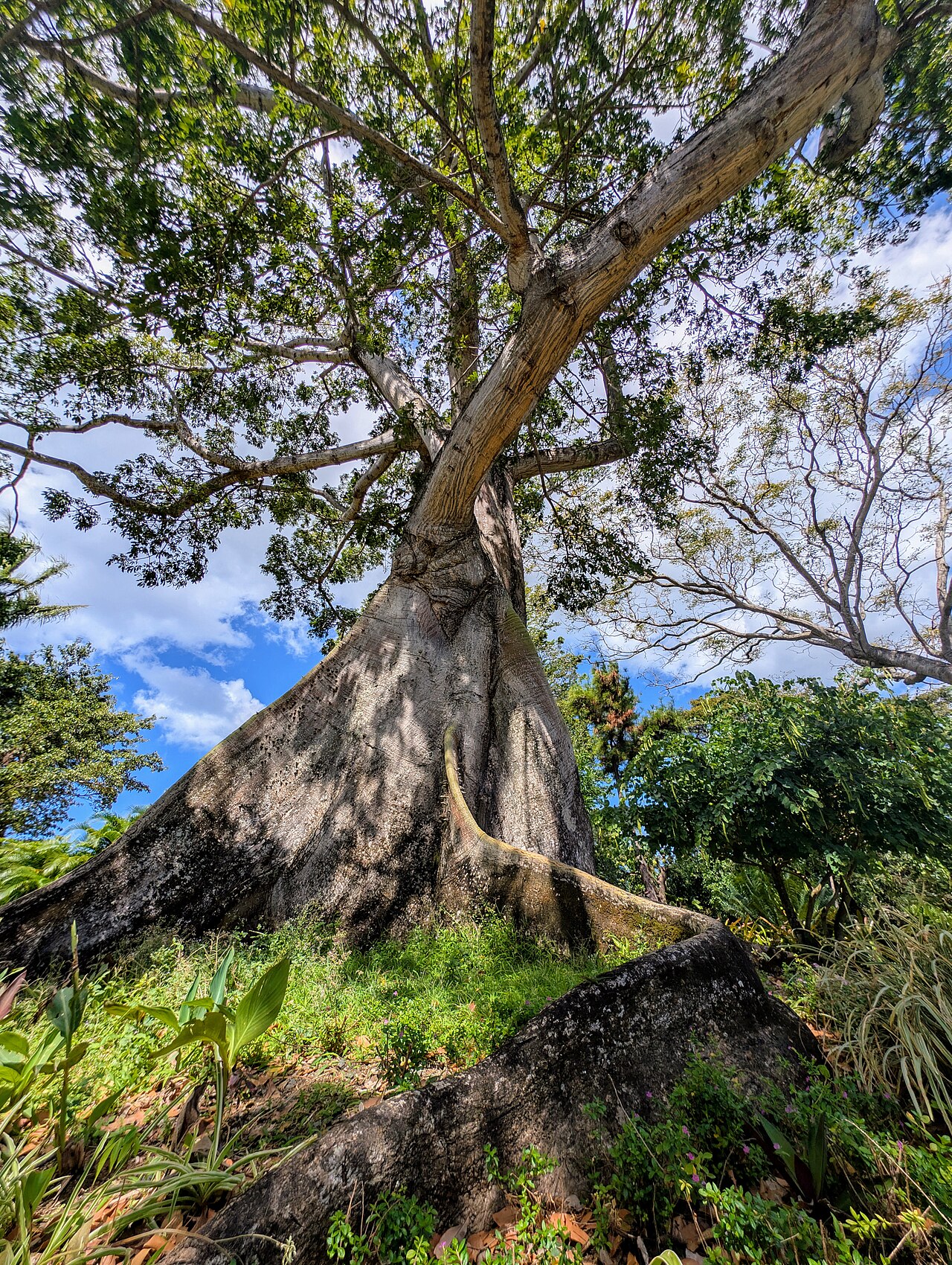
Ceiba pentandra, known in Puerto Rico simply as ceiba and in USDA PLANTS as kapoktree, is the giant of the island’s lowland forests. It is a fast-growing, briefly deciduous tree of the mallow family (Malvaceae, formerly placed in Bombacaceae) that can rise to 150 feet or more, carrying a flat, layered crown high above everything around it and standing on plank buttresses tall enough to walk between. Young trunks and branches are armed with stout conical spines.
USDA PLANTS lists the ceiba as native in Puerto Rico and in the U.S. Virgin Islands, and it is native nowhere in the continental United States. Its wider natural range runs from Mexico and Central America through the Caribbean to northern South America, and a number of authorities also treat it as native to western and central Africa. Wikipedia lists the ceiba among the national emblems of Puerto Rico, alongside Guatemala and Equatorial Guinea, and old specimens are protected and celebrated in plazas, pastures and roadsides across the island.
This guide covers how to recognize a ceiba at any age, where it grows on the island, how to give one the enormous room it needs, and why this tree carries more cultural weight in Puerto Rico and the wider Caribbean than almost any other plant. It is a magnificent tree for a park, finca or large rural property, and a poor choice for a small suburban lot.
Identification
Nothing else in Puerto Rico looks quite like a mature ceiba, but young trees are regularly confused with other big-leaved lowland trees. The combination of palmately compound leaves with five to nine leaflets, a smooth greenish-gray trunk flaring into plank buttresses, and conical spines on young wood identifies it reliably.
Form & Size
The ceiba grows with a straight, cylindrical trunk and tiers of nearly horizontal branches, giving older trees a distinctive flat-topped or umbrella-shaped silhouette. In Puerto Rico, open-grown trees commonly reach 60 to 100 feet with trunks 3 to 6 feet thick; in continental rainforest the species reaches about 200 feet (60 m), which makes it one of the tallest trees of tropical America. The crown of a very old tree can spread as wide as the tree is tall.
Buttresses & Trunk
Plank buttresses are the signature feature. They radiate from the base as thin, vertical walls of wood that can run 12 to 15 feet up the trunk and spread outward many feet before continuing underground. Bark on the trunk is smooth and gray to greenish-gray, often photosynthetic when young. Trunks and large limbs of young trees carry broad-based, sharply conical spines; these usually weather away as the tree matures, so an old ceiba may be smooth where a sapling nearby bristles.
Leaves
Leaves are alternate and palmately compound, like a hand with five to nine (sometimes more) narrow leaflets spreading from the tip of a long leaf stalk. Each leaflet is roughly 2 to 8 inches long, smooth-edged or slightly toothed near the tip, and tapers at both ends. The tree is briefly deciduous: in the island’s dry months it drops its leaves, stands bare for weeks, and then flushes new foliage.
Flowers
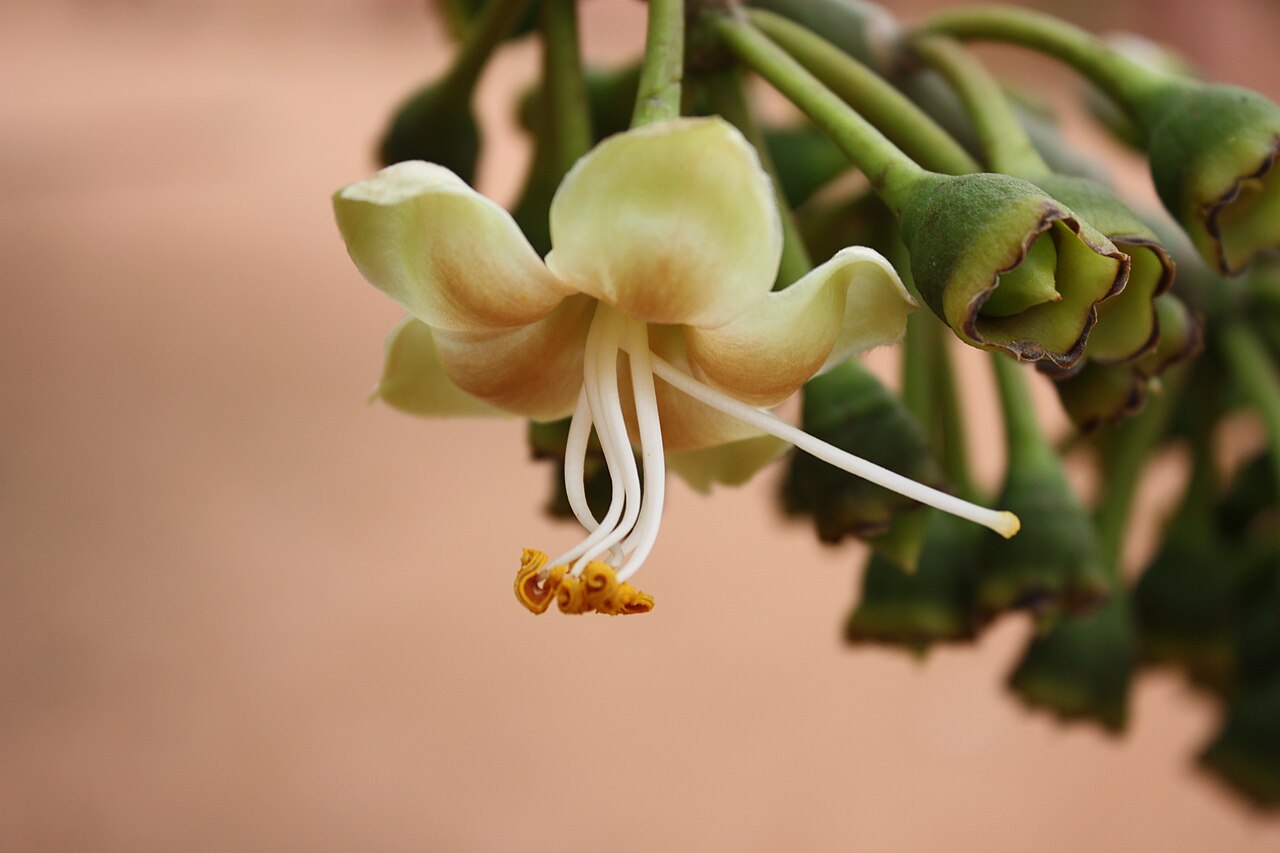
Flowering happens on the bare branches, which makes it conspicuous. Flowers are clustered along the twigs, about 1 to 1½ inches across, with five fleshy creamy-white to pale pink petals that curl back, five long stamen columns tipped with yellow anthers, and a protruding style. They open in the evening and are strongly scented. Trees do not flower every year; heavy blooming years alternate with lighter ones.
Fruit & Kapok
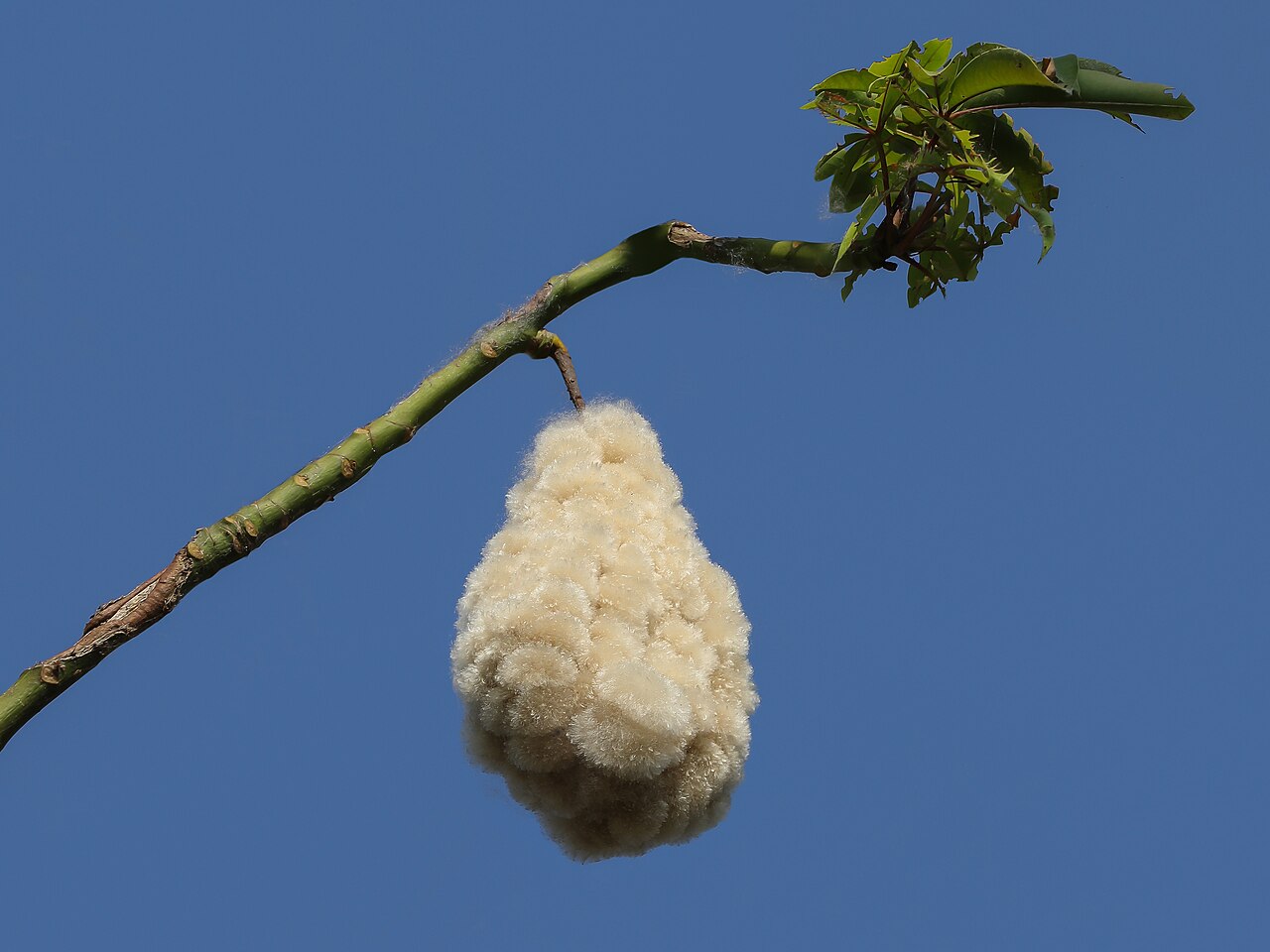
The fruit is a pendulous, leathery, elliptical capsule 4 to 6 inches long that ripens from green to brown and splits into five parts. Inside, dozens to a couple of hundred dark, pea-sized seeds are packed in a mass of pale, silky floss. That floss is kapok: each fiber is a hollow, waxy tube, which is why it is so light and so buoyant. When the capsules open, the wind carries seeds and fiber for long distances, and drifts of kapok collect under the tree and on nearby shrubs.
Quick Facts
| Scientific Name | Ceiba pentandra (L.) Gaertn. |
| Family | Malvaceae (mallow family; formerly Bombacaceae) |
| Plant Type | Large deciduous tropical tree |
| Mature Height | 60–100 ft in Puerto Rico; to about 200 ft in continental rainforest |
| Mature Spread | 60–120 ft; buttressed base may spread 20 ft or more |
| Growth Rate | Very fast |
| Sun Exposure | Full sun |
| Water Needs | Moderate; tolerates a pronounced dry season once established |
| Soil Type | Deep, well-drained soils; grows on limestone, alluvial and clay soils |
| Soil pH | Adaptable, roughly 5.5–8.0 |
| Bloom Time | Dry season, generally winter into spring, on leafless branches |
| Flower Color | Creamy white to pale pink with yellow anthers |
| Fall Color | None; briefly leafless in the dry season |
| Fruit | Leathery capsule 4–6 in long, filled with seeds and silky kapok floss |
| Deer Resistant | Not applicable in Puerto Rico; no native deer on the island |
| USDA Hardiness Zones | 10b–13; frost-sensitive |
| Other Common Names | Ceiba, ceibón (Puerto Rico and Spanish Caribbean); kapoktree (USDA PLANTS); silk-cotton tree, kapok |
Native Range
Ceiba is native across tropical America. USDA PLANTS records it as native in Puerto Rico and the U.S. Virgin Islands and lists no native occurrence in the continental United States. Beyond U.S. jurisdictions, its natural range covers Mexico, Central America, the Greater and Lesser Antilles, and the northern half of South America. Several authorities, including African forestry references, also treat the species as native to western and central Africa, where its buoyant fruits and long-distance seed dispersal make a natural trans-Atlantic arrival plausible.
On Puerto Rico the ceiba belongs to the lowlands. It grows in the moist and dry coastal plains, in river valleys, on the limestone hills of the northern karst and in the semi-arid southwest, and it turns up constantly as a remnant giant in pastures and along rural roads, where generations of farmers left it standing when they cleared everything else. It is a lowland species: it thrives from sea level to a few hundred feet and thins out well before the high elevations of the Cordillera Central and the Luquillo mountains.
If you garden in the continental United States, this is not a native plant, and in south Florida it is grown only as a landscape curiosity in frost-free spots. The ceiba in a Puerto Rican landscape, by contrast, is a true native canopy species and an important one: in a cleared pasture, a single old tree can be the only structure left for nesting birds, bats and epiphytes for a long way around.
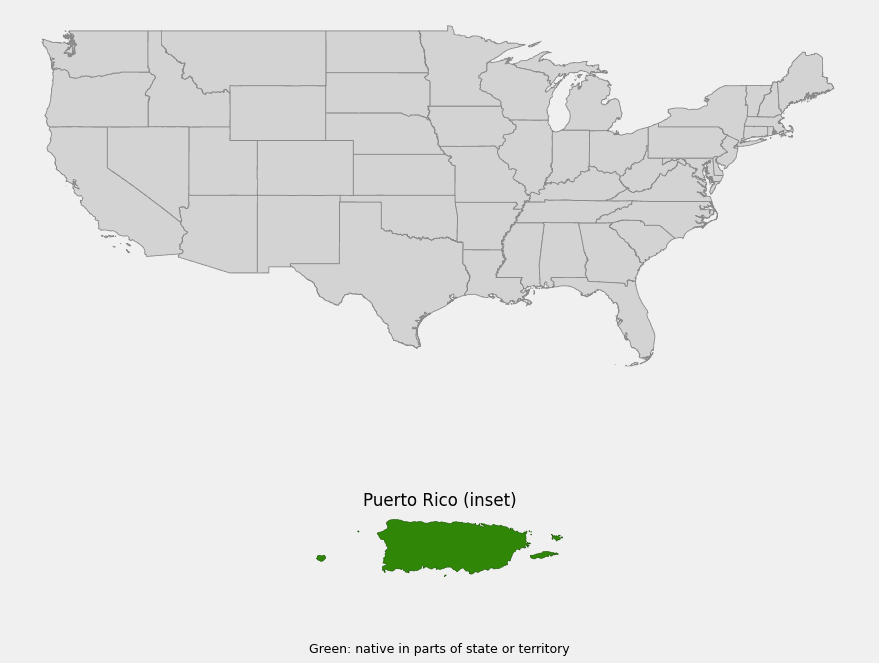
📋 Regional plant lists featuring Ceiba: Puerto Rico
Growing & Care Guide
Ceiba is one of the easiest large trees to grow in the tropical lowlands and one of the hardest to place. It asks for very little beyond sun, drainage and time; what it demands is room. Before planting one, look up, look sideways and think forty years ahead.
Light
Full sun, all day. Ceiba is a light-demanding pioneer species that shoots up in clearings, along rivers and in abandoned fields. Seedlings will tolerate part shade for a season or two, but a tree grown in shade stretches, leans and never develops the broad buttressed base that makes a mature ceiba worth having.
Soil & Water
It is not fussy. Ceiba grows on the deep alluvial soils of the coastal valleys, on clays, and directly on the limestone of the northern karst, and it tolerates a range from mildly acid to alkaline. What it will not accept is standing water at the root crown; plant it on ground that drains. Water a new tree weekly through its first dry season. After two or three years an established ceiba handles the island’s dry months on its own, dropping its leaves early in a hard year and refoliating with the rains.
Planting Tips
Give it space that sounds excessive: at least 50 to 60 feet from any building, wall, septic system, driveway, pavement or utility line, and more if you can. The buttresses alone will take over a 20-foot circle at the base, and the surface roots run far beyond that. Plant at the start of the rainy season from a container-grown seedling, keep the planting hole no deeper than the root ball, and stake only if the site is windy. Do not plant one where a falling limb would land on a roof.
Pruning & Maintenance
Prune for structure while the tree is young and you can still reach it: remove crossing or narrow-angled limbs and encourage a single straight leader. Once it is tall, leave it alone except for storm damage. The wood is soft and light, so large limbs can break in hurricanes; a clean, early structural prune is much more useful than heavy cutting later. Expect a thick litter of leaves in the dry season and drifts of kapok fiber after the capsules open, which is one more reason to keep the tree away from pools, gutters and screened porches.
Propagation
Easy from seed. Collect capsules as they turn brown but before they split, dry them in a paper bag until they open, and separate the seeds from the floss. Fresh seed germinates in about a week in moist potting mix and grows startlingly fast, often several feet in the first year. Large cuttings of ceiba also root readily, a trait used in parts of tropical America to make living fence posts, though seedlings make better-structured trees.
Landscape Uses
- Parks, plazas and large fincas: a landmark shade tree with no equal for scale in the Caribbean lowlands
- Pasture and silvopasture: a solitary shade tree that cattle and people have sheltered under for generations
- Reforestation and riparian buffers: a fast pioneer that quickly puts canopy over bare ground
- Wildlife plantings: nectar for bats and insects, cavities and perches for birds, and support for epiphytes
- Heritage and memorial plantings: a traditional tree for marking a place meant to outlive the planter
Wildlife & Ecological Value
A big ceiba functions less like a tree and more like a habitat. Its flowering schedule, its cavities, its crotches full of leaf litter and its exposed crown all support different sets of animals and plants through the year.
For Pollinators
Ceiba flowers are built for bats. They open after dark, hold large amounts of nectar, smell strongly, and are carried on bare branches where a flying animal can reach them without fighting through leaves. In Puerto Rico, bats are the only native land mammals, and nectar-feeding species visit ceiba flowers; hawkmoths and other night-flying insects also work them, and honey bees and other insects clean up the nectar left at dawn.
For Birds
Birds use the ceiba as a structure as much as a food source. The high, open crown is a favorite perch and nest site for raptors and for the island’s larger birds, and old trunks develop cavities that nesting birds use. Smaller birds forage for insects among the leaflets and flowers, and some take nectar from the open flowers early in the morning.
For Mammals
Fruit bats and nectar bats are the main mammal visitors. Elsewhere in its range, monkeys and other arboreal mammals feed in flowering ceibas; in Puerto Rico that role falls almost entirely to bats, which are also the tree’s most important pollinators.
Ecosystem Role
In a lowland forest the ceiba is an emergent: it grows above the general canopy and creates the uneven, layered structure that many forest animals depend on. Its rough crotches and spreading limbs collect debris and become gardens of bromeliads, orchids, ferns and mosses, each hosting its own invertebrates and tree frogs. In cleared country, a surviving ceiba is a stepping stone that lets forest species move across open land, and the shade under it is often where native seedlings begin to come back.
Cultural & Historical Uses
The ceiba is a sacred tree across the Americas. The Maya regarded it as the world tree joining the underworld, earth and sky, and in Cuba it is sacred in Palo, Arará and Santería, where offerings are placed at the base and the trees are left untouched out of respect. In Puerto Rico the tree carried similar weight for the Taíno, who valued it both as a sacred presence and as the source of the enormous dugout canoes they carved from single ceiba trunks, work made possible by the species’ soft, light, easily worked wood.
That cultural standing is still visible on the island. Old ceibas in town plazas and at rural crossroads are local landmarks with names and histories attached, protected by custom and by the sheer difficulty of removing them, and the tree is widely treated as an emblem of Puerto Rico. The botanical name records the same history from the other direction: ceiba is itself a Taíno word, carried into Spanish and then into scientific Latin when Linnaeus described the plant as Bombax pentandrum in 1753 and Gaertner moved it to Ceiba in 1791. The older names Bombax pentandrum and Eriodendron anfractuosum still turn up in forestry literature and herbarium labels.
Kapok, the floss around the seeds, made the tree commercially important worldwide. Because the fibers are hollow and waxy they are extremely light and do not absorb water, so kapok filled life jackets and life rings for decades before synthetic foams replaced it, and it is still used in pillows, mattresses, upholstery and insulation. The seeds yield a pale, mild oil; the soft timber is used for canoes, plywood, crates and light construction; and the bark and flowers appear in traditional medicine throughout the tree’s range.
Frequently Asked Questions
Is ceiba native to Puerto Rico?
Yes. USDA PLANTS lists Ceiba pentandra as native in Puerto Rico and the U.S. Virgin Islands, within a natural range that runs from Mexico and the Caribbean through northern South America. It is not native anywhere in the continental United States.
How big does a ceiba really get?
Bigger than almost any gardener expects. Open-grown trees in Puerto Rico commonly reach 60 to 100 feet tall with a crown just as wide, and the species reaches roughly 200 feet in continental rainforest. The plank buttresses can occupy a 20-foot circle at the base. Plan on at least 50 to 60 feet of clearance from buildings and pavement.
Why is my ceiba losing all its leaves?
Because that is what it does. Ceiba is briefly deciduous and normally drops its leaves in the dry season, often flowering while bare and then flushing new foliage when the rains return. A young tree may also shed leaves during an unusually dry spell; water it and it will releaf.
Are the spines on the trunk a problem?
They are a reason to site the tree thoughtfully, not a defect. Young trunks and branches carry stout conical spines that can injure anyone who brushes hard against them, so keep saplings away from paths and play areas. The spines generally weather off the trunk as the tree matures.
What is kapok used for?
Kapok is the silky floss around the seeds. It is hollow, waxy, very light and water-resistant, so it was long used to fill life jackets and flotation devices and is still used in pillows, mattresses, upholstery and insulation. The fiber is hard to spin, so it is used as stuffing rather than woven cloth.

Looking for a nursery that carries Ceiba?
Our nursery directory does not yet include Puerto Rico. Browse the native plant nursery directory by state: Alabama–Arkansas · California · Colorado–Hawaii · Idaho–Kansas · Kentucky–Montana · Nebraska–Oklahoma · Oregon · Pennsylvania–Virginia · Washington · West Virginia–Wyoming