
Puerto Rico Coontie (Zamia portoricensis)
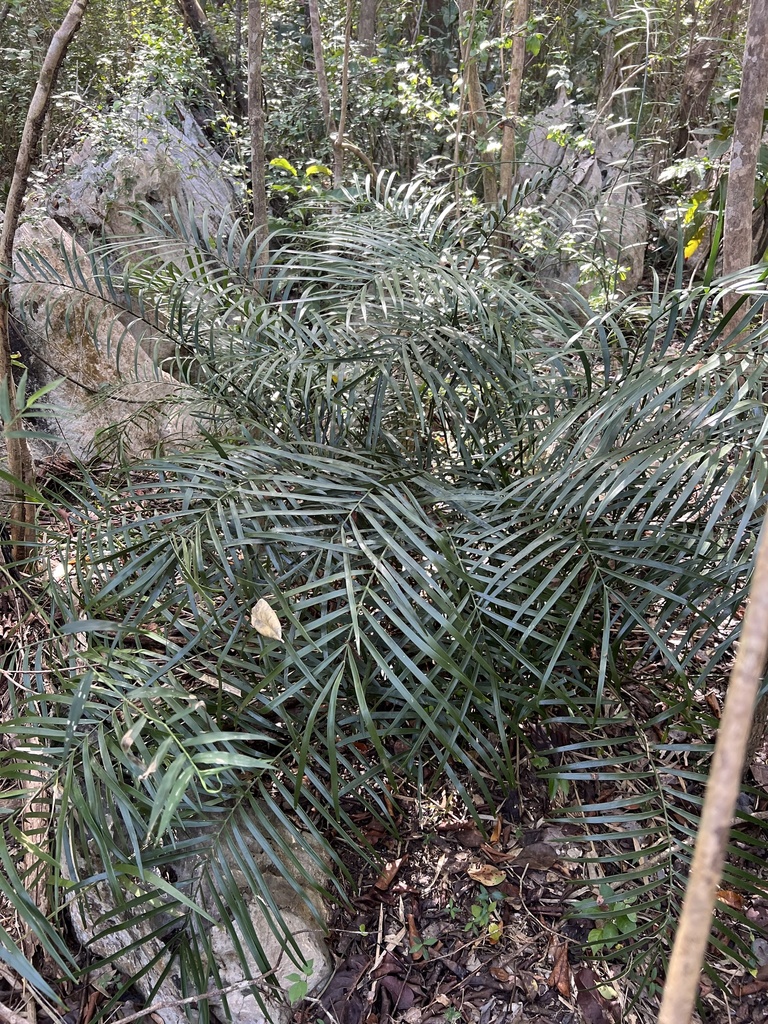
Zamia portoricensis, known in Puerto Rico as marunguey and in English as Puerto Rico Coontie or Puerto Rican zamia, is a small cycad found in the wild only in the southwest of the island. Cycads are not palms or ferns, even though they look like both: they are gymnosperms, seed plants that carry their seeds in cones rather than in flowers, and they are survivors of a lineage that was already old when the first flowering plants appeared. In this species almost the whole stem stays underground, so a mature plant looks like a tuft of stiff, arching, palm-like leaves a couple of feet tall rising straight out of the forest floor.
The species is endemic to Puerto Rico. The Institute for Regional Conservation records it from the southern coastal limestone around the Guánica State Forest, from the southwestern coastal lowlands at Sierra Bermeja, and from the western Cordillera in the Susúa State Forest, where it grows on serpentine. It is a plant of shaded understory on dry, rocky, well-drained slopes at low elevation. The IUCN Red List treats it as Endangered, and Puerto Rico’s Department of Natural and Environmental Resources has listed it as a critical element on its tracking list.
For gardeners, Puerto Rico coontie is a slow, long-lived, almost indestructible foliage plant for dry shade, and it is the only cycad native to the island that is widely grown. It is also one of the most interesting native plants to have in a yard, because it depends on a single Puerto Rican beetle to set seed. This guide covers how to tell it from the other zamias on the island, where it grows, how to grow and propagate it, and why plants should always be bought from a nursery rather than dug from the wild.
Identification
Three zamias grow wild in Puerto Rico, and they are easy to confuse at a glance. Puerto Rico coontie is the one with very narrow, almost grass-like leaflets. Nothing else on the island combines that fine foliage with a short, mostly buried stem and brown, felty cones at ground level.
Growth Form
Puerto Rico coontie makes a thick, fleshy, mostly subterranean stem, upright or leaning, usually unbranched or with a few branches, so the plant appears stemless. From the top of that stem it holds a crown of a few to a dozen or more leaves, each one commonly 1½ to 3 feet long. A large plant is about 2 feet tall and 3 to 5 feet across. The underground stem is a storage organ: it lets the plant survive drought, fire and browsing, and plants that lose all their leaves can push out a new flush later.
Leaves
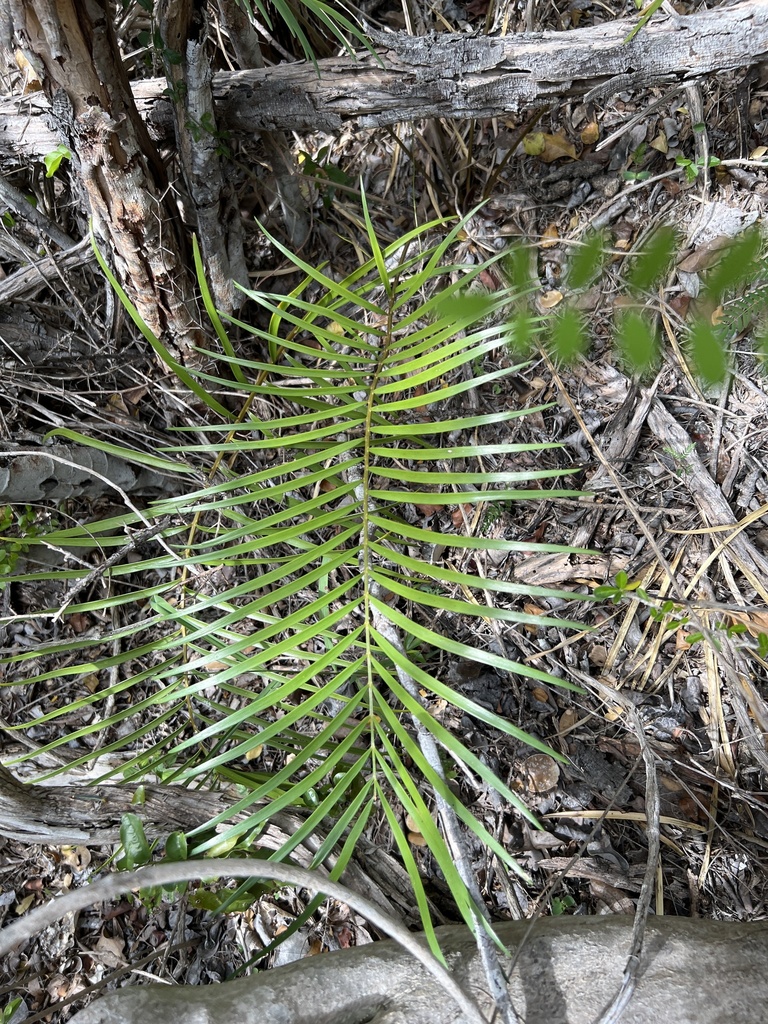
The leaves are pinnate, like a small palm or fern frond, with a smooth or slightly prickly stalk and ten to thirty or more pairs of leaflets. The leaflets of this species are narrowly linear, usually only about 5 to 10 mm wide (a quarter of an inch or less), with smooth margins and a long, tapering tip. They are stiff, leathery and dark green, and new flushes emerge soft and pale before hardening. The other two Puerto Rican zamias, Zamia amblyphyllidia and Zamia erosa, have much broader leaflets, often an inch or more wide and usually toothed toward the tip.
Cones
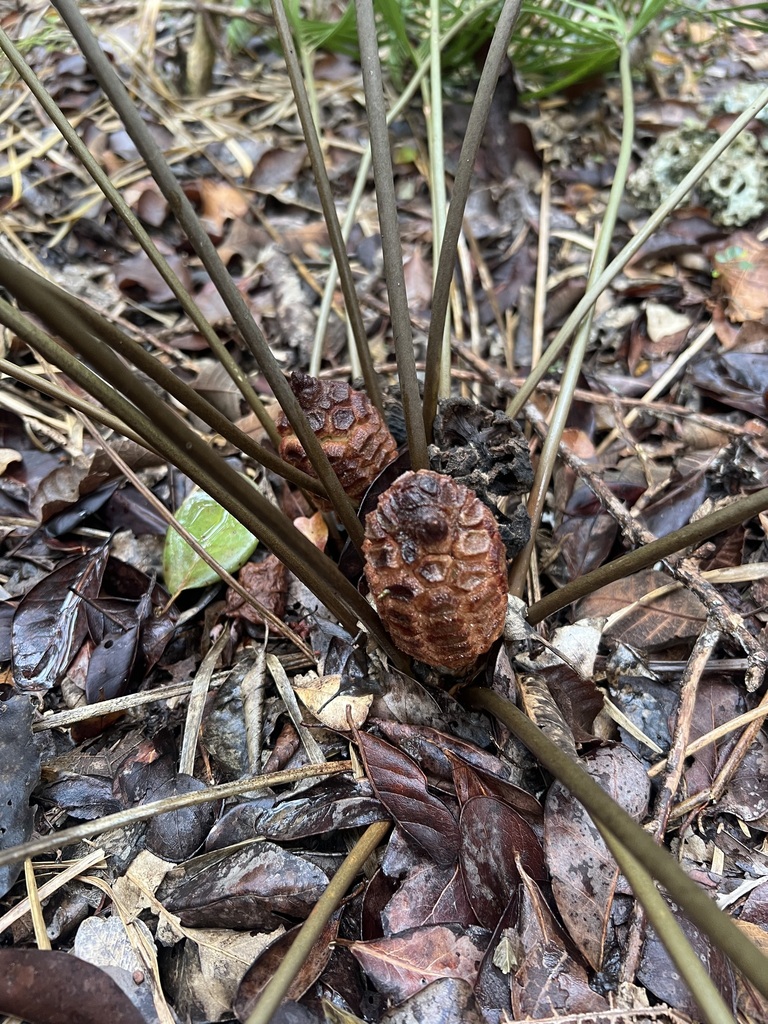
Like all cycads, this species is dioecious: a plant is either male or female, and both are needed for seed. Male cones are narrow and cylindrical, a few inches long and less than an inch thick, carried on a short stalk, and several may appear on one plant. Female cones are much stouter, barrel-shaped, roughly 2 to 5 inches long and 1½ to 2 inches thick, with a blunt tip. Both are covered in a dense, brownish, felt-like coat of hairs, and both sit low, almost on the ground among the leaf bases.
Seeds
A ripe female cone breaks apart on the plant and releases its seeds. Each seed is a little under an inch long and wrapped in a fleshy outer coat that turns bright red to blood-red, a color that separates this species from the paler-seeded zamias. The seeds fall close to the parent plant; cycad seeds are heavy and travel only a short distance, which is one reason the species occurs in dense local colonies rather than scattered widely.
Seasonal Cycle
The reproductive cycle is slow and well documented in this species. Male cones generally appear from late October, female cones become receptive in January and February, and if pollination succeeds the seeds take most of the rest of the year to mature, with the cones opening around November. A single plant may skip years between cones.
Quick Facts
| Scientific Name | Zamia portoricensis Urb. |
| Family | Zamiaceae (cycad family) |
| Plant Type | Evergreen cycad with a mostly underground stem |
| Mature Height | 1.5–3 ft (leaf length) |
| Mature Spread | 3–5 ft |
| Growth Rate | Very slow; long-lived |
| Sun Exposure | Partial shade to shade; tolerates some direct sun with moisture |
| Water Needs | Low once established; needs sharp drainage |
| Soil Type | Rocky, well-drained soils over limestone or serpentine |
| Soil pH | Adaptable; grows on both alkaline limestone and serpentine soils |
| Bloom Time | None; male cones from late October, female cones receptive January–February |
| Flower Color | None; cones are brown and felted |
| Fall Color | None; evergreen |
| Fruit | Cone breaking apart to release seeds with a bright red fleshy coat |
| Deer Resistant | Not applicable in Puerto Rico; foliage and seeds are toxic to livestock and pets |
| USDA Hardiness Zones | 10–11 |
Native Range
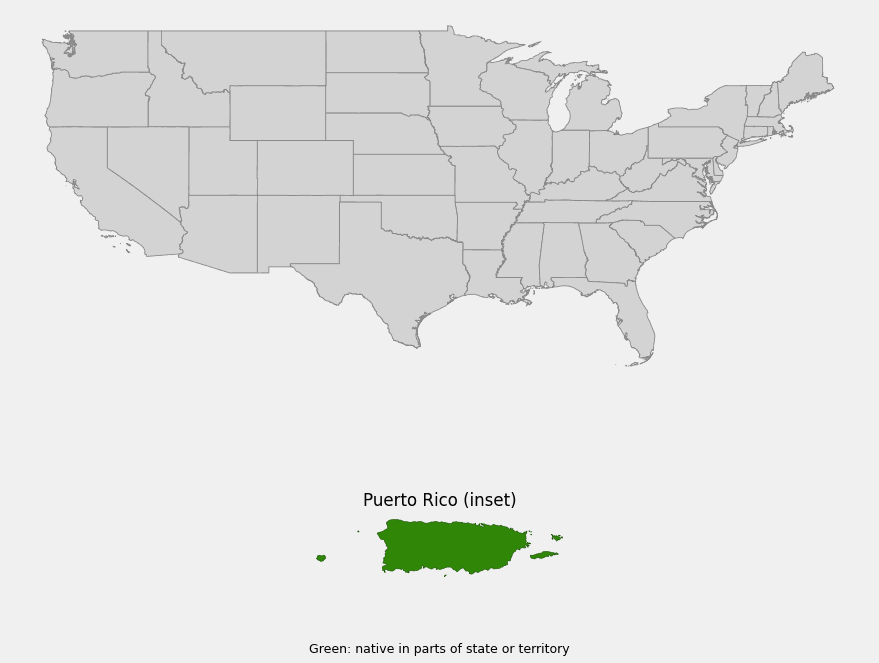
USDA PLANTS lists Zamia portoricensis (symbol ZAPO) as native to Puerto Rico and to nowhere else in the United States. The Smithsonian’s Flora of the West Indies treats it as endemic to Puerto Rico, and the Institute for Regional Conservation agrees, calling it a rare cycad of southwestern Puerto Rico at low elevations. It does not grow naturally in the U.S. Virgin Islands or on any other island.
Within Puerto Rico its range is small. The Institute for Regional Conservation places it in three areas: the southern coastal limestone, including the Guánica State Forest; the southwestern coastal lowlands at Sierra Bermeja, which is treated as a botanically unique area; and the western Cordillera in the Susúa State Forest, where it grows on serpentine. Field studies of the species describe it as a plant of the serpentine outcrops and limestone zones of south-central and southwestern Puerto Rico, growing on north-facing hill slopes under a nearly closed canopy.
Because the species belongs to the Zamia pumila complex, older references sometimes list these plants as Zamia pumila and show a much wider Caribbean range. PlantNative follows the World List of Cycads, published under the auspices of the IUCN/SSC Cycad Specialist Group, which keeps Z. portoricensis as a separate Puerto Rican species. On PlantNative it is listed for Puerto Rico only.
📋 Regional plant lists featuring Puerto Rico Coontie: Puerto Rico
Growing & Care Guide
In cultivation Puerto Rico coontie is undemanding and almost permanent. Give it shade, drainage and patience: it grows slowly, resents wet feet, and once settled it can live for decades with almost no care. It is a good choice for the dry, shaded, root-filled places under trees where little else will grow.
Light
Plant it in partial shade to fairly deep shade. In the wild it grows under a nearly closed forest canopy, and in gardens it does best with filtered light under trees or on the shaded side of a building. It will take more sun if the soil holds some moisture, but leaves grown in full sun are shorter, yellower and more likely to burn in the dry season.
Soil & Water
Sharp drainage matters more than soil type. Rocky, gravelly or sandy soils over limestone or serpentine suit it, and in containers a free-draining mix with added coarse sand, gravel or perlite works well. Water new plants regularly for the first season, then only in long dry spells. The thick underground stem stores water, and the commonest way to kill a zamia is to keep it wet: in soggy ground the stem rots and the plant collapses without warning.
Planting Tips
Set plants slightly high rather than deep, with the top of the stem at or just above soil level, and never bury the crown. Choose the position carefully, because the fleshy roots do not like being moved once the plant is established. Allow 3 to 4 feet between plants for a mass planting. It is a good understory plant beneath established trees, where it tolerates the dry shade and root competition that defeat most ornamentals.
Pruning & Maintenance
Almost none is needed. Cut old or damaged leaves off at the base with pruners when they yellow, which is usually only once or twice a year. Light feeding at the start of the rainy season encourages a new flush of leaves, but heavy fertilizer is unnecessary. Watch for cycad aulacaspis scale, a tiny white armored scale that has spread through the tropics on cultivated cycads and can kill a plant: treat early with horticultural oil and remove badly infested leaves. Mealybugs sometimes attack the leaf bases of plants kept too dry in containers.
Propagation
Seed is the normal method. Seed is only produced where male and female plants grow close together and the pollinating beetle is present, so nursery stock is often hand-pollinated. Clean the red fleshy coat off ripe seeds, which is easier after soaking, and sow them half buried in a gritty, barely moist mix in a warm, shaded place. Germination is slow and erratic, often taking several months, and seedlings take years to reach planting size. Large plants occasionally produce offsets at the base of the stem that can be separated, but cuttings of the leaves will not root. Never dig plants from the wild.
Landscape Uses
- Dry shade gardens: evergreen, palm-like foliage for the shaded, rooty ground beneath trees
- Native plant and conservation gardens: a chance to grow an endemic Puerto Rican cycad from nursery stock
- Rock gardens and slopes: thrives in shallow, rocky, well-drained soil
- Containers and courtyards: slow growth and a tidy shape make it an easy long-term pot plant
- Low-water landscaping: no irrigation needed once established in a shaded site
Wildlife & Ecological Value
Puerto Rico coontie has one of the most specific ecological relationships of any plant on the island. It is pollinated by a single beetle that lives nowhere else, and the two cannot do without each other.
For Pollinators
Cycads are pollinated by insects, not wind, and this species depends on Pharaxonotha portophylla, a small erotylid beetle described from Puerto Rico in 2008 and known only as a pollinator of Puerto Rican zamias. The beetles live and breed inside the male cones, feeding on pollen and cone tissue. Receptive female cones give off a scent that mimics the male cones and draws the pollen-covered beetles in, though the female cone offers them no reward. Research on wild populations near Susúa found that female plants set far more seed when male plants were close by, with success dropping off beyond about six feet, which suggests the beetles do not travel far.
For Birds
The bright red fleshy coat on the seed is the kind of signal that usually advertises food to birds, but effective dispersal by birds has not been documented for this species. Seeds mostly fall and stay near the parent plant. The dense tufts of stiff leaves provide cover at ground level for small forest birds and lizards.
For Mammals
Cycad seeds and leaves contain cycasin and related toxins and are dangerous to mammals, including dogs, cats and livestock. Rodents and introduced mammals sometimes gnaw the seed coat. There is no evidence of any native mammal depending on the plant; Puerto Rico’s only native land mammals are bats.
Ecosystem Role
In the dry forests of the southwest this cycad is a long-lived component of the understory, holding ground on thin, rocky, nutrient-poor serpentine and limestone soils. Like other cycads it hosts symbiotic cyanobacteria in specialized upward-growing coralloid roots, which fix nitrogen and help it survive in soils where nitrogen is scarce.
Cultural & Historical Uses
The Puerto Rican name marunguey goes back to the island’s pre-Columbian food plants. The thick underground stems of zamias are full of starch, and Taíno communities and later rural Puerto Ricans grated, soaked, washed and dried that starch to make a flour used in cassava-like breads. The processing is essential: raw cycad tissue contains cycasin, a toxin that causes severe illness, and the long leaching is what makes it safe. Nobody should try this at home, and the plant is far too rare today to be harvested.
The German botanist Ignatz Urban described Zamia portoricensis in the early twentieth century from Puerto Rican material. For much of the last century many botanists folded it, along with most other West Indian zamias, into a broad Zamia pumila, and that name still appears on old herbarium sheets and garden labels. The World List of Cycads, maintained under the IUCN/SSC Cycad Specialist Group, recognizes it again as a distinct species, and that is the treatment followed by the Institute for Regional Conservation and by USDA PLANTS.
Conservation now shapes how the plant is grown. The IUCN Red List assesses it as Endangered, Puerto Rico’s Department of Natural and Environmental Resources tracks it as a critical element, and all members of the family Zamiaceae, including every Zamia, are listed on CITES Appendix II, so international trade in wild plants and seed is regulated. It is not listed under the U.S. Endangered Species Act. Buy only nursery-propagated plants, ask where the seed came from, and never collect plants or seed from wild populations: the colonies in Guánica, Sierra Bermeja and Susúa are small, slow to recover, and depend on their own beetle to reproduce at all.
Frequently Asked Questions
Is Puerto Rico coontie the same as the Florida coontie?
No. The Florida plant is Coontie (Zamia integrifolia), a related but distinct species native to Florida and the northern Caribbean. Puerto Rico coontie, Zamia portoricensis, grows wild only in southwestern Puerto Rico and has much narrower, grass-like leaflets. Both belong to the Zamia pumila complex, which is why older books sometimes lump them together.
Is Puerto Rico coontie poisonous?
Yes. All parts, especially the seeds and the starchy underground stem, contain cycasin and related compounds that are toxic to people, dogs, cats and livestock. Keep seeds away from pets and children. The traditional marunguey flour was only edible after lengthy grating, soaking and washing.
How fast does it grow?
Very slowly. Seedlings take several years to look like anything, and a mature plant may add only one flush of leaves a year. The upside is longevity: an established plant can persist for decades with almost no care.
Why does my plant never set seed?
Cycads are either male or female, and a female plant needs pollen from a male. In the wild that transfer is made by a specialist beetle that is unlikely to be present in a garden, so nursery seed is usually produced by hand pollination. A lone plant of either sex will simply cone and stop there.
Can I collect one from the wild?
No. The species is assessed as Endangered by the IUCN, is tracked as a critical element by Puerto Rico’s Department of Natural and Environmental Resources, and most wild plants are inside the Guánica and Susúa state forests, where collecting is prohibited. Buy nursery-propagated plants instead; removing wild plants or seed takes decades of growth out of a very small population.

Looking for a nursery that carries Puerto Rico Coontie?
Our nursery directory does not yet include Puerto Rico. Browse the native plant nursery directory by state: Alabama–Arkansas · California · Colorado–Hawaii · Idaho–Kansas · Kentucky–Montana · Nebraska–Oklahoma · Oregon · Pennsylvania–Virginia · Washington · West Virginia–Wyoming