
Guadeloupe Marlberry (Ardisia obovata)
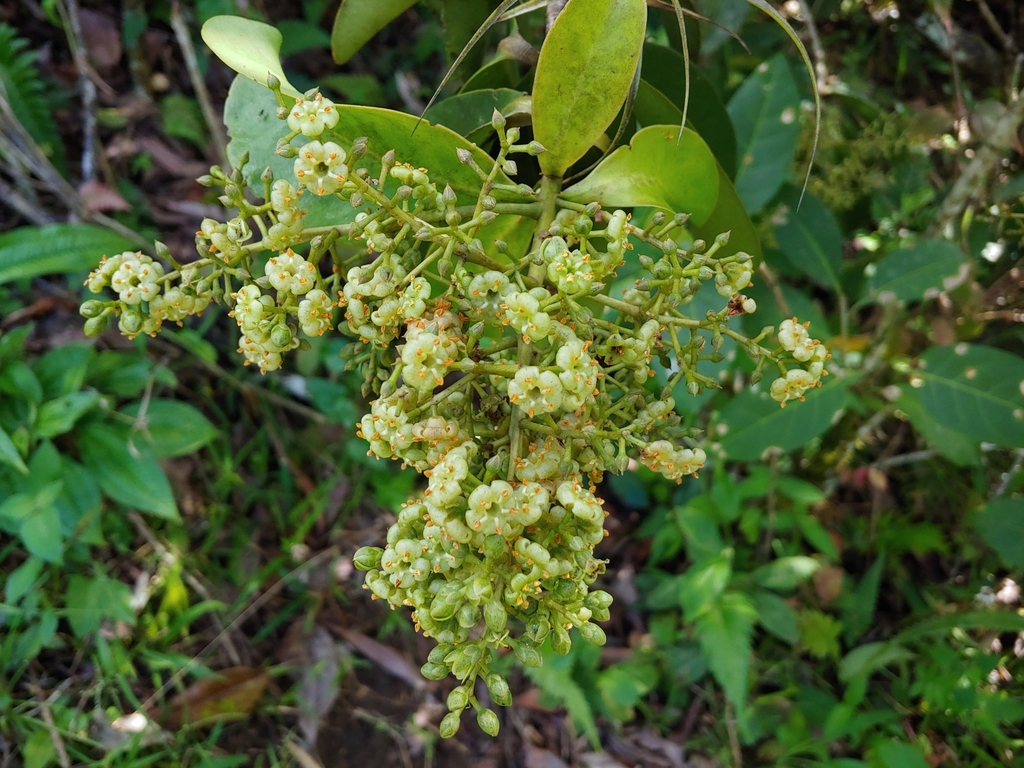
Guadeloupe Marlberry (Ardisia obovata) is an evergreen shrub or small tree of Puerto Rico and the islands around it. USDA PLANTS uses the common name Guadeloupe marlberry; in Puerto Rico it is better known as bádula or mameyuelo. It is a quiet, handsome plant: thick glossy leaves crowded toward the ends of the twigs, broad sprays of small cream-colored flowers, and dense bunches of round fruits that ripen from green to black.
This is not the same plant as the Florida marlberry. PlantNative already has a page for marlberry (Ardisia escallonioides), a different species native to south Florida and the Keys. The two are close cousins with a similar look, but A. obovata is a West Indian plant that in the United States grows only in Puerto Rico and the U.S. Virgin Islands, and its leaves are broader and blunter.
In the wild it belongs to limestone country: the karst hills and moist and dry limestone forests of the island, from near sea level up into the mountains. It takes shade, poor rocky soil and salt-laden air, grows slowly into a dense column of foliage, and feeds birds with its fruit. For a Puerto Rican garden that needs an evergreen screen or an understory shrub, it is one of the most practical natives available.
Identification
Marlberries are recognized by their leathery, untoothed leaves clustered near the twig tips, their many-branched sprays of small five-petaled flowers, and their round one-seeded fruits. Ardisia obovata is the broad-leaved West Indian member of the group.
Form
An evergreen shrub or small tree. In gardens and in the open it usually stands 5 to 12 feet tall; in forest it can reach 20 to 33 feet (up to about 10 m) on a short, slender trunk rarely more than 4 inches thick. Growth is upright and slow, with stiff branches and a dense, narrow crown that holds leaves to the ground when grown in good light.
Leaves
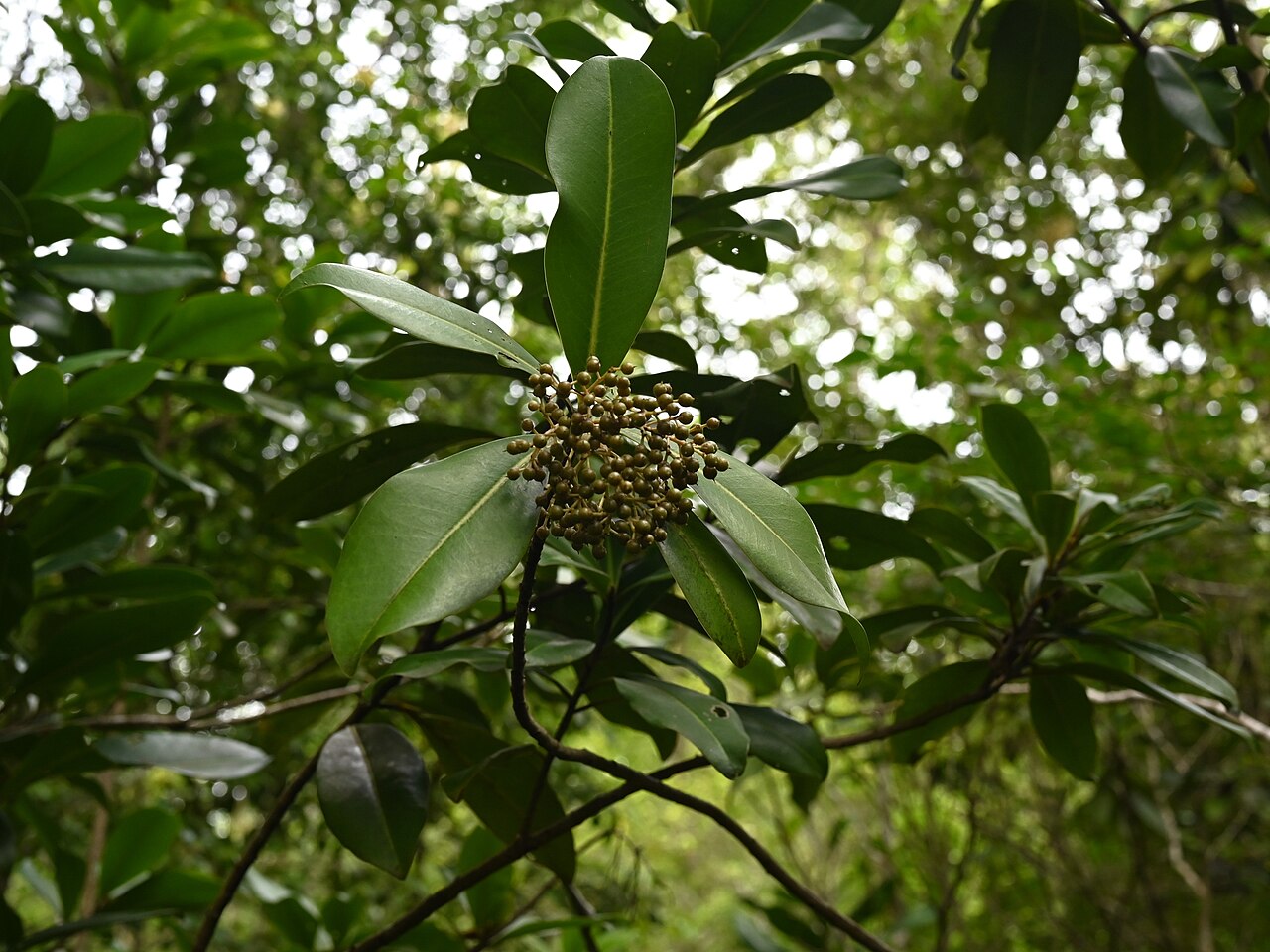
Leaves are alternate but crowded toward the ends of the twigs, so they look whorled. Each is obovate to oblong (widest above the middle), 3 to 8 inches long, leathery, smooth-edged and often slightly wavy, with a rounded or blunt tip, a pale midrib and a short stalk. They are glossy dark green above and dull below, and are held for more than one season; dead leaves turn yellow before dropping.
Flowers
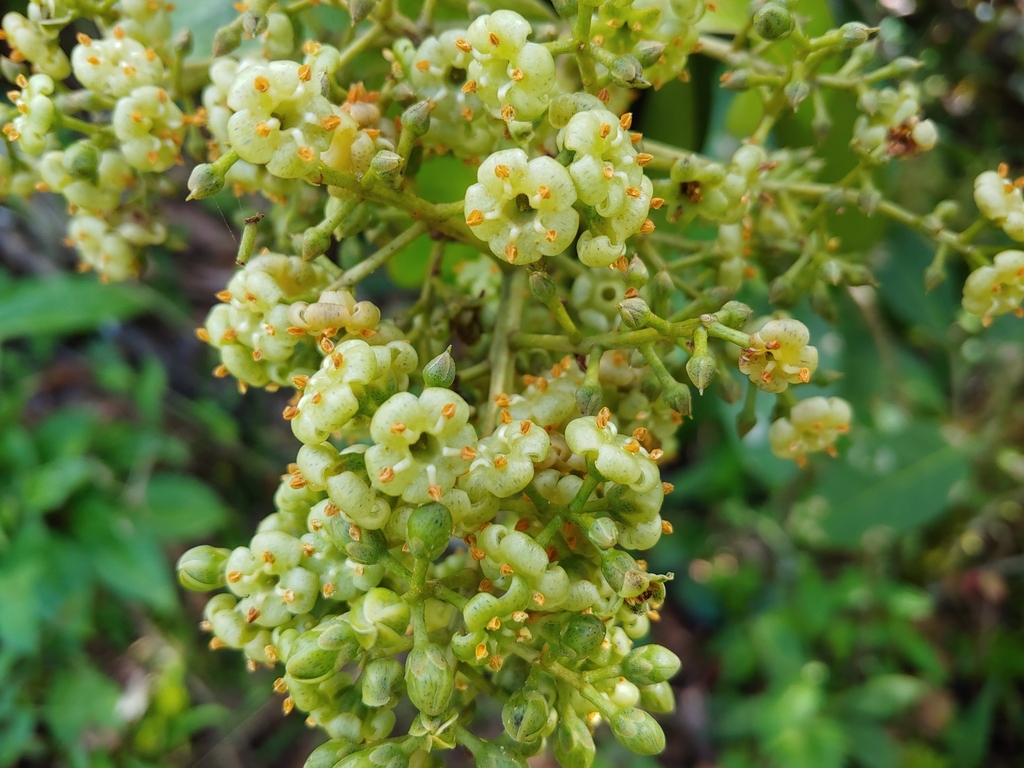
The flowers are carried in a broad, much-branched cluster at the end of a shoot, each spray holding dozens of small blooms. Individual flowers are about a quarter inch across, with five thick, cream to greenish-white petals, often finely speckled, and a cluster of orange to yellow anthers in the center. Flowering is mainly in the warmer, wetter months, and the display is quietly handsome rather than showy.
Fruit & Seeds
Fruits are round, fleshy drupes about a quarter inch across, packed in dense clusters where the flowers stood. They are green at first and ripen to purple-black, each holding a single hard seed. Fruiting branches can be heavy with hundreds of berries, and ripe fruit attracts birds.
Quick Facts
| Scientific Name | Ardisia obovata Desv. ex Ham. |
| Family | Primulaceae (primrose family; formerly Myrsinaceae) |
| Plant Type | Evergreen shrub or small tree |
| Mature Height | 5–12 ft in the open; to about 33 ft (10 m) in forest |
| Mature Spread | 4–10 ft; dense and upright |
| Growth Rate | Slow |
| Sun Exposure | Full sun to partial shade |
| Water Needs | Moderate; tolerates dry spells once established |
| Soil Type | Well-drained soils, especially limestone and karst; tolerates rocky ground |
| Soil pH | Adaptable; common on alkaline limestone soils |
| Bloom Time | Chiefly the warmer, wetter months; scattered flowering at other times |
| Flower Color | Cream to greenish-white with orange anthers |
| Fall Color | None; evergreen |
| Fruit | Round black one-seeded drupe about ¼ in. across, in dense clusters |
| Deer Resistant | Not applicable; Puerto Rico has no native deer |
| USDA Hardiness Zones | 10–12 (frost sensitive) |
Native Range
Guadeloupe marlberry is a West Indian species. The Smithsonian’s Flora of the West Indies (Acevedo-Rodríguez & Strong) treats it as endemic to the West Indies, recorded from the Lesser Antilles, Hispaniola, Puerto Rico including Vieques, and the Virgin Islands. Within the United States, USDA PLANTS lists it as native in Puerto Rico and in the U.S. Virgin Islands and in no state. There is no PlantNative regional list for the Virgin Islands, so this page is carried on the Puerto Rico list.
On Puerto Rico it is widespread in limestone country. The Institute for Regional Conservation records it as native in nine conservation areas, from the dry forests of Guánica and Punta Guaniquilla in the southwest to Guajataca, Cambalache and Río Abajo in the northern karst belt and up into Maricao, Susúa, Carite and Toro Negro in the mountains. Its recorded substrates are limestone and karst, at low elevations and middle elevations of roughly 500 to 1,000 meters.
Habitat is moist and dry limestone forest and the understory and edges of lowland and foothill woodland. Little and Wadsworth’s Common Trees of Puerto Rico and the Virgin Islands (USDA Forest Service) gives its Puerto Rican habitat as moist and dry limestone forests at lower and middle elevations. In the Lesser Antilles it is also a frequent part of coastal vegetation. It is not a mangrove or salt-marsh plant and it is not native anywhere in the mainland United States.
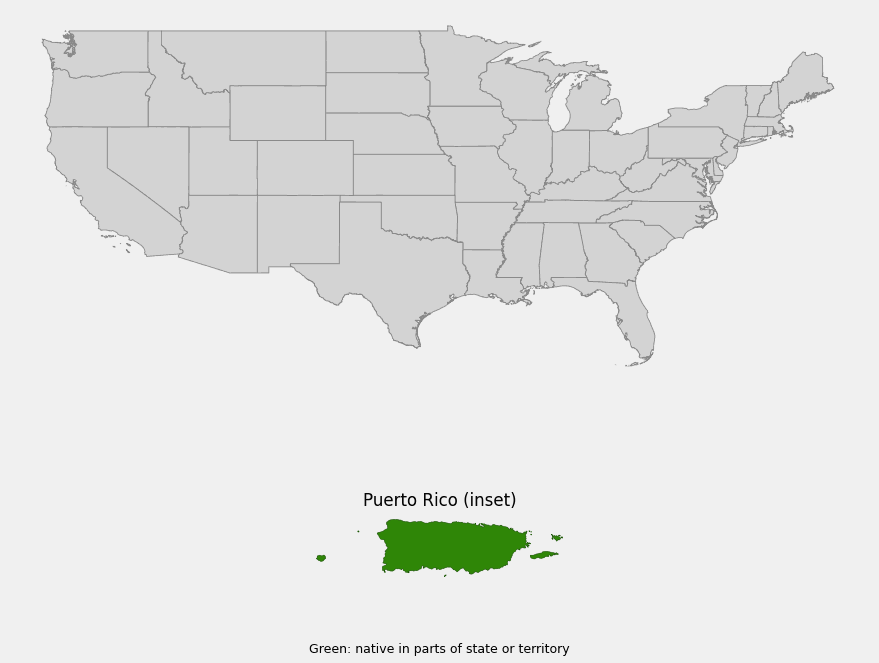
📋 Regional plant lists featuring Guadeloupe Marlberry: Puerto Rico
Growing & Care Guide
Guadeloupe marlberry is an easy, undemanding evergreen for frost-free gardens. It is slow, which makes it a good long-term hedge or understory plant, and it is one of the few native shrubs that stays dense in partial shade.
Light
It grows in full sun and in partial shade, and it is one of the better native shrubs for shaded spots under larger trees. Plants in full sun stay more compact and fruit more heavily; plants in deep shade are more open and leggy.
Soil & Water
Give it well-drained soil. It is at home on shallow, rocky, alkaline limestone soils, and it also grows in ordinary garden soil as long as water does not stand around the roots. Water regularly in the first year, then only in long dry spells. It is not a plant for wet, heavy ground.
Planting Tips
Set plants about 3 to 5 feet apart for a hedge or screen, more for specimens. Plant at the depth the plant grew in its container and mulch lightly, keeping mulch off the stem. It also grows well in a large container with a free-draining mix and bright light, which is how it is often sold in the nursery trade under the name mameyuelo.
Pruning & Maintenance
Little pruning is needed. Tip-prune after flowering if you want a denser outline, and remove any dead wood. Because growth is slow, hard cutting back takes a long time to recover, so shape the plant gradually. Seedlings sometimes appear under fruiting plants and are easily moved or removed.
Propagation
Grow from seed. Collect fruit when it is fully black, clean the pulp off the single seed and sow fresh in a free-draining mix, barely covered, in a warm, shaded place. Germination is slow and uneven. Seedlings can also be lifted from under established plants while small.
Landscape Uses
- Evergreen hedges and screens: dense, slow and long-lived, with year-round glossy foliage
- Shaded understory planting: one of the few natives that stays full in partial shade
- Bird gardens: heavy crops of black fruit for fruit-eating birds
- Limestone and karst sites: suited to shallow, alkaline, rocky soils
- Containers and courtyards: slow enough to hold its size in a large pot
Wildlife & Ecological Value
In Puerto Rican limestone forest, Guadeloupe marlberry is an understory shrub that flowers and fruits over a long season, which makes it useful to both insects and birds.
For Pollinators
The small, open, five-petaled flowers are easy for short-tongued insects to work, and the broad sprays give them a stable landing platform. Bees, flies, small butterflies and other insects visit the flowers, and in gardens hummingbirds are reported at the blooms as well.
For Birds
The fleshy black drupes are the main wildlife value. Fruits of this size and color are typical bird food, and birds swallow them whole and drop the single hard seed away from the parent plant, which is how the shrub spreads through forest. Dense evergreen branches also give small birds nesting cover and shelter from sun and rain.
For Mammals
Puerto Rico’s native mammal fauna is almost entirely bats, and fruit-eating bats take small fleshy fruits of this kind. There are no native browsing mammals on the island, so the foliage is not a significant food source.
Ecosystem Role
It is a structural plant of the limestone forest understory, holding thin soils on karst slopes, shading the ground and keeping leaf litter in place. Because it fruits heavily and is dispersed by animals, it is among the shrubs that return early to recovering forest on limestone ground.
Cultural & Historical Uses
The genus name Ardisia comes from the Greek ardis, a spear point, a reference to the sharply pointed anthers in the center of the flower; obovata describes the leaf shape, widest above the middle. The Puerto Rican names bádula and mameyuelo are both in everyday use, the second a diminutive built on mamey, from a loose resemblance of the leaves.
The plant has also carried a long list of other botanical names, including Icacorea guadalupensis, Ardisia guadeloupensis and Tinus obovata, and its family has moved too: the marlberries were long placed in Myrsinaceae, which modern classifications fold into the primrose family, Primulaceae.
Guadeloupe marlberry has no large commercial history. The wood is harvested occasionally for local use, and the stems are too small for timber of any size. Its main modern role is ornamental: it is grown as a hedge, container plant and understory shrub in the Caribbean and in frost-free parts of Florida, where it is sold under its Puerto Rican name.
Frequently Asked Questions
Is this the same plant as Florida marlberry?
No. Florida’s marlberry is Ardisia escallonioides, native to south Florida and the Keys. Ardisia obovata is a West Indian species native in the United States only to Puerto Rico and the U.S. Virgin Islands. The two look alike at a glance, but A. obovata has broader, blunter, more leathery leaves.
Is Ardisia obovata one of the invasive ardisias?
No. The problem species are Asian introductions: coral ardisia (Ardisia crenata) and shoebutton ardisia (Ardisia elliptica), both of which invade forests in Florida and elsewhere. Ardisia obovata is native to Puerto Rico and the West Indies and belongs in the native landscape there.
Where does it grow in Puerto Rico?
Mostly in limestone country. It is recorded from the dry forests of Guánica and Punta Guaniquilla, the northern karst forests of Guajataca, Cambalache and Río Abajo, and mountain forests at Maricao, Susúa, Carite and Toro Negro, from near sea level to about 1,000 meters.
Will it grow in shade?
Yes. It is a natural understory shrub and holds dense foliage in partial shade, which is why it works under larger trees. In deep shade it becomes open and flowers less; in full sun it is denser and fruits more heavily.
Are the berries edible?
They are bird food, not people food. The plant is harvested occasionally for local use in the Caribbean, but there is no reliable modern information on eating the fruit, so treat the berries as ornamental and leave them for wildlife.

Looking for a nursery that carries Guadeloupe Marlberry?
Our nursery directory does not yet include Puerto Rico. Browse the native plant nursery directory by state: Alabama–Arkansas · California · Colorado–Hawaii · Idaho–Kansas · Kentucky–Montana · Nebraska–Oklahoma · Oregon · Pennsylvania–Virginia · Washington · West Virginia–Wyoming