
Bloodwood (Pterocarpus officinalis)
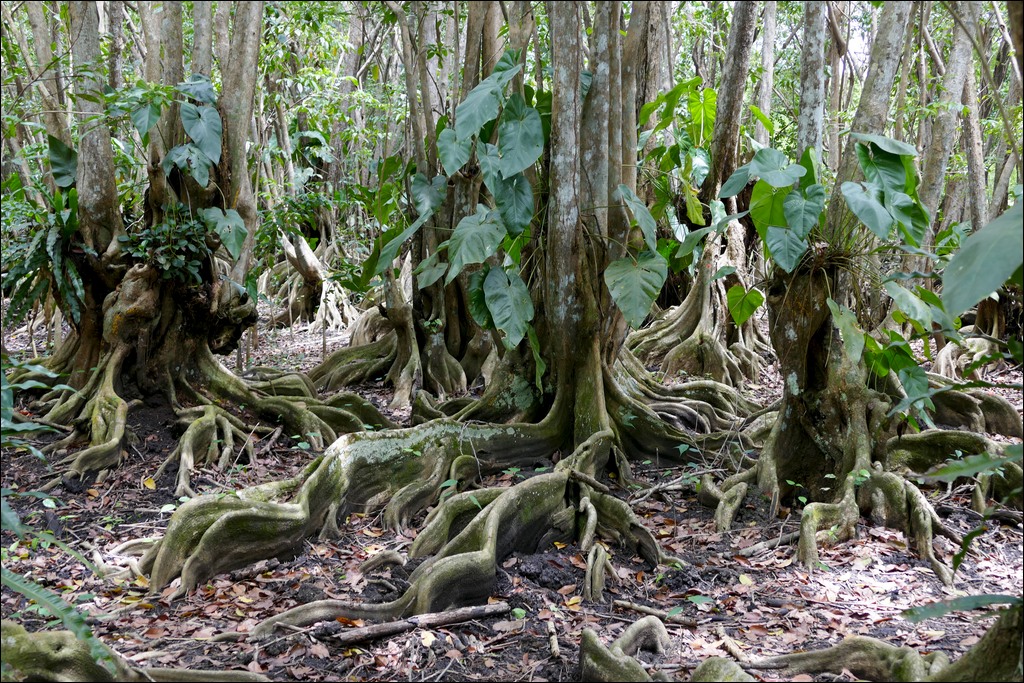
Pterocarpus officinalis, known as Bloodwood and in Puerto Rico as palo de pollo, is an evergreen swamp tree of the legume family (Fabaceae). USDA PLANTS lists it under the common name dragonsblood tree. Both English names come from the dark red sap that oozes from any cut in the bark. In Puerto Rico it is the defining tree of the Pterocarpus swamp forest, a rare freshwater wetland found just inland of the mangroves, where its enormous, snaking plank buttresses wind across the mud like ribbons.
Palo de pollo is one of the most distinctive trees in the Caribbean. Its trunk flares into thin, wavy buttresses that can extend 15 feet or more from the trunk and reach as high as a person’s head. They work like the base of a tripod, keeping the tree upright in deep, soft mud. In spring and summer it carries fragrant clusters of yellow pea flowers, followed by flat, round, winged pods that float away on floodwaters.
Puerto Rico’s Pterocarpus forests have shrunk dramatically. Many were drained for sugar cane, farms and development, and the USDA Forest Service counted only about 15 stands totaling roughly 600 acres, the largest near Humacao on the east coast. Protecting the remaining stands and replanting the species in suitable wetlands are important conservation goals. This guide covers how to recognize palo de pollo, where it grows and how to grow it in wet sites.
Identification
In its swamp habitat, palo de pollo is unmistakable: no other Puerto Rican tree has such long, thin, wavy plank buttresses. Away from the swamp, look for pinnately compound leaves, red sap from wounds in the bark, and flat, round winged pods.
Trunk & Buttresses
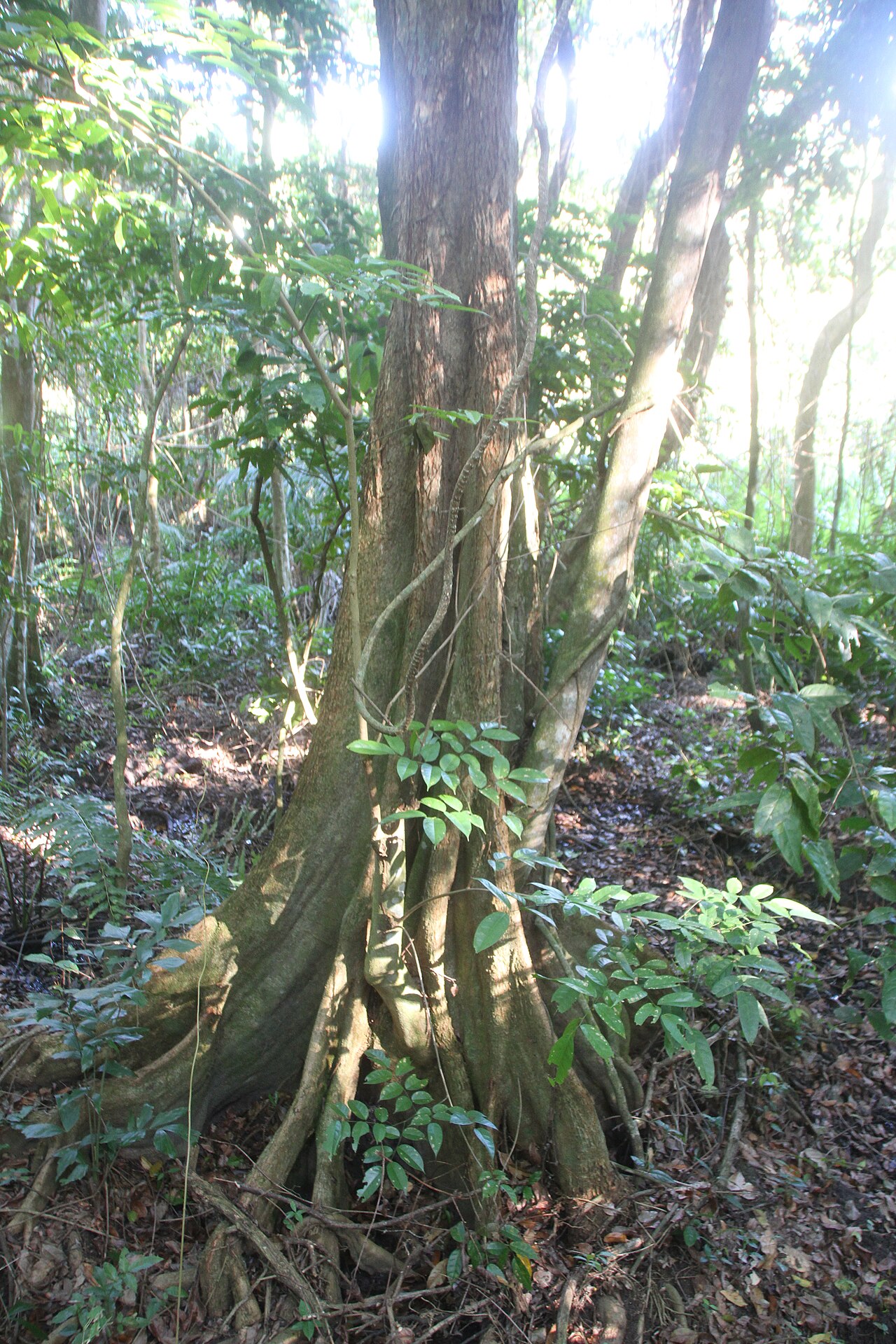
Across its range bloodwood can reach about 130 feet tall, but in Puerto Rico it is usually much smaller; the largest recorded on the island was about 67 feet tall with a massive trunk 9 feet thick at the buttresses. The bark is gray to light brown and fairly smooth. The buttresses are the key feature: narrow, sinuous plank roots that can run 15 feet or more along the ground and stand up to 15 feet high next to the trunk. Where water levels fluctuate, the tree also produces knee-like breathing roots (pneumatophores). A cut in the bark releases a sticky, dark red latex.
Leaves
The leaves are large, alternate and pinnately compound, with an odd number of leathery, glossy, elliptic leaflets with pointed tips. They are evergreen, so a Pterocarpus forest stays shady all year, and young seedlings have simple leaves at first rather than compound ones.
Flowers
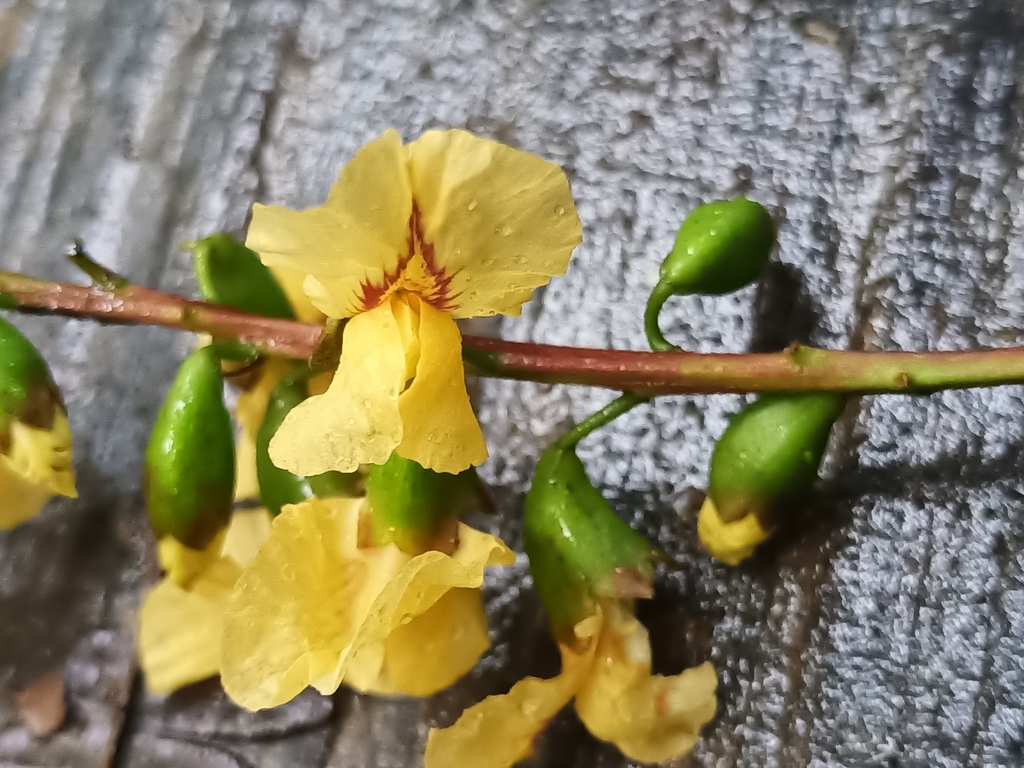
Fragrant flowers appear in branched clusters 2½ to 6 inches long at the leaf bases. Each flower is about half an inch long and pea-like, with yellow petals; the broad upper petal (the standard) is often streaked with red. In Puerto Rico flowering runs from February to September.
Fruit & Seeds
The fruit is a flat, nearly round pod, a few inches across, with a thin wing around its edge and a single seed in the thickened center. Pods are green at first and ripen to dark brown; in Puerto Rico they mature from March through November. The pods float, and seasonal floods spread them through the swamp and along streams, sometimes all the way to the sea. Seeds can even germinate while floating on debris in shallow water.
Quick Facts
| Scientific Name | Pterocarpus officinalis; USDA common name: dragonsblood tree |
| Family | Fabaceae (legume family) |
| Plant Type | Large evergreen swamp tree with plank buttresses |
| Mature Height | 40–65 ft in Puerto Rico (to about 130 ft elsewhere) |
| Mature Spread | 15–30 ft crown; buttresses spread 15 ft or more |
| Growth Rate | Presumed fast (very light wood); not measured in Puerto Rico |
| Sun Exposure | Partial shade to full sun |
| Water Needs | Very high; periodically flooded or permanently wet soil |
| Soil Type | Organic muck, clay or sandy swamp soils; fresh to slightly brackish water |
| Soil pH | About 6.0–6.5 (slightly acid) |
| Bloom Time | February–September in Puerto Rico |
| Flower Color | Yellow, often streaked with red |
| Fall Color | None; evergreen |
| Fruit | Flat, round, winged pod with one seed; floats |
| Deer Resistant | Not applicable in Puerto Rico |
| USDA Hardiness Zones | 10b–12 (frost-free only) |
Native Range
Bloodwood grows in coastal and lowland wetlands of the American tropics, from about 20° N to 2° S. The USDA Forest Service silvics of palo de pollo describes its range as southern Mexico and Central America (Honduras, Costa Rica, Panama), northern South America (Colombia, Venezuela, Ecuador, the Guianas, and the Amazon estuary south to Maranhão, Brazil), and the Caribbean islands of Jamaica, Hispaniola, Puerto Rico, Guadeloupe, Martinique, Dominica, Marie-Galante, St. Lucia, St. Vincent, and Trinidad and Tobago. It has been planted in Cuba and South Florida but is not native there.
In Puerto Rico palo de pollo grows mostly in coastal freshwater swamps and on the landward side of mangroves, where the water is fresh or only slightly salty. The USDA Forest Service recorded at least 15 stands totaling about 240 hectares (600 acres), with the largest near Humacao on the east coast; other stands are near Dorado on the north coast. It also grows along rivers in the Luquillo Mountains, up to about 1,150 feet along the Río Mameyes and its tributaries in El Yunque.
These Pterocarpus forests are among the most threatened forest types in Puerto Rico. Drainage for sugar cane, other crops and buildings has greatly reduced them, and runoff carrying pesticides and fertilizers probably degrades the remaining swamps. Several remaining stands, including the forest at Palmas del Mar, are now protected.
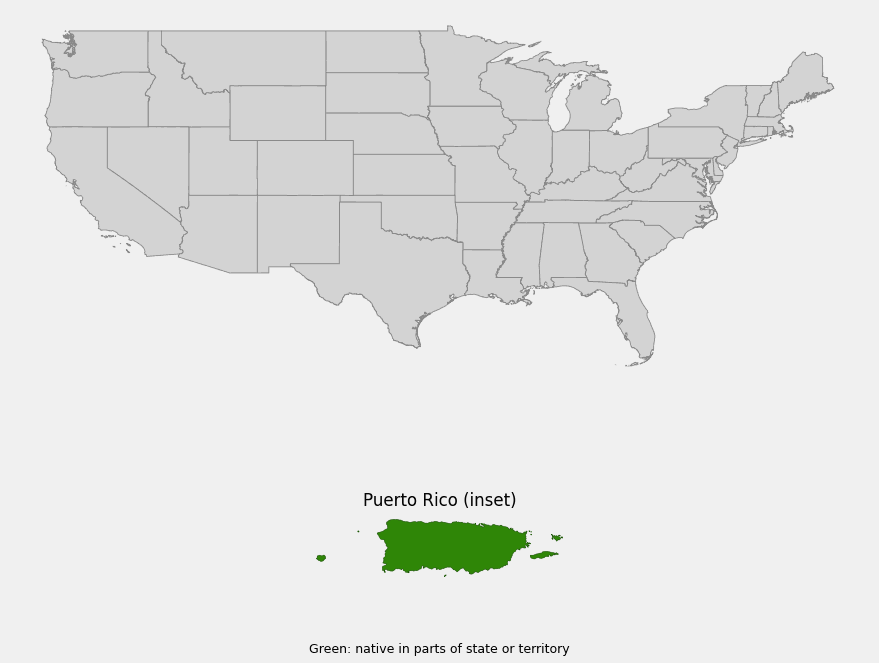
📋 Regional plant lists featuring Bloodwood: Puerto Rico
Growing & Care Guide
Palo de pollo is a specialist tree for wet ground. In Puerto Rico it is a valuable choice for restoring coastal wetlands, stream banks and the margins of ponds and retention basins, and for large properties with low, poorly drained areas. It is not suited to ordinary dry yards. On the U.S. mainland it can only be grown outdoors in frost-free South Florida, where it is not native.
Light
Seedlings establish best in partial shade, which is how they grow in the swamp under the parent trees. Older trees take full sun. In restoration plantings, setting young trees among existing vegetation or at forest edges helps them establish.
Soil & Water
Plant in soil that stays wet: freshwater swamps, stream and pond margins, seepage areas and low ground that floods seasonally. Organic muck and heavy clay are ideal. The tree tolerates slightly brackish water and seasonal changes in salinity, but it does not grow where the water is fully salty, which is why it occurs on the landward side of mangroves. Seedlings cannot root in water deeper than an inch or two, so plant on slightly raised spots or when water levels are low.
Planting Tips
Plant nursery-grown seedlings at the start of the rainy season on low mounds or hummocks within the wetland, where the soil is saturated but not flooded. Space trees well away from buildings, pipes and septic fields, since the buttresses and surface roots spread widely. Expect the tree to form its characteristic buttresses only after many years.
Pruning & Maintenance
Little pruning is needed. In Dominica strangler figs and pitch apple sometimes germinate in the branches and slowly overwhelm the host, so remove them from planted trees if desired. Protect existing stands from drainage, fill and polluted runoff, which are the main threats to the species.
Propagation
Grow from fresh seed. Sow pods on the surface of moist potting mix or swamp soil and keep them wet. Germination took about 40 days in Puerto Rico nursery trials and varied greatly between seed lots, from about 10 percent to 95 percent. The first leaves are simple, and later leaves are compound. Mature trees also send up root sprouts, especially after hurricane damage or cutting, and these can sometimes be separated.
Landscape Uses
- Wetland restoration: the key canopy tree for restoring Pterocarpus swamp forest in Puerto Rico
- Stream and pond margins: stabilizes wet banks with its spreading buttresses and roots
- Rain gardens and retention areas: for large, permanently wet sites in tropical lowlands
- Coastal buffers: grows just inland of mangroves, where fresh and salt water meet
- Specimen tree: its buttresses make a dramatic feature in large public gardens with wet ground
Wildlife & Ecological Value
Pterocarpus swamp forests are unique habitats, and palo de pollo creates their structure: shade, buttresses, root tangles and a thick layer of organic soil that holds water.
For Pollinators
The fragrant yellow flowers are visited by bees and other insects, and in coastal Guyana bloodwood has been used as a nectar source for honeybees. Its long flowering season, from February to September in Puerto Rico, provides nectar over many months.
For Birds
The shady, evergreen swamp forest gives wetland and forest birds cover and nesting sites close to the coast. In Dominica, the endangered red-necked parrot (Amazona arausiaca) eats the fruit.
For Mammals
Bloodwood has little recorded food value for mammals; Puerto Rico’s only native land mammals are bats. In Trinidad and the Guianas, where more mammals live, the buttressed swamp forests are part of a much richer wetland habitat.
Ecosystem Role
Palo de pollo often forms nearly pure stands where water levels swing widely through the year. Floating seeds, fast growth, the ability to resprout, buttresses, breathing roots and tolerance of slightly brackish water all help it thrive where few other trees can. Its swamps store large amounts of organic matter in their soils, far more than the neighboring dry forests, and like other coastal wetlands they hold back floodwater and sediment before it reaches the mangroves and sea. As a legume, it also belongs to a family well known for nitrogen-fixing root nodules.
Cultural & Historical Uses
The species name officinalis marks a medicinal plant. The dark red sap, sold historically as a form of “dragon’s blood,” has been used in traditional medicine as an astringent and to stop bleeding, and has also been reported as a disinfectant. Those uses gave the tree its USDA name, dragonsblood tree, and its English name, bloodwood.
Unlike its Old World relatives, some of which are prized cabinet woods, palo de pollo has soft, light, fairly weak wood with little distinct heartwood. It dries well and is easy to work but is used only locally. In nineteenth-century Puerto Rico, the thin buttresses were cut into shallow pans for panning gold from rivers. The tree has also been planted for shade and ornament in South Florida and Cuba.
Today palo de pollo is a symbol of Puerto Rico’s vanishing coastal wetlands. The remaining Pterocarpus forests, including those at Palmas del Mar in Humacao and near Dorado, are remnants of a forest type that once lined much more of the coast, and their buttressed landscapes are among the most striking forest scenes on the island.
Frequently Asked Questions
Why is it called bloodwood or dragonsblood tree?
A cut in the bark releases a thick, dark red latex that looks like blood. The sap was historically sold as a type of “dragon’s blood” and used in traditional medicine.
What is a Pterocarpus swamp forest?
It is a freshwater forested wetland dominated by palo de pollo, usually found just inland of mangroves or along rivers near the coast. In Puerto Rico only about 15 stands remain, the largest near Humacao. They are among the island’s most threatened forest types.
Can I grow bloodwood in a normal yard?
Only if you have permanently wet or seasonally flooded ground and plenty of space. It is a wetland specialist and a large tree with wide buttresses, so it is best for wetland restoration, stream banks and large properties in frost-free climates.
Does bloodwood tolerate salt water?
It tolerates slightly brackish water and seasonal changes in salinity but not full seawater. That is why it grows on the landward side of mangroves, where fresh water from rivers and rain dilutes the salt.
Is bloodwood native to Florida?
No. It has been planted in South Florida for shade and ornament, but it is native to Puerto Rico, other Caribbean islands, and Central and South America. Florida gardeners with wet sites should choose Florida native wetland trees such as pond apple instead.

Looking for a nursery that carries Bloodwood?
Our nursery directory does not yet include Puerto Rico. Browse the native plant nursery directory by state: Alabama–Arkansas · California · Colorado–Hawaii · Idaho–Kansas · Kentucky–Montana · Nebraska–Oklahoma · Oregon · Pennsylvania–Virginia · Washington · West Virginia–Wyoming